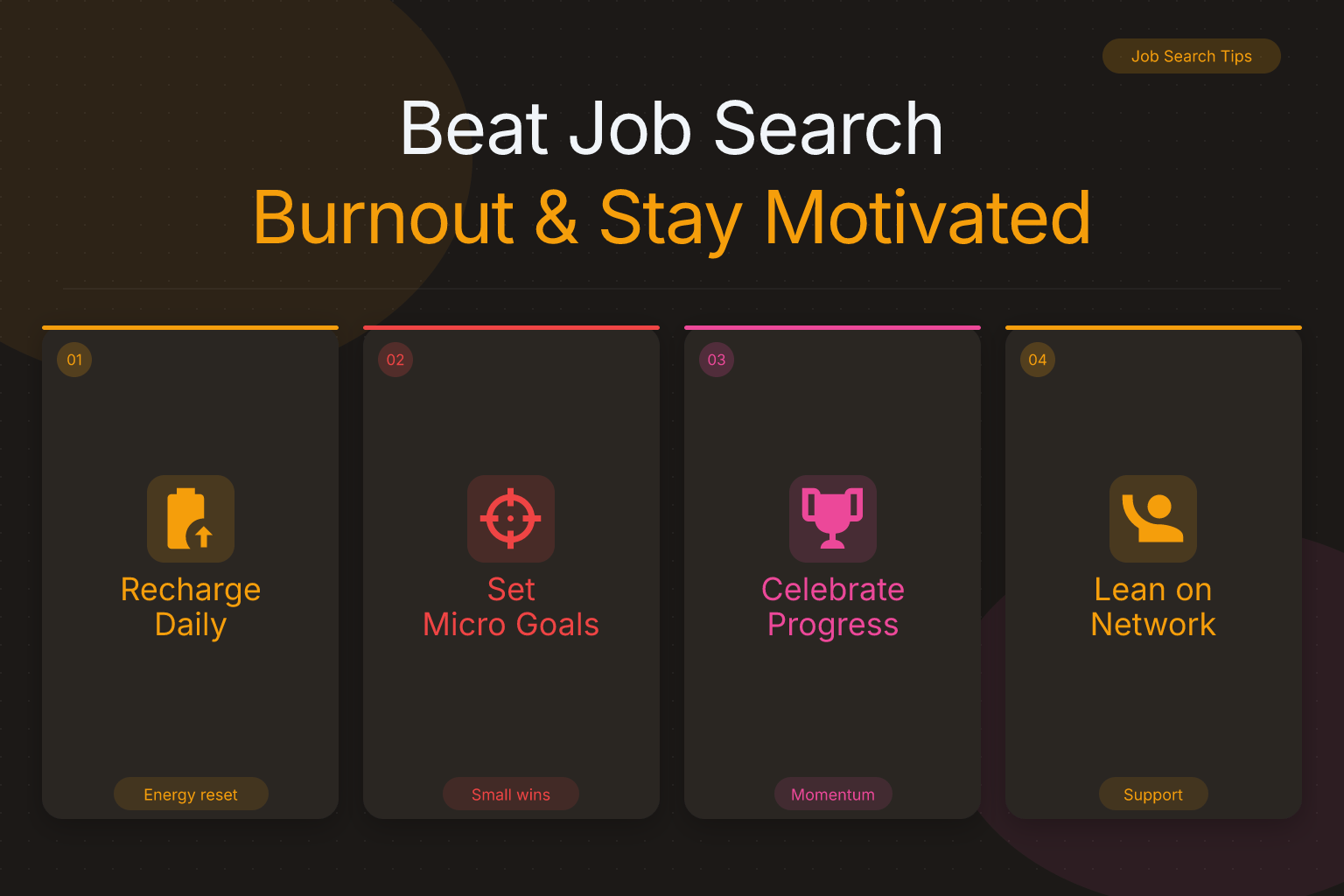
Job Search Burnout How to Stay Motivated: Tips
If you typed job search burnout how to stay motivated into a search bar at midnight, you already know the feeling: the endless scroll, the silence after applications, the creeping sense that you’re doing something wrong. Job search burnout is a real, predictable response to prolonged uncertainty and repeated rejection — not a character flaw. The good news is that motivation isn’t something you either have or don’t. It’s a system you can rebuild with the right structure, tools, and boundaries. This guide walks through exactly how to do that, step by step.
Key Takeaways
- Job search burnout is a normal response to prolonged uncertainty and rejection, not a personal failure.
- Set a daily application cap of three to five tailored applications and protect one full day off per week.
- Track every application, deadline, and follow-up in one place so you stop holding the entire search in your head.
- Reframe rejection as data: ask for feedback, adjust one thing, and move on instead of spiraling.
- Use free tools like a resume score checker and a job tracker to cut hours of repetitive manual work.
| What to Do | Why It Matters | Time |
|---|---|---|
| Set a daily application cap | Prevents decision fatigue and keeps application quality high | 5 minutes to plan |
| Track every application in one place | Stops the “did I already apply here?” spiral and frees mental space | 2 minutes per application |
| Take one full day off per week | Gives your brain recovery time and restores perspective | 24 hours |
| Ask for feedback after rejections | Turns a dead end into actionable data for the next application | 10 minutes per request |
| Run a resume score check before submitting | Catches ATS issues before they cost you an interview | 5 minutes per resume |
Job Search Burnout How to Stay Motivated: Start by Recognizing the Signs
Job search burnout doesn’t announce itself with a single symptom. It shows up as a cluster of behaviors and feelings that build over weeks or months. You might notice you’re dreading opening job boards that used to feel neutral. You start applying to roles you’re only half-qualified for because “something is better than nothing.” You reread the same rejection email three times, looking for hidden meaning. You feel irritable with friends who ask, “How’s the search going?” and you can’t remember the last time you felt genuinely hopeful about a specific role.
Physical symptoms can also appear: trouble sleeping, changes in appetite, or a constant low-grade headache. You might find yourself procrastinating on applications even when you have time, or feeling a sense of dread when you see a new job posting. These are all signals that your current approach is unsustainable.
None of this means you’re lazy, unmotivated, or bad at job hunting. It means your brain has been running a high-stakes, low-feedback process for too long without recovery. Motivation in a job search works like a muscle: it fatigues under constant load and recovers with rest and structure. The sections below give you that structure.
Set a Daily Application Cap Instead of a Daily Quota
The most common burnout trap is treating the job search like a volume game. You tell yourself you’ll send 20 applications today, then feel defeated when you only manage six — or worse, you send 20 generic applications and hear nothing back. Volume without tailoring produces silence, and silence feeds burnout.
Flip the goal. Instead of a minimum number of applications, set a maximum. Three to five tailored applications per day is a sustainable pace for most people. Each one should take 30 to 60 minutes because you’re adjusting your resume and cover letter to the specific posting. If you need help with that, this guide on how to tailor a resume to a job description walks through the exact process. When you hit your cap, stop. The remaining time goes to rest, networking, or skill-building — not more applications.
This cap does two things. It forces you to choose quality over quantity, which improves your response rate. And it gives you a finish line each day, so the search doesn’t bleed into every waking hour.
Track Every Application So Your Brain Can Let Go
A huge portion of job search anxiety comes from trying to hold the entire process in your head. You wonder whether you already applied to a company, when you should follow up, and which version of your resume you sent. That mental load is exhausting, and it’s completely unnecessary.
Use a single tracking system for every application. A spreadsheet works, but a tool built for the job is faster. The ResumeMate Job Tracker is a free Chrome extension that logs each application, deadline, and follow-up directly from your browser. When you apply, you click once and the record is saved. No more reconstructing your history from memory.
The benefit isn’t just organization — it’s cognitive offloading. When your brain knows the information is stored somewhere reliable, it stops rehearsing it. That frees up energy for the actual work of applying and interviewing.
Schedule Recovery Time Like It’s a Meeting
You wouldn’t schedule back-to-back interviews without a break, but many job seekers treat their search the same way: every evening, every weekend, every spare moment goes to applications. That’s a recipe for collapse.
Pick one full day per week when you do zero job search activities. No job boards, no email refreshes, no resume tweaks. Treat it as non-negotiable, like a doctor’s appointment. Use the day for whatever restores you: exercise, cooking, time with people who don’t ask about your search, or simply sleeping in.
If a full day feels impossible, start with a half day. The point is to create a clear boundary between “searching” and “not searching.” Without that boundary, your nervous system stays in low-grade alert mode around the clock, and burnout compounds.
Reframe Rejection as Data, Not a Verdict
Rejection is the most common trigger for job search burnout, and the way you interpret it determines whether it fuels despair or adjustment. When you get a “no,” the default story is often “I’m not good enough” or “this will never work.” That story is almost always false, but it feels true because you have no other information.
The fix is to extract data from every rejection. If the employer gives feedback, use it. If they don’t, send a brief, polite follow-up asking for one specific thing you could improve. Most won’t respond, but some will, and one piece of concrete feedback is worth more than ten silent rejections. This guide on how to handle job rejection and ask for feedback has scripts you can copy.
Then make one adjustment. If the feedback says your resume didn’t show enough impact, rewrite one bullet. If it says you lacked a specific skill, spend 30 minutes learning the basics. The goal isn’t to fix everything at once — it’s to convert a dead end into a next step. That shift alone reduces the emotional weight of rejection.
Reduce Repetitive Work With Free Tools
A lot of job search burnout comes from doing the same tedious tasks over and over: reformatting your resume, guessing whether it will pass an ATS, copying the same cover letter into different portals. Each task is small, but together they eat hours and drain motivation.
Automate or streamline what you can. Before you submit a resume, run it through a free resume score checker to see how an ATS will parse it. You’ll get section-by-section feedback on what’s working and what’s likely to get lost, so you can fix issues before they cost you an interview. That’s five minutes that can save you weeks of silence.
For the writing itself, AI tools can help you draft and tailor faster without starting from scratch. This guide on how to use AI tools to speed up your job search covers the practical workflow. The key is to use these tools as assistants, not replacements — you still need to review and personalize everything.
Build a Support System and Set a Daily Stop Time
Isolation makes burnout worse. When you’re the only one thinking about your job search, every rejection echoes louder. Find at least one person — a friend, former colleague, or mentor — who can listen without immediately offering solutions. Tell them what you need: sometimes it’s advice, sometimes it’s just 20 minutes to vent. If you don’t have a close contact, consider joining a job search accountability group online or attending local networking events. Even a weekly check-in with a former coworker can provide perspective and reduce the feeling of going it alone.
Equally important is a daily stop time. Decide in the morning what time your job search ends, and honor it. For many people, 5:00 or 6:00 p.m. works. After that, no job boards, no email, no “just one more application.” Set an alarm or calendar reminder for your stop time, and when it goes off, close all job-related tabs and apps. Use the evening for activities that recharge you, like exercise, reading, or spending time with family. If you catch yourself reaching for a job board after hours, remind yourself that rest is part of the search, not a break from it. This boundary prevents the search from consuming your evenings and weekends, which is where burnout takes root.
Know When to Pause the Search Entirely
Sometimes the most productive thing you can do is stop. If you’ve been applying for months, your response rate is dropping, and you can’t remember why you wanted a new job in the first place, a deliberate pause may be the reset you need.
A pause doesn’t mean giving up. It means taking one to two weeks off from active applications to rest, reflect, and rebuild your approach. During that time, you might update your resume once, reconnect with a few people, or simply do nothing job-related. When you return, you’ll often find that the roles you apply to are better fits because you’re choosing from clarity instead of desperation.
If you’re worried about missing opportunities during a pause, set up job alerts so new postings come to you instead of requiring daily scrolling. This guide on how to use job alerts effectively shows you how to set them up in minutes. Then step away knowing you won’t miss anything important.
FAQ
Q: How long does job search burnout last?
A: There’s no fixed timeline. For some people, a few days of rest and a better structure resolve it. For others, it takes weeks of reduced activity and changed habits. The key is to treat burnout as a signal to adjust your approach, not a condition to push through.
Q: What are the signs of job search burnout?
A: Common signs include dreading job boards, applying to roles you’re not qualified for, feeling irritable when people ask about your search, and losing hope after rejections. You might also notice physical symptoms like poor sleep or constant fatigue. If several of these sound familiar, it’s time to change your routine.
Q: How many job applications should I send per day to avoid burnout?
A: Most people do better with a cap of three to five tailored applications per day. That’s enough to maintain momentum without sacrificing quality or exhausting yourself. If you’re also working full-time, two to three may be more realistic.
Q: Should I take a break from job searching if I’m burned out?
A: Yes, a deliberate break of one to two weeks can be more productive than forcing yourself to keep applying. Use the time to rest, reflect on what you actually want, and set up job alerts so you don’t miss new postings. You’ll return with more energy and clearer judgment.
Q: How do I stay motivated after multiple rejections?
A: Reframe each rejection as data. Ask for feedback when possible, make one small adjustment, and move on. Also track your applications so you can see the full picture — a few rejections feel less personal when you can see you’ve had 20 applications and 3 interviews, not just the latest “no.”
Q: Can using a job tracker help with burnout?
A: Yes. A job tracker removes the mental load of remembering where you’ve applied and when to follow up. When that information is stored reliably, your brain stops rehearsing it, which frees up energy and reduces anxiety. The ResumeMate Job Tracker is a free Chrome extension that does this automatically.
Q: Is it normal to feel depressed during a job search?
A: Yes, it’s common to feel low, anxious, or hopeless during a prolonged job search, especially when you’re facing repeated rejection. If those feelings persist for more than a couple of weeks or interfere with daily life, consider talking to a mental health professional. Job search stress is real, and support is available.
Track Every Application While You Job Hunt
Stop losing track of where you’ve applied. The ResumeMate Job Tracker is a free Chrome extension that tracks every application, deadline, and follow-up in one place — right from your browser.