Jobs That Require Credit Check and How to Prepare: A Complete Guide
Some jobs require a credit check, and knowing how to prepare can make the process far less stressful. If you’re applying for a role in finance, government, or any position that involves handling money or sensitive data, you may face an employment credit check as part of the hiring process. The good news: you can take control of the situation before the employer ever pulls your report. This guide covers which jobs require credit checks, what employers actually see, and exactly how to prepare so a credit check doesn’t derail your job offer.
Key Takeaways
- Most employers run a “soft” credit check that does not affect your credit score and only shows a modified version of your credit report, not your score.
- Jobs in financial services, government, security clearance, cash handling, and executive roles are the most likely to require a credit check.
- You can prepare by pulling your free credit reports from AnnualCreditReport.com and disputing any errors before you apply.
- If you have legitimate negative items, prepare a brief, factual explanation that shows accountability and steps you’ve taken to improve.
- Federal law (the FCRA) requires employers to get your written consent and give you a copy of the report if they take adverse action based on it.
Summary Table
| What to Do | Why It Matters | Time |
|---|---|---|
| Pull your credit reports from all three bureaus | Spot errors or surprises before the employer does | 1–2 hours |
| Dispute any inaccuracies with the credit bureau | Remove incorrect negative items that could cost you the job | 2–4 weeks |
| Prepare a brief explanation for any legitimate negative items | Show accountability and reduce interviewer concern | 30 minutes |
| Review the job description for credit check requirements | Know what to expect and whether to apply | 15 minutes |
| Know your FCRA rights | Protect yourself from unfair denials | 30 minutes |
Which Jobs Require a Credit Check and How to Prepare
Not every job requires a credit check, but certain industries and roles use them as a standard part of the screening process. If you’re applying for a position that involves fiduciary responsibility, access to cash, sensitive personal data, or national security, expect a credit check. The key to preparing is understanding what employers look for and taking proactive steps to ensure your credit report is accurate and explainable.
Before diving into the specifics, it’s worth noting that a credit check is just one piece of a broader employment background check. Employers often combine credit checks with criminal history, employment verification, and reference checks. Knowing the full picture helps you prepare holistically.
Many job seekers are surprised to learn that a credit check is not the same as a background check. A background check can include criminal records, driving history, education verification, and employment history. A credit check focuses solely on your financial history. Some employers run both, while others only run one or the other. If a job posting says “background check required,” it may or may not include a credit check—always ask for clarification if you’re unsure.
Why Employers Run Credit Checks
Employers don’t run credit checks to judge your personal financial choices. They run them to assess risk. A credit report can reveal patterns of financial irresponsibility that might translate to poor judgment on the job, especially in roles where you handle money, manage budgets, or have access to sensitive information.
Common reasons employers run credit checks include:
- Fiduciary responsibility: If you’ll manage company funds, approve expenses, or handle payroll, employers want to see that you manage your own finances responsibly. A history of missed payments or high debt could signal that you might be careless with company money.
- Security clearance: Government and defense contractors use credit checks to evaluate vulnerability to bribery or financial coercion. High debt or a history of unpaid bills can be a red flag because it might make you more susceptible to offers of money in exchange for sensitive information. The federal government’s adjudicative guidelines specifically list “financial considerations” as a factor in security clearance decisions.
- Cash handling: Retail managers, bank tellers, casino workers, and armored car drivers all handle cash. A history of collections or bankruptcy might raise concerns about temptation. Employers want to minimize the risk of theft or embezzlement.
- Trust and integrity: For executive roles or positions with access to trade secrets, a credit check is one more layer of due diligence. A candidate who is deeply in debt might be seen as a higher risk for insider trading or selling proprietary information.
In most cases, a credit check is a “soft pull,” meaning it does not affect your credit score. Employers cannot see your credit score at all—only the underlying report data. That’s a crucial distinction many job seekers misunderstand.
What a Credit Check Shows (and What It Doesn’t)
When an employer runs a credit check, they receive a modified version of your consumer credit report. This version is designed for employment screening and omits certain personal information to comply with the Fair Credit Reporting Act (FCRA).
What employers can see:
- Payment history on credit accounts (on-time, late, missed)
- Current and past debts, including credit cards, loans, and mortgages
- Collections accounts, charge-offs, and judgments
- Bankruptcies, foreclosures, and repossessions
- Credit inquiries (though employment inquiries are not shown to other employers)
What employers cannot see:
- Your credit score (FICO, VantageScore, or any other score)
- Your date of birth, spouse’s name, or account numbers
- Medical information (unless it’s a medical debt that appears as a collection)
- Your income or employment history
This means a low credit score alone won’t disqualify you. Employers care about the specific items on your report—late payments, collections, bankruptcies—and whether they indicate a pattern of financial instability. A single late payment from three years ago is far less concerning than multiple recent collections.
Employers are looking for red flags that suggest financial irresponsibility or vulnerability. They typically focus on:
- Recent negative items: A collection from six months ago is more concerning than one from five years ago.
- Patterns of late payments: Multiple 30-, 60-, or 90-day lates show a consistent struggle to manage debt.
- High debt-to-income ratio: Even if you pay on time, carrying a large amount of debt relative to your income could be seen as a risk.
- Public records: Bankruptcies, tax liens, and civil judgments can raise concerns, though some states restrict how these are used.
Common Misconceptions About Employment Credit Checks
There’s a lot of confusion about what an employment credit check actually involves. Let’s clear up the most common myths:
- Myth: Employers see your credit score. Fact: They don’t. Employers receive a modified credit report that excludes your score. They evaluate the underlying data, not a three-digit number.
- Myth: A credit check is the same as a background check. Fact: A background check can include many things—criminal history, driving records, education verification—and may or may not include a credit check. Always ask what’s included.
- Myth: A credit check will hurt your credit score. Fact: Employment credit checks are soft pulls, which do not affect your score. Only hard pulls (like applying for a loan) impact your score.
- Myth: You need a perfect credit score to pass. Fact: There’s no minimum score because employers don’t see your score. They care about specific negative items and patterns.
- Myth: All jobs require a credit check. Fact: Only certain roles, primarily in finance, government, and cash handling, commonly require them. Many jobs never check credit.
Jobs That Commonly Require Credit Checks
While any employer can request a credit check with your consent, certain roles are far more likely to include one. Here are the categories to watch for:
- Financial services: Bank tellers, loan officers, financial advisors, accountants, and anyone who handles client funds or sensitive financial data. This includes roles at banks, credit unions, investment firms, and insurance companies.
- Government and military: Federal, state, and local government positions, especially those requiring security clearance. Law enforcement, intelligence, and defense contractors almost always run credit checks. Even non-sensitive government roles may include a credit check as part of a standard background investigation.
- Cash handling and retail management: Store managers, casino employees, armored car drivers, and any role with daily cash reconciliation. This also includes positions at convenience stores, restaurants, and any business where employees handle cash.
- Executive and C-suite roles: CFOs, controllers, and other senior leaders who oversee budgets and financial strategy. A credit check is often part of the due diligence for high-level hires.
- IT and data security: Roles with access to payroll systems, customer financial data, or proprietary information. This includes system administrators, database managers, and cybersecurity professionals.
- Healthcare administration: Billing managers, insurance coordinators, and roles that handle patient financial records. While clinical roles (nurses, doctors) rarely require credit checks, administrative roles that deal with billing and insurance often do.
If you’re unsure whether a specific job requires a credit check, review the job posting carefully. Many employers disclose screening requirements upfront. You can also ask the recruiter during the initial phone screen—it’s a reasonable question and shows you’re proactive.
Note that some states have laws restricting when employers can use credit checks. For example, California, Colorado, Connecticut, Hawaii, Illinois, Maryland, Nevada, Oregon, Vermont, and Washington limit credit checks to certain roles (like those involving money, trade secrets, or management). If you live in one of these states, your employer may not be able to run a credit check unless the job meets specific criteria.
Step-by-Step: How to Prepare for an Employment Credit Check
Preparation is the single most effective way to reduce anxiety and improve your chances. Follow these steps before you submit your application or at least before the employer runs the check.
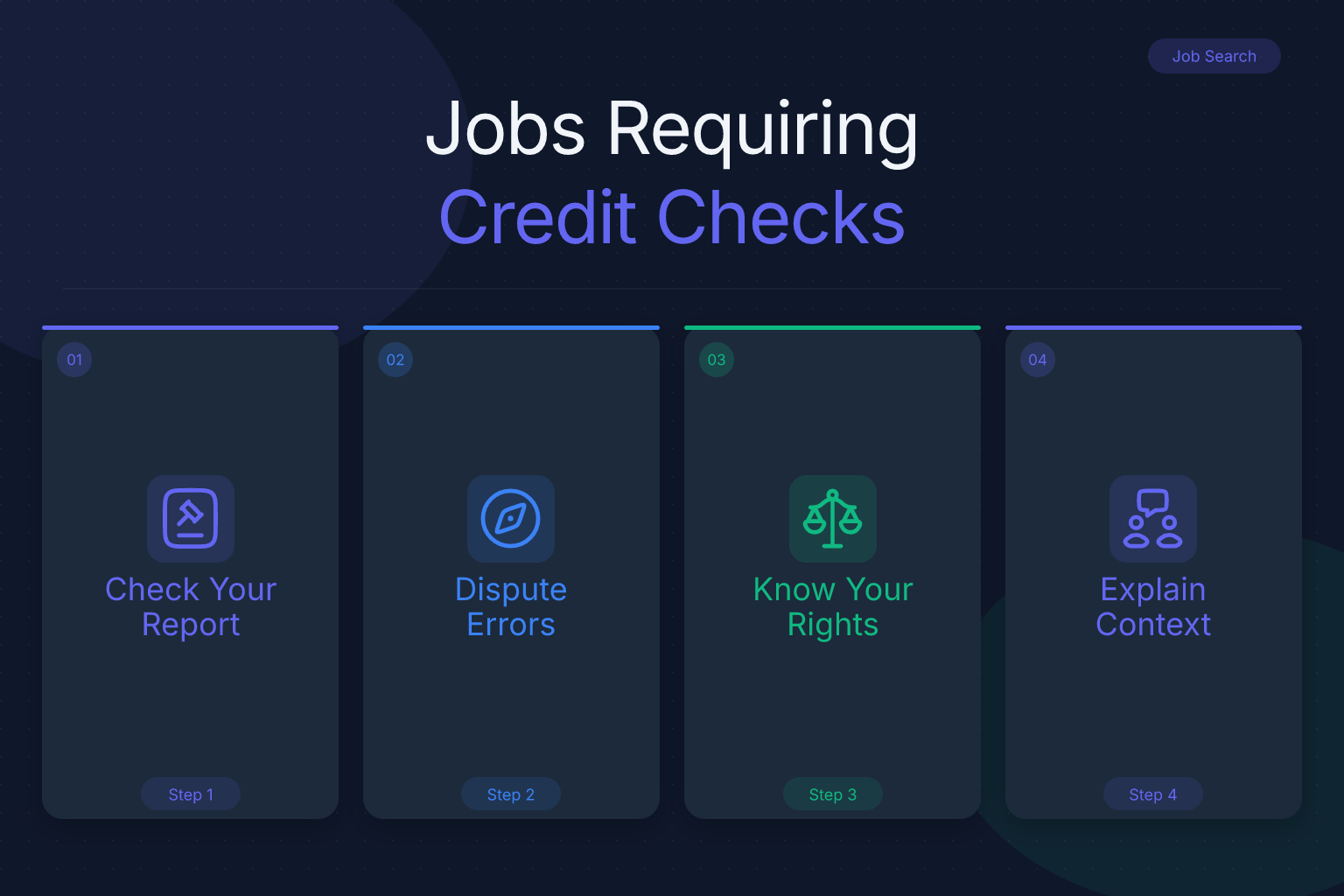
Pull your free credit reports. Visit AnnualCreditReport.com to get a free copy of your report from each of the three major bureaus—Equifax, Experian, and TransUnion. You’re entitled to one free report from each bureau every 12 months. Review all three because they can contain different information.
Check your credit score for your own awareness. While employers don’t see your score, knowing it can help you understand the overall health of your credit. You can get a free score from many credit card issuers, banks, or websites like Credit Karma. This isn’t required, but it gives you a baseline.
Look for errors. Common mistakes include accounts that aren’t yours, late payments reported incorrectly, outdated negative items that should have fallen off, and duplicate accounts. According to the Federal Trade Commission, one in five people has an error on at least one credit report. Disputing these errors is your right.
Dispute inaccuracies. If you find an error, file a dispute with the credit bureau that produced the report. You can do this online, by mail, or by phone. The bureau must investigate within 30 days and correct or remove inaccurate information. Do this well before your job application deadline because disputes take time. Gather any supporting documentation (receipts, letters, court records) to strengthen your case.
Address legitimate negative items. If you have real late payments or collections, consider paying them off or setting up a payment plan. Some creditors will remove a collection from your report if you pay in full (a “pay for delete” arrangement), though this isn’t guaranteed. Even if the item remains, showing that you’ve taken action demonstrates responsibility.
Prepare a short explanation. For any negative items you can’t remove, write a brief, factual explanation. Keep it to two or three sentences. Example: “I fell behind on credit card payments after a layoff in 2024, but I’ve since set up a payment plan and all accounts are current.” Practice saying it out loud so it sounds natural.
Know your rights. Under the FCRA, an employer must get your written consent before running a credit check. If they plan to take adverse action (like not hiring you) based on the report, they must give you a copy of the report and a summary of your rights before making the final decision. You then have time to dispute any inaccuracies.
Be ready to discuss it in the interview. If a credit check is part of the process, the interviewer may ask about your financial history. Don’t wait to be caught off guard. If you know there’s a negative item, consider proactively mentioning it in a later-stage interview, especially if the role involves financial responsibility. This shows honesty and self-awareness.
Consider timing. Start preparing at least 30–60 days before you expect a credit check. Disputes can take weeks, and you want any corrections to appear on your report before the employer pulls it. If you’re actively job hunting, pull your reports now so you’re ready.
For a broader look at preparing for all types of background checks, see our guide on how to prepare for an employment background check.
How to Explain Negative Credit History in an Interview
If an interviewer asks about your credit history, the worst thing you can do is get defensive or lie. The best approach is to be honest, brief, and forward-looking. Here’s a simple framework:
- Acknowledge the issue: “Yes, I had a period of financial difficulty a couple of years ago.”
- Explain the cause without blaming others: “I was laid off and fell behind on some bills.”
- Show what you’ve done to fix it: “I’ve since set up payment plans, and all my accounts are current. I’ve also built an emergency fund.”
- Connect it to the job: “I’ve learned to manage finances more carefully, which I think will serve me well in this role.”
Avoid over-explaining or sharing unnecessary personal details. Keep it professional and focused on the present. If the negative item is old and you’ve had years of clean history since, mention that: “That was five years ago, and my credit has been clean since then.”
Here are a few more examples for common scenarios:
- Medical debt: “I had an unexpected medical emergency that resulted in some collections. I’ve since negotiated a payment plan and I’m on track to pay it off.”
- Student loans: “I struggled with student loan payments after graduation, but I’ve consolidated my loans and I’m now on an income-driven repayment plan.”
- Identity theft: “I was a victim of identity theft, and some fraudulent accounts appeared on my report. I’ve filed a police report and disputed those accounts with the credit bureaus.”
If the negative item is minor and old, you may not need to bring it up unless asked. But if the role involves significant financial responsibility, proactively addressing it in a later interview can demonstrate integrity.
This same principle applies to other difficult interview topics. If you’re also dealing with a short tenure or a bad fit in a previous job, check out our guide on how to explain short tenure due to bad fit in an interview for a similar framework.
Your Legal Rights and What to Do If You’re Denied
The Fair Credit Reporting Act gives you specific protections during an employment credit check. Here’s what you need to know:
- Written consent: An employer must get your written permission before pulling your credit report. If they don’t, they’re violating the law.
- Pre-adverse action notice: If the employer plans to reject you based on the credit report, they must give you a copy of the report and a document called “A Summary of Your Rights Under the FCRA” before making the final decision. This gives you a chance to review the report and dispute any errors.
- Adverse action notice: If the employer ultimately decides not to hire you because of the credit report, they must tell you the name and contact information of the credit bureau that supplied the report, and inform you of your right to dispute the accuracy of the report and get a free copy within 60 days.
Some states go further. California, Colorado, Connecticut, Hawaii, Illinois, Maryland, Nevada, Oregon, Vermont, and Washington restrict when employers can use credit checks for employment. For example, California generally prohibits credit checks unless the job involves managerial duties, access to cash, trade secrets, or law enforcement. Check your state’s laws to understand your protections.
If you’re denied because of a credit check, don’t panic. First, get a copy of the report the employer used and review it for errors. If you find inaccuracies, dispute them immediately. Once corrected, you can reapply for the job or apply to similar roles. Many employers will reconsider if the negative item was an error.
If you believe the employer violated the FCRA—for example, by running a credit check without your consent or failing to provide the required notices—you can file a complaint with the Federal Trade Commission (FTC) or the Consumer Financial Protection Bureau (CFPB). You may also have the right to sue for damages.
If you’d rather avoid credit checks altogether, plenty of jobs don’t require them. Browse the ResumeMate job board to find openings in industries that typically skip credit checks, such as creative roles, education, and many tech positions. For example, cloud engineering roles rarely require credit checks—see our guide on AWS jobs for more.
FAQ
Q: Does an employment credit check hurt my credit score?
A: No. Employment credit checks are “soft pulls,” which do not affect your credit score. Only “hard pulls”—like when you apply for a loan or credit card—impact your score. Employers cannot see your score anyway.
Q: Can an employer see my credit score?
A: No. Employers receive a modified credit report that excludes your credit score, account numbers, date of birth, and other personal details. They see payment history, debts, collections, and public records like bankruptcies.
Q: What credit score do I need to pass an employment credit check?
A: There is no minimum credit score for employment because employers don’t see your score. They evaluate the specific items on your report. A clean report with no recent negative items is ideal, but a single old late payment is unlikely to disqualify you.
Q: Can I be denied a job because of bad credit?
A: Yes, in most states, an employer can deny you a job based on negative credit history if it’s relevant to the role. However, they must follow FCRA procedures, including giving you a copy of the report and a chance to dispute errors before making a final decision.
Q: How far back do employment credit checks go?
A: Most negative items stay on your credit report for seven years, and bankruptcies can stay for up to ten years. However, employers typically focus on recent activity—the last two to three years—rather than old issues.
Q: Do all jobs require a credit check?
A: No. Only certain roles, primarily in finance, government, cash handling, and executive positions, commonly require credit checks. Many jobs in tech, creative fields, education, and healthcare (non-financial roles) do not.
Q: Can I refuse a credit check?
A: You can refuse, but the employer can also refuse to hire you. If a credit check is a legitimate requirement for the job and you decline, you may be removed from consideration. However, if the employer runs a credit check without your written consent, that’s a violation of the FCRA.
Q: What information is needed for a credit check?
A: To run an employment credit check, the employer needs your full name, address, Social Security number, and date of birth. They also need your written consent and a permissible purpose under the FCRA (such as employment screening).
Q: What do employers look for in a credit check?
A: Employers look for patterns of financial irresponsibility: recent late payments, collections, charge-offs, bankruptcies, and high debt relative to income. They are not looking at your credit score, but at specific negative items that might indicate risk.
Q: Do background checks include credit reports?
A: Sometimes, but not always. A background check can include criminal history, driving records, education verification, and employment history. A credit check is a separate component that may or may not be included, depending on the employer and the role. Always ask what’s included in the background check.
Q: How do I prepare for a credit check?
A: Pull your free credit reports from AnnualCreditReport.com, review them for errors, dispute any inaccuracies, address legitimate negative items, and prepare a brief explanation for anything that remains. Start at least 30–60 days before you expect the check.
Q: What is a pre-employment credit check?
A: A pre-employment credit check is the same as an employment credit check—it’s a review of your credit report conducted by an employer before making a hiring decision. It’s a soft pull and does not affect your credit score.
Q: What do you need to run a credit check?
A: To run a credit check, an employer needs a permissible purpose under the FCRA (such as employment), your written consent, and your identifying information (name, address, SSN, date of birth). They then request a consumer report from a credit bureau.
Q: What information is required for a credit check?
A: The required information includes your full legal name, current and previous addresses, Social Security number, and date of birth. The employer must also obtain your written authorization before pulling the report.
Q: What information is needed to run a credit check?
A: The same as above: name, address, SSN, date of birth, and written consent. The credit bureau uses this information to match your identity and produce the correct report.
Track Every Application While You Job Hunt
Stop losing track of where you’ve applied. The ResumeMate Job Tracker is a free Chrome extension that tracks every application, deadline, and follow-up in one place — right from your browser.
Install ResumeMate Free on Chrome →
Once you’ve passed the credit check and landed the offer, you might want to negotiate a signing bonus. Check out our guide on how to ask for a signing bonus for scripts and timing tips.