How to List Multiple Short-Term Jobs on One Resume (Without Looking Like a Job Hopper)
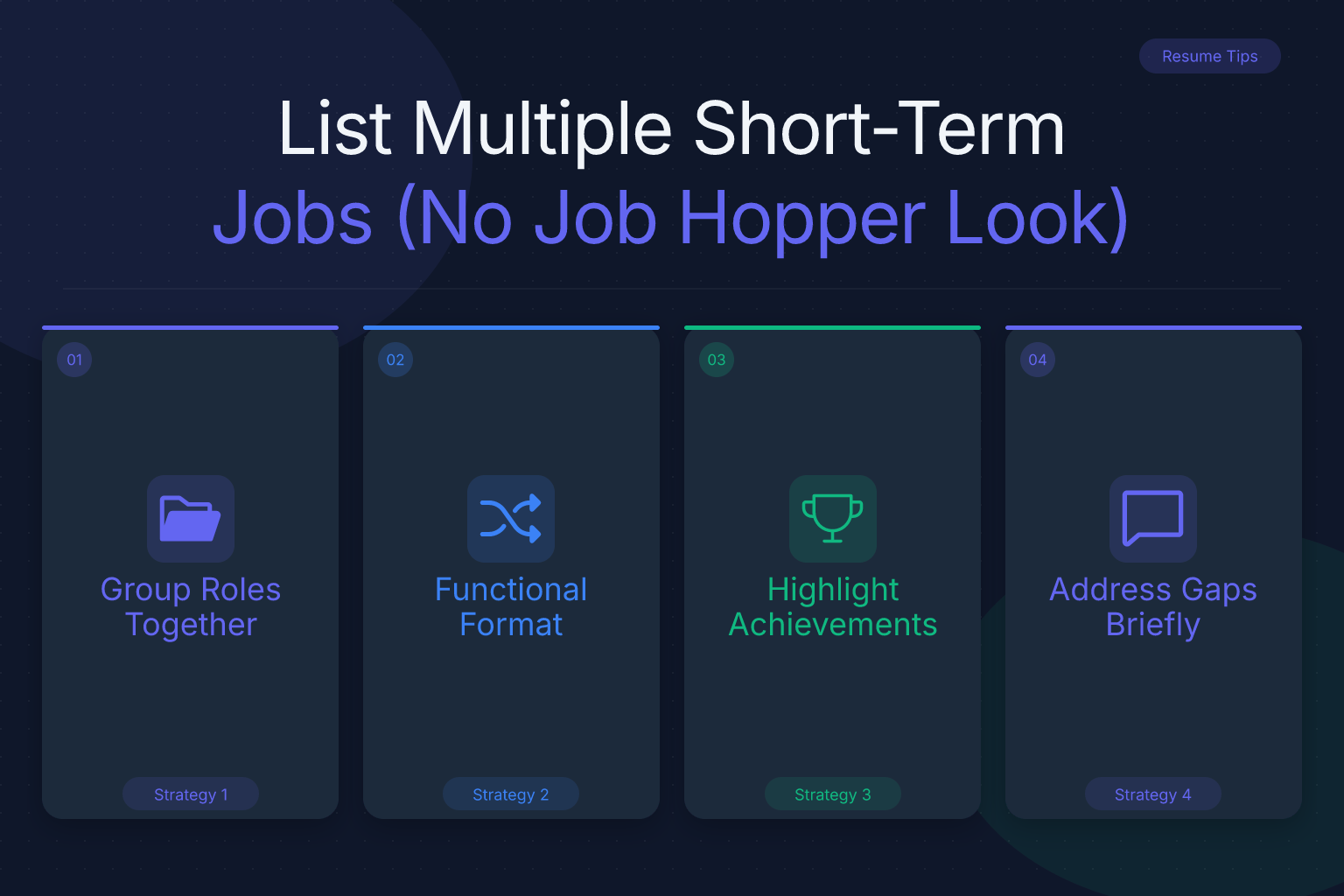
If you’ve held several positions that lasted only a few months each, you might be wondering how to list multiple short-term jobs on one resume without scaring off recruiters. A string of brief roles can raise questions about your reliability, but the way you present that experience makes all the difference. By grouping similar roles, emphasizing achievements over tenure, and using a clean format, you can turn a potential red flag into a compelling story of adaptability and broad skill acquisition.
Key Takeaways
- Grouping short-term contract, freelance, or temp roles under a single functional heading reduces visual clutter and shifts focus to your skills.
- A hybrid resume format (combining chronological and functional elements) lets you lead with relevant competencies while still showing a work timeline.
- Bullet points should highlight measurable results and specific contributions, not just list duties or employment dates.
- Address gaps honestly by framing them as periods of consulting, upskilling, or project-based work.
- Tailor every resume to the job description, and use an ATS score checker to ensure your grouped entries parse correctly.
| What to Do | Why It Matters | Time |
|---|---|---|
| Group similar short-term roles under one heading | Reduces visual noise and prevents the “job hopper” label | 5–10 min |
| Use a hybrid resume format | Puts skills and achievements first while still showing employment history | 10–15 min |
| Write bullet points focused on results, not dates | Shifts attention from tenure to impact | 15–20 min |
| Explain gaps with a brief note (e.g., “Contract roles”) | Prevents recruiters from assuming the worst | 5 min |
| Tailor your resume to each job description | Increases ATS match and shows you’re a targeted candidate | 20–30 min |
Why Multiple Short-Term Jobs Can Raise Red Flags (and How to Overcome Them)
Recruiters and hiring managers often view a series of short stints—roles lasting less than a year—as a potential sign of instability. They may worry you’ll leave quickly, struggle with commitment, or have performance issues. But the reality is that short-term jobs are increasingly common. Contract work, freelancing, temp-to-perm roles, seasonal employment, and project-based gigs are legitimate career paths. The key to listing multiple short-term jobs on one resume is to frame them as intentional choices that built a diverse skill set, not as a series of failures.
Start by acknowledging the context. If you worked several short contracts in the same field, group them under a single “Contract Assignments” or “Freelance Projects” heading. This immediately tells the reader that the short durations were by design, not due to being fired or quitting. For example, instead of listing three separate 3-month marketing coordinator roles, you can create one entry: “Marketing Coordinator (Contract Roles)” with the combined date range and a summary of key achievements across all assignments. This approach reduces visual clutter and shifts the focus to what you accomplished.
Addressing Employment Gaps Between Short-Term Jobs
Gaps between short-term jobs are common, especially if you were between contracts or took time off. Don’t leave them unexplained, as recruiters may assume the worst. Instead, address gaps proactively with a brief, honest note.
- If you were freelancing or consulting: Add a “Freelance [Your Field]” entry for the gap period, even if you only had one or two small projects. This shows you remained active.
- If you were upskilling: List relevant courses, certifications, or self-study. For example: “Completed Google Data Analytics Professional Certificate (Mar 2025 – Jun 2025).”
- If you took personal time: A simple line like “Career break for family caregiving” or “Planned travel sabbatical” is acceptable. You don’t need to over-explain.
- If you were laid off: Frame it as a company-wide reduction, not a personal failure. For more on this, see our guide on how to list layoffs on your resume without stigma.
The goal is to fill the timeline so there are no unexplained blank periods. Even a one-line entry is better than a gap.
How to Group and Format Short-Term Jobs on Your Resume
When to Group Multiple Short-Term Jobs Together
Not all short-term jobs should be grouped. The decision depends on the nature of the work and how it relates to your target role. Grouping works best when:
- The roles were in the same function or industry. If you held three different administrative assistant temp jobs, grouping them under “Administrative Support (Temporary Assignments)” makes sense.
- You worked for the same staffing agency or client. For example, multiple projects through a single consulting firm can be listed under that firm’s name with a note like “Various client engagements.”
- The jobs were project-based or freelance. Freelance writers, designers, and developers often work on short-term projects. Grouping them as “Freelance Content Writer” with a date range and a bulleted list of notable projects is far more effective than listing each client separately.
- The roles were seasonal or recurring. If you worked retail during the holidays for three consecutive years, group them under “Seasonal Sales Associate” with the combined months.
Avoid grouping jobs that are completely unrelated or that would misrepresent your experience. If you were a barista for two months, then a data entry clerk for three months, and then a customer service rep for four months, grouping them under a vague “Various Roles” heading won’t help. Instead, you might list only the most relevant ones or use a functional format to highlight transferable skills.
How to Format a Grouped Entry on Your Resume
A grouped entry should look clean and professional. Here’s a step-by-step approach:
- Choose a descriptive job title. Use something like “Contract Marketing Specialist” or “Freelance Graphic Designer” rather than a generic “Various Positions.”
- Add a combined date range. Use the earliest start month/year to the latest end month/year. If there are gaps, you can note “Multiple engagements” in parentheses.
- Write a brief summary line. One sentence that explains the nature of the work, e.g., “Completed 5 short-term contracts for mid-size tech companies, delivering email campaigns and social media content.”
- List 3–5 bullet points of key achievements across all roles. Focus on results, not duties. Use numbers where possible.
- Optionally, list the client or employer names in a sub-bullet or in parentheses if they add credibility. For example: “Clients included XYZ Corp, ABC Inc., and 123 Solutions.”
Before (ungrouped):
- Marketing Coordinator, Company A (Jan 2025 – Mar 2025)
- Marketing Coordinator, Company B (Apr 2025 – Jun 2025)
- Marketing Coordinator, Company C (Jul 2025 – Sep 2025)
After (grouped):
- Contract Marketing Coordinator (Jan 2025 – Sep 2025)
- Completed three consecutive 3-month contracts for SaaS companies, managing email campaigns that increased open rates by an average of 18%.
- Coordinated product launches for two clients, resulting in a combined 12% lift in trial sign-ups.
- Clients: Company A, Company B, Company C
This format immediately tells the recruiter that the short durations were intentional contracts, not a series of quick departures.
Writing Bullet Points That Emphasize Skills Over Tenure
The bullet points under each role are where you shift the narrative from “I only stayed 4 months” to “Here’s what I delivered in those 4 months.” Follow these guidelines:
- Start with a strong action verb. Use words like “Spearheaded,” “Resolved,” “Generated,” “Streamlined,” or “Delivered.”
- Quantify results whenever possible. Even if you don’t have exact numbers, use estimates or percentages. “Handled customer inquiries” becomes “Resolved 40+ customer inquiries daily, maintaining a 95% satisfaction rating.”
- Focus on outcomes, not responsibilities. Instead of “Responsible for social media,” write “Grew Instagram following by 30% in 3 months through daily content and community engagement.”
- Tie achievements to the job you want. If you’re applying for a project management role, highlight any short-term job where you coordinated tasks, managed timelines, or communicated with stakeholders.
For short-term roles, one or two powerful bullets are better than a long list of mundane duties. Quality over quantity.
Using a Functional or Hybrid Resume Format
If you have a patchwork of short-term jobs across different fields, a purely chronological resume can look chaotic. A functional resume organizes experience by skill category rather than by employer, which can be tempting. However, many recruiters and ATS systems dislike functional resumes because they obscure the timeline and can appear as if you’re hiding something.
A hybrid (combination) resume is often the safest and most effective choice. It leads with a strong skills summary and then provides a concise chronological work history. This lets you front-load your most relevant competencies while still showing a clear employment timeline. For a detailed comparison, see our guide on functional vs. chronological resumes.
For example:
- Professional Summary: 3+ years of customer-facing experience across retail, hospitality, and call center environments. Proven ability to de-escalate conflicts, upsell services, and maintain high satisfaction scores.
- Skills Section: Conflict Resolution, POS Systems, CRM Software (Salesforce), Cash Handling, Team Training.
- Experience Section: Then list your roles, using grouping where appropriate.
When using any format, stick to a clean, single-column layout. Modern ATS platforms parse text-based PDFs reliably, but multi-column designs, tables, and graphics can still cause parsing errors. A single-column resume ensures your grouped entries and skills are read correctly. You can build an ATS-friendly resume for free using ResumeMate’s resume builder, which offers clean templates that won’t confuse parsing software.
Tailoring Your Resume for Each Application
A generic resume won’t work when you have a non-linear work history. You need to customize your resume for every job you apply to, pulling the most relevant short-term experiences to the forefront. For more strategies, read our article on how to tailor your resume for each job. Here’s how:
- Analyze the job description. Identify the top 5–7 keywords and required skills.
- Reorder your grouped entries. Place the most relevant contract or freelance role first, even if it’s not the most recent.
- Adjust your bullet points. Rewrite them to mirror the language in the job posting. If the ad asks for “stakeholder communication,” use that exact phrase in your bullets.
- Update your skills section. Add any skills from short-term jobs that match the role, and remove irrelevant ones.
- Check your ATS score. Before submitting, upload your tailored resume to ResumeMate’s free score checker. It analyzes your resume against ATS criteria and gives you section-by-section feedback, so you can fix any issues that might cause your grouped entries to be misread.
Tailoring takes extra time, but it dramatically increases your chances of getting an interview. When a recruiter sees that your short-term experiences directly align with the job requirements, the tenure becomes secondary.
Sample Resume Section: Multiple Short-Term Jobs
Here’s a complete example of how a candidate with several short-term IT support roles might present their experience:
IT Support Specialist (Contract & Temp Roles) | Jan 2025 – Present Completed 6 short-term assignments for mid-size healthcare and finance companies, providing Level 1 and 2 support for 500+ end users.
- Resolved an average of 35 tickets per day with a 98% first-call resolution rate, exceeding client SLAs.
- Migrated two offices to Windows 11, including data backup, imaging, and post-migration support with zero data loss.
- Documented troubleshooting procedures that reduced repeat tickets by 20% across all client sites.
- Clients: HealthFirst Medical, Apex Financial, Riverdale Clinic, and others.
Freelance Web Developer | Jun 2024 – Dec 2024 Designed and launched responsive websites for small business clients on a project basis.
- Built 4 WordPress sites with e-commerce functionality, resulting in an average 40% increase in online sales for clients.
- Managed all client communication, project timelines, and post-launch support.
Customer Service Associate (Seasonal) | Nov 2023 – Jan 2024 Provided holiday peak support for a national retailer.
- Handled 60+ customer interactions daily, maintaining a 4.8/5 satisfaction score.
- Trained 3 new seasonal hires on POS system and return policies.
This format groups the most relevant contract work, includes a freelance period to cover a gap, and lists a seasonal role without overemphasizing its short duration.
Frequently Asked Questions
Q: Can I leave short-term jobs off my resume entirely?
A: You can omit very short jobs (under 2–3 months) if they are not relevant to the role and leaving them out doesn’t create a large, unexplained gap. However, if the job provided a key skill or fills a timeline gap, it’s better to include it briefly or group it with similar roles.
Q: How do I explain job hopping in an interview?
A: Frame your short stints as intentional choices that helped you gain diverse experience quickly. For example: “I took on several contract roles to build expertise in different industries before committing to a long-term position. Now I’m looking for a place where I can apply that breadth of knowledge.”
Q: Should I use a functional resume for multiple short-term jobs?
A: A purely functional resume is risky because many recruiters and ATS systems prefer to see a clear timeline. A hybrid format that leads with a skills summary and follows with a concise chronological history is a safer, more effective choice.
Q: How do I list temp agency jobs on a resume?
A: List the staffing agency as the employer if you worked multiple assignments through them, and then describe the roles and clients in the bullet points. For example: “Adecco (Temp Assignments) – Completed 3 administrative support contracts for clients in the legal and healthcare sectors.”
Q: What if I was fired from a short-term job?
A: You don’t need to state the reason for leaving on your resume. If the role lasted only a few months, you can group it with other short-term jobs or list it without explanation. In an interview, be honest but brief: “It wasn’t the right fit, and I moved on to a role that better matched my skills.”
Q: How many short-term jobs is too many before it looks bad?
A: There’s no magic number, but if you have more than three or four roles lasting under a year in a row, grouping becomes essential. The key is to show a pattern of growth or skill acquisition, not a series of random exits.
Track Every Application While You Job Hunt
Stop losing track of where you’ve applied. The ResumeMate Job Tracker is a free Chrome extension that tracks every application, deadline, and follow-up in one place — right from your browser.