How to List Study Abroad Experience on a Resume (With Examples)
Knowing how to list study abroad experience on a resume can turn a semester overseas into a powerful differentiator. Recruiters see hundreds of applications with similar degrees and GPAs. A well-presented study abroad entry shows adaptability, cross-cultural communication, and initiative — traits that employers consistently rank among the most desirable. In fact, a survey by the Institute of International Education found that 64% of employers consider study abroad experience important when evaluating candidates. This guide covers exactly where and how to include your international experience, with examples for every stage of your career. Plus, we’ll show you how to craft a resume specifically for a study abroad application — a common need that many job seekers overlook.
Key Takeaways
- Study abroad belongs in the Education section unless you held a job, internship, or volunteer role — then it can go under Work Experience or a dedicated International Experience section.
- Always include the program name, host institution, location, and dates; add relevant coursework, projects, or language gains to show concrete value.
- For recent graduates, study abroad can be a major differentiator; for experienced professionals, condense it to one line or fold it into a skills narrative.
- Avoid listing study abroad as a separate degree or using vague descriptions — tie every detail to a skill the employer cares about.
- Use the same formatting rules as the rest of your resume: reverse-chronological order, action-oriented language, and ATS-friendly layout.
| What to Do | Why It Matters | Time |
|---|---|---|
| Place study abroad in the Education section (default) | Recruiters look for it there; keeps your resume organized | 2 minutes |
| Add a bullet with relevant coursework, language, or projects | Transforms a line into a proof point for skills | 5 minutes |
| Create a separate “International Experience” section if you worked or volunteered abroad | Highlights cross-cultural competence and soft skills | 10 minutes |
| Quantify achievements (e.g., “Conducted 15 interviews in Spanish”) | Makes your experience tangible and memorable | 5 minutes |
| Tailor the entry to each job description | Shows you understand the role and didn’t just copy-paste | 10 minutes |
Where to Put Study Abroad on a Resume
Most of the time, study abroad fits naturally in the Education section. That’s where recruiters expect to find it, and it keeps your resume’s structure clean. List it as a separate entry under your home university, or as a bullet point within your degree entry.
Example — as a sub-entry under your degree:
University of Michigan, Ann Arbor, MI
Bachelor of Arts in International Relations, Expected May 2027
- Study Abroad: Semester at University of Cape Town, South Africa (Spring 2026)
- Relevant Coursework: Post-Apartheid Political Economy, African Development Studies
If your study abroad program was a full academic year or you earned a certificate, you can give it its own entry within the Education section, but still keep your home university as the primary institution.
When to move it out of Education:
- You completed an internship, co-op, or significant volunteer work abroad — that belongs in Work Experience or a separate “International Experience” section.
- You’re applying for a role where cross-cultural skills are the main selling point (e.g., international sales, NGO work) — a dedicated section can make those skills pop.
- You’re a recent graduate with little work history — pulling study abroad into its own section can fill space and highlight soft skills.
For students targeting specific industries, the placement strategy may vary. For example, if you’re pursuing accounting internships and completed a finance-related study abroad program, emphasizing the quantitative coursework in your Education section becomes critical. Similarly, if you held an interim or acting role while abroad, you can reference our guidance on listing interim titles to frame that experience properly.
For more on structuring your education section based on your career stage, see our guide on what to include in the education section of a resume.
How to Format Study Abroad in the Education Section
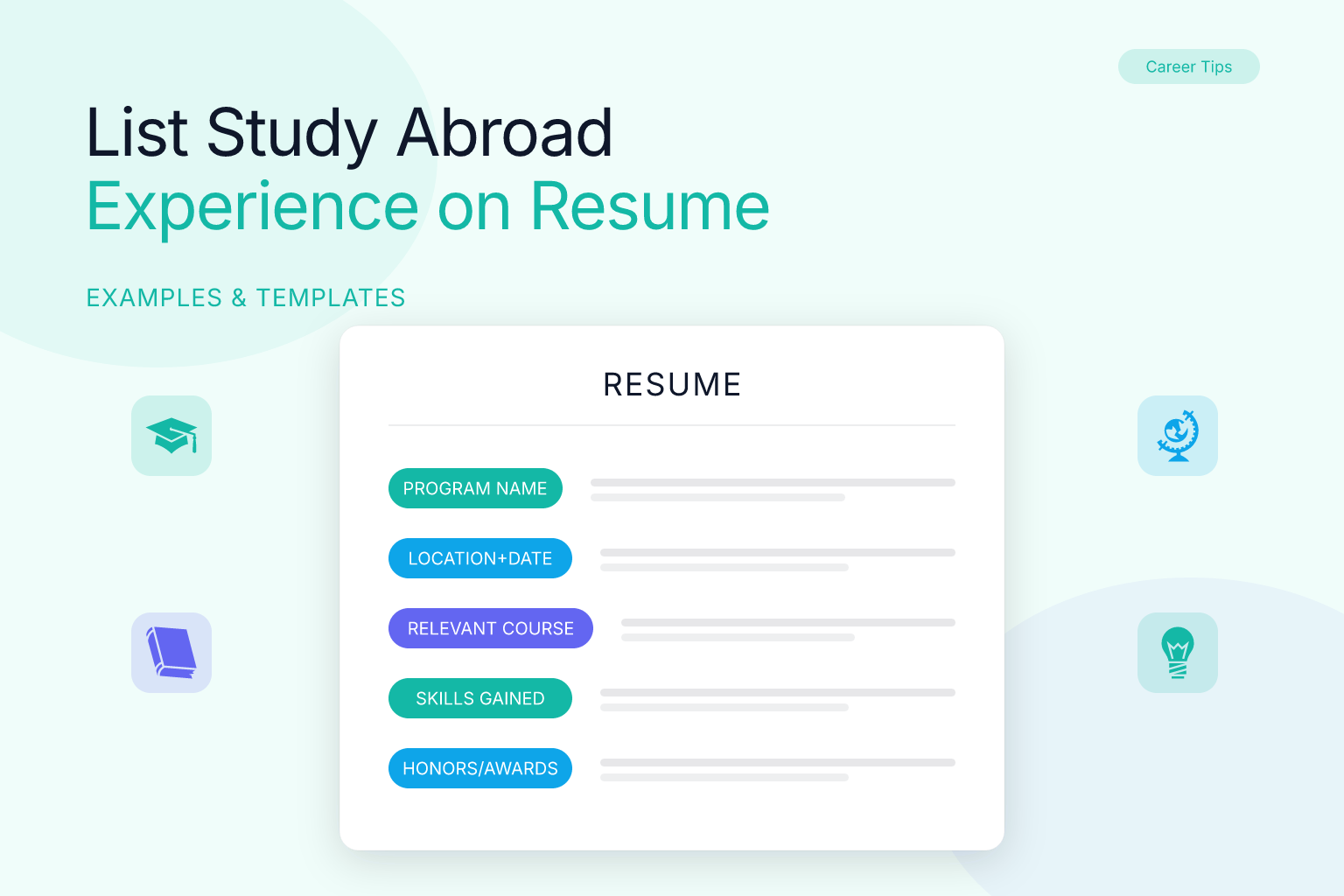
Treat the study abroad entry like a mini-degree entry. Include:
- Program name (if different from the host institution)
- Host institution name and location (city, country)
- Dates (semester, year, or month/year format)
- Relevant coursework, projects, or academic focus
Example — semester abroad with academic focus:
University of Texas at Austin, Austin, TX
Bachelor of Science in Environmental Science, GPA 3.6, Expected May 2027
Study Abroad: University of Queensland, Brisbane, Australia (Fall 2026)
- Completed coursework in Marine Ecology and Sustainable Resource Management
- Conducted field research on coral bleaching at Heron Island Research Station
If you studied abroad through a third-party provider (e.g., CIEE, IES Abroad), list the host institution where you actually took classes, not the provider’s name. Employers care about the academic setting, not the logistics company.
For multiple study abroad experiences, list each as a separate sub-entry under your degree, in reverse-chronological order. If you studied abroad more than twice, consider a dedicated section.
Formatting variations by program type:
| Program Type | Format Recommendation | Example |
|---|---|---|
| Semester exchange | Sub-entry under home degree | “Study Abroad: University of Edinburgh, Scotland (Fall 2025)” |
| Full year abroad | Separate Education entry | List host university with dates and credits transferred |
| Summer program | Single bullet under degree | “Summer Intensive: Japanese Language Program, Tokyo (6 weeks)” |
| Erasmus program | Include “Erasmus+” in program name | “Erasmus+ Exchange: Sorbonne University, Paris (Spring 2026)” |
| Research fellowship | Treat as Work Experience or Projects | List as research role with PI and institution |
ATS formatting tips:
- Use standard section headings (Education, Experience, Skills)
- Avoid tables, text boxes, or graphics that can confuse parsing software
- Keep dates in a consistent format (MM/YYYY or Season YYYY)
- Use standard fonts (Arial, Calibri, Times New Roman) at 10-12pt
If you’re unsure whether your resume layout is ATS-compatible, run it through our free resume score checker to catch formatting issues before you apply.
When to Create a Dedicated “International Experience” Section
A separate section works best when your time abroad included substantial work, volunteering, or research that doesn’t fit neatly under Education. This section can sit between Education and Work Experience, or after Work Experience if you’re an experienced professional.
Use this section if:
- You held a part-time job, internship, or freelance gig while abroad.
- You volunteered with a local organization (teaching English, environmental projects, etc.).
- You conducted independent research or a capstone project in the host country.
- You’re applying for roles that explicitly value global perspective (e.g., international business, diplomacy, global health).
Example — International Experience section:
International Experience
English Teaching Volunteer | Chiang Mai, Thailand | Summer 2025
- Designed and led daily English conversation classes for 20+ primary school students
- Adapted lesson plans for mixed proficiency levels, improving student participation by 40%
- Collaborated with local teachers to integrate cultural exchange activities
This format mirrors a standard work entry, which makes it easy for recruiters to scan. If you’re unsure how to structure volunteer or freelance work, check out our guides on listing volunteer work on a resume and formatting freelance work.
Section naming alternatives:
- Global Experience
- International Projects
- Cross-Cultural Experience
- Study & Work Abroad
- International Academic Experience
Choose the name that best reflects your activities and aligns with the job you’re targeting. For international business roles, “Global Experience” signals commercial awareness. For NGO positions, “International Volunteer Experience” emphasizes service orientation.
How to List Study Abroad Work or Internships
If you completed an internship, co-op, or paid job while abroad, list it in your Work Experience section — not buried in Education. Treat it like any other professional role. Use the same structure: job title, organization, location (city, country), dates, and 3-5 bullet points with action verbs and quantifiable results.
Example — internship abroad in Work Experience:
Marketing Intern | GreenTech Solutions, Berlin, Germany | June–August 2026
- Managed social media accounts across 3 platforms, growing follower base by 25% in 8 weeks
- Conducted competitor analysis for the DACH market, presenting findings to the CMO
- Wrote and translated blog content from English to German, increasing organic traffic by 15%
Even if the internship was unpaid or part of your study abroad program, it still counts as work experience. The key is to focus on what you accomplished, not the circumstances. If you’re struggling to quantify achievements, our article on adding numbers to your resume when you don’t have data offers practical strategies.
How to handle unpaid internships abroad:
- List them the same way as paid roles — compensation doesn’t determine experience value
- If the internship was through your university, list the host organization, not the school
- Include “Unpaid Intern” in the title only if required for visa or legal transparency
- Focus on skills gained and deliverables produced, not the unpaid status
For research positions at abroad colleges: If you’re wondering how to make a resume for research interns at abroad colleges, treat the position as academic work experience. Include the principal investigator’s name, department, specific research methods used, and any publications or presentations that resulted.
Research Assistant | Department of Economics, London School of Economics | Jan–May 2026
- Collected and analyzed economic data from 500+ survey respondents across 3 EU countries
- Co-authored working paper on post-Brexit trade patterns (under review)
- Presented findings at LSE Graduate Research Symposium
Highlighting Skills Gained from Studying Abroad
Study abroad builds skills that employers actively seek: adaptability, cross-cultural communication, problem-solving, independence, and often language proficiency. Don’t assume the recruiter will infer these — spell them out in your bullet points and, where appropriate, in a Skills section.
Top skills employers associate with study abroad:
- Adaptability and flexibility
- Cross-cultural communication and sensitivity
- Problem-solving in unfamiliar environments
- Independence and self-motivation
- Language proficiency (if applicable)
- Global perspective and cultural awareness
Ways to weave skills into your resume:
- Language skills: If you achieved conversational or professional proficiency, add it to a Languages section or a Skills list. Be honest about your level (e.g., “Spanish — Professional Working Proficiency”).
- Soft skills in bullet points: Instead of “Developed cross-cultural communication skills,” write “Facilitated weekly discussions between international and local students, bridging cultural differences in academic expectations.”
- Technical or research skills: If you used specific tools, lab equipment, or methodologies abroad, list them in a Skills section or mention them in context.
Example — Skills section snippet:
Skills: Cross-Cultural Communication | Spanish (Intermediate) | Qualitative Research | Intercultural Training | Adaptability
Language proficiency frameworks to reference:
- CEFR levels (A1-C2) for European positions
- ILR scale (0-5) for U.S. government roles
- Simple descriptors: Basic, Conversational, Professional, Fluent, Native
If you’re early in your career, a well-crafted Skills section can compensate for limited work history. Just make sure every skill you list is backed up by something in your experience entries.
Study Abroad on a Resume for Recent Graduates vs. Experienced Professionals
Recent graduates (0–3 years out of school): Study abroad can be a headline item. You likely have less work experience, so your international semester can fill space and demonstrate maturity. Use a dedicated “International Experience” section if you did anything beyond attending classes. Even a purely academic semester can be expanded with a bullet about a research project, language immersion, or cross-cultural teamwork.
Example — recent grad with limited work history:
Education
University of California, Davis — B.A. in Sociology, Minor in Chinese, June 2026
Study Abroad: Fudan University, Shanghai, China (Spring 2025)
- Completed all coursework in Mandarin; conducted 10 ethnographic interviews with local residents on urban migration
- Presented research at UC Davis Undergraduate Research Conference
For entry-level roles in specialized fields, your study abroad coursework may be directly relevant. If you’re targeting accountant positions requiring CPA and GAAP knowledge, international accounting courses taken abroad can demonstrate global financial literacy — a growing asset in multinational firms.
Experienced professionals (5+ years): At this stage, study abroad shrinks to a single line or gets folded into a summary. Recruiters care more about your recent professional achievements. Keep the entry brief, but don’t delete it entirely — it can still signal language skills or global mindset.
Example — experienced professional:
Education
University of Wisconsin–Madison — B.B.A. in Marketing, 2018
Semester abroad: Universidad de Buenos Aires, Argentina (Spring 2017)
If the study abroad experience directly relates to the job (e.g., you’re applying for a role that requires Portuguese and you studied in Brazil), you can mention it in your cover letter or professional summary instead of expanding the resume entry.
Career stage placement guide:
| Career Stage | Recommended Placement | Detail Level |
|---|---|---|
| Current student | Education section | 2-3 bullets with coursework |
| Recent grad (0-2 yrs) | Education or International Experience | 2-3 bullets with projects |
| Mid-career (3-10 yrs) | Education section | 1 line, optional bullet |
| Senior (10+ yrs) | Education section | 1 line only |
| Career changer | Summary + Education | Highlight transferable skills |
Common Mistakes to Avoid
Even a strong study abroad experience can backfire if presented poorly. Here are the most frequent missteps:
- Listing it as a degree you earned. Unless you actually received a diploma from the host institution, don’t write “B.A. in International Studies, University of Barcelona.” That’s misleading and can be flagged in a background check.
- Using vague descriptions. “Studied abroad in Italy” tells a recruiter nothing. What did you study? What did you accomplish? Be specific.
- Overemphasizing tourism. “Traveled to 12 countries on weekends” is not a professional qualification. Focus on academic, work, or volunteer achievements.
- Ignoring ATS formatting. Use standard section headings (Education, Work Experience). Avoid tables, text boxes, or graphics that can confuse parsing software. If you’re unsure whether your resume is ATS-friendly, run it through a free resume score checker to catch issues before you apply.
- Forgetting to tailor the entry. A generic study abroad line won’t help. Adjust the coursework, projects, or skills you highlight based on the job description. For a step-by-step approach, read our guide on tailoring your resume to a job description.
- Omitting the country or city. Always include the location — it immediately signals international exposure and can be a keyword for global roles.
- Inflating language proficiency. Claiming “fluent” when you’re conversational can backfire in interviews. Use accurate descriptors like “Intermediate” or “Professional Working Proficiency.”
How to Tailor Study Abroad Experience to the Job Description
Every job values different aspects of international experience. A marketing role might care about your understanding of a foreign consumer market; a software engineering role might care about collaborating on a multicultural team. Before you finalize your resume, scan the job posting for keywords and required skills, then adjust your study abroad entry to match.
Tailoring in practice:
- Identify the top 3–5 skills the job description emphasizes (e.g., “cross-functional collaboration,” “data analysis,” “Spanish fluency”).
- Match your study abroad bullet points to those skills. If the job wants data analysis, highlight the research project where you crunched survey data. If it wants Spanish fluency, mention that you took all your courses in Spanish.
- Use the employer’s language. If the posting says “global mindset,” use that phrase in your bullet point (e.g., “Developed a global mindset by navigating academic and social norms in three distinct cultural settings”).
- Move the most relevant bullet to the top. Recruiters skim; put your strongest match first.
Before tailoring (generic):
- Studied abroad at University of Tokyo
After tailoring (for a consulting role):
- Analyzed case studies on Japanese business practices; collaborated with a cross-cultural team of 5 to deliver client recommendations in a semester-long consulting simulation
Tailoring by industry:
| Industry | What to Emphasize | Example Bullet |
|---|---|---|
| Consulting | Cross-cultural teamwork, analysis | “Led multicultural team project analyzing local market entry strategies” |
| Tech | Collaboration tools, remote work | “Collaborated with international peers using Slack, Zoom, and GitHub” |
| Marketing | Consumer insights, localization | “Researched consumer behavior patterns in Southeast Asian markets” |
| Finance | International regulations, currency | “Studied EU financial regulations and cross-border transaction frameworks” |
| Healthcare | Cultural competency, patient care | “Observed patient care protocols in diverse healthcare settings” |
This small effort can make the difference between a resume that gets skimmed and one that gets an interview. If you’re building your resume from scratch, our free AI resume builder makes it easy to create a clean, ATS-optimized layout in minutes.
How to Write a Resume for a Study Abroad Application
Many students search for “resume for study abroad” because they need to submit a resume as part of their application to a study abroad program. This is a different goal than listing past study abroad on a job resume. Here, you’re selling yourself to a program provider or university selection committee. They want to see academic readiness, maturity, and a genuine interest in the host culture.
Key sections for a study abroad application resume:
- Contact Information: Name, email, phone, and optionally your home university address.
- Objective or Summary (optional): A 2–3 line statement about your academic goals and why you want to study abroad. Example: “Sophomore International Studies major seeking a semester in Japan to deepen language skills and conduct comparative research on urban sustainability.”
- Education: Your current university, major, GPA (if strong), expected graduation date, and relevant coursework. You can also list your high school if you’re a freshman.
- Relevant Experience: This can include part-time jobs, volunteer work, campus leadership, or previous travel/language immersion. Focus on skills like independence, adaptability, and cross-cultural communication.
- Skills: Language proficiency (even basic), technical skills, and soft skills like teamwork or problem-solving.
- Extracurricular Activities: Clubs, sports, or community involvement that show you’re engaged and can contribute to the program’s community.
Sample resume snippet for a study abroad application:
Jane Doe
jane.doe@university.edu | (555) 123-4567Objective
Dedicated Environmental Science major seeking a spring semester in Costa Rica to study tropical ecology and improve Spanish proficiency, with the goal of pursuing a career in conservation.Education
University of Florida, Gainesville, FL
Bachelor of Science in Environmental Science, GPA 3.7, Expected May 2027
- Relevant Coursework: Ecology, Environmental Policy, Spanish Language I & II
Experience
Volunteer Trail Guide | Gainesville Nature Preserve | Fall 2025–Present
- Lead weekly educational hikes for groups of 10–15 visitors, explaining local flora and fauna
- Assist with trail maintenance and invasive species removal
Skills
Spanish (Intermediate) | GPS Mapping | Public Speaking | Team CollaborationActivities
Environmental Action Club (Secretary) | Intramural Soccer
Tips for a strong study abroad application resume:
- Keep it to one page. Programs review hundreds of applications; brevity is key.
- Tailor your objective and experience to the host country and program focus. If you’re applying to a language immersion program, highlight any language study or practice.
- Use a clean, ATS-friendly format. Even if a human reads it, a well-structured resume shows professionalism. You can use a free resume builder to get a polished layout quickly.
- Proofread carefully. Errors can signal a lack of attention to detail, which is critical when you’ll be navigating a new country.
- Include references if requested. Some programs ask for faculty or advisor contacts who can vouch for your readiness.
FAQ
Q: How to add study abroad to resume?
A: Add study abroad to the Education section as a sub-entry under your home university degree. Include the host institution name, location (city and country), dates (semester or year), and 1-2 bullets highlighting relevant coursework, projects, or language skills gained during the program.
Q: Does study abroad look good on a resume?
A: Yes, study abroad looks good on a resume when presented strategically. It signals adaptability, independence, and cross-cultural communication skills — qualities 64% of employers value according to IIE research. The key is connecting your experience to skills the employer needs, not just listing the location.
Q: How to include Erasmus in CV?
A: List Erasmus programs in your Education section with “Erasmus+” in the program name for clarity. Example: “Erasmus+ Exchange: University of Amsterdam, Netherlands (Fall 2025).” Include relevant coursework and any EU-specific projects that demonstrate understanding of European markets or regulations.
Q: How to put semester abroad on resume?
A: Put semester abroad as an italicized sub-entry under your degree in the Education section. Format: Study Abroad: [Host University], [City, Country] ([Semester] [Year]) followed by 1-2 bullets about coursework or achievements. Keep it concise but specific enough to show academic rigor.
Q: Do you put study abroad on a resume if it was only a summer program?
A: Yes, include summer programs if they had academic or professional components. A 4-8 week intensive language program, research fellowship, or structured internship warrants a bullet under Education. Purely touristic trips without learning outcomes should be omitted from your professional resume.
Q: How to show study abroad on resume for research interns at abroad colleges?
A: List research internships at foreign colleges in the Work Experience section, not Education. Include the department, principal investigator, specific research methods used, and any publications or presentations. This demonstrates hands-on academic work beyond standard coursework.
Q: What’s the difference between a resume for study abroad application vs. job resume?
A: A study abroad application resume emphasizes academic readiness, cultural interest, and personal maturity with sections like Objective and Extracurriculars. A job resume focuses on professional achievements, quantifiable results, and industry-specific skills. Both should be one page and ATS-friendly, but the content priorities differ significantly.
Track Every Application While You Job Hunt
Stop losing track of where you’ve applied. The ResumeMate Job Tracker is a free Chrome extension that tracks every application, deadline, and follow-up in one place — right from your browser.
Install ResumeMate Free on Chrome →
Related articles:
Ready to Build Your Resume?
Whether you’re listing study abroad experience or crafting your first professional resume, ResumeMate makes it easy. Our free AI resume builder creates clean, ATS-optimized resumes in minutes with templates designed for every career stage.