How to List Time Zone on a Resume for Remote Jobs (With Examples)
If you’re applying to remote roles, knowing how to list time zone on a resume remote hiring managers can see at a glance is a small detail that prevents scheduling chaos. Remote recruiters often screen dozens of candidates across multiple regions, and a missing or unclear time zone can make you look harder to schedule than you actually are. This guide shows you exactly where to put your time zone, how to format it, and which mistakes to avoid.
Key Takeaways
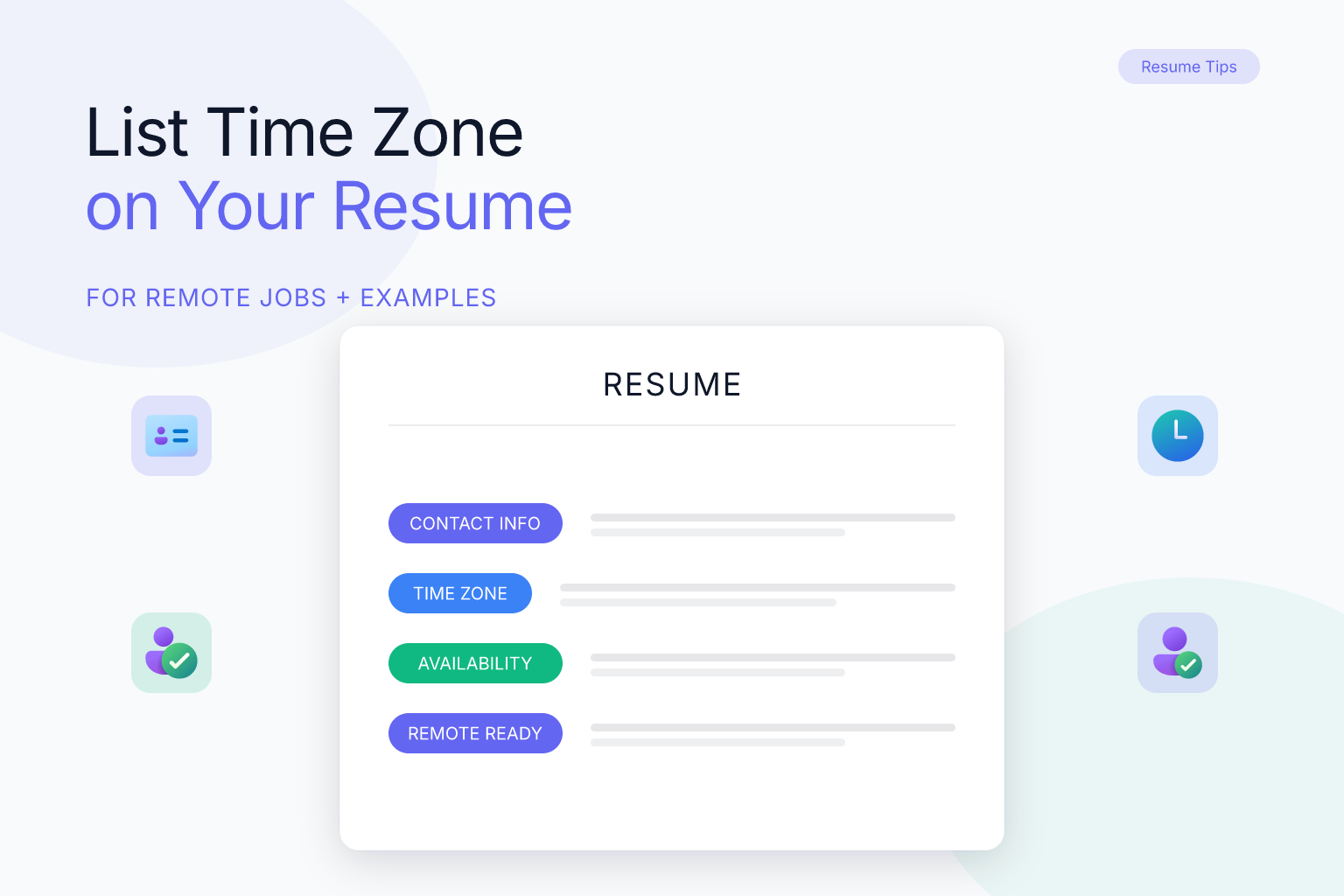
- Add your time zone to your resume header next to your location, using a clear format like “Austin, TX (CT)” or “Remote — UTC-6.”
- List your working hours or overlap window in your summary or work experience if the job posting asks for specific availability.
- Never list a time zone you don’t actually work in just to look more convenient; it creates trust problems during interviews.
- Use a single, consistent time zone format across your resume, LinkedIn, and application forms so recruiters don’t get conflicting signals.
- If you’re open to working across multiple time zones, state your overlap explicitly, such as “Available 9am–5pm ET / 6am–2pm PT.”
| What to Do | Why It Matters | Time |
|---|---|---|
| Add time zone to header next to city/state | Recruiters see availability instantly | 2 min |
| State your working hours or overlap window | Removes guesswork for scheduling | 5 min |
| Match time zone on resume, LinkedIn, and application | Prevents conflicting info | 3 min |
| Avoid listing a time zone you don’t work in | Builds trust and avoids awkward interviews | 1 min |
| Use UTC offset if applying internationally | Clear across countries and daylight saving | 2 min |
Why You Need to Know How to List Time Zone on a Resume for Remote Jobs
Remote hiring managers rarely have the luxury of assuming you’re in the same city. A job posted in New York might attract candidates from Lisbon, Bangalore, and Mexico City. If your resume just says “Remote” with no time zone, the recruiter has to guess when you’re available — and many won’t bother. They’ll move to a candidate who made scheduling easy.
Time zone is also a signal of how seriously you take remote work logistics. Listing your time zone shows you understand that remote collaboration depends on overlapping hours, not just skills. It pairs naturally with other remote-ready signals like async communication tools, self-management, and written documentation. If you want to strengthen that section, see our guide on remote work skills to put on a resume.
The short answer to how to list time zone on a resume remote teams will actually read is: put it in your header next to your location, and add an overlap window if the job posting asks for one. That’s it. The rest of this guide shows you the exact formats.
Where to Put Time Zone on a Resume
You have three natural places to list your time zone, and you don’t need all three. Pick the one that matches how the job posting is written.
- Resume header, next to your location. This is the most common and most scannable spot. Example: “Austin, TX (CT)” or “Remote — UTC-6.”
- Professional summary. If the role requires a specific overlap, add one sentence: “Remote product manager based in CT, available 9am–5pm ET with a 4-hour overlap with GMT.”
- Work experience entries. If you’ve held remote roles before, add the time zone to each entry: “Senior Customer Success Manager, Remote (ET) — Jan 2022–Present.”
Avoid creating a separate “Availability” section unless the job posting explicitly asks for one. ATS software parses headers and work experience more reliably than a custom section, and recruiters scan top-down. If you’re also open to relocating, you can combine time zone with relocation willingness — see how to indicate relocation willingness on a resume header.
How to Format Time Zone in Your Resume Header
The header is where most recruiters look first, so keep the format simple and consistent. Use one of these patterns:
- City, State (Time Zone Abbreviation): “Denver, CO (MT)” or “Raleigh, NC (ET)”
- Remote — UTC Offset: “Remote — UTC-5” or “Remote — UTC+5:30”
- Remote (Named Time Zone): “Remote (US Eastern Time)” or “Remote (Central European Time)”
- Open to All US Time Zones: “Remote — Open to all US time zones”
If you’re applying to a company in a different country, use the UTC offset instead of a US-centric abbreviation. “UTC-5” is unambiguous whether the reader is in Toronto, London, or Singapore. “EST” can mean Eastern Standard Time to some and be confused with other regions.
One rule: don’t write “EST” in the summer if you actually observe Eastern Daylight Time. Use “ET” (Eastern Time) to cover both, or use the UTC offset. The same applies to CT, MT, and PT. If you’re in a region with a half-hour offset, like India (UTC+5:30) or Newfoundland (UTC-3:30), write the full offset — don’t round it.
How to List Time Zone in Your Work Experience Section
If you’ve held remote jobs before, adding the time zone to each entry gives recruiters context about how you’ve managed distributed work. It also shows you’re not hiding a location mismatch.
Format each entry like this:
Senior Product Manager
Remote (ET) — Jan 2022–Present
- Led a 12-person team across US and EU time zones with a 4-hour daily overlap.
Customer Support Specialist
Remote (UTC+8) — Mar 2020–Dec 2023
- Handled live chat and email for North American customers during their business hours.
If you worked as a contractor or freelancer across multiple time zones, you can write “Remote (US & EU overlap)” or “Remote (Flexible — UTC-5 to UTC+1).” For more on formatting non-traditional remote work, see how to list contract vs freelance work on a resume.
Don’t list a time zone for a job you held in an office unless the role was remote. If you worked in an office in Chicago, just write “Chicago, IL” — no time zone needed. The time zone belongs on remote entries and your current header.
How to Handle Overlapping Time Zones and Flexible Hours
Many remote job postings say something like “must overlap at least 4 hours with US Eastern Time.” If that’s the case, don’t just list your home time zone and hope they figure it out. State the overlap explicitly.
Add a line in your summary or directly under your header:
- “Based in Lisbon (UTC+0), available 1pm–9pm local time to overlap with US Eastern Time.”
- “Remote — UTC+8, available 6am–2pm local time (5pm–1am ET).”
- “Open to working US Pacific hours from UTC+5:30.”
This removes the mental math for the recruiter. It also signals that you’ve thought about the logistics, which is exactly what a remote hiring manager wants to see.
If you’re a digital nomad or your location changes frequently, list your current time zone and add “willing to adjust to company time zone.” Don’t list three different time zones in your header — that looks scattered. Pick the one you’ll actually work from during the interview process and stick with it.
Time Zone on LinkedIn, Cover Letters, and Application Forms
Your resume isn’t the only place recruiters check. Keep your time zone consistent everywhere.
LinkedIn: LinkedIn doesn’t have a dedicated time zone field, but you can add it to your headline or summary. Example headline: “Remote Product Manager (ET) | SaaS | 8+ years.” Or add a line in your About section: “Based in Austin, TX (CT), available for remote roles across US time zones.”
Cover letter: If the job posting mentions a specific time zone or overlap requirement, address it in the first paragraph. One sentence is enough: “I’m based in Central Time and can work 9am–5pm ET without issue.”
Application forms: Many ATS platforms have a time zone or location field. Fill it in exactly as you did on your resume. If the form asks “Are you willing to work in [time zone]?” answer honestly and add a note in the additional comments if you have a specific overlap.
Inconsistency is the fastest way to look disorganized. A recruiter who sees “CT” on your resume and “UTC-6” on your application might wonder which one is current. Pick one format and use it everywhere.
Common Time Zone Mistakes That Cost You Interviews
These mistakes are easy to make and easy to fix.
- Listing a time zone you don’t actually work in. If you’re in Pacific Time but write “ET” because the job is in New York, you’ll get caught in the first interview when you can’t join a 9am ET call without waking up at 6am. Be honest.
- Using “EST” year-round. Eastern Standard Time only applies in winter. Use “ET” or “UTC-5” to avoid confusion.
- Putting time zone in a graphic or table. Some ATS can’t parse text inside images or complex tables. Keep your time zone in plain text in the header.
- Forgetting to update after a move. If you move from Denver to Atlanta, change “MT” to “ET” on your resume, LinkedIn, and any saved application profiles.
- Overcomplicating the format. “UTC-5 (EST/EDT, US Eastern)” is too much. “ET” or “UTC-5” is enough.
- Leaving it off entirely. If the job is remote and you don’t list a time zone, the recruiter has to ask — and they may not.
Before you submit, run your resume through a free resume score checker to see if your header and formatting parse cleanly. It flags issues like missing location details and ATS-unfriendly layouts.
Resume Examples: Time Zone Done Right
Here are three full header and summary examples you can adapt.
Example 1: US-based remote candidate
Jordan Lee
Austin, TX (CT) | jordan.lee@email.com | (512) 555-0134 | linkedin.com/in/jordanlee
Remote product manager with 7 years of experience leading distributed teams. Available 9am–5pm CT with a 3-hour overlap with Pacific Time.
Example 2: International candidate applying to US company
Priya Sharma
Remote — UTC+5:30 | priya.sharma@email.com | +91 98765 43210 | linkedin.com/in/priyasharma
Senior software engineer based in India, available 6pm–2am IST to overlap with US Eastern Time. 5 years of experience working with US-based remote teams.
Example 3: Digital nomad with flexible hours
Alex Rivera
Remote — UTC-5 (currently Mexico City) | alex.rivera@email.com | +52 55 1234 5678 | linkedin.com/in/alexrivera
Content strategist open to all US time zones. Willing to adjust working hours to match company needs.
You can build a clean, ATS-safe version of these headers in minutes with the free ResumeMate resume builder. It exports a text-based PDF that modern ATS platforms parse without issues.
FAQ
Q: Should I put my time zone on my resume if the job is remote?
A: Yes. Remote recruiters need to know when you’re available, and a missing time zone forces them to guess or ask. Add it to your header next to your location, like “Austin, TX (CT)” or “Remote — UTC-6.”
Q: Where exactly should I list my time zone on a resume?
A: The header is the best spot because recruiters scan it first. You can also add it to your professional summary or work experience entries if the role requires a specific overlap window.
Q: What is the best format for listing time zone on a resume?
A: Use a short, unambiguous format: “City, State (ET)” for US roles, or “Remote — UTC-5” for international applications. Avoid “EST” in summer; use “ET” or the UTC offset instead.
Q: Should I use EST/EDT or ET on my resume?
A: Use “ET” (Eastern Time) to cover both standard and daylight time, or use the UTC offset like “UTC-5.” Writing “EST” in July is technically incorrect and can confuse international recruiters.
Q: What if I’m willing to work in the employer’s time zone?
A: State the overlap explicitly. For example: “Based in Lisbon (UTC+0), available 1pm–9pm local time to overlap with US Eastern Time.” This removes the recruiter’s mental math.
Q: Do I need to list time zone on LinkedIn too?
A: Yes, keep it consistent. Add your time zone to your LinkedIn headline or About section, and make sure it matches your resume. Inconsistent time zones make you look disorganized.
Q: Can I list a time zone I don’t live in if I’m willing to work those hours?
A: Only if you’re genuinely willing and able to work those hours consistently. Don’t list “ET” just to look convenient if you can’t join early-morning calls. Be honest about your actual working hours.
Related articles:
Track Every Application While You Job Hunt
Stop losing track of where you’ve applied. The ResumeMate Job Tracker is a free Chrome extension that tracks every application, deadline, and follow-up in one place — right from your browser.