Marketing Executive Resume: How to Write One That Gets Interviews
A marketing executive resume must do more than list job titles and responsibilities — it has to prove you can drive revenue, build brands, and lead teams at the highest level. Whether you’re targeting a Chief Marketing Officer, VP of Marketing, or Director role, your resume needs to tell a story of strategic impact backed by hard numbers. This guide walks you through every section, with examples, formatting rules, and the keywords that get you past applicant tracking systems and into the interview room.
Key Takeaways
- A marketing executive resume must lead with a strategic summary that connects your leadership to revenue growth, market share gains, or brand transformation — not a generic objective statement.
- Quantify your impact with specific metrics: percentage increases in pipeline, reductions in customer acquisition cost, or revenue attributed to campaigns you led.
- Use a clean, single-column layout to ensure your resume passes through modern ATS platforms like Workday, Greenhouse, and Lever without parsing errors.
- Tailor your core competencies and experience bullets to each role using the exact keywords from the job description — especially for leadership, strategy, and channel-specific terms.
- Avoid common executive resume mistakes like listing responsibilities without results, using an outdated format, or burying your most impressive achievements on page two.
Summary Table
| What to Do | Why It Matters | Time |
|---|---|---|
| Open with a strategic summary, not an objective | Hiring managers scan the top third of your resume first; a strong summary hooks them immediately | 15–20 minutes |
| Quantify every major achievement | Numbers prove your impact and differentiate you from candidates who only describe duties | 30–45 minutes |
| Tailor your skills section to the job description | ATS filters and human reviewers both look for role-specific keywords | 20–30 minutes |
| Use a single-column, clean layout | Ensures your resume is parsed correctly by ATS and reads well on screen | 10–15 minutes |
| Include a link to your LinkedIn profile and portfolio | Provides social proof and lets hiring managers verify your track record | 5 minutes |
What Makes a Marketing Executive Resume Different
A marketing executive resume isn’t just a senior-level version of a marketing manager resume. It must demonstrate that you operate at a strategic, cross-functional level — setting vision, influencing C-suite decisions, and driving measurable business outcomes. While a marketing manager resume might highlight campaign execution and channel management, an executive resume needs to show how you built the marketing function, aligned it with company goals, and delivered revenue growth.
Hiring committees for VP and CMO roles look for evidence of:
- Strategic leadership: Did you define the marketing strategy, or just execute someone else’s plan?
- P&L ownership: Have you managed budgets of $1M+ and demonstrated ROI?
- Team building and mentoring: How many people did you hire, develop, and lead?
- Cross-functional influence: Did you partner with sales, product, and finance to drive company-wide results?
- Brand and market impact: Did you reposition a brand, enter new markets, or significantly grow market share?
If your resume reads like a list of marketing tactics — “managed social media accounts, oversaw email campaigns, coordinated events” — it will be discarded for executive roles. Every bullet must answer the question: “What business result did this produce?”
How to Structure Your Marketing Executive Resume
Executive resumes follow a standard hierarchy, but the emphasis shifts toward strategy and results. Here’s the optimal structure:
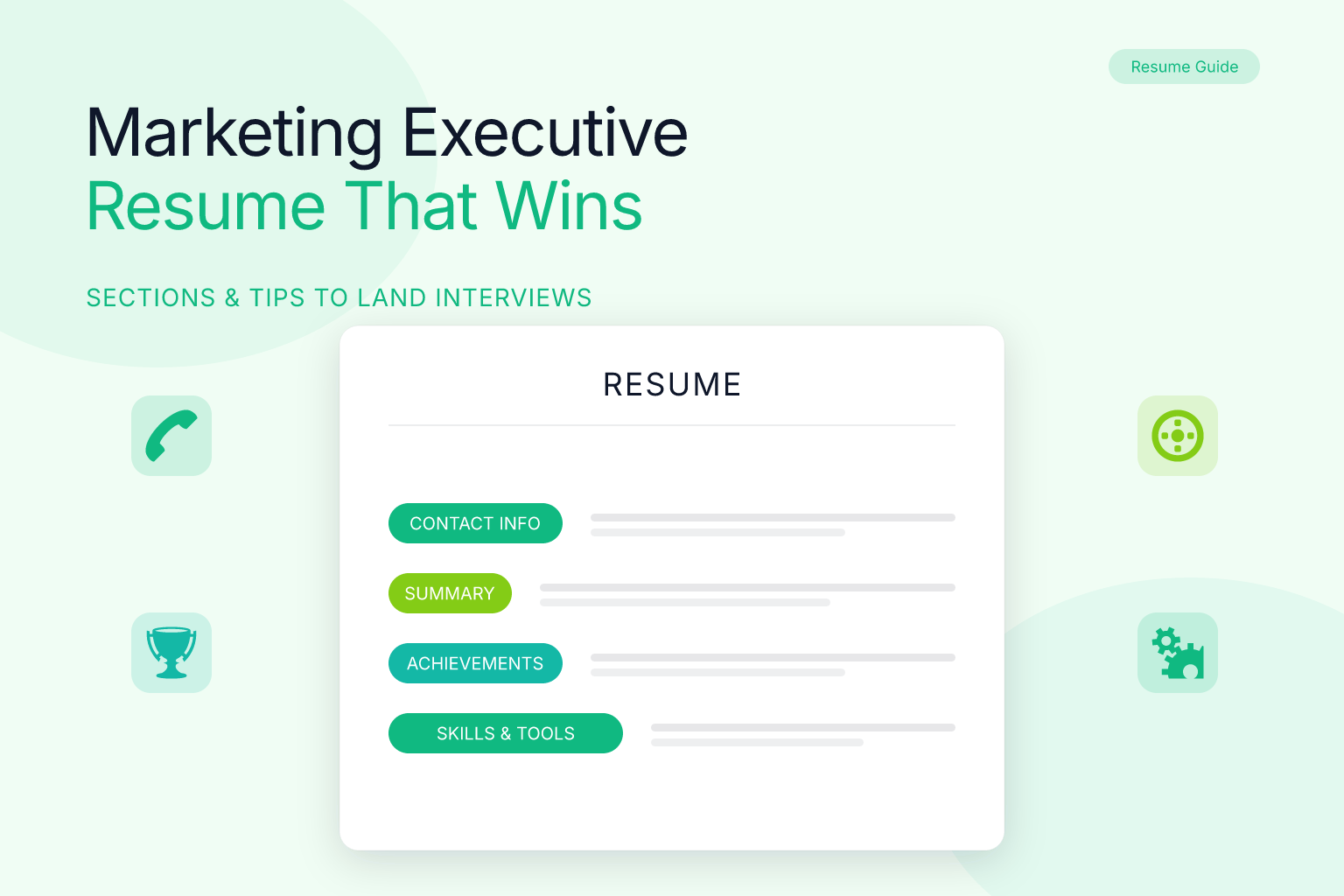
- Contact Information — Name, phone, email, LinkedIn URL, and optionally a portfolio or personal website.
- Executive Summary — 3–5 lines that capture your leadership brand, core strengths, and career-defining achievements.
- Core Competencies — A 12–15 keyword section tailored to the role, covering strategic, functional, and leadership skills.
- Professional Experience — Reverse-chronological, with 4–6 bullets per role. Lead with a one-line scope statement (team size, budget, mandate), then results-focused bullets.
- Education — Degree, institution, graduation year (optional if experienced). Include executive education or relevant certifications here.
- Board Memberships, Speaking Engagements, Publications — Optional but powerful for establishing thought leadership.
Avoid long paragraphs, functional formats, or “creative” layouts with graphics and columns that confuse ATS software. A single-column, text-based PDF is the safest choice for most applications. If a specific portal explicitly requests a Word document, provide that — but otherwise, a clean PDF exported from a tool like the ResumeMate AI Resume Builder will parse reliably in modern ATS platforms.
Writing a High-Impact Executive Summary
The executive summary is the most-read section of your resume. It must instantly communicate who you are, what you’ve achieved, and what you’ll bring to the next role. Avoid vague statements like “results-driven marketing leader seeking a challenging position.” Instead, write a tight, evidence-based paragraph that reads like a highlight reel.
Weak example:
Marketing executive with 15 years of experience in driving growth and leading teams. Proven track record of success in B2B and B2C environments.
Strong example:
Chief Marketing Officer with 15+ years scaling B2B SaaS companies from Series A to $100M+ ARR. Built marketing organizations of 40+ across demand generation, product marketing, and brand. Drove 3x pipeline growth while reducing CAC by 35% through account-based marketing and sales alignment. Board advisor and frequent speaker at SaaStr and INBOUND.
Notice the difference: the strong version names the industry, company stage, team size, specific metrics, and thought leadership activities. It gives the reader a clear picture of your operating range.
For more summary formulas across different roles, see our resume summary examples for 20+ roles.
Showcasing Strategic Leadership and Revenue Impact
This is where most marketing executive resumes fall short. They describe activities — “led a rebrand,” “managed the marketing budget” — without connecting those activities to business outcomes. To stand out, you need to quantify your impact in terms the CEO and board care about: revenue, market share, customer acquisition cost, lifetime value, and pipeline.
How to turn responsibilities into results:
| Responsibility | Result-Oriented Bullet |
|---|---|
| Managed demand generation | Built a demand generation engine that delivered $12M in pipeline and reduced cost per lead by 40% year-over-year |
| Oversaw brand strategy | Repositioned the brand from a commodity player to a premium solution, enabling a 22% price increase without volume loss |
| Led a team of marketers | Hired and developed a 25-person marketing team, improving employee retention from 70% to 92% over two years |
| Launched a content marketing program | Created a content and SEO strategy that grew organic traffic from 50K to 300K monthly visits and generated 60% of inbound leads |
Use the CAR method (Challenge – Action – Result) or STAR method to structure your bullets. Start with the result when possible — it grabs attention faster.
If you’re coming from a marketing manager background and need to frame your experience for an executive leap, our marketing manager resume guide shows how to present channel-specific results that ladder up to strategic impact.
Key Skills for a Marketing Executive Resume
Your core competencies section should be a scannable grid of 12–15 keywords that align with the job description. Split them into categories to show breadth:
Strategic & Leadership Skills
- Marketing Strategy & Planning
- P&L Management
- Board Presentations
- Organizational Design
- Change Management
- Cross-Functional Leadership
Functional Marketing Skills
- Demand Generation
- Account-Based Marketing (ABM)
- Product Marketing
- Brand Strategy & Positioning
- Digital Marketing & Analytics
- Customer Acquisition & Retention
Technical & Data Skills
- Salesforce, HubSpot, Marketo
- Google Analytics, Tableau, Looker
- SEO/SEM, Paid Media
- Marketing Automation
- CRM Implementation
Tailor this list for every application. If the job description emphasizes “revenue marketing” and “sales alignment,” make sure those exact phrases appear. This is critical for ATS keyword matching and for catching a recruiter’s eye during a 6-second scan. For a deeper dive into tailoring, read how to tailor a resume to a job description.
Formatting and Design for ATS and Human Readers
Executive resumes often fall into a design trap: candidates use multi-column layouts, graphics, charts, and fancy fonts to look “creative.” The problem? Many applicant tracking systems can’t parse those elements, causing your resume to be rejected before a human ever sees it.
Formatting rules for a marketing executive resume:
- Use a single-column layout as the safest choice. Modern ATS platforms (Workday, Greenhouse, Lever, iCIMS) parse clean, text-based PDFs reliably. Multi-column templates can work in some systems, but single-column eliminates risk.
- Export as a PDF unless the application specifically requests a Word document. The idea that PDFs are ATS-unfriendly is outdated — problems come from scanned or image-based PDFs, not text-based ones.
- Stick to standard fonts (Arial, Calibri, Helvetica, Garamond) at 10–12pt size.
- Avoid headers, footers, tables, and text boxes — ATS often misreads content inside them.
- Use bold and ALL CAPS sparingly for section headings, but never for entire sentences.
- Keep your resume to two pages maximum. If you have 20+ years of experience, two pages are acceptable; anything longer risks losing the reader.
After you’ve drafted your resume, run it through a score checker to see how it performs against ATS algorithms. The ResumeMate Score Checker gives you section-by-section feedback and flags formatting issues before you submit.
Marketing Executive Resume Example
Below is a full example of a marketing executive resume that balances strategy, metrics, and leadership. Use it as a template, but always customize it to your own experience and the target role.
JANE DOE
jane.doe@email.com | (555) 123-4567 | linkedin.com/in/janedoe | janedoemarketing.com
EXECUTIVE SUMMARY
VP of Marketing with 18 years driving growth for B2B technology companies from $10M to $200M+ in revenue. Built and led marketing teams of up to 50 across demand generation, product marketing, brand, and communications. Grew pipeline 4x and reduced customer acquisition cost by 45% through data-driven ABM and sales alignment. Board member of the American Marketing Association and frequent keynote speaker.
CORE COMPETENCIES
Marketing Strategy & Planning | Demand Generation | Account-Based Marketing | Product Marketing | Brand Positioning | P&L Management | Team Leadership & Development | Sales Alignment | Digital Marketing | Marketing Analytics | CRM & Marketing Automation | Board Presentations
PROFESSIONAL EXPERIENCE
VICE PRESIDENT OF MARKETING | TechGrowth Inc. | San Francisco, CA | 2018–Present
Led a 45-person marketing organization with a $15M annual budget for a B2B SaaS company scaling from $50M to $200M ARR.
- Developed and executed a go-to-market strategy that grew annual recurring revenue from $50M to $200M in four years.
- Built an ABM program targeting Fortune 500 accounts, generating $80M in pipeline and a 35% win rate.
- Reduced customer acquisition cost by 45% through marketing automation, lead scoring, and tighter sales handoff processes.
- Repositioned the company from a point solution to a platform, increasing average contract value by 60%.
- Hired and mentored 5 director-level leaders, creating a succession pipeline that filled 3 VP roles internally.
SENIOR DIRECTOR OF MARKETING | CloudSolutions Co. | Austin, TX | 2014–2018
Managed a 20-person team and $8M budget for a cloud infrastructure provider.
- Launched a demand generation engine that delivered 150,000 marketing-qualified leads and $45M in pipeline annually.
- Led a brand refresh that increased unaided awareness from 12% to 34% in the target market within 18 months.
- Implemented Marketo and Salesforce integration, improving lead-to-opportunity conversion by 25%.
EDUCATION
MBA, Marketing | University of Texas at Austin B.A., Communications | University of California, Los Angeles
BOARD & SPEAKING
Board Member, American Marketing Association (2020–Present) Keynote Speaker, SaaStr Annual, INBOUND, MarketingProfs B2B Forum
This example uses a clean, single-column format that will pass through any modern ATS without issues. You can build a similar resume in minutes using the ResumeMate AI Resume Builder — it’s free and exports a perfectly formatted PDF.
Common Mistakes to Avoid
Even experienced executives make resume mistakes that cost them interviews. Here are the most frequent ones and how to fix them:
- Writing a job description, not a performance record. If your bullets could be copied from a job posting, they’re too generic. Every line should answer “What did I achieve?” not “What was I responsible for?”
- Burying the lead. Your biggest wins — the $50M revenue increase, the 3x pipeline growth — should appear in the first bullet of your most recent role, not on page two.
- Using an objective statement. “Seeking a challenging executive marketing role” wastes prime real estate. Replace it with the executive summary format shown above.
- Ignoring ATS keywords. If the job description mentions “revenue marketing,” “PLG,” or “demand waterfall,” and your resume doesn’t, you may be filtered out before a human reads it.
- Including outdated or irrelevant experience. For executive roles, the last 10–15 years matter most. Early-career roles can be summarized in one line or omitted entirely.
- Skipping the LinkedIn alignment. Recruiters will check your LinkedIn profile. Make sure your resume and LinkedIn tell the same story — same metrics, same titles, same dates.
How to Tailor Your Resume for Different Executive Roles
A CMO role at a Series B startup looks very different from a VP of Marketing at a Fortune 500 company. Your resume must reflect the specific context the employer cares about.
- For startup/scale-up roles: Emphasize agility, building from scratch, wearing multiple hats, and driving rapid growth with limited resources. Highlight any experience with product-led growth, viral marketing, or fundraising support.
- For enterprise roles: Focus on scale, process, team development, and cross-functional leadership. Show how you managed large budgets, navigated complex organizations, and drove incremental growth in mature markets.
- For industry-specific roles (e.g., healthcare, fintech): Include relevant regulatory knowledge, industry-specific channels, and compliance experience. Use the industry’s terminology.
Before you apply, create a master resume with all your achievements, then cut and tailor it for each role. The ResumeMate AI Resume Builder lets you save multiple versions, so you can maintain tailored resumes for different target roles without starting from scratch each time.
Frequently Asked Questions
Q: How long should a marketing executive resume be?
A: Two pages is the standard for executive-level roles. If you have less than 15 years of experience, one page may suffice, but most marketing executives with 15+ years will need two pages to adequately cover leadership scope, key achievements, and board or speaking engagements. Never exceed two pages.
Q: Should I include a photo on my marketing executive resume?
A: No. In the U.S. and many other countries, including a photo can introduce unconscious bias and may cause your resume to be rejected by ATS or recruiters trying to comply with anti-discrimination policies. Let your achievements speak for themselves.
Q: What’s the best format for a marketing executive resume — PDF or Word?
A: A clean, text-based PDF is the best format for most applications. Modern ATS platforms parse PDFs reliably. Only submit a Word document if the application portal explicitly requests it. Avoid scanned or image-based PDFs, as those are unreadable by ATS.
Q: How do I show career progression on a marketing executive resume?
A: List roles in reverse-chronological order under the same company header if you were promoted internally. For example:
VICE PRESIDENT OF MARKETING (2019–Present) DIRECTOR OF MARKETING (2016–2019) Company Name
This makes your growth trajectory immediately visible.
Q: What if I don’t have exact revenue numbers to share?
A: Use directional metrics or percentages if you can’t share confidential figures. For example, “Grew pipeline by 200%+” or “Reduced CAC by approximately 40%.” If you truly have no numbers, describe the scope and scale qualitatively: “Led marketing for a $50M business unit” or “Managed a team of 30 across four countries.”
Q: Should I include a “Career Objective” on my marketing executive resume?
A: No. Replace it with an executive summary that highlights your leadership brand and key achievements. An objective statement focuses on what you want; a summary focuses on what you offer — and that’s what hiring executives care about.
Q: How do I handle a career gap on an executive resume?
A: If the gap is less than a year, you can simply use years (e.g., 2018–2020) without months, which often conceals short gaps. For longer gaps, include a brief line explaining what you did — consulting, board service, sabbatical, or caregiving — framed as a deliberate choice. Honesty and confidence are key.
Related articles:
Track Every Application While You Job Hunt
Stop losing track of where you’ve applied. The ResumeMate Job Tracker is a free Chrome extension that tracks every application, deadline, and follow-up in one place — right from your browser.