Master the STAR Method for Behavioral Interview Questions
The STAR interview method is a proven framework for answering behavioral interview questions—the kind that ask you to describe a past situation and how you handled it. Instead of rambling or giving vague answers, STAR helps you deliver a clear, evidence-based story that shows hiring managers exactly how you perform under pressure. Whether you’re preparing for a first-round screening or a final panel interview, mastering STAR can turn a nerve-wracking question into a confident, memorable response.
| What to Do | Why It Matters | Time |
|---|---|---|
| Understand the STAR acronym (Situation, Task, Action, Result) | Gives you a repeatable structure that interviewers recognize and trust | 5 minutes |
| Prepare 5–7 STAR stories covering common competencies (teamwork, problem-solving, leadership) | Ensures you have relevant examples ready for any behavioral question | 2–3 hours |
| Practice delivering your stories out loud with a timer | Builds fluency and keeps answers concise (under 2 minutes) | 1 hour |
| Tailor each story to the job description’s key skills | Shows the interviewer you’ve done your homework and can meet their specific needs | 30 minutes per application |
What Is the STAR Interview Method and Why It Matters
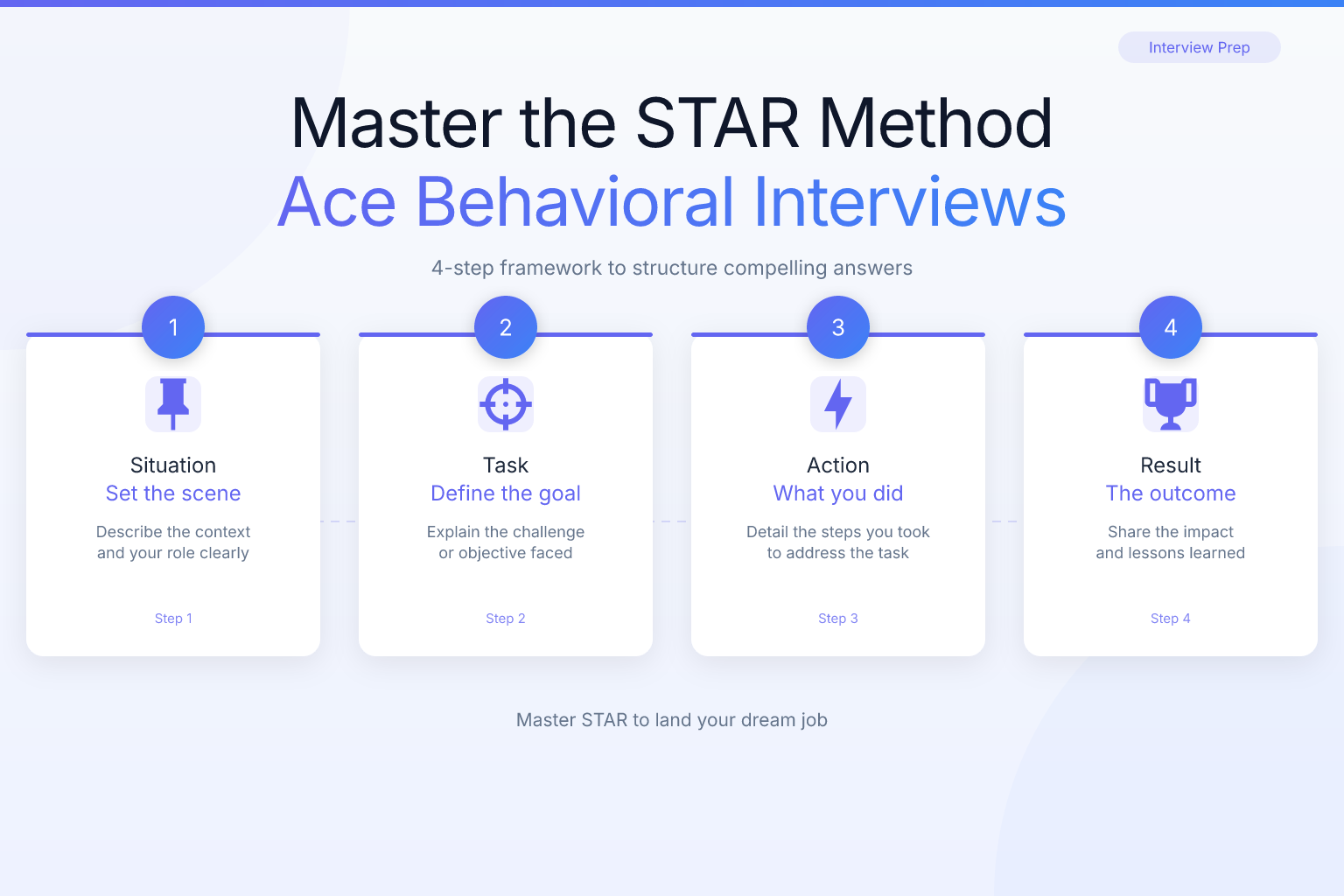
STAR stands for Situation, Task, Action, Result. It was developed by organizational psychologists at Development Dimensions International (DDI) in the 1970s as a structured way to evaluate past behavior—based on the principle that past behavior is the best predictor of future performance. Today, most Fortune 500 companies and many mid-sized organizations use behavioral interviewing, often explicitly expecting candidates to answer in a STAR-like format.
When you use STAR, you give the interviewer exactly what they’re trained to listen for: a specific context, your role, the steps you took, and the measurable outcome. This makes your answer easy to follow, credible, and memorable. Without a framework, candidates often drift into generalities or tell stories that lack a clear point. STAR forces you to be concrete, which is exactly what hiring managers need to compare you fairly against other applicants.
Why Employers Use the STAR Method
Behavioral interviewing reduces bias and focuses on evidence, not gut feelings. Employers want to see how you actually handled situations, not how you think you would handle them. The STAR method gives them a consistent scoring rubric: they can evaluate each candidate’s Situation clarity, Task ownership, Action logic, and Result impact.
Many recruiters and hiring managers are trained to probe for missing STAR elements. If you describe a challenge but never mention the outcome, they’ll ask, “And what was the result?” If you talk about what the team did without specifying your role, they’ll ask, “What exactly did you do?” Coming prepared with complete STAR stories shows you respect their time and understand how hiring decisions are made. It also prevents you from being caught off guard when they dig for details.
For example, imagine a hiring manager evaluating two candidates for a project manager role. One says, “We launched the product on time.” The other says, “I coordinated a team of six, resolved a vendor delay by sourcing an alternative supplier, and delivered the project two weeks early, saving $15,000.” The STAR-structured answer immediately shows leadership, problem-solving, and measurable impact. The manager can score each element: clear Situation, owned Task, specific Actions, quantified Result. Without STAR, the first candidate’s contribution is invisible.
How to Structure Your STAR Answer (Situation, Task, Action, Result)
Each part of STAR plays a specific role. Here’s how to build a tight, compelling answer:
- Situation: Set the scene briefly. Give just enough context—who, what, where, when—so the listener understands the challenge. Avoid unnecessary backstory. Example: “In my last role as a customer success manager, a key account threatened to churn after a billing error.”
- Task: Describe your specific responsibility or goal. What was expected of you? Use “I” not “we” to own your role. Example: “I needed to rebuild trust, correct the error, and retain the account.”
- Action: This is the most important part. Detail the steps you took, focusing on your individual contributions. Use active verbs: “I analyzed,” “I proposed,” “I led.” Explain your reasoning if it shows critical thinking. Example: “I immediately called the client to apologize, investigated the root cause with finance, and proposed a credit plus a process change to prevent recurrence. I then set up a weekly check-in for the next month.”
- Result: Share the outcome, ideally quantified. “The client not only stayed but expanded their contract by 20% the following quarter. Our billing error rate dropped to zero for six months.” If the result wasn’t purely positive, share what you learned and how you applied it later—that still counts as a strong Result.
Full example for “Tell me about a time you resolved a conflict within your team”:
- Situation: “As a project coordinator, two senior developers disagreed on the tech stack for a client project, delaying the kickoff.”
- Task: “I needed to facilitate a decision without damaging team morale or the timeline.”
- Action: “I scheduled a meeting where each could present pros and cons with data. I then summarized the trade-offs and proposed a hybrid approach that used the best of both. I also checked in individually afterward to ensure buy-in.”
- Result: “The team agreed on the hybrid approach within two days. We launched on time, and the client later praised the solution’s flexibility. The developers thanked me for mediating fairly.”
Notice how the Action section is the longest and most detailed. That’s where you prove your skills.
How to Prepare STAR Stories Before the Interview
Walking into an interview without prepared stories is a gamble. Here’s a step-by-step process to build a reliable story bank:
- Extract competencies from the job description. Look for phrases like “strong collaborator,” “ability to prioritize,” “data-driven decision maker.” List 5–7 key competencies.
- Brainstorm a specific example for each competency. Pull from work, internships, school projects, or volunteer roles. The example doesn’t need to be dramatic—a small, well-handled situation often works better than a grandiose one.
- Write bullet points for each STAR element. Don’t script word-for-word; you’ll sound robotic. Bullet points keep you on track while allowing natural delivery.
- Practice out loud with a timer. Aim for 1.5–2 minutes per story. Record yourself on your phone to catch filler words (“um,” “like”) and rambling. If you want to simulate real interview pressure, use AI tools to generate follow-up questions—our guide on ChatGPT interview prompts shows you how to turn AI into a mock interviewer.
- Create a story matrix. Map each story to multiple possible questions. For instance, a story about leading a project can answer “Tell me about a leadership experience,” “Describe a time you managed a tight deadline,” or “Give an example of influencing others.” This flexibility prevents panic when a question comes from an unexpected angle.
- Tailor your stories to the company’s values. Research the organization’s mission and culture. If they emphasize innovation, choose a story where you introduced a new idea. If they value customer obsession, pick an example of going above and beyond for a client. This small tweak makes your answer feel custom-built for the role.
If you’re also preparing for the classic opener, our guide on how to answer “Tell me about yourself” walks you through a complementary framework that pairs well with STAR.
STAR Method Examples for Common Behavioral Questions
Here are three full STAR answers for questions you’re likely to face:
“Give me an example of a time you went above and beyond for a customer.”
- Situation: “A long-time client emailed us frustrated after receiving a shipment with incorrect labeling, right before their big product launch.”
- Task: “I had to fix the error immediately and make sure they felt valued, not just corrected.”
- Action: “I drove to our warehouse that evening, personally relabeled the boxes, and delivered them to the client’s office by 7 a.m. the next day. I also created a checklist for future shipments to catch labeling issues before they left.”
- Result: “The client’s launch went smoothly. They sent a thank-you note to our CEO and increased their annual order by 30%. The checklist reduced labeling errors by 90% across all accounts.”
“Describe a time you had to learn something new quickly.”
- Situation: “Our company adopted a new CRM system with only two weeks before go-live, and I was responsible for training my team of five.”
- Task: “I had to learn the system myself and then get the team proficient fast enough to avoid service disruptions.”
- Action: “I spent the first weekend doing every tutorial and building a sandbox workflow. I then created a one-page quick-reference guide with screenshots and ran two hands-on workshops. I also set up a Slack channel for real-time questions during the first week.”
- Result: “The team transitioned with zero missed tickets. Our average response time actually improved by 12% in the first month because the new system was more efficient.”
“Tell me about a time you failed.”
- Situation: “I underestimated the time needed for a data migration project and missed the original deadline by two days.”
- Task: “I had to own the mistake, communicate transparently, and deliver as quickly as possible without sacrificing accuracy.”
- Action: “I immediately informed the stakeholders, explained the root cause (poor scoping), and presented a revised timeline. I then re-prioritized my week, worked extra hours, and enlisted a colleague to QA the migration.”
- Result: “We delivered two days late, but the data was clean. The client appreciated the honesty and actually extended our contract. More importantly, I implemented a new estimation checklist that improved my project timeline accuracy by about 30% going forward.”
“Give an example of a time you showed leadership.”
- Situation: “During a product launch, the marketing and engineering teams were misaligned on the go-to-market timeline, causing last-minute confusion.”
- Task: “As the project lead, I needed to get both teams on the same page and keep the launch on track.”
- Action: “I organized a cross-functional stand-up, created a shared timeline in Asana, and assigned clear owners for each deliverable. I also set up a 15-minute daily sync for the final week to surface blockers instantly.”
- Result: “We launched on the original date with zero critical bugs. The process was so effective that the VP of Product adopted it for all future launches, and I was asked to lead the next two product releases.”
If you’re worried about explaining an employment gap, our guide on explaining employment gaps in interviews provides sample answers that can be structured with STAR to turn a potential red flag into a story of growth.
Common STAR Method Mistakes to Avoid
Even well-prepared candidates can undermine their answers with these missteps:
- Rambling Situation: Giving too much background. Fix: Limit the Situation to two sentences. If the interviewer wants more, they’ll ask.
- Skipping the Task: Jumping straight from Situation to Action without clarifying your responsibility. Fix: Always state what you were supposed to achieve.
- Using “we” instead of “I”: Interviewers need to assess your contribution. Fix: Even if it was a team effort, isolate your specific actions. “I proposed the new workflow, and the team adopted it” is fine.
- No measurable Result: Ending with “and it worked out well.” Fix: Attach a number, percentage, or concrete outcome whenever possible. If you truly can’t quantify, describe observable impact: “My manager cited this as a best practice in the department meeting.”
- Choosing a trivial or overly negative example: “I once fixed a typo” doesn’t demonstrate competence; a story where you caused a major loss without a redemption arc can raise red flags. Fix: Pick examples with moderate stakes and a clear learning or success arc.
- Memorizing a script: Sounding rehearsed kills authenticity. Fix: Use bullet points and practice enough that the story feels conversational.
- Not tailoring to the question: Using the same generic story regardless of what’s asked. Fix: Listen for the competency behind the question and select the story that best matches.
- Ignoring the company’s values: A technically perfect STAR answer can fall flat if it doesn’t align with what the employer cares about. Fix: Before the interview, identify the organization’s core values (innovation, customer focus, collaboration) and subtly highlight those themes in your Action and Result.
- Skipping practice out loud: Reading your bullet points silently isn’t enough. Fix: Practice speaking your stories until they flow naturally. Record yourself and listen for clarity, pace, and filler words.
How to Adapt STAR for Different Interview Formats
The core STAR structure stays the same, but delivery adjustments matter:
- Video interviews: Position your camera at eye level, look into the lens (not the screen) when speaking, and keep notes as bullet points taped near the camera—not visible on screen. A slight pause before answering feels natural on video and gives you a moment to mentally select your story.
- Panel interviews: Address the person who asked the question first, then make eye contact with each panelist as you move through your answer. This includes everyone and shows confidence.
- Phone screens: Without visual cues, your vocal energy carries the entire impression. Speak slightly more animatedly than usual, and pause after the Result to let the interviewer ask follow-ups. Have your story matrix printed in front of you.
- Case or technical interviews: STAR can still apply if the question is behavioral (“Tell me about a time you debugged a complex issue”). For purely technical problems, use a problem-solving framework instead, but keep the habit of structuring your thinking aloud.
STAR vs. Other Interview Models (CAR, PAR, and More)
While STAR is the most widely recognized behavioral interview framework, you may encounter variations like CAR (Challenge, Action, Result) or PAR (Problem, Action, Result). These models are similar but often omit the explicit “Task” step, which can blur the line between the situation and your specific responsibility. STAR’s strength is that it forces you to separate the context (Situation) from your personal accountability (Task), making it easier for interviewers to evaluate your individual contribution.
Some companies also use the SOAR model (Situation, Obstacle, Action, Result) or the SHARE model (Situation, Hindrance, Action, Result, Evaluation). All of these are essentially variations on the same theme: tell a structured story with a clear outcome. If you’ve mastered STAR, you can adapt to any of these by simply adjusting the labels. The key is to always include a concrete example, your specific actions, and a measurable result—regardless of the acronym.
Using STAR on Your Resume (and Beyond)
The same STAR thinking that powers your interview answers can transform your resume bullet points. Instead of listing duties, you can frame achievements as mini STAR statements: Situation/Task implied, Action and Result explicit. For example, “Led a cross-functional team of 4 to redesign the onboarding flow, cutting new-hire ramp time by 40%.” That’s a resume-ready STAR snippet.
For instance, a customer service rep might write: “Resolved 95% of escalated complaints within 24 hours by implementing a new triage system, boosting customer retention by 15%.” This shows Action and Result clearly. You can also use STAR in your LinkedIn summary or cover letter to highlight key achievements. For example, your LinkedIn About section could say: “As a sales lead, I turned around an underperforming territory by redesigning the outreach strategy, resulting in a 30% revenue increase in six months.” This gives recruiters a quick, evidence-based snapshot of your capabilities.
To turn your own STAR stories into powerful resume bullets, start by writing out the full STAR for each achievement, then condense it to one line that captures the Action and Result. If you’re building a new resume from scratch, our free AI resume builder can help you structure these achievement bullets in a clean, ATS-friendly format that highlights your impact. For cover letters, our cover letter templates by role show you exactly how to weave STAR stories into a compelling narrative that complements your resume.
We’ve written a dedicated guide on turning resume duties into impact using STAR that shows you exactly how to rewrite every bullet for maximum effect. And after the interview, a well-crafted thank-you email can reinforce your strongest STAR story—our thank-you email templates include examples that subtly reference a key moment from the conversation.
FAQ
Q: What does STAR stand for in interviews?
A: STAR stands for Situation, Task, Action, Result. It’s a four-part framework for structuring answers to behavioral interview questions so you tell a clear, evidence-based story about a past experience.
Q: Why is the STAR method important?
A: The STAR method is important because it forces you to be specific and results-oriented, which is exactly what hiring managers need to evaluate your skills fairly. Without it, answers often become vague or rambling, making it hard for interviewers to compare candidates.
Q: How do I use the STAR method in an interview?
A: When asked a behavioral question, quickly choose a relevant example from your prepared story bank. Then walk through the Situation (brief context), Task (your responsibility), Action (the steps you personally took), and Result (the measurable outcome). Keep the whole answer under two minutes.
Q: Why do employers use the STAR method?
A: Employers use behavioral interviewing—and often explicitly expect STAR-formatted answers—because past behavior is a strong predictor of future performance. STAR gives them a consistent way to score candidates on real examples rather than hypotheticals or first impressions.
Q: When was the STAR interview method created?
A: The STAR method was developed in the 1970s by organizational psychologists at Development Dimensions International (DDI) as part of a structured behavioral interviewing system. It has since become a standard tool in hiring across industries.
Q: Can I use the STAR method for non-behavioral questions?
A: STAR is designed for behavioral questions that ask about past experiences. For hypothetical or technical questions, you can still use a structured approach, but STAR’s specific elements may not fit. However, the habit of giving concrete examples with clear outcomes is valuable in almost any interview response.
Q: How long should a STAR answer be?
A: Aim for 1.5 to 2 minutes. The Situation and Task should be quick (20–30 seconds combined), the Action should take about a minute, and the Result 20–30 seconds. If the interviewer wants more detail, they’ll ask follow-up questions.
Q: What if I don’t have a measurable result for my STAR story?
A: Not every result comes with a number. If you can’t quantify, describe a concrete, observable outcome: positive feedback from a stakeholder, adoption of your process by the team, or a lesson that improved your later work. The key is to show that your action led to something meaningful.
Q: What are some STAR format examples?
A: A classic STAR format example: Situation – “Our team missed a critical deadline due to miscommunication.” Task – “I needed to get the project back on track and prevent future delays.” Action – “I implemented a daily stand-up and a shared task board, and I personally followed up on blockers.” Result – “We delivered the next three projects on time, and the team’s productivity rose by 20%.” For more examples, see the full section above.
Q: How can I use the STAR method on my resume?
A: Condense your STAR stories into one-line bullet points that highlight Action and Result. For example, “Redesigned the onboarding process, cutting new-hire ramp time by 40%.” This shows impact without the full narrative. For a step-by-step guide, check out our article on turning resume duties into impact using STAR.
Q: What is a behavioural interview? (UK spelling)
A: A behavioural interview (or behavioral interview) is a structured interview technique where candidates are asked to provide specific examples of past behavior. The STAR method is the most common framework for answering these questions. The spelling difference (behavioural vs. behavioral) is simply regional; the concept and approach are identical.
Q: How is the STAR method different from other interview models like CAR or PAR?
A: CAR (Challenge, Action, Result) and PAR (Problem, Action, Result) are similar but often skip the explicit “Task” step. STAR’s separation of Situation and Task clarifies your specific responsibility, making it easier for interviewers to assess your individual contribution. All models work, but STAR is the most widely recognized and gives you the most complete structure.
Related articles:
- Case Interview Prep Guide: Master the Process
- Interview Questions & Best Answers: Prep & Respond in 2025
Track Every Application While You Job Hunt
Stop losing track of where you’ve applied. The ResumeMate Job Tracker is a free Chrome extension that tracks every application, deadline, and follow-up in one place — right from your browser.