Military-to-Civilian Resume (Translate MOS to Skills)
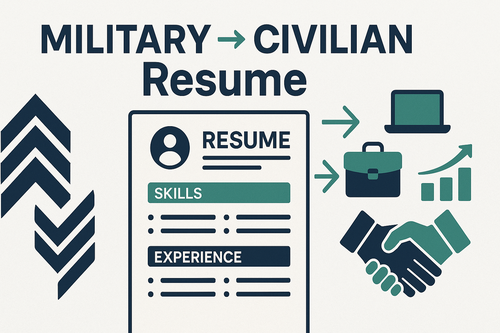
A military-to-civilian resume focuses on translating Military Occupational Specialty (MOS) roles into civilian job skills and experiences. In 2025, the key to success lies in creating an ATS-optimized, skills-driven resume that bridges military experience with industry expectations and highlights your readiness for civilian employment.
| What to Include (At a Glance) |
|---|
| Translate MOS titles into civilian-friendly roles |
| Highlight transferable skills and leadership |
| Reframe military projects and commendations |
| Address career gaps or transitions positively |
The Challenge (Recruiter Perspective)
Recruiters may have difficulty interpreting military jargon and assessing the applicability of military experience because:
- MOS titles and duties are unfamiliar
- Military language does not align with ATS keywords
- Concerns about adapting to civilian workplace culture
- Difficulty verifying non-traditional experience
Clear translation of military terms and emphasizing transferable skills reduces these barriers. In fact, a 2024 survey by the Society for Human Resource Management found that 68% of HR professionals admit they struggle to understand military resumes, often passing over qualified veterans simply because they can’t decode the terminology. That’s why your resume must do the translation work for them—before a human ever sees it, the ATS must also recognize your skills.
Choose the Right Format to De-Emphasize Gaps
- The combination resume is most effective, presenting a strong skills summary upfront followed by military and civilian work history.
- Group military experience by skill themes or leadership roles rather than only chronologically.
- Include sections for training, certifications, and volunteer/community involvement.
A combination format lets you lead with what you can do rather than when you did it. This is especially valuable if you have deployment gaps or a non-linear career path. Avoid a purely functional resume—many recruiters and ATS systems view it as a red flag because it hides dates and employers. Instead, use a hybrid approach: a skills summary at the top, followed by a reverse-chronological work history that includes both military and civilian roles, with clear dates.
Reframe Experience (Skills, Projects, Volunteering)
- Convert MOS-specific tasks into universally understood skills (e.g., leadership, logistics, problem-solving).
- Quantify achievements: numbers, scope, budgets, teams led.
- Include volunteer or veteran network activities to show engagement and continuous growth.
Start by listing every duty you performed in the military, then ask: “What civilian job would need this same skill?” For example, “conducted pre-combat inspections” becomes “performed quality assurance checks on equipment and processes.” Use action verbs like managed, coordinated, analyzed, developed, led, implemented. If you’re unsure whether your translated skills are landing, run your resume through a free resume score checker to see how an ATS interprets your content. You can also add verified skills to your LinkedIn profile to reinforce the same language across platforms.
Language Examples You Can Adapt
- MOS: “Infantry Squad Leader” → Civilian: “Team Leader, coordinating and training teams in high-pressure environments.”
- MOS: “Supply Chain Specialist” → Civilian: “Managed logistical operations including inventory, distribution, and vendor relations.”
- Emphasize soft skills like adaptability, discipline, and communication critical to civilian roles.
Here are a few more translations to model:
- MOS: “Combat Medic (68W)” → Civilian: “Emergency Medical Technician / Clinical Support Specialist, providing patient care and triage in fast-paced environments.”
- MOS: “Intelligence Analyst (35F)” → Civilian: “Data Analyst, interpreting complex information and delivering actionable reports to stakeholders.”
- MOS: “Communications Specialist (25S)” → Civilian: “Network Operations Coordinator, maintaining secure communication systems and troubleshooting connectivity issues.”
When in doubt, pull up 5–10 job descriptions for your target civilian role and mirror the exact phrases they use. That’s the language the ATS is scanning for.
How to Explain Gaps in Applications
- Briefly acknowledge career transitions or deployments in your summary or cover letter.
- Focus on skills and experiences gained during gaps (training, education, leadership).
- Maintain a confident, forward-looking tone.
For example, instead of leaving a two-year gap unexplained, write in your summary: “Transitioned from active duty to civilian workforce after completing advanced leadership training and a project management certification.” This reframes the gap as a period of growth. Never apologize for your service—frame it as an asset.
ATS Considerations
- Use civilian job titles and keywords relevant to your target industry.
- Avoid military acronyms or jargon without civilian equivalents.
- Use clear headings and bullet points for readability.
- Submit as ATS-friendly DOCX or PDF files.
Modern ATS platforms (Workday, Greenhouse, Lever, iCIMS) parse clean, text-based PDFs reliably. The problems arise from scanned/image PDFs, tables, and graphics—not from the PDF format itself. If a specific job portal explicitly requests a DOCX, use that; otherwise, a well-formatted PDF from a tool like ResumeMate’s free resume builder is perfectly safe. For a deeper dive into what actually trips up ATS systems, read our guide on ATS myths vs. facts in 2026.
Templates & Checklist
| Military-to-Civilian Resume Checklist |
|---|
| Civilian-friendly job titles replacing MOS codes |
| Detailed skills summary highlighting leadership & soft skills |
| Quantifiable achievements & project descriptions |
| Relevant certifications, training, and volunteer work included |
| ATS-compatible layout with relevant keywords |
| No unexplained military acronyms or jargon |
| Tailored to the specific job description |
| Contact information with a professional email address |
Use a clean, single-column template for maximum ATS compatibility. Most ResumeMate templates are single-column and designed to pass ATS scans while still looking professional.
Copy-Ready Example (Combination Format)
Skills Summary
- Team Leadership & Training
- Logistics & Supply Chain Management
- Project Coordination & Execution
- Risk Assessment & Problem Solving
Military Experience
Team Leader (Infantry Squad Leader) | U.S. Army | 2015–2022
- Led a team of 12 soldiers, conducting operations under high-pressure conditions.
- Developed training programs improving team readiness by 40%.
- Managed logistics planning, equipment maintenance, and resource allocation.
Volunteer & Training
- Participated in veteran mentorship programs supporting workforce reintegration.
- Completed Project Management Professional (PMP) certification in 2024.
This example works because it leads with skills, uses a civilian job title, and quantifies impact. Adapt it to your own MOS by swapping in your specific achievements and certifications.
MOS Translation Guide: Common Examples
One of the most practical steps in building a military-to-civilian resume is converting your MOS title and duties into language civilian employers understand. Below are expanded examples across several common MOS codes.
| MOS / Role | Civilian Equivalent | Transferable Skills to Highlight |
|---|---|---|
| Infantry Squad Leader (11B) | Operations Supervisor / Team Lead | Team leadership, tactical planning, performance under pressure |
| Army Medic (68W) | Emergency Medical Technician / Clinical Support | Patient care, triage, medical documentation, emergency response |
| Intelligence Analyst (35F) | Data Analyst / Research Analyst | Data interpretation, report writing, risk assessment, briefing stakeholders |
| Logistics Specialist (92A) | Supply Chain Coordinator / Operations Analyst | Inventory management, vendor coordination, process optimization |
| IT Specialist (25B) | Systems Administrator / Network Technician | Network maintenance, hardware/software support, cybersecurity basics |
| Combat Engineer (12B) | Project Engineer / Construction Supervisor | Site planning, safety compliance, equipment operations, team coordination |
| Public Affairs Specialist (46Q) | Communications Specialist / Content Writer | Media relations, written communications, storytelling, brand messaging |
| Military Police (31B) | Security Supervisor / Loss Prevention Specialist | Incident response, access control, investigation, report writing |
| Human Resources Specialist (42A) | HR Coordinator / Recruiting Assistant | Personnel records, onboarding, benefits administration, compliance |
| Aviation Operations Specialist (15P) | Flight Coordinator / Logistics Scheduler | Flight planning, resource allocation, regulatory compliance, communication |
Use this kind of translation throughout your resume — not just in the job title but in every bullet point under your military experience.
If you’re unsure where to start, free online tools like O*NET OnLine, the Military.com MOS Translator, or the Department of Labor’s Veterans’ Employment and Training Service (VETS) can help you map your MOS to civilian occupations. But remember: these tools give you a starting point, not a finished resume. You still need to tailor the language to each specific job posting.
How to Quantify Military Achievements for a Civilian Audience
Civilian employers respond strongly to numbers. Military experience is full of measurable accomplishments that veterans often understate. Here is how to extract and present them effectively.
- Team size: “Led a team of 12 soldiers” becomes meaningful to a civilian manager who needs to assess your leadership scale.
- Budgets: “Managed a maintenance budget of $500k” signals financial accountability and resource management.
- Training outcomes: “Developed training program that improved unit readiness scores by 40%” maps directly to corporate learning and development language.
- Project timelines: “Coordinated deployment logistics for 200 personnel within a 72-hour window” demonstrates project management under extreme constraints.
- Awards and commendations: Translate these into outcomes. Instead of listing “Army Commendation Medal,” write “Awarded Army Commendation Medal for designing a new maintenance protocol that reduced equipment failure rates by 25%.”
The civilian world values evidence of impact, not just titles or ranks. Every bullet point on your resume should answer the question: “So what?”
A simple formula: Action verb + what you did + scope/scale + result. For example: “Supervised maintenance operations for a fleet of 30 vehicles, reducing downtime by 15% over 12 months.”
Common Mistakes Veterans Make on Civilian Resumes
- Using military acronyms without explanation: MOS codes, military abbreviations, and rank titles mean nothing to most civilian recruiters. Spell out every term and provide context.
- Underselling accomplishments: Military culture tends toward humility and team credit. On a civilian resume, you need to claim your individual contributions clearly. Use “I led,” “I managed,” and “I developed” rather than attributing everything to the unit.
- Listing duties instead of accomplishments: “Responsible for maintaining vehicles” is a duty. “Maintained a fleet of 15 vehicles with zero operational failures over 18 months” is an accomplishment. The second version is what gets interviews.
- Forgetting civilian education and certifications: If you completed any college coursework, earned industry certifications (CompTIA, PMP, Six Sigma), or attended professional development programs during or after service, include all of them.
- One-size-fits-all resume: Just like any job seeker, veterans need to tailor each resume submission. Different industries value different aspects of military experience. A cybersecurity firm cares about different things than a logistics company.
- Using a military email address: An email like
sgt.smith@army.milcan confuse civilian recruiters. Create a professional Gmail or Outlook address for job applications. - Including security clearance details improperly: While a clearance can be a huge asset, don’t list classified specifics. Simply state “Active Secret Clearance” or “Eligible for Top Secret Clearance” if relevant to the role.
FAQ
Q: How do I translate my MOS to civilian jobs?
A: Use online MOS translation tools such as O*NET OnLine or the Department of Defense’s SkillMil platform, and focus on transferable skills and accomplishments rather than job titles alone. Map your specific duties and achievements to civilian equivalents.
Q: Should I list ranks or military awards?
A: Include your highest rank briefly in the job title or experience section. Translate awards into outcome-focused language — explain what you did to earn the recognition rather than listing award names that civilian recruiters may not recognize.
Q: How long should my resume be?
A: Typically one to two pages focusing on relevant civilian skills. Veterans with 20+ years of service may need two pages, but prioritize quality over quantity. Older or less relevant positions can be summarized in one or two lines.
Q: Do I need to explain military terms?
A: Always provide civilian-friendly explanations or equivalents. Assume the person reading your resume has zero familiarity with military structure, ranks, or terminology.
Q: Should I mention my deployment history?
A: You can reference deployments briefly as context for your experience, but focus on the skills and accomplishments gained rather than the locations or operations themselves. Avoid classified details.
Q: Is a military transition resume the same as a federal resume?
A: No. Federal resumes (used for USAJobs.gov applications) are intentionally longer and more detailed, sometimes running five or more pages. A civilian industry resume should be one to two pages and much more concise. Use the right format for the right application type.
Q: What is a 12B in civilian terms?
A: A 12B (Combat Engineer) translates well to roles like Project Engineer, Construction Supervisor, or Site Safety Coordinator. Highlight skills in site planning, safety compliance, equipment operations, and team coordination.
Q: How do I translate my military title to a civilian job title?
A: Start by identifying the core function of your MOS (e.g., leadership, logistics, IT, healthcare). Then search for civilian job titles that match that function. Use job boards like ResumeMate’s job board to see what titles employers actually use, and mirror that language on your resume.
Q: What is the best military to civilian resume translator?
A: There’s no single “best” tool, but free options like O*NET OnLine, Military.com’s translator, and the VA’s CareerScope are solid starting points. However, the most effective translation comes from studying real job descriptions in your target field and rewriting your experience to match their keywords.
Q: How do I convert my MOS to a civilian job description?
A: Break down your MOS duties into individual tasks, then ask what civilian role performs similar tasks. For example, “maintained radio equipment” becomes “performed hardware troubleshooting and preventive maintenance on communication systems.” Use action verbs and quantify results.
Q: What civilian jobs can I get with my MOS?
A: Almost any MOS has civilian equivalents. For example, 11B (Infantry) → operations supervisor, project manager, or security manager; 68W (Medic) → EMT, medical assistant, or clinical coordinator; 25B (IT) → help desk technician, network administrator, or systems analyst. Research your specific MOS on O*NET to see a full list of related occupations.
Q: Is there a free MOS translator?
A: Yes. O*NET OnLine’s Military Crosswalk Search, Military.com’s MOS Translator, and the Department of Labor’s My Next Move for Veterans are all free. They provide civilian job titles and skill mappings based on your MOS code.
Q: How do I translate my military experience into civilian terms on my resume?
A: Focus on outcomes and skills, not military-specific tasks. Replace jargon with plain language, quantify achievements, and use the exact keywords from job postings. If you’re unsure, have a civilian friend or mentor review your resume and flag anything they don’t understand.
Related articles:
- Translate Government Experience to Private Sector Resume
- Translate Entrepreneur Experience to Corporate Resume
- Account Executive Roles & Responsibilities Guide
- Add Verified Skills to LinkedIn Profile (Step-by-Step)
- ATS Myths vs. Facts in 2026 (With Recruiter Quotes)
Build, Score & Track Your Job Search with ResumeMate
Resume Builder → — Create an ATS-ready resume in minutes.
Resume Score Checker → — See how your resume scores against ATS systems instantly.
Job Board → — Browse jobs matched to your resume.
Job Tracker Chrome Extension → — Track every application, deadline, and follow-up in one place — free.