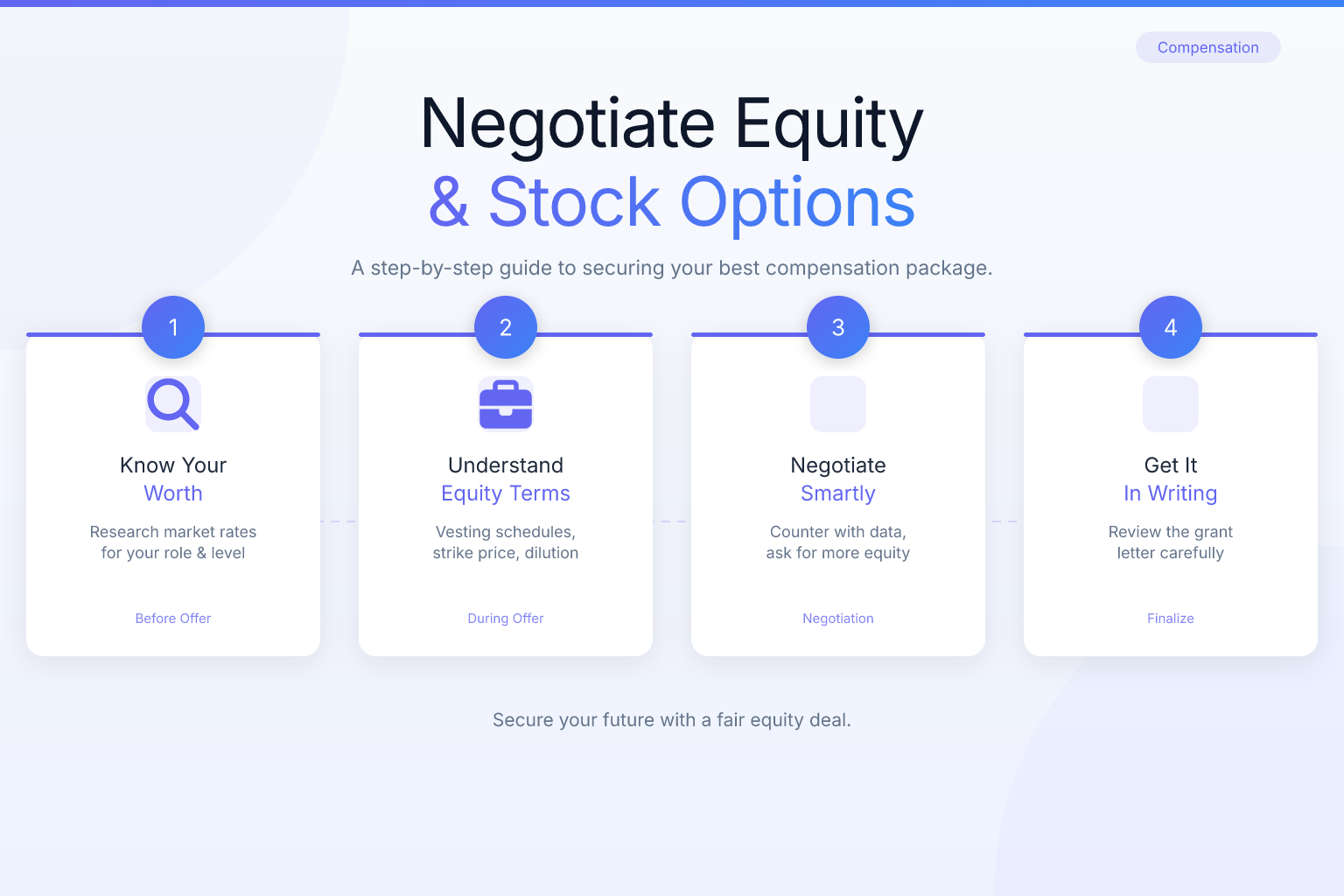
How to Negotiate Equity and Stock Options in a Job Offer
You just received a job offer with equity stock options — but the shares, strike price, and vesting schedule might as well be in a foreign language. Equity can be the most valuable part of your compensation, especially at startups, yet most candidates accept whatever is put in front of them. Don’t be one of them. Negotiating equity is expected; you just need to know what to ask for and how to ask for it.
Key Takeaways
- Equity is negotiable — companies rarely offer their best package upfront.
- Understand the type of equity (ISOs, NSOs, RSUs) and key numbers (strike price, 409A valuation, fully diluted shares) before negotiating.
- Use data: benchmark your offer against market rates for your role, stage, and location.
- Focus on percentage ownership, not just the number of shares, and ask for a refresher or early exercise option if you plan to stay long-term.
- If the company won’t budge on equity, negotiate other levers like salary, signing bonus, or a performance-based equity review in 6–12 months.
| What to Do | Why It Matters | Time |
|---|---|---|
| Ask for the 409A valuation and total shares outstanding | You can’t value your options without knowing the current fair market value and your ownership percentage | 5 minutes |
| Benchmark your equity against market data | Ensures you’re not leaving money on the table compared to peers at similar-stage companies | 1–2 hours |
| Request an extended exercise window | Protects you from losing your vested options if you leave the company | 5 minutes |
| Negotiate for a higher option grant or RSUs | Directly increases the potential upside of your compensation | 1–2 conversations |
| Ask for early exercise and 83(b) election eligibility | Can significantly reduce your tax liability on future gains | 5 minutes |
Start with the Basics
Equity compensation falls into a few main categories, and negotiation tactics differ for each.
Stock options give you the right to buy shares at a set strike price after vesting. Incentive stock options (ISOs) offer tax advantages but may trigger alternative minimum tax (AMT). Non-qualified stock options (NSOs) are taxed as ordinary income at exercise. Restricted stock units (RSUs) are more common at public companies: you receive shares when they vest, with no purchase required, and the value is taxed as income.
Key terms: grant size, strike price, 409A valuation (the company’s fair market value, which sets the strike price), vesting schedule (typically four years with a one-year cliff), and exercise window (how long you have to exercise after leaving). If any of these are missing from your offer, ask for them.
How to Value Your Equity Offer
Don’t fixate on the number of shares. 10,000 options sounds like a lot, but if the company has 100 million shares outstanding, your stake is 0.01%. That percentage is what matters.
To calculate it:
- Ask for the fully diluted share count (all outstanding shares, options, and warrants).
- Divide your option grant by that number to get your ownership percentage.
- Estimate potential value: multiply the company’s projected exit value by your ownership percentage, then subtract exercise costs and taxes.
For example, 20,000 options at a $2 strike price with 20 million fully diluted shares gives you 0.1%. If the company sells for $200 million, your stake is worth $200,000 before exercise costs and taxes. Benchmark your equity against market data from sites like Levels.fyi or Carta’s equity reports to see if your offer is competitive.
Questions to Ask Before You Negotiate
Get these answers before making a counteroffer:
- What is the current 409A valuation?
- What is the total number of fully diluted shares?
- What is the post-termination exercise window? (Ask for an extended window if it’s only 90 days.)
- Do you allow early exercise and 83(b) elections?
- Is there a refresher grant policy?
- What happens to my equity in an acquisition?
Write these down and ask in a follow-up call or email. The answers shape your strategy.
Strategies for Negotiating Equity
1. Benchmark and Ask for the Market Rate
If your equity offer is below the median for your role and stage, present data. For example: “Based on my research, the typical equity grant for a senior product manager at a Series B company is 0.2%–0.4%. My offer of 0.1% seems below that range. Can we adjust to 0.25%?” This is data-driven and hard to argue with.
2. Tie Equity to Your Expected Impact
If you bring a unique skill set or track record, use it. “Given my experience scaling sales teams from $5M to $20M in ARR, I believe I can accelerate your growth. I’d like an equity grant that reflects that impact — something in the 0.3% range.”
3. Negotiate the Terms, Not Just the Amount
If the company can’t increase the number of options, improve the terms: extended exercise window (10 years instead of 90 days), early exercise eligibility, faster vesting, or performance-based acceleration.
4. Use a Competing Offer (Carefully)
If you have another offer with better equity, mention it transparently. “I have another offer with a 0.3% stake. I’m more excited about your company, but the financial difference is significant. Is there any flexibility?” Only use this if you’re willing to walk away.
For more on negotiating your base salary, see our salary negotiation guide.
Scripts and Phrases to Use
When you first receive the offer:
“Thank you for the offer. Before I can fully evaluate it, could you share the 409A valuation, the fully diluted share count, and the post-termination exercise window? I want to understand the equity component completely.”
When you’re ready to negotiate:
“I’ve reviewed the equity package and compared it to market data. Based on that, I’d like to discuss increasing the grant to [X] options, which would bring my ownership to [Y]%. I believe that’s in line with what’s typical and reflects the value I can bring.”
If they say no to more options:
“I understand the constraints. Would it be possible to adjust the terms instead — for example, an extended exercise window or early exercise eligibility? That would make a big difference in the long-term value for me.”
Common Mistakes to Avoid
- Focusing only on the number of shares without the fully diluted count.
- Ignoring the exercise window — a 90-day window can force you to leave money on the table.
- Not asking about the 409A valuation.
- Assuming equity is free money — taxes can be significant.
- Negotiating only salary; equity can be worth far more over time.
- Accepting the first offer without questions.
When to Walk Away
If the company won’t share basic information like the 409A valuation or fully diluted share count, that’s a red flag. Also, if the equity grant is so small it’s essentially a lottery ticket and they won’t budge, prioritize cash compensation. Use a simple framework: estimate expected value (ownership percentage × realistic exit value × probability of success) and compare it to the cash difference. A 0.05% stake in a company with a 10% chance of a $500M exit is worth $25,000 in expected value — less than a $10,000 salary bump over four years. Run the numbers.
How to Track Your Offers and Follow Up
Once you start negotiating, you’ll likely have multiple conversations, emails, and deadlines to manage. Missing a follow-up or forgetting a key detail can cost you the offer. Use a system to stay organized.
After each negotiation conversation, send a brief thank-you email summarizing the discussion and any agreed-upon next steps. Set a calendar reminder to follow up if you haven’t heard back within the agreed timeframe. A tool like the ResumeMate Job Tracker lets you log every application, offer, and negotiation deadline in one place, so nothing slips through the cracks. You can note the equity details, the contact person, and the next step. If you prefer a manual approach, a simple spreadsheet with columns for company, role, equity details, contact, and follow-up date works too. The key is to keep all your offer information accessible and up-to-date, so you can make informed decisions quickly.
For more on negotiating other parts of your offer, read our guide on how to negotiate PTO in a job offer and how to request more time before a job offer expires.
FAQ
Q: Can you really negotiate equity in a job offer?
A: Yes, absolutely. Equity is a standard part of compensation at startups and many public companies, and it’s expected that candidates will negotiate. Recruiters often have a range they can work within.
Q: What’s more important: the number of options or the strike price?
A: Neither is meaningful in isolation. The number of options only matters relative to the fully diluted share count (your ownership percentage). The strike price only matters relative to the 409A valuation (the discount). Always ask for both numbers.
Q: How do I know if my equity offer is competitive?
A: Benchmark it against market data. Use resources like Levels.fyi, Option Impact, or Carta’s equity reports. Compare your ownership percentage and the company’s stage to similar roles. If you’re below the median, you have a strong case for negotiation.
Q: What if the company says the equity grant is “standard” and non-negotiable?
A: Ask what “standard” means — standard for the role, the level, or the company? Then present your market data. If they still won’t budge, negotiate the terms: exercise window, early exercise, or a performance review with a guaranteed equity refresh in 6–12 months.
Q: Should I negotiate equity if I’m joining a public company?
A: Yes. RSU grants at public companies are often negotiable, especially for experienced hires. Benchmark your RSU value against peers and ask for an increase. You can also negotiate the vesting schedule or a signing bonus to offset a lower grant.
Q: What’s an 83(b) election and why should I care?
A: An 83(b) election lets you pay taxes on the fair market value of your shares at the time of early exercise, rather than as they vest. If the company’s value increases, you’ll pay significantly less in taxes. It’s a powerful tool, but you must file within 30 days of exercise.
Q: How do I bring up equity negotiation without sounding greedy?
A: Frame it as a collaborative discussion about making the offer work for both sides. Use market data and your expected impact as the rationale. Phrases like “I want to make sure the equity reflects the value I can bring” keep the conversation positive.
Track Every Application While You Job Hunt
Stop losing track of where you’ve applied. The ResumeMate Job Tracker is a free Chrome extension that tracks every application, deadline, and follow-up in one place — right from your browser.