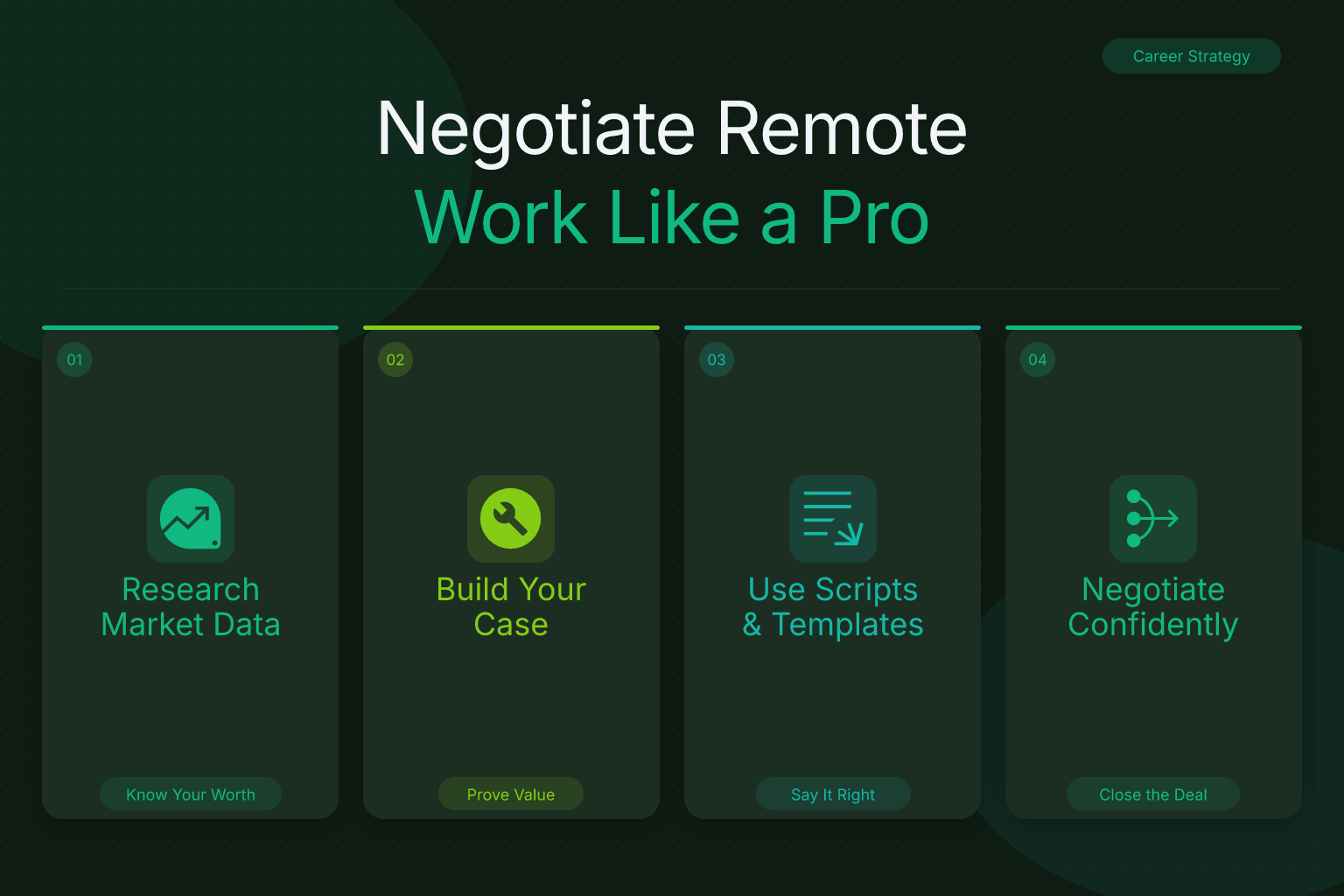
Negotiate Remote Work in a Job Offer: Scripts & Strategies
You just received a job offer, but there’s a catch — the role is listed as on-site or hybrid, and you need how to negotiate remote work in a job offer to make it fully remote. Maybe you’re a parent who needs the flexibility, you live far from the office, or you simply do your best work from a home office. Whatever the reason, you don’t have to accept the default. Remote work is a negotiable term, just like salary or vacation days, and in 2025 many companies are willing to bend for the right candidate.
Key Takeaways
- Ask for remote work after receiving a written offer but before accepting, as this is when you have the most negotiating leverage.
- Frame your request around business benefits like increased productivity and retention, not personal needs.
- Propose a trial period or hybrid schedule to overcome employer hesitation about fully remote work.
- If remote work is denied, negotiate for alternative perks such as flexible hours or a home office stipend, and get any agreement in writing.
- Research the company’s remote work culture during interviews by asking about team locations and collaboration tools without revealing your full intent.
This guide walks you through exactly how to ask for remote work after receiving an offer — without sounding demanding or risking the opportunity. You’ll get scripts, timing advice, and ways to handle objections so you can turn a hybrid or on-site offer into the remote role you want.
The 2025 Landscape: Why Remote Work Negotiation Works
Remote work isn’t the exception it was a decade ago. By 2025, many companies have settled into permanent hybrid or remote-first models, but plenty of employers still default to on-site roles — especially for positions that weren’t historically remote. The good news: the pandemic-era experiment proved that remote work can be highly productive, and that data is your ally.
When you negotiate remote work in a job offer, you’re not asking for a special favor. You’re proposing a work arrangement that research shows can increase productivity, reduce turnover, and lower overhead costs for the employer. A 2024 study by Stanford’s Institute for Economic Policy Research found that fully remote work led to a 13% performance increase, driven by fewer distractions and a quieter environment. Frame your request around these outcomes, and you’ll sound like a strategic partner — not someone who just wants to avoid a commute.
Research and Build Your Case Before You Ask
Before you even apply, dig into how the company handles remote work. Check their careers page, Glassdoor reviews, and LinkedIn posts. Look for phrases like “remote-first,” “distributed team,” or “work from anywhere.” If the job description says “on-site” but you see that half the team works from different cities, you have a strong opening.
During interviews, ask subtle questions to gauge flexibility:
- “How does the team handle collaboration across different locations?”
- “What tools do you use for remote communication?”
- “Are there any team members who work remotely on a regular basis?”
These questions give you intel without tipping your hand too early. If the interviewer says, “We’re all in the office five days a week, no exceptions,” you know the culture is rigid. But if they mention that some people work from home on Fridays or that the team uses Slack and Zoom heavily, you have room to negotiate.
If you’re still searching for remote-friendly companies, our guide on the 100 best remote job websites can help you target employers that already embrace flexibility.
Build a business case, not a personal plea. The biggest mistake candidates make is framing remote work as a personal need. “I have a long commute” or “I need to pick up my kids” might be true, but they don’t give the employer a reason to say yes. Instead, focus on three pillars:
- Productivity: Explain that you’ve done your best work remotely in the past. If you have data — like a project you delivered ahead of schedule while working from home — mention it. If not, point to the well-documented productivity gains of remote work.
- Availability: Remote workers often log more hours because they’re not losing time to commuting. You can be available earlier or later, which might benefit a team spread across time zones.
- Retention: Companies that offer flexibility have lower turnover. You’re signaling that you’ll stay longer if you can work in a way that suits you.
Write down your talking points before the negotiation. For example: “In my last role, I worked remotely two days a week and consistently hit my deadlines. I found that the focused time without office interruptions let me complete deep work 30% faster. I’d bring that same discipline here.”
When and How to Ask for Remote Work (Scripts Included)
Timing is everything. If you ask about remote work in the first interview, you risk looking like you’re only interested in the perk, not the job. If you wait until after you’ve started, you have almost no leverage. The sweet spot is after you receive a written offer but before you accept. At that point, the company has invested time and resources in you, and you have maximum negotiating power.
Here’s a simple timeline:
- During interviews: Ask about team location and collaboration tools (as above). Do not explicitly request remote work unless the interviewer brings it up.
- After the verbal offer: When the recruiter calls with the good news, express enthusiasm. Then say, “I’d love to discuss the details of the offer, including the work location. Is now a good time?”
- Written offer in hand: This is when you make your formal request. You can do it over email or on a call, depending on your relationship with the hiring manager.
If you’re juggling multiple offers, use that leverage. “I have another offer that is fully remote, but I’m more excited about this role. Is there flexibility on the location?” This works best when it’s true — never bluff.
Scripts that work:
Direct request (for roles that could be remote): “Thank you so much for the offer — I’m really excited about the team and the work. I wanted to discuss the possibility of working remotely. I’ve reviewed the responsibilities and I’m confident I can deliver the same results from a home office. In my previous role, I worked remotely three days a week and consistently exceeded my targets. I’d love to propose a fully remote arrangement with regular check-ins to ensure we’re aligned. Would you be open to discussing that?”
Trial period approach (when you sense hesitation): “I understand the team values in-person collaboration. What if we started with a trial period — say, 90 days of remote work with weekly one-on-ones to assess how it’s going? If at any point you feel it’s not working, we can revisit. I’m confident I can prove that remote work won’t affect my performance.”
Hybrid compromise (when full remote is a hard no): “I completely respect the team’s culture. Would you be open to a hybrid schedule? For example, I could be in the office Tuesday through Thursday and work remotely Monday and Friday. That way I still get face time with the team while having focused days for deep work.”
Email version (if you prefer writing): Subject: Following up on the offer — quick question about work location
“Hi [Name],
Thank you again for the offer. I’m very excited about joining [Company]. Before I sign, I wanted to ask about the possibility of working remotely. Based on my experience and the nature of the role, I believe I can be highly effective from a home office. I’d be happy to discuss a trial period or hybrid arrangement if that’s more comfortable. Let me know if you’re open to a quick call.
Best, [Your Name]”
Handling Common Objections to Remote Work
You’ll likely face pushback. Prepare for these objections so you can respond calmly and persuasively.
“We value in-person collaboration.” “I do too, and I’d make it a priority to be present for key meetings and team events. I’ve found that a mix of focused remote work and intentional in-person collaboration actually improves the quality of both. I’d propose coming in for quarterly team gatherings or monthly strategy sessions.”
“Our culture is built around being in the office.” “I respect that. I’m not asking to change the culture — I want to contribute to it. I’d be fully engaged on Slack, video calls, and any other channels the team uses. I’ve built strong relationships with remote colleagues before by being proactive about communication.”
“We need someone who can be available for impromptu meetings.” “I can be available instantly via Slack or Zoom during working hours. In fact, because I won’t be commuting, I can often be online earlier or later if needed. I’m happy to set clear ‘office hours’ so the team knows when I’m reachable.”
“We’ve tried remote work and it didn’t work.” “I understand. Every team is different. What if we set specific metrics for success in the first 90 days? If I’m not meeting them, we can revisit. I’m confident I can make it work, but I’m also open to feedback.”
If They Say No (or Yes, But…)
If the answer is a flat no, you have a decision to make. Is the role still worth it? If yes, accept gracefully and don’t burn the bridge. You can revisit the conversation after you’ve proven yourself — many managers become more flexible once they trust you.
If they say yes but with conditions (e.g., hybrid only, or remote after six months), get it in writing. An email from the hiring manager confirming the arrangement is enough. You don’t need a formal contract amendment, but you do need a record. Without it, a new manager or policy change could erase your agreement.
Also, negotiate a review date. “Can we schedule a check-in at the three-month mark to evaluate how the hybrid schedule is working? If I’m meeting all my goals, I’d love to discuss moving to fully remote.” This keeps the door open.
Negotiate Other Remote-Friendly Perks
If remote work itself is off the table, pivot to related benefits that make on-site life easier or that support occasional remote days.
- Flexible hours: Even if you have to be in the office, can you start early and leave early to beat traffic?
- Home office stipend: If you’ll work from home even one day a week, ask for a budget to set up a proper workspace.
- Commuter benefits: Some companies subsidize parking or transit passes. It’s worth asking.
- Professional development budget: Use it to take courses on remote collaboration or time management — skills that make you a stronger candidate for future flexibility.
These smaller wins can make a big difference in your day-to-day life while you build the trust needed to eventually go fully remote.
Prepare Your Resume for Remote Job Offers
Before you can negotiate remote work, you need to land the offer. A resume that highlights remote-ready skills — self-management, digital communication tools, and independent project delivery — puts you in a stronger position. If you’re applying to remote-friendly companies, tailor your resume to emphasize those strengths.
Use the free ResumeMate AI resume builder to create a clean, ATS-friendly resume that showcases your ability to work independently. Then run it through the resume score checker to see how well it’s optimized for the roles you’re targeting. A higher score means more interviews — and more offers to negotiate.
If you’re still in the job search phase, our guide on how to find and land call center remote jobs walks you through targeting remote-friendly industries and crafting applications that get noticed.
FAQ
Q: Can you negotiate remote work even if the job posting says on-site?
A: Yes. Job postings often reflect the default, not a hard rule. If you’re the top candidate, many hiring managers will make exceptions — especially if you frame the request around productivity and propose a trial period.
Q: When is the best time to ask about remote work during the hiring process?
A: After you receive a written offer but before you accept. Asking too early can make you seem inflexible; asking after you start gives you almost no leverage. The offer stage is when you have the most power.
Q: How do I negotiate remote work without sounding entitled?
A: Use collaborative language, focus on business outcomes, and offer a trial period. Phrases like “I’d love to explore the possibility” and “I’m confident I can deliver the same results” keep the conversation positive and professional.
Q: What if the employer says remote work is against company policy?
A: Ask if there’s flexibility for exceptions. If not, negotiate for hybrid work, remote Fridays, or a future review date. If the policy is truly rigid, decide whether the role is still a fit. You can always revisit the topic after you’ve built trust.
Q: Should I get a remote work agreement in writing?
A: Absolutely. An email from the hiring manager confirming the arrangement is sufficient. Without written confirmation, a change in management or policy could undo your agreement.
Related articles:
- Negotiate Equity and Stock Options in a Job Offer
- Negotiate Start Date: Scripts, Timing, Mistakes to Avoid
- How to Negotiate PTO in a Job Offer: Scripts & Strategies
Track Every Application While You Job Hunt
Stop losing track of where you’ve applied. The ResumeMate Job Tracker is a free Chrome extension that tracks every application, deadline, and follow-up in one place — right from your browser.