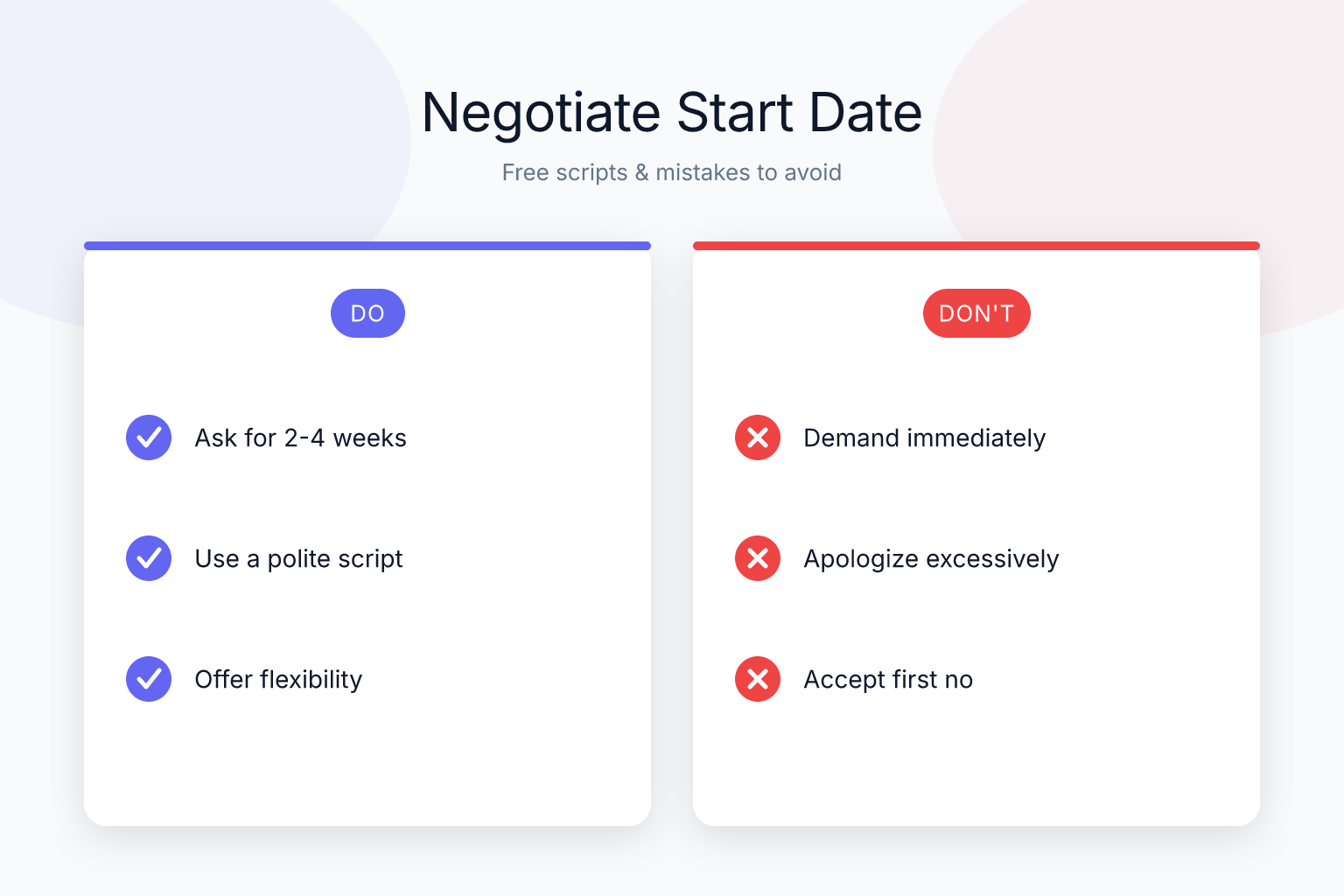
How to Negotiate Start Date with a New Employer: Free Scripts, Timing, and Mistakes to Avoid (2026)
You just got the job offer. The salary is right, the role is exciting, but the start date they proposed doesn’t work for you. Maybe you need to give your current employer a full two weeks’ notice, or you have a pre-planned trip, or you simply need a breather between jobs. Asking to change the start date can feel awkward, but it’s a normal part of the hiring process. Most employers expect some back-and-forth, and handling it professionally won’t cost you the offer.
Key Takeaways
- Most employers are open to adjusting the start date by a week or two if you ask early and give a clear, professional reason.
- Frame the request around making a smooth transition and starting strong — not just personal convenience.
- If you need to start earlier, offer to help with a specific handoff or project to show initiative.
- Never accept a start date you can’t meet; it’s better to negotiate upfront than to ask for a delay after you’ve already committed.
- Use email to document the agreed-upon start date and confirm it in writing before your first day.
| What to Do | Why It Matters | Time |
|---|---|---|
| Ask before signing the offer letter | Once you sign, you’ve committed to the date; negotiating after is much harder | Before acceptance |
| Give a specific, professional reason | Employers respect transparency about notice periods, pre-planned commitments, or relocation needs | During negotiation |
| Offer a compromise or flexible option | Shows you’re collaborative and not making demands | When proposing a new date |
| Confirm the new start date in writing | Protects both sides and avoids miscommunication | After verbal agreement |
| Use the extra time to prepare | Arriving prepared and rested makes a better first impression | Before your first day |
Why You Might Need to Negotiate Your Start Date
Most job offers come with a proposed start date, often two to four weeks out. But life doesn’t always align with a company’s ideal timeline. You might need to negotiate your start date for several legitimate reasons:
- You’re currently employed and need to give proper notice. Two weeks is standard, but some roles require longer. If you’re in a senior position or managing critical projects, your current employer may ask for three or four weeks to wrap things up. Leaving on good terms matters for your professional reputation.
- You have a pre-planned vacation or family commitment. If you booked a trip months ago or have a wedding, medical procedure, or other non-negotiable event, it’s better to disclose it now than to ask for time off right after starting.
- You’re relocating for the job. Moving to a new city takes time. You may need a few extra weeks to find housing, settle in, and handle logistics so you can show up focused on day one.
- You need a mental break between roles. Burnout is real. A short gap between jobs can help you recharge and start the new position with more energy. Many hiring managers understand this, especially if you frame it as wanting to be at your best.
- The proposed start date conflicts with a prior commitment. Maybe you have a non-compete clause that hasn’t expired, or you’re finishing a certification. Whatever the reason, it’s better to address it now.
Employers invest significant time and resources in hiring. They’d rather adjust the start date by a week or two than restart the search. As long as your request is reasonable and you communicate it clearly, you have room to negotiate.
When to Bring Up Start Date Negotiation
Timing is everything. The best moment to discuss your start date is after you receive the written offer but before you accept it. At this stage, the employer has already decided you’re the right candidate. They’re motivated to close the deal, and small adjustments are easier to accommodate.
If you bring it up too early — say, during the first interview — you risk looking presumptuous or inflexible. Wait until you have the offer in hand. Then, when you’re reviewing the terms, you can address the start date along with salary, benefits, and other details.
One exception: if you know upfront that you can’t start until a specific date (for example, you’re finishing a degree or have a non-compete that ends in three months), mention it during the final interview stage. That way, the employer can factor it into their decision. Frame it as: “I want to be transparent — my earliest available start date is [date]. I hope that works with your timeline.”
If you need more time to decide on the offer itself, that’s a separate conversation. Check out our guide on how to request more time to consider a job offer for scripts and strategies.
How to Ask for a Later Start Date (With Scripts)
Once you have the offer, approach the conversation with gratitude and clarity. Here’s a step-by-step framework:
- Express enthusiasm for the role. Start by reaffirming your excitement about the job and the team. This sets a positive tone.
- State the proposed start date and the issue. Be direct but polite. Mention the date they suggested and explain why it’s challenging.
- Propose a specific alternative. Don’t just say “I need more time.” Give a concrete date, ideally within a reasonable window (one to three weeks beyond the original).
- Reinforce your commitment. End by reiterating that you’re eager to join and want to ensure a smooth start.
Script for a phone call or video call:
“Thank you again for the offer — I’m really excited about joining the team. I noticed the start date is set for [original date]. I’d love to accept, but I want to be upfront: I need to give my current employer a full [three-week] notice to wrap up a key project. Would it be possible to start on [proposed date] instead? I want to make sure I can hit the ground running and leave things in good shape on my end.”
Script if you have a pre-planned trip:
“I’m thrilled about the offer and can’t wait to get started. I do have a pre-planned trip from [dates] that I booked several months ago. I want to be fully present during onboarding, so would it work to start on [date after trip]? I’m happy to do any pre-reading or paperwork beforehand to make the transition seamless.”
Script if you need a mental health break:
“I’m really excited to join and give this role my full energy. To be honest, I’ve been going non-stop for a while, and I’d love to take a short break between roles so I can show up refreshed and ready to contribute. Would a start date of [proposed date] be feasible? I’m flexible and happy to work with your timeline.”
Always follow up with an email confirming the agreed-upon date. If you’re also negotiating other terms like PTO, you can bundle these conversations. See our guide on how to negotiate PTO in a job offer for scripts that work.
How to Ask for an Earlier Start Date
Sometimes you want to start sooner — maybe you’re between jobs, or the role is urgent. Here’s how to ask without seeming desperate:
- Frame it as eagerness, not impatience. Say you’re excited to contribute and would love to accelerate the timeline if possible.
- Offer flexibility. Acknowledge that onboarding and team readiness might dictate the date, and you’re happy to adapt.
- Propose a specific earlier date. For example: “If it works for the team, I could start as early as [date]. I’ve already wrapped up my previous commitments and am ready to dive in.”
Be careful not to pressure the employer. Some companies have fixed onboarding cycles or need time to set up equipment and access. If they can’t accommodate an earlier start, accept it gracefully.
What to Do If the Employer Pushes Back
Sometimes the employer can’t budge. The start date might be tied to a training cohort, a project kickoff, or budget cycles. If they say no, here’s how to handle it:
- Ask if there’s any flexibility at all. Maybe they can’t move it by two weeks, but they can shift it by a few days. Even a small adjustment can help.
- Explore creative solutions. Could you work remotely for the first week while you relocate? Could you do part-time hours initially? Could you take unpaid leave for your pre-planned trip shortly after starting? Some employers are open to these arrangements if you ask.
- Decide if the original date is a dealbreaker. If you absolutely cannot make the proposed date work, be honest. Say: “I completely understand the constraints. Unfortunately, I’m unable to start on [date] due to [reason]. Is there any alternative, or would it be better to revisit this opportunity at a later time?” This is a last resort, but it’s better than accepting and then failing to show up.
If the employer rescinds the offer because you asked for a reasonable adjustment, that’s a red flag about their culture. Most reputable companies will work with you.
Balancing Start Date with Other Offer Terms
Start date negotiation doesn’t happen in a vacuum. You might be negotiating salary, benefits, and PTO at the same time. Here’s how to prioritize:
- If the start date is your only concern, lead with it. Don’t muddy the waters by asking for a higher salary and a later start date simultaneously unless you have to. Tackle the most important issue first.
- If you’re negotiating multiple items, bundle them. For example: “I’m excited about the offer. I have two requests: a start date of [date] to accommodate my notice period, and a base salary of [amount] to align with market data. Are either of these possible?”
- Be willing to trade. If the employer can’t move the start date, maybe they can offer a signing bonus to offset the inconvenience, or allow you to work remotely for a period. Think about what would make the original date workable.
Remember, the goal is to reach an agreement that works for both sides. Approach it as a collaboration, not a confrontation.
Common Mistakes to Avoid When Negotiating a Start Date
Even well-intentioned candidates can make missteps. Avoid these:
- Waiting until after you’ve accepted the offer. Once you sign, you’ve agreed to the terms. Changing the start date afterward can damage trust and make you look unreliable.
- Giving a vague or dishonest reason. Saying “I just need more time” without context can raise suspicion. Be honest — if it’s a vacation, say so. Employers appreciate transparency.
- Asking for an unreasonably long delay. Pushing the start date out by more than a month without a compelling reason (like relocation or a non-compete) can make the employer question your commitment. Most companies expect a start within two to four weeks of the offer.
- Making demands instead of requests. Use collaborative language: “Would it be possible…” rather than “I need…” or “You have to…”
- Forgetting to confirm in writing. Verbal agreements can be forgotten. Send a brief email summarizing the new start date and any other agreed-upon terms.
- Not considering the employer’s needs. If they need someone urgently because a team is understaffed, a long delay could be a genuine hardship. Acknowledge their situation and try to find a middle ground.
Sample Email Templates for Start Date Negotiation
Here are ready-to-use templates. Customize them with your details.
Template 1: Requesting a later start date due to notice period
Subject: Start Date — [Your Name]
Hi [Hiring Manager Name],
Thank you again for the offer to join [Company] as [Job Title]. I’m very excited about the opportunity.
I’m writing about the proposed start date of [original date]. To ensure a smooth transition, I need to give my current employer a full [number]-week notice, which would make my earliest available start date [proposed date]. I want to leave on good terms and wrap up my responsibilities properly.
Would a start date of [proposed date] work for your team? I’m happy to complete any onboarding paperwork in the meantime so I can hit the ground running.
Thank you for understanding, and I look forward to joining the team.
Best, [Your Name]
Template 2: Requesting a later start date due to pre-planned travel
Subject: Start Date Question — [Your Name]
Hi [Hiring Manager Name],
I’m thrilled to accept the offer for [Job Title] and can’t wait to get started. I wanted to discuss the start date. I have a pre-planned trip from [start date] to [end date] that I booked before our interview process began. I’d love to start after I return, on [proposed date], so I can be fully present for onboarding.
I’m happy to complete any pre-reading or paperwork before then. Please let me know if this works for your timeline.
Thanks so much, [Your Name]
Template 3: Confirming the agreed-upon start date
Subject: Confirming Start Date — [Your Name]
Hi [Hiring Manager Name],
Thanks for the conversation earlier. I’m confirming that my start date will be [agreed date]. I’ve accepted the offer and am looking forward to joining the team.
Please let me know if there’s anything I can do to prepare before my first day.
Best, [Your Name]
If you’re also drafting a resignation letter to your current employer, check out our guide with examples to leave on a positive note.
FAQ
Q: How to negotiate start date with new employer?
A: Wait until you have the written offer, then express enthusiasm, explain your reason clearly (notice period, pre-planned trip, relocation), and propose a specific alternative date. Use collaborative language and confirm the new date in writing. Most employers will accommodate a one- to three-week adjustment if you ask professionally.
Q: How to negotiate a later start date for a new job?
A: After receiving the offer, call or email the hiring manager. Thank them, state the original date, explain why you need more time (e.g., giving proper notice, finishing a project, or a pre-existing commitment), and suggest a concrete later date. Emphasize that you want to start strong and be fully available. Follow up with a confirmation email.
Q: How to negotiate start date new job when you have a vacation planned?
A: Be upfront as soon as you have the offer. Say something like: “I have a pre-planned trip from [dates]. I’d love to start on [date after trip] so I can be fully present during onboarding. I’m happy to complete any paperwork beforehand.” Most employers appreciate the honesty and will work with you.
Q: Can asking to change the start date cost me the job offer?
A: It’s unlikely if your request is reasonable and you communicate it professionally. Employers invest significant time in hiring and would rather adjust the date by a week or two than restart the search. However, if you make demands, give no reason, or ask for an excessively long delay, you risk appearing uncommitted. Approach it as a collaborative request.
Q: What if the employer says no to my requested start date?
A: Ask if there’s any flexibility at all — even a few days can help. Explore alternatives like remote work for the first week or unpaid leave for a pre-planned trip. If the date is truly non-negotiable and you can’t make it work, be honest and ask if the opportunity can be revisited later. It’s better to walk away than to accept and then fail to show up.
Q: Should I negotiate start date over email or phone?
A: A phone or video call is often better because it allows for a real-time conversation and shows you’re serious. You can gauge the employer’s reaction and find a compromise more easily. Follow up with an email to confirm the agreed-upon date. If you’re more comfortable with email, that’s fine too — just keep the tone warm and collaborative.
Q: How much time can I reasonably ask for between jobs?
A: Most employers expect a start date within two to four weeks of the offer. Asking for an additional one to two weeks (so three to six weeks total) is usually acceptable if you have a valid reason like a notice period, relocation, or pre-planned travel. Requests beyond six weeks may raise concerns unless you have a compelling explanation, such as a non-compete clause or finishing a degree.
Track Every Application While You Job Hunt
Stop losing track of where you’ve applied. The ResumeMate Job Tracker is a free Chrome extension that tracks every application, deadline, and follow-up in one place — right from your browser.