What to Do If No Response After Interview Follow-Up: A Step-by-Step Guide
You walked out of the interview feeling confident. You sent a thoughtful thank-you email the next day, maybe even a polite follow-up a week later. And then — nothing. No response after interview follow-up can feel like shouting into a void, but it doesn’t mean you should give up. Silence from a hiring manager is frustratingly common in the 2026 job market, where remote teams and automated ATS systems often create communication bottlenecks. It rarely means you did something wrong. This guide walks you through exactly what to do next, from sending a second follow-up to knowing when to move on, so you can handle the silence professionally and keep your job search moving.
Key Takeaways
- A second follow-up email sent 5–7 business days after your first can politely nudge the hiring manager without seeming pushy.
- Silence often stems from internal delays, not a rejection — keep applying elsewhere while you wait.
- If you still hear nothing after two follow-ups, send a gracious closing email and shift your energy to other opportunities.
- Use a job tracker to log every application and follow-up so no conversation falls through the cracks.
| What to Do | Why It Matters | Time |
|---|---|---|
| Wait 5–7 business days after your first follow-up | Gives the hiring team space to respond without pressure | 1 week after initial follow-up |
| Send a second, value-added follow-up email | Shows continued interest and professionalism | 1–2 weeks after interview |
| Try an alternative contact method (LinkedIn, phone) | Your email may have been missed or buried | After second email, if appropriate |
| Keep applying and interviewing elsewhere | Protects your momentum and prevents fixation on one role | Immediately |
| Send a final, gracious close-out email | Leaves a positive impression and lets you move on | 3–4 weeks after interview |
Why You Might Get No Response After an Interview Follow-Up
When you send a follow-up email and hear nothing back, it’s easy to assume the worst. But no response after interview follow-up often has nothing to do with your candidacy. Hiring processes are messy. Here are the most common reasons for the silence:
- Internal delays: Budget approvals, headcount freezes, or a key decision-maker being out of office can stall everything. Recruiters often can’t share updates until they’re finalized.
- They’re still interviewing other candidates: Many companies wait until they’ve completed all first-round interviews before moving anyone forward. Your follow-up may have arrived mid-process.
- Your email got lost: Spam filters, overflowing inboxes, or a recruiter who left the company — technical glitches happen more than you’d think.
- The role changed or was put on hold: Sometimes a job requisition gets revised or frozen, and the recruiter isn’t allowed to communicate that yet.
- They’re simply disorganized: Not every company has a streamlined hiring process. Some teams are understaffed and drop the ball on candidate communication.
None of these reasons reflect poorly on you. The key is to stay proactive without taking the silence personally.
How Long Should You Wait Before Following Up Again?
Timing is everything. If you’ve already sent one follow-up (typically a thank-you email within 24 hours and a status check about a week later), give the hiring team breathing room before reaching out again. The optimal timing depends on where you are in the process.
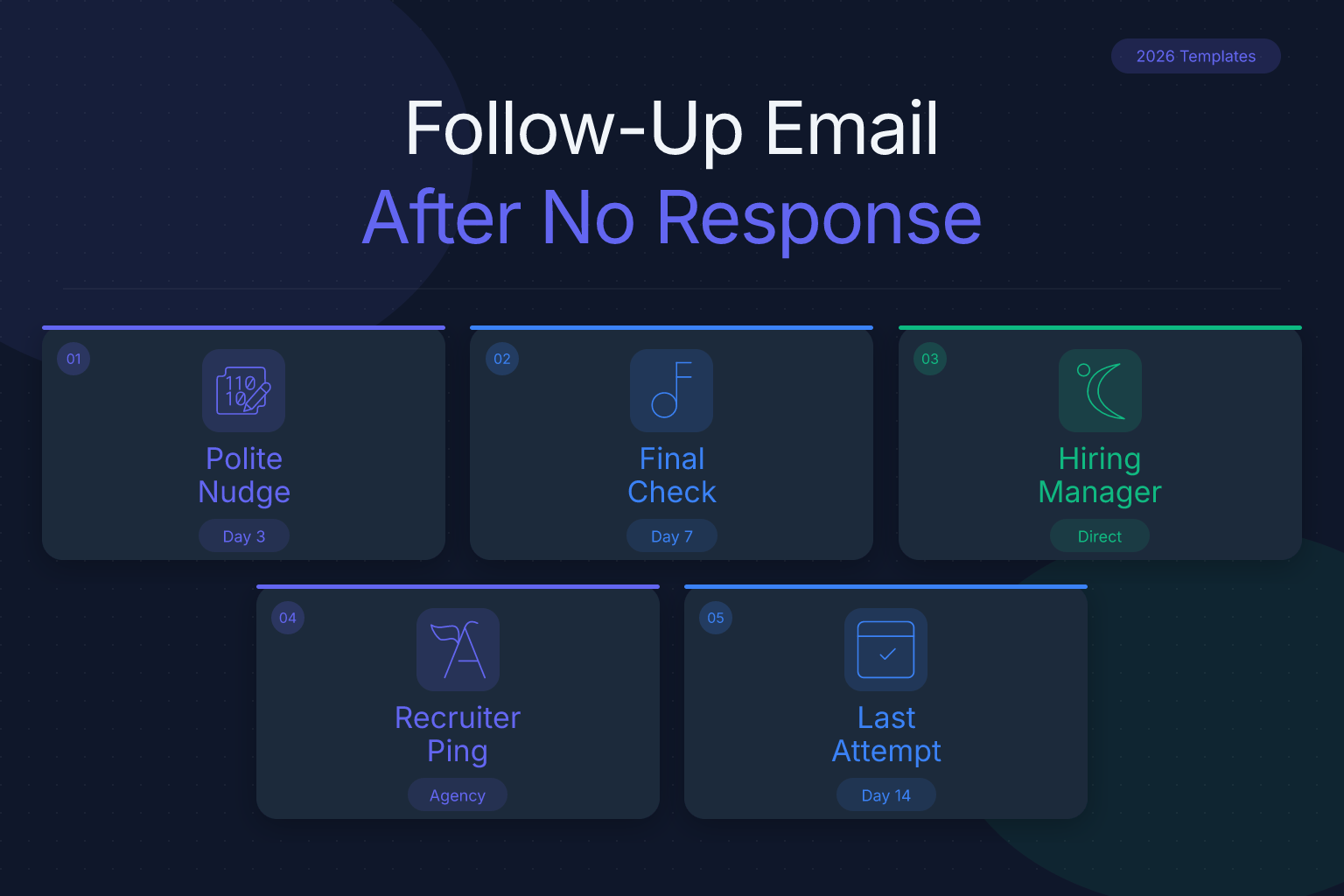
3 Days After Interview No Response
If it’s only been 3 days after interview no response, do not send another email yet. This is typically too soon unless the recruiter explicitly promised an answer within 48 hours. Sending a follow-up this quickly can signal impatience. Instead, use this time to prepare for potential next steps.
1 Week After Interview No Response
Searching for 1 week after interview no response is common. This is the sweet spot for your first status check if you haven’t sent one yet. If you sent a thank-you note immediately, wait until the 5–7 business day mark to send a polite inquiry about the timeline.
2 Weeks After Interview, No Response Examples
If you are looking for 2 weeks after interview, no response examples, this is the time for a second follow-up. By now, the initial urgency has faded. Your email should be brief and reiterate value without demanding an answer. (See templates below).
3 Weeks After Interview No Response Examples
For 3 weeks after interview no response examples, the tone should shift toward closure. You aren’t expecting a job offer at this point; you are seeking clarity so you can move on. A “checking in one last time” approach works best here.
General Rule: Wait 5–7 business days after your last email. That means if you sent a follow-up on a Tuesday, don’t send another until the following Tuesday or Wednesday. Weekends and holidays don’t count. This window respects their time while keeping you on their radar. It’s long enough for them to have made progress but not so long that you’re forgotten.
If the interviewer gave you a specific date by which they’d respond and that date has passed, you can follow up sooner — 2–3 business days after the deadline is reasonable. For larger companies with notoriously slow hiring processes, you might even extend the wait to 7–10 business days to avoid appearing impatient.
While you wait, resist the urge to refresh your inbox every five minutes. Instead, channel that energy into other applications. The ResumeMate job board can help you find fresh openings so you’re never waiting on a single opportunity.
How to Write a Second Follow-Up Email That Gets a Response
Your second follow-up needs to strike a balance: polite persistence without sounding desperate. The goal is to make it easy for the recipient to reply with a quick update. Below are templates tailored to specific timelines.
Subject Line Options
- “Following up on [Position] interview”
- “Checking in — [Your Name] / [Position]”
- “Quick question about [Company]’s hiring timeline”
Standard Follow-Up Template (1 Week)
Subject: Following up on [Position] interview

Hi [Hiring Manager Name],

I hope you're having a good week. I'm writing to check in on the [Position] role I interviewed for on [Date]. I remain very interested in the opportunity and would love to know if there's an updated timeline for next steps.

In the meantime, I came across [a relevant article / industry news / a project the company launched] and thought you might find it interesting: [link or brief mention]. It reinforced my excitement about the work your team is doing.

Please let me know if there's anything else I can provide on my end. I appreciate your time and look forward to hearing from you.

Best,
[Your Name]
[Your Phone Number]
2 Weeks No Response Example (Value-Add)
Subject: Checking in — [Position] Role

Hi [Hiring Manager Name],

I wanted to briefly follow up on my application for the [Position] role. I know how busy hiring seasons can get, but I remain very enthusiastic about the possibility of joining [Company].

Since we last spoke, I [completed a certification / finished a relevant project] that aligns well with the challenges we discussed. I've attached an updated resume for your reference.

Do you have any updates on the team's decision timeline?

Best regards,
[Your Name]
3 Weeks No Response Example (Closing the Loop)
Subject: Final check-in regarding [Position]

Hi [Hiring Manager Name],

I'm writing to close the loop on my application for the [Position] role. I haven't heard back since my last note, so I assume the team has moved in a different direction or the role is on hold.

I truly enjoyed learning about [Company] and would love to be considered for future roles that match my skills. Please feel free to keep my information on file.

Thank you for your time during the interview process.

Best,
[Your Name]
Why These Work
- Adds value: Sharing a relevant article or insight shows you’re engaged with the company’s work, not just asking for a status update.
- Keeps it short: Hiring managers are busy. A few sentences are enough.
- Makes responding easy: You’re asking for a timeline, not a decision — that’s a low-friction request.
If you’re unsure how to tailor the value-add, think about a recent company announcement, a blog post they published, or an industry trend that relates to the role. Even a simple “I saw your team launched X — congratulations!” can work.
Alternative Ways to Reconnect When Email Fails
If your second email also goes unanswered, consider a different channel. But tread carefully — you don’t want to appear as if you’re going around the hiring manager.
LinkedIn Message
A brief, professional LinkedIn message can be effective if you’re already connected with the recruiter or hiring manager. Keep it similar to the email but even shorter:
“Hi [Name], I sent a follow-up email last week about the [Position] role and wanted to make sure it didn’t get lost. I’m still very interested and would appreciate any update when you have a moment. Thanks!”
Only use LinkedIn if you have an existing connection or the recruiter is active on the platform. Don’t send a connection request just to follow up — that can feel invasive.
Phone Call (Use Sparingly)
A phone call is a last resort and only appropriate if you’ve already established a rapport or the recruiter previously encouraged calls. If you do call, be prepared for voicemail. Leave a concise message with your name, the role, and a callback number. Then let it go.
Connect with Another Team Member
If you interviewed with multiple people, you could reach out to a different interviewer — especially one you had a good conversation with. Frame it as a thank-you and a gentle check-in, not a complaint about the lack of response. For example: “I really enjoyed our conversation about [topic]. I’m still very interested in the role and wanted to see if you had any insight into the timeline.”
What to Do While You Wait: Keep Your Job Search Moving
The biggest mistake you can make after an interview is putting your job search on pause. Silence from one company shouldn’t stop you from pursuing others. Here’s how to stay productive:
- Apply to at least 2–3 new roles per week. Use the ResumeMate job board to find openings that match your skills.
- Track every application. The free ResumeMate Job Tracker Chrome extension logs each job, deadline, and follow-up automatically so you never lose track of where you stand.
- Improve your resume. Run your resume through the ResumeMate score checker to see how ATS-friendly it is and get section-by-section feedback. A stronger resume can lead to more interview invitations. Remember, ResumeMate exports clean, ATS-safe PDF resumes that modern systems parse reliably.
- Practice for future interviews. Review common questions and refine your answers. If you stumbled on questions about your future plans, review our guide on how to answer ‘Where Do You See Yourself in 5 Years?’.
- Prepare for logistical questions. Interviewers often ask about start dates. Have a clear answer ready using these availability start date sample answers.
- Network. Attend virtual events, engage on LinkedIn, or set up informational interviews. Many jobs are filled through referrals before they’re ever posted.
Staying active not only increases your chances of landing a role but also reduces the emotional sting of a single unresponsive employer.
How to Interpret Radio Silence: Is It a Rejection?
It’s tempting to read silence as a definitive “no,” but that’s not always the case. Some companies take weeks to make a decision. Others have a policy of only contacting candidates who advance. However, if you’ve sent two follow-ups over the course of 3–4 weeks with no reply, it’s safe to assume you’re no longer under active consideration.
Signs that silence likely means rejection:
- The job posting has been taken down and reposted or filled (check LinkedIn or the company’s careers page).
- You see on LinkedIn that someone else has started in the role.
- The recruiter or hiring manager is active on social media but hasn’t responded to your messages.
Even then, don’t burn bridges. You may be considered for future roles, so always remain professional.
When and How to Send a Final Follow-Up (The “Moving On” Email)
If you’ve followed up twice and still heard nothing, it’s time to close the loop on your end. A final, gracious email accomplishes two things: it lets you mentally move on, and it leaves a positive last impression.
Send this email about 3–4 weeks after the interview, assuming you’ve already sent two follow-ups.
Final Follow-Up Template
Subject: Checking in one last time — [Position]

Hi [Hiring Manager Name],

I wanted to reach out one final time regarding the [Position] role. I remain enthusiastic about [Company] and would still welcome the opportunity to contribute to your team.

I understand that priorities shift and timelines change. If the role has been filled or put on hold, I'd appreciate any update you can share. Either way, I'd love to stay in touch for future opportunities that might be a fit.

Thank you again for the chance to interview. I wish you and the team all the best.

Warmly,
[Your Name]
This email is not a demand for closure — it’s a graceful exit. After sending it, archive the email thread and redirect your focus to active opportunities.
Learn from the Experience to Improve Your Next Interview
Every interview — even one that ends in silence — is a chance to get better. While the lack of response is frustrating, you can still extract value from the experience.
- Reflect on your performance. What questions tripped you up? Were there moments you could have given stronger examples? Write down your observations while they’re fresh.
- Update your resume with any new insights. If the interview highlighted a skill gap or a project you should emphasize, revise your resume accordingly. The ResumeMate AI resume builder makes it easy to tailor your resume for each application.
- Practice answering behavioral questions. Use the STAR method (Situation, Task, Action, Result) to structure your responses. If you struggled to articulate your long-term vision, review our tips on career goals interview questions.
- Request feedback — if appropriate. If you eventually hear back with a rejection, politely ask for feedback. Not all companies will provide it, but when they do, it’s gold. Read our advice on how to handle job rejection and ask for feedback.
Treating the process as a learning loop keeps you improving, regardless of any single outcome.
When to Move On and How to Do It Gracefully
Knowing when to let go is a skill. If you’ve sent two follow-ups, waited a reasonable amount of time, and still have no response, it’s time to mentally move on. That doesn’t mean you’ve failed — it means you’re prioritizing your energy.
Here’s how to move on without regret:
- Send the final follow-up email (as outlined above) to close the loop professionally.
- Unfollow the job posting and stop checking for updates. Constant monitoring only prolongs frustration.
- Focus on active leads. Redirect your attention to applications where you’re getting responses and interviews.
- Keep the door open. Connect with the interviewer on LinkedIn if you haven’t already. You never know when a new role might open up.
- Celebrate the fact that you got an interview. In a competitive market, landing an interview is an achievement. It means your resume and application stood out.
Remember: a company that can’t communicate with candidates during the hiring process often has communication issues internally. You may have dodged a bullet.
FAQ
Q: 1 week after interview no response, should I worry?
A: No, one week is still within the normal window for hiring decisions. Many teams need 10–14 days to complete all interviews. Send a polite follow-up email now, but continue applying to other roles while you wait.
Q: What are some 2 weeks after interview, no response examples?
A: At two weeks, send a brief email reiterating your interest and offering additional value, such as a relevant portfolio piece or certification. Keep the tone helpful rather than demanding. See the templates above for specific wording.
Q: Is 3 days after interview no response too soon to follow up?
A: Yes, unless they promised an answer within 48 hours. Sending a follow-up after only 3 days can appear impatient. Wait until at least 5 business days have passed since your last contact.
Q: Do you have 3 weeks after interview no response examples?
A: Yes. At three weeks, send a “closing the loop” email. Acknowledge the delay, express continued interest in future roles, and wish them well. This allows you to move on mentally while leaving a positive impression.
Q: Follow up email after second interview no response — is it different?
A: The approach is similar, but the stakes are higher. Since you’re likely a top candidate, emphasize your excitement about the specific team or projects discussed in the second round. Wait 5–7 business days before sending this note.
Q: How many follow-ups are too many after an interview?
A: Two follow-ups (a thank-you email plus one status check) are standard. A third, final follow-up is acceptable if you’ve had no response after several weeks. Anything beyond three can come across as pushy and may hurt your chances for future roles.
Q: Can I reach out to another person at the company if the recruiter is unresponsive?
A: Yes, but do it carefully. If you interviewed with multiple people, you can send a brief, friendly message to one of them — not to complain, but to express continued interest and ask if they have any insight into the timeline. Avoid going over the recruiter’s head to their manager, as that can backfire.
Related articles:
Track Every Application While You Job Hunt
Stop losing track of where you’ve applied. The ResumeMate Job Tracker is a free Chrome extension that tracks every application, deadline, and follow-up in one place — right from your browser.