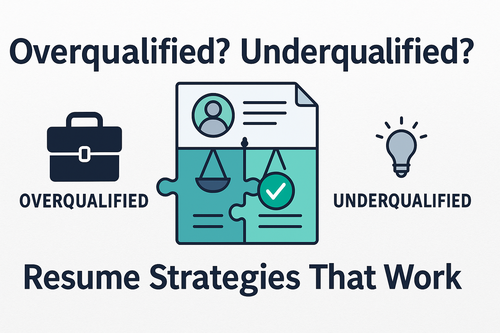
Overqualified? Underqualified? Resume Strategies That Work
Navigating job searches when you are perceived as overqualified or underqualified requires strategic resume writing that addresses recruiter concerns and highlights your fit. In 2025, adopting the right resume format and language can help you bridge the gap, showcase relevant skills, and position yourself as the ideal candidate.
| Resume Strategies at a Glance |
|---|
| Use a combination format to balance skills and experience |
| Reframe overly advanced or limited experience to focus on relevant qualifications |
| Highlight transferable skills & projects |
| Use language that signals enthusiasm and cultural fit |
The Challenge (Recruiter Perspective)
Recruiters often worry about:
- Overqualified candidates being costly or leaving quickly
- Underqualified candidates lacking essential skills
- Difficulty interpreting non-traditional experience
- ATS filters excluding resumes lacking exact keywords
Your resume needs to proactively alleviate these concerns.
Understanding why these concerns exist helps you address them directly. A recruiter screening an overqualified candidate thinks: “Will this person accept our salary range? Will they get bored in six months and leave?” Meanwhile, someone reviewing an underqualified candidate wonders: “Can they actually do the job, or will we spend months training them?” Your resume must answer those unspoken questions before an interview even happens.
Choose the Right Format to De-Emphasize Gaps
- Use the combination resume format to lead with skills and relevant accomplishments followed by experience.
- Focus on the qualifications and attributes that align with the job.
- De-emphasize dates or irrelevant roles that raise doubts.
The combination (or hybrid) format works because it puts your most relevant qualifications front and center before a recruiter even reaches your employment dates. For overqualified candidates, this means a recruiter sees that you have exactly the right skills for the role before they notice your VP-level title. For underqualified candidates, they see your transferable skills and relevant projects before noticing a missing credential.
Format tip for overqualified candidates: You do not need to list every job you have held. A resume can legitimately focus only on the most relevant ten to fifteen years of experience. Roles from earlier in your career that are significantly more senior than the target position can simply be omitted or listed briefly without bullet points under an “Additional Experience” section.
Reframe Experience (Skills, Projects, Volunteering)
- For overqualified candidates, downplay senior titles and focus on skills applicable to the target role.
- For underqualified candidates, emphasize learning agility, certifications, and volunteer or project experience.
- Use metrics and outcomes that demonstrate impact regardless of role level.
Reframing is not dishonesty — it is strategic emphasis. Here is how it looks in practice:
Overqualified reframe example: Instead of: “VP of Marketing overseeing a $5M budget and a team of 30” Write: “Marketing strategist with expertise in campaign execution, brand positioning, and cross-functional collaboration”
This describes the same experience at a level that feels appropriate for a Senior Marketing Manager role, rather than signaling you are two levels above it.
Underqualified reframe example: Instead of: “Completed online course in Python programming” Write: “Applied Python scripting to build automated data reports, reducing manual processing time by 3 hours per week (personal project)”
The second version demonstrates real-world application rather than passive learning, which is far more convincing to a hiring manager.
Language Examples You Can Adapt
- Overqualified: “Leveraged extensive leadership experience to improve team collaboration and streamline processes aligned with organizational goals.”
- Underqualified: “Rapidly developed technical skills via coursework and real-world projects, demonstrating strong problem-solving abilities.”
- Emphasize motivation, adaptability, and eagerness to contribute.
Common Mistakes That Hurt Both Groups
Understanding what not to do is just as important as knowing the right strategies.
Mistakes overqualified candidates make:
- Listing every senior-level title prominently without context
- Writing a summary that emphasizes authority and budget ownership when the role does not require it
- Failing to explain why they genuinely want a less senior position
- Using jargon and acronyms from executive-level work that does not translate to the target role
Mistakes underqualified candidates make:
- Hiding gaps or leaving unexplained white space that raises more questions
- Using vague, unquantified language like “helped with projects” or “assisted the team”
- Applying to roles where the gap is too large (e.g., applying for a senior engineering role with no engineering experience)
- Failing to show any proactive effort to close the skills gap
How to Explain Gaps in Applications
- Briefly address gaps with positive phrasing in cover letters or summary sections.
- Highlight continuous skill development or freelance/volunteer work during gaps.
- Keep explanations concise and forward-looking.
Role-Specific Strategies by Industry
Different industries have different tolerance levels for qualification mismatches.
Tech roles: Underqualified candidates can close gaps faster here than in most fields. If a job listing asks for three years of experience but you have one year plus a strong portfolio of projects, your GitHub profile and portfolio can speak louder than your experience timeline. Lead with skills and projects.
Healthcare and regulated industries: These fields often have hard requirements — specific licenses, certifications, or years of clinical experience. Underqualified candidates should not apply unless they can genuinely meet the minimum requirements. Overqualified candidates transitioning from private to public health, for example, should emphasize mission alignment and patient outcomes over administrative achievements.
Finance and accounting: Certifications (CPA, CFA) carry significant weight. If you are underqualified on credentials but have strong practical experience, emphasize your practical output (reports generated, portfolios managed, audit findings resolved) and note any certifications in progress. Overqualified candidates should focus on the specific technical skills required rather than management scope.
Creative and marketing roles: Portfolio work often outweighs formal credentials. Both overqualified and underqualified candidates benefit from linking to concrete work samples directly in or alongside the resume.
ATS Considerations
- Match keywords from job postings carefully, even if skills are above/below stated requirements.
- Use simple, ATS-friendly formatting with clear headings and bullet points.
- Avoid jargon unrelated to the target role; translate specialized terms as needed.
- Submit in recommended file formats (DOCX, clean PDF).
Templates & Checklist
| Overqualified/Underqualified Resume Checklist |
|---|
| Combination format prioritizing relevant skills |
| Tailored keywords from job description |
| Focus on transferable skills and demonstrable outcomes |
| Positive phrasing around motivation and adaptability |
| ATS-compatible layout and keyword density |
Copy-Ready Example (Combination Format)
Skills & Qualifications
- Team Leadership & Collaboration
- Process Improvement & Efficiency
- Technical Proficiency (Microsoft Office, CRM tools)
- Adaptability & Continuous Learning
Professional Experience
Senior Analyst | XYZ Corp | 2015–2023
- Streamlined reporting processes resulting in 20% time savings.
- Mentored junior staff to improve productivity and engagement.
Project Experience
- Completed certification in Agile Project Management (2024).
- Volunteered as data analyst for community nonprofit increasing fundraising success by 15%.
FAQ
Q: How can I avoid being screened out as overqualified?
A: Tailor your resume to focus on relevant skills, omit overly senior details, and express genuine interest in the role.
Q: What if I lack some listed qualifications?
A: Emphasize transferable skills, training, and your quick learning ability.
Q: Should I mention career gaps?
A: Address gaps positively, emphasizing ongoing development.
Q: How long should the resume be?
A: One to two pages, focused and concise.
Q: Should I write different resumes for different types of roles?
A: Yes. Maintain a master resume with your full history, then create targeted versions for each job category you are applying to. This is much more effective than sending the same document everywhere.
Q: Can I omit a high-level title from my resume if it makes me look overqualified?
A: You can legitimately omit very early roles or combine multiple roles under a general timeframe. However, never misrepresent your title or responsibilities on roles you do include, as this can be verified by background checks.
Q: What should I put in my summary section when I am underqualified?
A: Lead with your strongest transferable skills and genuine enthusiasm for the field, then address the gap proactively. For example: “Customer service professional transitioning into UX design, with completed coursework in user research and wireframing and three self-directed design projects.”
Related articles:
Build, Score & Track Your Job Search with ResumeMate
Resume Builder → — Create an ATS-ready resume in minutes.
Resume Score Checker → — See how your resume scores against ATS systems instantly.
Job Board → — Browse jobs matched to your resume.
Job Tracker Chrome Extension → — Track every application, deadline, and follow-up in one place — free.