Phone Interview Questions and Tips
You’ve landed a phone interview — now you need the right phone interview questions and tips to turn that short call into a face-to-face invitation. Phone screens are a make-or-break step that most job seekers underestimate. This guide walks you through exactly what recruiters ask, why they ask it, and how to prepare so you sound confident, clear, and hireable.
| What to Do | Why It Matters | Time |
|---|---|---|
| Prepare answers to common questions | Shows you’re ready and articulate | 1–2 hours |
| Set up a quiet, distraction-free space | Ensures clear communication | 10 minutes |
| Have your resume and notes handy | Quick reference for details | 5 minutes |
| Practice speaking clearly and at a moderate pace | Phone-only communication relies on voice | 30 minutes |
| Send a thank-you email after | Leaves a positive impression | 5 minutes |
Phone Interview Questions and Tips: What to Expect and How to Prepare
A phone interview typically lasts 15 to 30 minutes and serves as a screening tool before a company invests time in a longer in-person or video interview. Recruiters use it to verify your basic qualifications, assess communication skills, and gauge genuine interest. Knowing the format upfront helps you prepare with purpose.
You’ll usually face a mix of:
- Resume walk-through questions (“Walk me through your background”)
- Motivation questions (“Why this role? Why our company?”)
- Behavioral questions (“Tell me about a time you handled a difficult situation”)
- Logistical checks (salary expectations, availability, work authorization)
Before the call, research the company’s recent news, reread the job description, and prepare a concise “tell me about yourself” answer that connects your experience to the role. Keep your resume, the job posting, and a few bullet points of key achievements open on your screen or printed out. You can also run your resume through a free ATS score checker to make sure it’s clean and easy for recruiters to scan — many phone screens start with a quick review of your application.
Why Do Companies Conduct Phone Interviews?
Phone interviews aren’t random. They solve a practical problem: hiring teams need to filter a large applicant pool quickly and cheaply. A 20-minute call can reveal red flags — poor communication, mismatched salary expectations, lack of enthusiasm — that would waste an hour-long in-person meeting. For companies that receive hundreds of applications per role, the phone screen is the most efficient way to narrow the field to a manageable shortlist.
Beyond logistics, phone interviews test skills that resumes can’t show. Recruiters listen for clarity, confidence, and the ability to think on your feet. They also gauge cultural fit through tone and conversational style. For candidates, it’s a two-way street: you can assess the recruiter’s responsiveness and get a feel for the company’s communication norms. Some organizations even record calls (with permission) for later review by hiring managers, so treat every answer as if it’s being evaluated by multiple decision-makers.
For remote roles, phone and video interviews are even more central. If you’re applying to a distributed team, the phone screen often doubles as a test of how you communicate when you’re not in the same room. Our guide on remote job interviews covers that dynamic in detail.
In call center and BPO (business process outsourcing) jobs, the phone interview is a direct audition. Recruiters listen for tone, clarity, and empathy — the same skills you’d use on the job. If you’re targeting those roles, you’ll find specific strategies in our call center remote jobs guide.
Common Phone Interview Questions and How to Answer Them
Most phone interviews follow a predictable script. Preparing answers to these questions removes the panic and lets you focus on delivery.
“Tell me about yourself.”
This is almost always the opener. Keep it under two minutes, structure it as past-present-future, and tie your story to the job. For a full breakdown and sample scripts, read our tell me about yourself interview guide.
“Why are you interested in this role?”
Connect a specific detail from the job description to your skills. Instead of “I need a job,” say: “I saw you’re expanding your customer success team, and I’ve spent three years reducing churn in a similar SaaS environment — I want to bring that impact here.”
“What are your strengths and weaknesses?”
Choose a strength that matches a key requirement and give a one-sentence example. For a weakness, pick something real but fixable, and explain what you’re doing about it. “I used to rush through email follow-ups, so I now block 30 minutes at the end of each day to review them carefully.”
“Why are you leaving your current job?”
Stay forward-looking. Frame it as seeking growth, a new challenge, or alignment with the company’s mission — never badmouth a previous employer.
Behavioral questions (“Tell me about a time when…”)
Recruiters use these to predict future performance. The STAR method (Situation, Task, Action, Result) keeps your answers structured and impactful. Our STAR method guide walks you through it with examples you can adapt.
“What are your salary expectations?”
Research the market range beforehand. Give a range based on data, not a single number, and express flexibility: “Based on roles like this in the area, I’m targeting $60,000 to $70,000, but I’m open to discussing the full package.”
“How do you handle pressure or tight deadlines?”
This question tests your composure and problem-solving. Use a brief STAR example that shows you stay organized, communicate proactively, and deliver results even when stakes are high. Avoid saying you “thrive under pressure” without evidence.
“Where do you see yourself in five years?”
Recruiters want to know if your career trajectory aligns with the role. Tie your answer to realistic growth within the company or industry, and show ambition without sounding like you’ll outgrow the position in six months.
Phone Interview Tips for a Confident Performance
Your voice carries the entire conversation. These tips help you sound composed and professional.
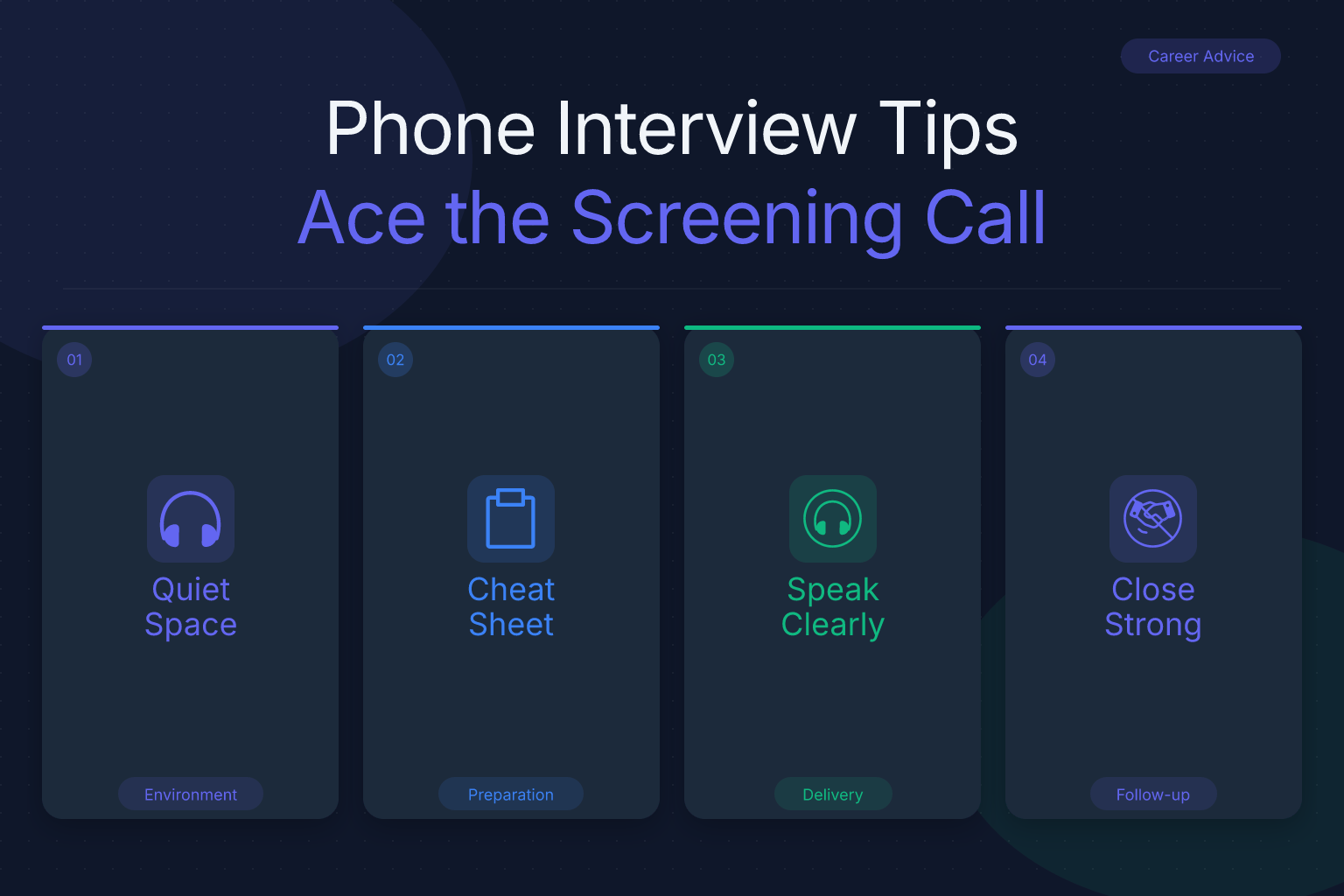
- Choose a quiet location. Background noise distracts both you and the interviewer. A room with a closed door, no pets, and no notifications is ideal.
- Use a reliable connection. A landline or a cell phone with full signal beats a shaky VoIP call. If you must use a computer, test your headset first.
- Have water nearby. A dry throat can make you sound strained. Take a sip before you answer a long question.
- Dress like it’s an in-person interview. It shifts your mindset. Many candidates report that wearing professional clothes — even on a phone call — improves their tone and confidence.
- Smile while you speak. It literally changes the sound of your voice, making you warmer and more engaged.
- Listen more than you talk. Let the recruiter finish. A brief pause before you answer shows you’re thoughtful, not scripted.
- Keep notes, not a script. Bullet points are fine; reading full sentences sounds robotic. Glance at your resume for dates and numbers, but maintain a conversational flow.
- Avoid filler words. “Um,” “like,” and “you know” undermine credibility. Practice pausing silently instead.
- Stand up while talking. Standing naturally increases energy and projection, making you sound more alert and authoritative.
- Use a headset or earbuds. This frees your hands for note-taking and prevents you from accidentally muffling the microphone.
- Mute when not speaking if there’s potential background noise. A quick mute during a cough or a passing siren can save the conversation.
How to Handle Tricky Phone Interview Situations
Not every call goes perfectly. Here’s how to recover gracefully.
If you don’t understand a question: “I want to make sure I answer what you’re asking — could you rephrase that?” It’s better than guessing.
If the connection is bad: “I’m having trouble hearing you clearly. Would it be possible to switch to a different line or reschedule for a few minutes from now?” Most recruiters appreciate the honesty.
If you’re caught off guard: “That’s a great question. Let me take a moment to think.” A 3–5 second pause is perfectly acceptable and shows composure.
If they ask about a gap or a short stint: Own it briefly and pivot to what you learned. “I took six months to care for a family member, and during that time I completed a certification in project management — which I’m excited to apply here.”
If the interviewer seems rushed or distracted: Stay concise and offer to follow up. “I know you’re busy — I can send a quick summary of my key points after the call if that helps.” This shows adaptability and respect for their time.
Does Interview Order Matter? First vs. Last Phone Interview
Candidates often wonder if being scheduled first or last gives an edge. Research on interview order is mixed. Some studies suggest early candidates set the benchmark, benefiting from the primacy effect where first impressions stick. Others indicate later candidates gain from recency bias, as the most recent conversation is fresher in the interviewer’s mind. In practice, a strong performance outweighs timing.
If you’re given a choice, pick a time when you’re naturally alert — mid-morning for most people — and avoid end-of-day slots when both you and the interviewer may be fatigued. If you’re first, use the opportunity to set a high bar: be energetic, clear, and memorable. If you’re last, summarize your fit succinctly and leave a lasting positive impression by referencing something unique from the conversation. Ultimately, focus on what you can control: preparation, energy, and a tailored follow-up.
After the Phone Interview: Follow-Up and Next Steps
What you do after the call can be as important as the call itself.
- Send a thank-you email within 24 hours. Mention one specific point from the conversation to show you were listening. Our thank-you email templates make this quick and personal.
- Log the interaction. Use the ResumeMate Job Tracker to record the date, recruiter name, and any promised follow-up. The free Chrome extension keeps your job search organized so nothing slips through the cracks.
- Reflect and adjust. If a question tripped you up, write a better answer now — you’ll likely hear it again in the next round. If you realized your resume undersold a relevant skill, update it in the ResumeMate free resume builder before the interviewer revisits your file.
- Prepare for the next stage. A phone screen that goes well usually leads to a video or in-person interview. Our complete interview preparation guide covers what changes and what stays the same.
Phone Interview for Remote and BPO Jobs: Special Considerations
Remote job phone interviews often emphasize self-management, communication tools, and home office setup. Expect questions like “How do you stay productive without direct supervision?” and “What collaboration platforms have you used?” Recruiters want to know you can work independently, manage time zones, and troubleshoot basic tech issues. Be ready to describe your dedicated workspace, internet reliability, and experience with tools like Slack, Zoom, or Asana. If you’ve worked remotely before, share a specific example of a project you delivered successfully from home.
For BPO and call center roles, the phone screen is a live audition of your phone presence. Recruiters listen for pace, clarity, empathy, and the ability to de-escalate. Practice answering common customer scenarios aloud, and record yourself to hear what the interviewer will hear. Focus on active listening: paraphrase the customer’s concern before offering a solution. If you can, simulate a mock call with a friend and ask for feedback on your tone and patience. Demonstrating these skills in the interview itself proves you’re ready for the job.
FAQ
Q: Why do companies do phone interviews first?
A: Phone interviews are a low-cost, high-speed screening tool. They let recruiters verify basic qualifications, assess communication skills, and filter out candidates who aren’t a fit before scheduling longer in-person or video interviews.
Q: What are the most common phone interview questions?
A: Expect “Tell me about yourself,” “Why are you interested in this role?,” “What are your strengths and weaknesses?,” “Why are you leaving your current job?,” and one or two behavioral questions like “Tell me about a time you solved a problem at work.”
Q: How should I prepare for a phone interview?
A: Research the company, review the job description, prepare concise answers to common questions, set up a quiet space with good reception, and keep your resume and a few achievement bullet points handy. Practice speaking at a steady pace and record yourself to catch filler words.
Q: Is it better to have your interview first or last?
A: There’s no definitive advantage. Early candidates can set a positive benchmark; later candidates may benefit from recency bias. Focus on delivering a strong, well-prepared answer regardless of slot. If you can choose, pick a time when you’re naturally alert.
Q: What should I do after a phone interview?
A: Send a personalized thank-you email within 24 hours, log the details in a job tracker, reflect on any questions that challenged you, and update your resume if you uncovered a missing strength. Then prepare for the next interview stage.
Q: How long does a phone interview usually last?
A: Most phone screens run 15 to 30 minutes. Initial recruiter calls tend to be shorter; hiring manager phone interviews may extend to 45 minutes if they dive deeper into technical or behavioral topics.
Q: Can I use notes during a phone interview?
A: Yes. Having your resume, the job description, and a few bullet points of key achievements in front of you is smart. Avoid reading full sentences — it makes you sound scripted. Glance at notes for facts, but keep your answers conversational.
Track Every Application While You Job Hunt
Stop losing track of where you’ve applied. The ResumeMate Job Tracker is a free Chrome extension that tracks every application, deadline, and follow-up in one place — right from your browser.