Personal Pronouns on Resume & LinkedIn: Should You Include Them? (2026 Guide)
Deciding whether to include your pronouns on a resume and LinkedIn profile is a personal choice that sits at the intersection of identity, professionalism, and job-search strategy. Some candidates add pronouns to signal inclusivity and avoid misgendering; others worry it could invite bias or feel out of place in their industry. This guide walks you through the pros, cons, and practical steps so you can make a confident decision that aligns with your goals and comfort level.
Key Takeaways
- Adding pronouns to your LinkedIn profile is widely accepted and takes less than two minutes using the dedicated pronoun field.
- On a resume, including pronouns is optional and depends heavily on your industry, company culture, and personal preference.
- Placing pronouns next to your name in the resume header is the cleanest, most professional format.
- Researching a company’s diversity statements and employee resource groups can help you gauge whether including pronouns will be seen as a positive.
- If you’re unsure, you can always add pronouns to LinkedIn and leave them off your resume — the two platforms don’t have to match.
| What to Do | Why It Matters | Time |
|---|---|---|
| Add pronouns to your LinkedIn profile | Shows inclusivity and helps recruiters address you correctly | 2 minutes |
| Decide whether to include pronouns on your resume | Depends on industry, company culture, and personal comfort | Varies |
| Use a consistent format (e.g., “she/her”) | Avoids confusion and looks professional | 1 minute |
| Research the company before applying | Some conservative industries may view it differently | 5–10 minutes |
| Update your email signature and Zoom name if you want consistency | Reinforces your pronouns across all professional touchpoints | 2 minutes |
Why Including Pronouns on Your Resume and LinkedIn Is a Growing Trend
In 2021, LinkedIn introduced a dedicated pronoun field on profiles, making it easier than ever to display “she/her,” “he/him,” “they/them,” or custom pronouns right after your name. This move reflected a broader cultural shift: more companies are actively encouraging employees to share pronouns in email signatures, Slack profiles, and video calls. For job seekers, the question naturally extends to resumes and LinkedIn.
Several forces are driving this trend:
- Inclusive hiring initiatives. Many large employers — including IBM, Google, and Salesforce — publicly state that they welcome pronoun sharing as part of building a respectful workplace.
- Remote and hybrid work. With less face-to-face interaction, written pronouns help colleagues and recruiters avoid awkward misgendering on Zoom or in emails.
- Generational expectations. Younger workers, particularly Gen Z, often view pronoun sharing as a basic courtesy, similar to stating your name.
That said, norms vary widely by region, industry, and company size. A tech startup in San Francisco will likely see pronouns as a non-issue, while a traditional manufacturing firm in a conservative area may not. Understanding this landscape is the first step toward making your own choice.
The Case for Including Pronouns on Your Resume
Adding pronouns to your resume can be a strategic move, especially if you’re targeting employers that value diversity, equity, and inclusion (DEI). Here’s why many candidates choose to include them:
1. It Prevents Misgendering from the Start
If you have a name that is gender-ambiguous (like Alex, Jordan, or Taylor) or a name that may be unfamiliar to some recruiters, pronouns remove the guesswork. A recruiter who sees “Alex Chen (he/him)” knows immediately how to address you in a phone call or email. This small addition can save you from the discomfort of being misgendered during a first impression.
2. It Signals Cultural Alignment
Companies that invest in DEI often look for candidates who share those values. Including pronouns can subtly communicate that you’re thoughtful about inclusion and would be a good cultural fit. In industries like tech, non-profits, education, and creative fields, this can be a genuine advantage.
3. It Normalizes Pronoun Sharing for Everyone
When cisgender people include pronouns, it reduces the stigma for transgender and non-binary individuals who might otherwise feel singled out. If you’re comfortable doing so, adding pronouns can be a small act of allyship that contributes to a more inclusive hiring process.
4. It’s Already Common on LinkedIn
Because LinkedIn has a built-in pronoun field, many recruiters are accustomed to seeing pronouns there. Carrying that consistency over to your resume can create a cohesive personal brand. If a recruiter views your LinkedIn profile first (which often happens), they’ll already know your pronouns — so including them on the resume simply reinforces that information. For more on optimizing your LinkedIn presence, check out our LinkedIn profile tips.
The Case Against Including Pronouns on Your Resume
Despite the benefits, there are valid reasons why some job seekers choose to leave pronouns off their resume. These concerns are not about being “anti-inclusive” — they’re about navigating a job market that isn’t always fair.
1. Risk of Bias or Discrimination
Unfortunately, bias still exists. A 2021 study published in the Proceedings of the National Academy of Sciences found that resumes with signals of LGBTQ+ identity received fewer callbacks in certain regions of the U.S. While many companies have non-discrimination policies, unconscious bias can still creep into the screening process. If you’re applying to roles in conservative industries or regions, you may worry that including pronouns could lead to your resume being passed over — even if the company would never admit it.
2. It’s Not Yet a Universal Norm
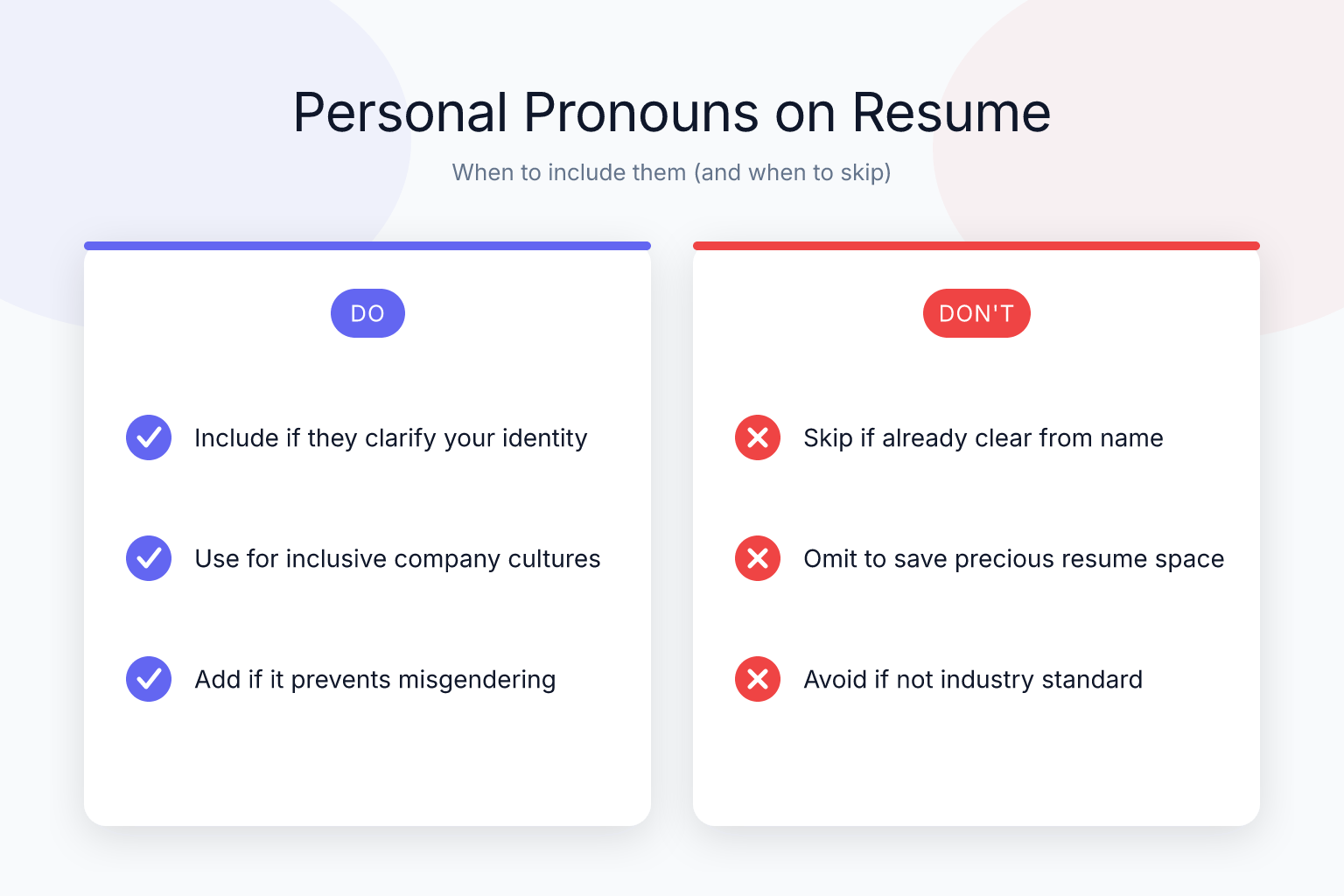
In many traditional fields — law, finance, manufacturing, and government contracting — pronouns on a resume are still rare. A hiring manager who isn’t familiar with the practice might view it as unnecessary personal information or even a distraction. You don’t want your resume to stand out for the wrong reasons.
3. Some ATS Systems May Strip or Mishandle the Field
While modern applicant tracking systems (ATS) parse text-based PDFs well, adding extra text in the name field could theoretically cause parsing errors if the system expects only a first and last name. This is rare, but if you’re applying through an older ATS, it’s worth considering. (You can check how your resume parses by using a free tool like the ResumeMate score checker.)
4. Personal Safety and Privacy
For transgender, non-binary, or gender-nonconforming individuals, disclosing pronouns on a public resume or LinkedIn profile can feel exposing. You may not be out in all contexts, or you may worry about being targeted by transphobic individuals. Your safety and comfort should always come first.
How to Add Pronouns to Your LinkedIn Profile (Step-by-Step)
LinkedIn makes it straightforward to display pronouns. Here’s how to do it in under two minutes:
- Go to your LinkedIn profile and click the “Edit” pencil icon in the top section (the intro card).
- Find the “Pronouns” field. It’s located right below your name and headline. If you don’t see it, make sure your profile language is set to English — the feature is available in several languages but not all.
- Select your pronouns. LinkedIn offers “she/her,” “he/him,” “they/them,” or a custom option. You can also choose who can see your pronouns: “All LinkedIn members” or “Connections only.” For job searching, “All LinkedIn members” is recommended so recruiters can see them.
- Save your changes. The pronouns will appear in parentheses next to your name on your profile.
If you’re also updating your resume, you can use the ResumeMate LinkedIn import tool to pull your profile data into a clean resume format — just make sure to review the pronouns field and adjust as needed.
Where to Place Pronouns on Your Resume (With Examples)
If you decide to include pronouns on your resume, placement matters. The goal is to make them visible but not distracting. Here are the most common approaches:
Option 1: Next to Your Name in the Header (Recommended)
This is the cleanest method and mirrors how LinkedIn displays pronouns.
Example:
Alex Chen (he/him)
Seattle, WA | alex.chen@email.com | (555) 123-4567
linkedin.com/in/alexchen
Option 2: On a Separate Line Below Your Name
If your header feels crowded, you can place pronouns on their own line.
Example:
Alex Chen
Pronouns: he/him
Seattle, WA | alex.chen@email.com | (555) 123-4567
Option 3: In the Contact Information Section
Some candidates list pronouns alongside phone and email, but this can look cluttered. Use this only if you have a very simple header.
Example:
Alex Chen
Seattle, WA | he/him | alex.chen@email.com | (555) 123-4567
Whichever format you choose, keep it consistent with your LinkedIn profile. If you use “he/him” on LinkedIn, don’t write “He/Him/His” on your resume — stick to the standard two-part format.
Industry and Company Culture Considerations
Before adding pronouns to your resume, research the company and industry. Here’s a quick breakdown of how different sectors tend to view pronoun sharing:
- Tech, Startups, Creative Agencies: Highly accepting. Pronouns are common and often expected as part of an inclusive culture.
- Non-Profits, Education, Government (Progressive Regions): Generally welcoming. Many organizations actively encourage pronoun disclosure.
- Finance, Law, Consulting (Large Firms): Mixed. Big firms often have DEI initiatives, but individual hiring managers may have varying perspectives. Check the firm’s website for pronoun usage in employee bios.
- Manufacturing, Construction, Trades: Less common. Pronouns on a resume may stand out and could be seen as irrelevant to the job.
- Conservative Regions or Small Local Businesses: Proceed with caution. If the company’s online presence shows no sign of inclusive language, you might choose to leave pronouns off.
To gauge a company’s culture, look at:
- The “About Us” or “Careers” page for diversity statements.
- Employee LinkedIn profiles — do current staff include pronouns?
- The company’s social media presence during Pride Month or other DEI-related events.
If you’re still unsure, you can always add pronouns to your LinkedIn profile (where it’s more expected) and leave them off your resume. The two don’t have to match, and a recruiter who views both will still see your pronouns on LinkedIn.
What to Do If You’re Unsure — A Decision Framework
If you’re on the fence, use this simple decision tree to guide your choice:
- Are you comfortable with strangers knowing your pronouns? If no, don’t include them. Your safety and privacy come first.
- Is your name frequently misgendered? If yes, adding pronouns can prevent awkward corrections and make your job search smoother.
- Are you applying to companies with visible DEI commitments? If yes, including pronouns may strengthen your application.
- Are you in a conservative industry or region where bias is a concern? If yes, consider leaving pronouns off your resume but adding them to LinkedIn (where you can control visibility).
- Do you want to be an ally and normalize pronoun sharing? If yes, and you’re in a safe environment, go for it.
Remember: this is not a permanent decision. You can add or remove pronouns from your resume for each application. Tailoring your resume to the specific company is a best practice anyway — just like you might adjust your summary or skills section. For more on tailoring, see our guide on what contact information to include on a resume and our resume tailoring checklist.
How to Handle Pronouns in Job Applications and Interviews
Beyond your resume and LinkedIn, pronouns may come up in other parts of the hiring process:
- Online application forms. Some companies now include an optional pronoun field. If you see one, fill it out if you’re comfortable. It’s a good sign that the company values inclusion.
- Email signatures. If you’re corresponding with a recruiter, adding pronouns to your email signature (e.g., “Alex Chen (he/him)”) can be a subtle way to share them without making it a big deal.
- Video interviews. You can add pronouns to your Zoom or Teams display name. This is especially helpful if your video feed is off or your name is ambiguous.
- In-person interviews. You’re not obligated to state your pronouns verbally, but if you’re comfortable, you can introduce yourself with them: “Hi, I’m Alex, and I use he/him pronouns.”
If a recruiter or interviewer misgenders you, it’s okay to correct them politely. A simple “Actually, I use they/them pronouns” is usually enough. How they respond can tell you a lot about the company’s culture.
FAQ
Q: Should I include my pronouns on my resume if I’m cisgender?
A: It’s entirely up to you. Many cisgender people include pronouns to normalize the practice and signal allyship. If you’re applying to inclusive companies, it can be a positive. If you’re in a conservative field, you might skip it to avoid standing out for the wrong reason.
Q: Will including pronouns on my resume hurt my chances of getting hired?
A: It depends on the employer. At companies with strong DEI programs, it’s unlikely to hurt and may even help. In more traditional or biased environments, there’s a small risk of unconscious discrimination. Research the company before deciding.
Q: Can I add pronouns to my LinkedIn but not my resume?
A: Absolutely. Many job seekers do this. LinkedIn is a social platform where pronoun sharing is normalized; resumes are more formal and often tailored to specific roles. There’s no rule that they must match.
Q: What if I use neopronouns like “ze/zir”?
A: LinkedIn allows custom pronouns, so you can enter “ze/zir” or any other set. On a resume, you can do the same, but be aware that not all recruiters will be familiar with neopronouns. If you’re comfortable, you might add a brief note like “(pronounced zee/zeer)” to help with pronunciation.
Q: Where exactly should I put pronouns on my resume?
A: The most professional placement is right after your name in the header, separated by a space or parentheses. For example: “Taylor Smith (they/them).” This mirrors the LinkedIn format and keeps your contact information clean.
Q: Do applicant tracking systems (ATS) have trouble with pronouns on a resume?
A: Modern ATS platforms parse text-based PDFs well and typically ignore a few extra characters in the name field. However, if you’re concerned, you can test your resume using a free ATS score checker like ResumeMate’s score tool to see how it’s read.
Track Every Application While You Job Hunt
Stop losing track of where you’ve applied. The ResumeMate Job Tracker is a free Chrome extension that tracks every application, deadline, and follow-up in one place — right from your browser.