Questions to Ask an Interviewer: 30+ Smart Questions That Impress Hiring Managers
The questions to ask an interviewer are just as important as the answers you give. When you ask thoughtful, well-researched questions, you show genuine interest, critical thinking, and confidence — qualities every hiring manager wants. But many candidates stumble here, either asking nothing or firing off generic queries that waste everyone’s time. This guide gives you over 30 smart questions to ask an interviewer, organized by category, so you can walk into any interview ready to have a real conversation and leave a lasting impression. Before you step into the room, make sure your overall preparation is solid — from your resume to your answers to common questions like “Tell me about yourself.” (See our guides on interview preparation and answering “Tell me about yourself”.)
| What to Do | Why It Matters | Time |
|---|---|---|
| Prepare 5–7 tailored questions based on the job description and company research | Shows you’ve done your homework and are genuinely interested | 30–60 min before interview |
| Ask about team dynamics, success metrics, and challenges | Reveals how the role fits into the bigger picture and what’s expected of you | During the interview |
| Avoid questions about salary, benefits, or time off until the offer stage | Keeps the focus on your value and fit, not what you can get | Save for later |
| Listen actively and ask follow-up questions | Turns a Q&A into a conversation; demonstrates emotional intelligence | Throughout |
| End with a question that invites the interviewer to share their own experience | Builds rapport and leaves a positive final impression | Last 5 minutes |
Why the Questions You Ask an Interviewer Matter More Than You Think
Many candidates treat the “do you have any questions for us?” part as an afterthought. But your questions reveal your priorities, your understanding of the role, and your ability to think on your feet. Hiring managers often remember the questions you asked more than some of your answers. In a survey by staffing firm OfficeTeam, 86% of senior managers said that a candidate who asks no questions is a red flag. So asking good questions isn’t optional — it’s a key part of the evaluation.
Beyond impressing the interviewer, your questions are your best tool for evaluating the employer. An interview is a two-way street. You need to know if this job, team, and company are right for you. The right questions uncover red flags, clarify expectations, and give you a feel for the culture. When you ask about challenges, you’ll also want to be ready to answer behavioral questions that demonstrate how you’ve handled similar situations. (Review the STAR method to structure your answers.)
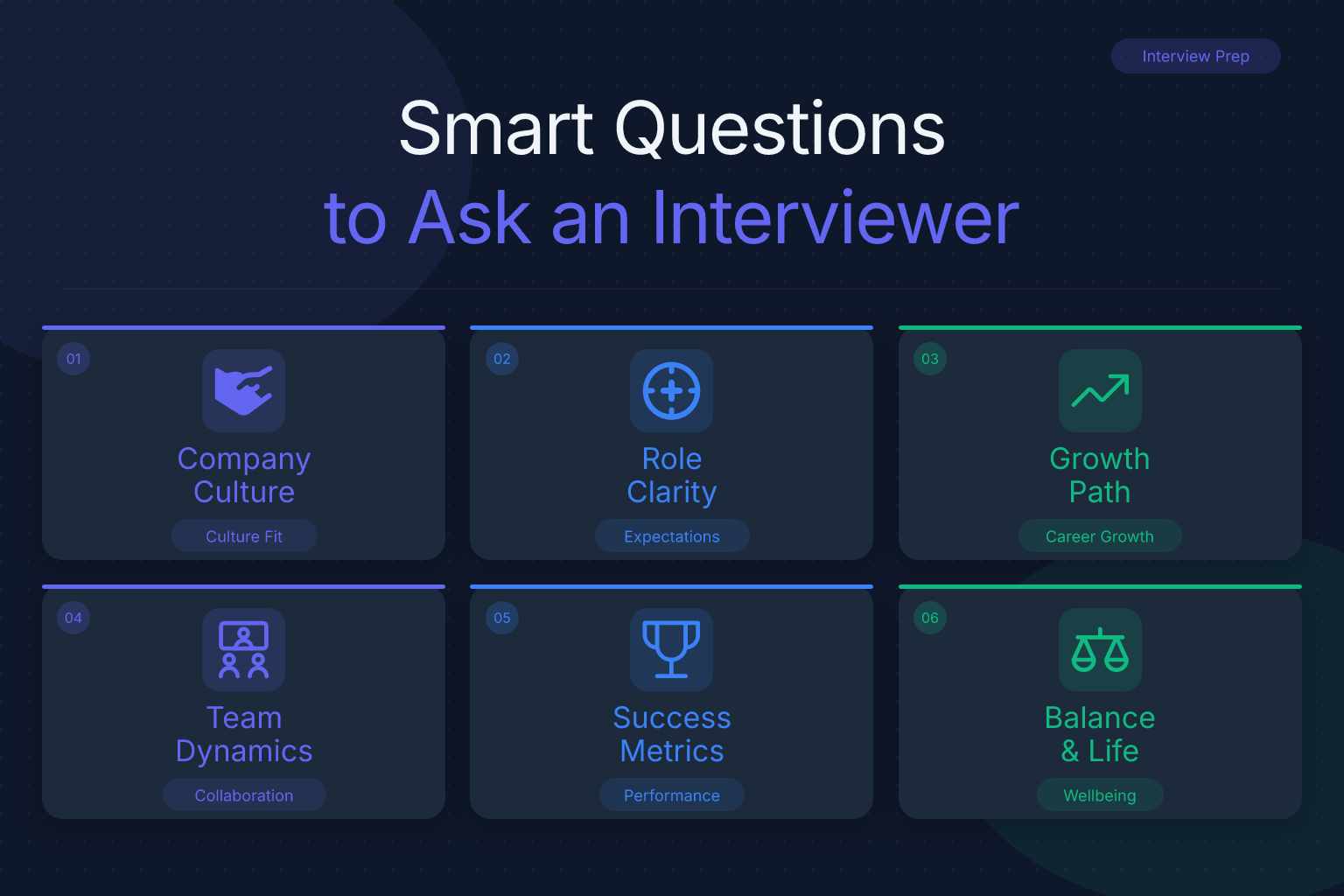
Questions About the Role and Day-to-Day
These questions show you’re thinking practically about what you’ll actually do every day. They also help you picture yourself in the role and spot any mismatches early.
- “What does a typical day look like in this role?” — This uncovers the rhythm of the work, the mix of tasks, and whether it aligns with your strengths.
- “What are the most immediate projects or priorities I’d tackle in the first 30 days?” — Shows you’re ready to hit the ground running and gives you a concrete picture of onboarding.
- “How is success measured in the first 90 days and beyond?” — Clarifies expectations and what “good” looks like, so you can decide if the goals are realistic.
- “What tools, software, or systems does the team use daily?” — Helps you assess whether your technical skills match and if you’d enjoy the toolset.
- “Who would I collaborate with most closely, and how does cross-functional communication work?” — Reveals the team structure and how siloed or collaborative the environment is.
- “What’s the biggest challenge someone in this role would face in the first six months?” — Gives you an honest preview of the pain points, and you can follow up by explaining how you’d tackle them.
Questions About Team and Culture
Culture fit goes both ways. These questions help you understand the team’s working style, values, and whether you’d thrive there.
- “How would you describe the team’s working style and communication norms?” — Uncovers whether the team is formal or casual, synchronous or async, and how decisions get made.
- “What’s the biggest challenge the team is facing right now?” — Shows you’re thinking about the team’s success, not just your own. Listen for signs of burnout, understaffing, or unclear direction.
- “How does the team handle conflict or disagreement?” — A mature answer indicates psychological safety; a vague one is a red flag.
- “What do you enjoy most about working here?” — A personal question that often gets a genuine, unscripted response. If the interviewer struggles to answer, that’s telling.
- “How does the company support work-life balance?” — Frame it around sustainability and productivity, not just time off. Ask about typical hours, after-hours expectations, and flexibility.
- “What’s something you wish you had known before joining the company?” — A disarming question that can surface honest insights about culture, pace, or politics.
Questions About Growth and Development
You want to know if this role is a stepping stone or a dead end. These questions signal ambition without sounding entitled.
- “What opportunities for professional development or learning does the company offer?” — Look for specifics: training budgets, conference attendance, mentorship programs, or internal courses.
- “Can you share an example of someone who started in this role and advanced?” — A concrete story tells you more than a generic “we promote from within.”
- “What skills or competencies would I need to develop to excel here long-term?” — Shows you’re coachable and thinking about growth, not just the immediate job.
- “How does the company support career growth — is it structured or more organic?” — Helps you understand if there’s a clear ladder or if you’ll need to carve your own path.
- “What’s the typical career trajectory for someone in this role over 2–3 years?” — Gives you a realistic timeline and helps you decide if it matches your goals.
Questions About Company Strategy and Challenges
Asking about the bigger picture demonstrates business acumen and genuine interest in the organization’s success.
- “What are the company’s top goals this year, and how does this department contribute?” — Connects your role to the mission and shows you think beyond your own to-do list.
- “What’s the biggest challenge the company or industry is facing right now?” — Signals you’re aware of external factors and want to understand how the company is navigating them.
- “I read about [recent news or product launch]; how is that impacting the team?” — Proves you did your research and can engage in a strategic conversation.
- “How does the company stay competitive in the market?” — Invites the interviewer to talk about differentiators, innovation, or culture — all useful for your decision.
- “What’s the leadership’s vision for the next 3–5 years?” — A forward-looking question that shows you’re thinking about long-term fit.
Questions to Ask at the End of the Interview
The final minutes are your chance to leave a strong last impression and clarify next steps. These questions wrap up the conversation on a confident, positive note.
- “Is there anything about my background or experience that makes you hesitate about my fit for this role?” — This takes courage, but it gives you a chance to address concerns directly. Many hiring managers respect the directness.
- “What are the next steps in the hiring process, and when can I expect to hear back?” — Practical and shows you’re organized. It also sets clear expectations so you’re not left guessing.
- “Do you have any final questions for me that I haven’t addressed?” — Opens the door for anything they might still be wondering, and shows you’re thorough.
- “What’s your favorite part about working here?” — Ends the conversation on a personal, positive note and often elicits a warm response.
- “Is there anything else I can clarify or expand on from our conversation?” — A graceful way to offer more detail without being pushy.
Questions to Avoid (and What to Ask Instead)
Some questions can hurt your candidacy because they signal poor preparation, entitlement, or a lack of genuine interest. Here’s what to skip and how to reframe.
- Avoid: “What does your company do?” — This screams zero research. Instead, ask a specific question about a recent initiative or product you read about.
- Avoid: “How much vacation time do I get?” or “Can I work from home?” — These focus on perks before you’ve proven your value. Instead, ask about work-life balance or team flexibility in a broader context: “How does the team handle remote or hybrid work?”
- Avoid: “How quickly can I get promoted?” — Sounds like you’re already eyeing the exit from the role you’re applying for. Instead, ask about growth paths: “What does career progression typically look like for someone who excels in this role?”
- Avoid: “What’s the salary?” — Unless the interviewer brings it up, save compensation for the offer stage. If you must, ask about the salary range for the role in a neutral way, but only if it hasn’t been disclosed and you’re deep in the process.
- Avoid: Questions with yes/no answers that kill conversation. — Instead of “Is there training?” ask “What does onboarding and training look like for this role?”
How to Choose the Right Questions for Your Interview
You don’t need to ask all 30+ questions. The key is selecting a handful that fit the role, the interviewer, and what you genuinely want to learn. Here’s a step-by-step approach:
- Research the company and role thoroughly. Read the job description, the company’s website, recent news, and employee reviews on sites like Glassdoor. Note anything that sparks curiosity or concern.
- Identify your priorities. What matters most to you — growth, culture, stability, impact? Pick 3–5 questions that probe those areas.
- Tailor questions to the interviewer. For an HR screen, ask about process, team structure, and high-level culture. For a hiring manager, dive into role specifics, expectations, and challenges. For a peer, ask about day-to-day collaboration and team dynamics.
- Practice asking them naturally. You don’t want to sound like you’re reading a list. Weave questions into the conversation when relevant, and save 2–3 for the dedicated Q&A time.
- Listen and adapt. If the interviewer already answered a question earlier, don’t ask it again. Instead, ask a follow-up: “You mentioned the team is working on X — could you tell me more about how that project is going?”
- Don’t overdo it. Asking 5–7 well-chosen questions is better than firing off 15. Respect the interviewer’s time and watch for cues that the conversation is wrapping up.
FAQ
Q: Why should I ask questions in an interview?
A: Asking questions shows you’re engaged, prepared, and genuinely interested in the role. It also turns the interview into a two-way conversation, giving you the information you need to decide if the job is right for you. Candidates who ask no questions often come across as disinterested or unprepared.
Q: What are the best questions to ask an interviewer?
A: The best questions are tailored to the role and company, and they probe areas like day-to-day responsibilities, team culture, success metrics, and growth opportunities. Examples include “What does a typical day look like?” and “How is success measured in the first 90 days?” Avoid generic questions that could be answered with a quick Google search.
Q: What questions should I ask at the end of an interview?
A: End with questions that leave a positive impression and clarify next steps. Strong closing questions include “Is there anything about my background that makes you hesitate?” and “What are the next steps in the hiring process?” You can also ask a personal question like “What’s your favorite part about working here?” to build rapport.
Q: What questions should I avoid asking?
A: Avoid questions that show a lack of research (“What does your company do?”), focus on perks too early (“How much vacation do I get?”), or sound entitled (“How quickly can I get promoted?”). Also steer clear of yes/no questions that don’t spark conversation. Reframe these topics into broader, more thoughtful inquiries.
Q: How many questions should I ask in an interview?
A: Aim for 5–7 well-chosen questions, but be flexible. If the conversation naturally covers some of your points, ask fewer. The quality and relevance of your questions matter far more than the quantity. Watch for cues that time is running short and prioritize your most important questions.
Q: Can I ask about salary and benefits during the interview?
A: It’s usually best to wait until the employer brings up compensation or until you’re in the offer stage. Asking too early can signal that you’re more interested in the package than the work. If you need to know the range to proceed, you can ask neutrally: “Could you share the budgeted salary range for this role?” but only if it hasn’t been disclosed and you’re in later rounds.
Q: What questions to ask an interviewer for a college interview?
A: For college admissions interviews, ask questions that show genuine interest in the school beyond rankings. Examples: “What do students love most about the campus community?” “How accessible are professors outside of class?” “What surprised you most about your own experience here?” Avoid questions easily answered on the school’s website.
Track Every Application While You Job Hunt
Stop losing track of where you’ve applied. The ResumeMate Job Tracker is a free Chrome extension that tracks every application, deadline, and follow-up in one place — right from your browser.