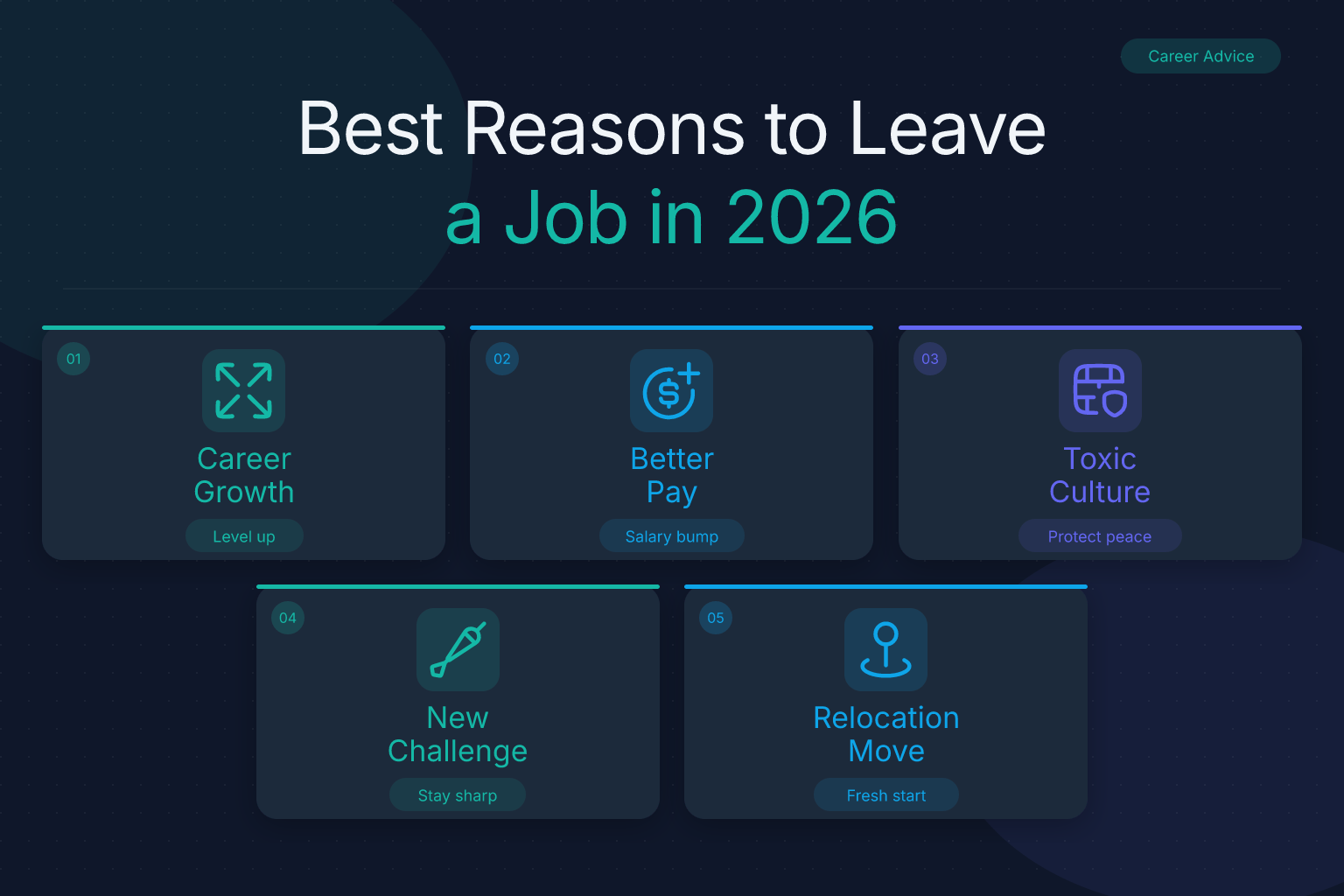
Best Reasons for Leaving a Job in 2026: Examples & Acceptable Answers
When an interviewer asks about your reasons for leaving a job, they’re not just making conversation — they’re evaluating your judgment, professionalism, and whether you’ll be a stable, motivated hire. A well-framed answer can turn a potential red flag into a reason to hire you. A poorly handled one can sink an otherwise strong candidacy. This guide gives you the exact language, strategies, and sample answers to explain any departure with confidence, no matter what really happened.
| What to Do | Why It Matters | Time |
|---|---|---|
| Focus on growth and new challenges | Shows ambition and forward-thinking | During interview prep |
| Avoid badmouthing previous employer | Demonstrates professionalism and emotional maturity | Always |
| Be honest but strategic | Builds trust without raising red flags | When crafting your answer |
| Align your reason with the new role | Proves you’re a strong fit for this specific job | Before the interview |
| Keep it brief and positive | Prevents rambling and accidental negativity | During the answer |
Why Interviewers Ask About Your Reasons for Leaving a Job
When hiring managers dig into your reasons for leaving a job, they’re looking for patterns. They want to know if you left for a legitimate, forward-looking reason — or if you’re running away from problems you might bring with you. According to most recruiters, the question serves three purposes:
- Stability check: Frequent, unexplained departures can signal that you’ll leave them just as quickly.
- Culture-fit gauge: If you left because of a toxic environment, they’ll wonder whether you contributed to it or can handle normal workplace friction.
- Motivation insight: A candidate who left to grow is more appealing than one who left because they were bored or unhappy.
Your answer also gives them a window into how you handle difficult situations. Someone who trashes a former boss or company comes across as a risk — no one wants to hire a potential liability. On the other hand, a candidate who frames even a layoff as a learning experience shows resilience and maturity.
Here’s the thing most candidates miss: interviewers aren’t just listening to what you say — they’re watching how you say it. A candidate who can discuss a difficult departure calmly and without defensiveness signals emotional intelligence, which is consistently ranked among the top soft skills employers look for in 2026. If you’re interviewing remotely, your delivery matters even more. A distracting background or poor camera setup can undermine an otherwise polished answer. Check out our guide on professional virtual backgrounds for job interviews to make sure your environment supports your message, not distracts from it.
Good Reasons for Leaving a Job (That Employers Love to Hear)
Not all departures are equal in an interviewer’s eyes. The best reasons for leaving a job are those that point toward the future, not the past. Here are the ones that consistently land well, with sample phrasing you can adapt.
Career Growth and Advancement
You hit a ceiling — no promotion path, no new responsibilities, no skill development. This is one of the strongest reasons because it signals ambition without negativity. When discussing this, be ready to elaborate on what specific growth you seek, such as when answering career goals interview questions.
Sample phrasing: “I learned a lot in my previous role, but after three years I’d mastered the core responsibilities and there wasn’t a clear path to the next level. I’m looking for a position where I can take on more leadership and keep growing.”
Why it works: Career advancement is the most commonly cited reason for leaving a job in 2026, and for good reason. It’s universally understood, requires no awkward explanation, and positions you as someone who wants to contribute more — not less. When you frame your departure around growth, you’re telling the interviewer that you’re the kind of person who outgrows roles, not the kind who coasts in them.
Seeking New Challenges
Similar to growth, but framed around the work itself becoming routine. It shows you’re self-motivated and not content to coast.
Sample phrasing: “I thrive when I’m solving new problems. My last role became very predictable, and I wanted to stretch myself in a more dynamic environment like this one.”
Why it works: This reason signals intrinsic motivation. You’re not leaving because something was wrong — you’re leaving because you want more. That’s a powerful distinction. Employers want people who seek challenges rather than avoid them.
Better Job Opportunity
Sometimes the simplest reason is the most honest one: you found something better. This overlaps with career growth but is distinct — it’s about the specific opportunity, not just a general desire to advance.
Sample phrasing: “I wasn’t actively looking, but when I learned about this role, it was too compelling to pass up. The combination of [specific responsibility], [team/company quality], and [growth potential] aligned exactly with where I want to take my career.”
Why it works: This answer flatters the interviewer while remaining honest. It shows you’re selective and intentional — you don’t leave jobs casually, but you recognize a strong opportunity when you see one. Just be prepared to articulate what specifically made this opportunity better, or it can sound like empty flattery.
Company Restructuring or Layoff
Layoffs are common and carry zero stigma when you explain them matter-of-factly. Never apologize for being laid off; just state it and pivot to what you did next.
Sample phrasing: “The company went through a major restructuring and my entire department was eliminated. It was a business decision, not performance-related. I used the time to upskill in [X] and I’m excited to bring that to this role.”
Why it works: In 2026, layoffs are so common across tech, finance, and beyond that most interviewers have either experienced one themselves or hired multiple people who have. The key is to remove any doubt that it was performance-related, then immediately shift focus to what you did with the time.
Relocation
Moving for personal or family reasons is neutral and easy to explain. Tie it to your enthusiasm for the new location if possible.
Sample phrasing: “I relocated to [city] to be closer to family. I left a great team on good terms, and now I’m focused on building my career here.”
Why it works: Relocation is one of the few reasons that requires zero justification. It’s a life decision, not a career judgment. The only risk is if the interviewer worries you’ll relocate again — so if you’re settled in the new location, say so explicitly.
Career Change or Pivot
You decided to move into a new industry or function. This shows intentionality and a willingness to start fresh — qualities many employers value.
Sample phrasing: “I realized my strengths are more aligned with [new field] than my previous industry. I’ve spent the last six months taking courses and building projects in this area, and I’m fully committed to the switch.”
Why it works: A career pivot demonstrates self-awareness and courage. You’re not drifting — you’re making a deliberate choice. The key is to show evidence of commitment: courses, projects, certifications, or volunteer work that proves you’re serious about the transition.
Contract or Temporary Role Ended
If you were a contractor, freelancer, or in a fixed-term position, the end date is built in. Frame it as a completed engagement.
Sample phrasing: “It was a 12-month contract to lead a specific project. We delivered on time, and when the contract wrapped up, I started looking for a permanent role where I can make a longer-term impact.”
Why it works: Contract endings are the cleanest possible reason for leaving — there’s no ambiguity, no conflict, no performance question. The only thing to watch is that you don’t sound like you’re only interested in short-term work. Emphasize that you’re now seeking permanence.
Better Work-Life Balance
This can be tricky — you don’t want to sound like you’re unwilling to work hard. But if you left a role with unsustainable hours, you can frame it around sustainable productivity.
Sample phrasing: “The role required 70-hour weeks consistently, and I found that after two years it was affecting the quality of my work. I’m looking for a high-performance environment where I can do my best work without burning out.”
Why it works: Work-life balance has become a mainstream priority, not a fringe concern. In 2026, most employers understand that burned-out employees are unproductive employees. The key is to frame it around quality of work — you want to perform at your best, and unsustainable hours prevent that.
AI and Automation Impact on Your Role
This is a newer reason that’s becoming increasingly common in 2026. If your role was significantly changed, reduced, or eliminated due to AI adoption or automation, you can frame it as a forward-looking pivot rather than a loss.
Sample phrasing: “My previous company automated a significant portion of my role’s core functions. Rather than wait for the position to shrink further, I proactively invested in upskilling in [AI-adjacent skill or new area] and I’m now looking for a role where I can apply both my original expertise and these new capabilities.”
Why it works: This answer shows adaptability and foresight — two qualities that are increasingly valuable as AI reshapes the workforce. You’re not a victim of automation; you’re someone who saw the shift coming and took action. Just be careful not to sound bitter about the technology itself. Frame AI as a reality you’ve embraced, not a threat you’re fleeing.
Reasons to Avoid Mentioning (and How to Reframe Them)
Some honest reasons will hurt you if stated bluntly. The key isn’t to lie — it’s to find the forward-looking truth inside the messy reality.
- “I hated my boss” → Reframe: “I’m looking for a leadership style that’s more collaborative and gives me room to take ownership.”
- “I was underpaid” → Reframe: “I’m seeking a role where my contributions and impact are better aligned with the compensation.”
- “I was bored” → Reframe: “I’d mastered the role and was ready for more complex challenges.”
- “Personality conflicts with coworkers” → Reframe: “I work best in environments that prioritize direct communication and cross-functional teamwork, and I’m seeking a culture that matches that.”
- “I was fired for performance” → Reframe honestly: “It wasn’t the right fit for my strengths. I’ve reflected a lot on what I’m best at, and that’s why I’m targeting roles like this one where I can excel in [specific skill].”
Notice the pattern: you’re not denying the situation, you’re extracting the lesson and pointing it toward the job you want now.
How to Craft Your Answer: A Step-by-Step Formula
A strong answer to “Why did you leave your last job?” follows a simple three-part structure. Practice it until it feels natural.
- State the reason in one positive, forward-looking sentence. Avoid backstory. Example: “I left because I wanted to move into a role with more strategic responsibility.”
- Connect it to what you learned or how you grew. This shows self-awareness. Example: “That experience taught me that I’m at my best when I’m leading cross-functional initiatives.”
- Bridge to why this new role is the right next step. This makes the interviewer see you as a fit. Example: “That’s exactly what drew me to this position — the chance to drive projects that span multiple teams.”
Keep the whole answer under 60 seconds. Anything longer and you risk over-explaining or drifting into negativity.
To make the formula even more concrete, here’s another example for someone leaving a stagnant role: “I’d been in the same position for four years and had taken on every stretch project I could, but there was no path upward. That experience taught me I’m ready to manage a team and own a P&L. This role’s focus on team leadership and strategic planning is exactly the next step I’ve been working toward.”
If you want to pressure-test your answer before the real thing, try running it through an AI interview coach. Our guide on ChatGPT interview prompts shows you how to get instant feedback on tone, clarity, and red flags — so you walk in with a polished, confident response.
Reason for Leaving on Job Applications vs. Interviews
Many candidates confuse how to answer this question on a formal job application versus in a live interview. The context changes the required depth.
On Online Applications: Most applicant tracking systems (ATS) have a dropdown or small text box for “Reason for Leaving.” Keep it neutral and concise. Do not write paragraphs here.
- Safe options: “Career advancement,” “Relocation,” “Contract completed,” “Company restructuring.”
- Avoid: Detailed explanations about conflict, pay, or dissatisfaction.
Here are the exact phrases that work best in application dropdowns and text fields, depending on your situation:
| Your Situation | What to Write on the Application |
|---|---|
| Left for a promotion or bigger role | “Career advancement” or “Better opportunity” |
| Moved to a new city | “Relocation” |
| Fixed-term contract ended | “Contract completed” |
| Company-wide layoff | “Company restructuring” or “Position eliminated” |
| Switched industries | “Career change” |
| Left for more responsibility | “Seeking new challenges” |
| Personal or family reasons | “Personal reasons” |
On a CV or Resume: Unlike applications, you should not list reasons for leaving on your CV or resume itself. Your CV is a marketing document focused on achievements, skills, and impact — not a chronological explanation of every transition. If a CV template or online form specifically asks for a reason for leaving (some European and UK application forms do), use the same concise phrases from the table above. For more on structuring your CV to emphasize strengths over chronology, check out our resume builder — it’s designed to highlight what you accomplished, not the gaps between roles.
In Interviews: This is where you expand using the three-part formula above. You have the opportunity to convey tone and body language. If you’re worried about how your resume presents these transitions, you can use the ResumeMate resume builder to craft a document that emphasizes achievements and skills over chronology, and the score checker to see if any gaps or flags stand out to an ATS.
Exit Interview Reasons for Leaving
Sometimes you’ll be asked for your reason for leaving during an exit interview with your current employer, not a future one. The strategy here is different.
- Keep it professional: Your goal is to leave on good terms and preserve references.
- Be constructive, not combative: If culture was an issue, frame it as “I think the team would benefit from more structured feedback loops” rather than “Management never listens.”
- Know your audience: Exit interview data often goes to HR, not necessarily your direct boss. Honesty is good, but burning bridges is not.
What to say in an exit interview, by scenario:
- Leaving for growth: “I’ve really valued my time here, and I’ve learned a tremendous amount. The new role offers a path to [specific responsibility] that isn’t available in my current position, and I felt ready to take that step.”
- Leaving due to culture: “I’ve appreciated the opportunity to work here. Over time, I’ve realized my working style aligns better with environments that have [specific cultural quality], and I wanted to be honest about that as I transition.”
- Leaving due to compensation: “The new opportunity offers a compensation package that better reflects my current market value. I’ve enjoyed my time here and I’m grateful for the experience.”
- Leaving due to management: “I’ve learned a lot, but I’ve found I work best with a management style that provides more [autonomy/feedback/structure]. I wanted to share that constructively as I move on.”
Remember: the exit interview is not the place to unload years of frustration. Even if you’re leaving because of serious issues, your goal is to exit gracefully. Future references, industry reputation, and even boomerang opportunities (returning to the company later) all depend on how you handle this conversation.
Sample Answers for Common Scenarios
Here are ready-to-use scripts for the situations you’re most likely to face. Adapt the specifics to your own story.
Left for growth: “I spent four years at my last company and grew from an associate to a senior role. But the team structure was flat, and there wasn’t a path to management. I’m ready to lead people and projects, which is why I’m excited about the team lead opening here.”
Laid off: “My position was eliminated during a company-wide reduction last fall. It was a tough moment, but I used the time to earn my [certification] and do freelance consulting. I’m re-entering the full-time market with sharper skills and a lot of energy.”
Relocated: “My spouse accepted a position in Denver, so we relocated. I left my previous role on excellent terms — they actually offered to let me work remotely, but I wanted to be fully present in a new city and find a local team to grow with.”
Career change: “I spent five years in accounting and realized my favorite part of the job was building the financial models, not the compliance work. I’ve since completed a data analytics bootcamp and built a portfolio of projects. This junior data analyst role is exactly the kind of work I want to do full-time.”
Contract ended: “I was brought on for an 18-month contract to overhaul their onboarding program. We hit all our milestones, and when the contract ended, I decided to look for a permanent L&D role where I can build something long-term.”
Toxic environment (reframed): “I learned a lot in that role, but over time I realized the organization’s values around transparency and collaboration didn’t match my own. I’m looking for a culture where open feedback and teamwork are genuinely practiced, and from everything I’ve read, that’s a priority here.”
Better opportunity: “I wasn’t actively searching, but when I learned about this role, the scope and growth potential were exactly what I’d been hoping to find. My previous company was great, but this opportunity represents a clear step forward in the direction I want my career to go.”
AI impact on role: “My previous company began automating core parts of my role, and I could see the position shrinking over time. I took that as a signal to invest in [new skill], and I’m now looking for a role where I can combine my original expertise with these new capabilities — which is exactly what this position offers.”
How to Address a Job You Were Fired From
Being terminated is the hardest departure to explain, but it’s not a dealbreaker if you handle it with honesty and perspective. Most hiring managers have seen it before and care more about what you learned than the fact it happened.
- Don’t hide it. If a background check will reveal the termination, getting ahead of it in the interview builds trust.
- Take responsibility without self-flagellation. “It wasn’t the right match for my skills at the time” is better than “I was unfairly targeted.”
- Show the turnaround. Describe what you did afterward — upskilling, freelancing, volunteering — to demonstrate you’ve moved forward.
- Keep it short. One or two sentences, then pivot to the future.
Example: “I was let go from my last role because my performance in [area] wasn’t where it needed to be. It was a tough lesson, but it clarified that my strengths are in [different area]. Since then, I’ve taken [specific course] and focused my job search on roles that play to those strengths, like this one.”
If the interviewer presses for more detail, stay calm and reiterate the lesson without getting defensive. You might say, “It really came down to a mismatch between the role’s demands and my natural strengths. I’ve since done a lot of self-assessment and targeted my search toward positions where I can deliver the most value — like this one.” The goal is to acknowledge the past without letting it define the conversation.
How to Explain a Gap in Employment After Leaving
Sometimes leaving a job creates a gap — whether intentional (a sabbatical, caregiving) or unintentional (a long job search). The same principles apply: be honest, frame it as a period of growth or deliberate choice, and connect it to your readiness now.
- Planned break: “I took six months off after a intense five-year run to travel and recharge. I came back with fresh energy and a clear sense of the kind of work I want to do next.”
- Caregiving: “I stepped away to care for a family member. That chapter is now stable, and I’m fully ready to re-engange with my career.”
- Job search stretch: “I’ve been selective in my search because I’m committed to finding the right long-term fit, not just the next job. In the meantime, I’ve been [freelancing/volunteering/learning].”
If your resume has a gap, a well-written resume summary can frame your story before the timeline even comes up. And when you tailor your resume to each role, you shift focus to what you can do, not the dates. Our guide on tailoring your resume to a job description walks you through that process step by step.
For gaps that appear on a resume, your cover letter is another chance to proactively address them. A brief, confident sentence — “After a planned career break to care for family, I’m fully re-engaged and excited to bring my updated skills to this role” — can neutralize the question before it’s even asked. If you need help structuring that letter, our cover letter templates and examples give you role-specific frameworks that make it easy.
Preparing Your Answer for the Interview
You’ve got your reason and your script. Now make sure it lands smoothly in the room.
- Practice out loud. Say your answer to a friend or record yourself. You’ll catch phrases that sound defensive or vague.
- Align with your resume and cover letter. If your resume shows a three-month gap, your answer should acknowledge it, not ignore it. If you addressed the departure in a cover letter, your interview answer should be consistent.
- Stay calm and matter-of-fact. The more emotional you sound, the more the interviewer will probe. A neutral, confident tone signals that the departure is resolved.
- Don’t volunteer extra details. Answer the question, bridge to the future, and stop. Oversharing is the fastest way to introduce doubt.
- Use the STAR method if asked for specifics. If they follow up with “Can you give me an example of how you handled that situation?”, structure your response with Situation, Task, Action, Result — keeping the focus on your professional handling of it.
- Simulate the real thing with AI. Tools like ChatGPT can fire follow-up questions at you, helping you practice staying composed under pressure. Our ChatGPT interview prompts guide includes a ready-to-use prompt that turns the AI into a mock interviewer — perfect for rehearsing your departure story until it feels effortless.
Finally, before you walk into any interview, make sure your resume isn’t silently undermining you. Run it through the ResumeMate score checker to catch formatting issues, missing keywords, or employment gaps that might prompt uncomfortable questions. A clean, ATS-friendly resume lets you control the narrative from the first impression. If you’re asked about your availability during this process, having a clear answer ready helps too; check our tips on availability start date sample answers to ensure you’re prepared for logistical questions as well.
FAQ
Q: What is the best answer for reason for leaving a job?
A: The best answer is forward-looking and positive, such as seeking career growth, new challenges, or a better culture fit. Avoid negativity about your past employer and focus on how the new role aligns with your professional goals. Use the three-part formula: state the reason briefly, share what you learned, and bridge to why this role is the right next step.
Q: What is the best answer for reason for leaving on a job application?
A: On written applications, keep it concise and neutral. Use phrases like “Career advancement,” “Relocation,” or “Contract completed.” Save detailed explanations for the interview stage where you can convey tone. Never write paragraphs in an application text box — one to three words is usually sufficient.
Q: What is a good reason for leaving a job on a resume?
A: You typically should not list reasons for leaving on a resume at all. Resumes are achievement-focused marketing documents, not chronological explanations. If a specific application form or CV template requires a reason, use a neutral phrase like “Career advancement” or “Relocation.” The detailed explanation belongs in the interview.
Q: Is career growth a good reason for leaving?
A: Yes, career growth is one of the most accepted reasons for leaving. It shows ambition and a desire to contribute more. Just be specific about what growth looks like for you, perhaps by preparing for related questions like where do you see yourself in 5 years.
Q: Is a better job opportunity a good reason for leaving?
A: Absolutely. “Better opportunity” is a universally understood and respected reason. The key is to articulate what specifically made the new opportunity better — whether it’s scope, growth potential, company reputation, or alignment with your long-term goals. Vague answers like “it just felt right” don’t land as well as specific ones.
Q: What are good exit interview answers for reason for leaving?
A: In exit interviews, remain professional and constructive. Focus on positive opportunities ahead rather than complaints about the current company. This ensures you leave on good terms and preserve future references. If you’re leaving due to culture or management issues, frame them as style mismatches rather than accusations.
Q: Should I put my reason for leaving on a resume?
A: No, you typically do not list reasons for leaving on a resume itself. Resumes should focus on achievements and skills. Reasons for leaving are discussed in cover letters, applications, or interviews.
Q: How do you explain why you left a job?
A: Use a three-part formula: state the positive reason briefly, mention what you learned, and connect it to why the new role is the right next step. Keep your explanation under 60 seconds to maintain engagement.
Q: What is the best way to answer reason for leaving?
A: The best way is to be honest but strategic. Frame any negative situations (like layoffs or mismatches) as learning experiences that led you to seek a role better aligned with your skills and values.
Q: What are examples of reasons for leaving a job on an application form?
A: Common acceptable examples include: “Career advancement,” “Better opportunity,” “Relocation,” “Contract completed,” “Company restructuring,” “Career change,” and “Personal reasons.” Choose the one that most accurately and neutrally describes your situation, and avoid detailed explanations about conflict, pay, or dissatisfaction.
Q: How do I explain leaving a job due to AI or automation?
A: Frame it as a proactive pivot rather than a loss. Say something like: “My previous company automated significant portions of my role, so I invested in upskilling in [new area] and I’m now looking for a position where I can apply both my original expertise and these new capabilities.” This shows adaptability and foresight — qualities employers increasingly value.
Q: What is a good reason for leaving a job on a CV?
A: On a CV, you generally don’t include reasons for leaving at all. If a specific application requires it (common in some UK and European formats), use the same neutral phrases you’d use on a job application: “Career advancement,” “Relocation,” or “Contract completed.” Keep it to one or two words.
Q: How do you explain reasons for leaving a job during interviews using professional phrasing?
A: Professional phrasing means avoiding emotional language, blame, or negativity. Instead of “I hated my boss,” say “I’m looking for a leadership style that’s more collaborative.” Instead of “I was underpaid,” say “I’m seeking a role where my contributions are better aligned with compensation.” The pattern: extract the forward-looking truth from the messy reality, and state it calmly and confidently.
Related articles:
- How to Evaluate 401k Vesting Schedules in Job Offers
- How to Pass Probation Period at New Job: Complete Checklist
- How to Clean Social Media for a Job Search
- Format a CV for New Zealand Job Market 2026
- How to Decide Between Two Job Offers: A Complete Checklist
- How to Negotiate a Job Title Without Changing Your Role
- How to Negotiate PTO in a Job Offer: Scripts & Strategies
- Negotiate Remote Work in a Job Offer: Scripts & Strategies
- How to Ask for a Letter of Recommendation: Email Templates
- How to Ask for a LinkedIn Referral: Templates That Work
- How to Use Job Alerts Effectively: Step-by-Step Guide
- How to Handle Job Rejection & Ask Feedback (2026)
- What to Wear to an Interview: A Complete Guide for 2026
- How to Answer “Tell Me About Yourself” in an Interview
Track Every Application While You Job Hunt
Stop losing track of where you’ve applied. The ResumeMate Job Tracker is a free Chrome extension that tracks every application, deadline, and follow-up in one place — right from your browser.