Are References Required on a Resume in 2026? No—Do This Instead
References on a resume were once a staple, but in 2025 their role has evolved. Most recruiters no longer require references upfront, preferring to request them later in the hiring process. Knowing when and how to include references — or if you should omit them entirely — can streamline your application and improve ATS compatibility.
| What to Do (Short Checklist) |
|---|
| Don’t include references unless requested |
| Prepare a separate reference list document |
| Provide relevant and professional references |
| Use consistent formatting with contact details |
| Share references only after employer’s request |
Who This Guide Is For
This guide suits all job seekers—from novices to veterans—wondering about including references on their resumes. Whether you’re applying for internships, mid-level roles, or executive positions, understanding modern references etiquette ensures professionalism.
References on a Resume — Definition & Purpose
References are individuals who can vouch for your skills, qualifications, and character. Including them directly on a resume was once common to validate applicants, but today they primarily support later-stage interviews or background checks.
Think of references as a final verification step in the hiring process, not an upfront sales pitch. By the time a recruiter contacts your references, they are already close to extending you an offer. That is why it makes far more sense to save that valuable resume space for skills, achievements, and experience — the content that actually gets you to that stage.
Who Makes the Best Reference?
Choosing the right references is just as important as formatting them correctly. Here is how to think about it:
Former or current managers are the gold standard. They can speak directly to your work output, reliability, and professional demeanor. Even a manager from a part-time job is a strong reference.
Professors or academic advisors work well for recent graduates or entry-level candidates with limited work history. They can speak to your intellectual rigor, work ethic, and communication skills. If you’re still in school or just graduated, check out our guide on college student resumes for more tips on positioning your academic experience.
Colleagues or team leads who worked closely with you on a specific project can add depth. They offer a peer perspective that complements what a manager would say.
Clients or external collaborators are useful in freelance or project-based roles. If a client can speak to the quality of your work and your professionalism, they carry real weight.
Who to avoid: Never list family members, close friends who have not worked with you professionally, or anyone who does not know your work in a relevant context. Personal character references are generally not accepted unless specifically requested.
Step-by-Step Guide to Preparing Your Reference List
Step 1: Identify three to five candidates. Aim for variety — a manager, a peer, and a mentor or professor covers most bases well.
Step 2: Ask for permission before listing anyone. This is non-negotiable. Being listed as a reference without warning can lead to an unprepared or even negative response. Give each person context: what role you are applying for, why you chose them, and what skills you hope they will highlight.
Step 3: Provide them with your current resume. Your references should know what you have listed on your resume so their comments reinforce rather than contradict your narrative.
Step 4: Format your reference list document consistently. Use the same header style as your resume (name, contact info, LinkedIn). List each reference with their full name, title, company, phone, and email.
Step 5: Save the document separately. Name it clearly, such as “FirstName LastName — References.pdf.” Do not attach it to your resume unless the employer specifically requests it.
Step 6: Send a thank-you note after each reference is contacted. Keep your references informed and appreciated — they are doing you a professional favor.
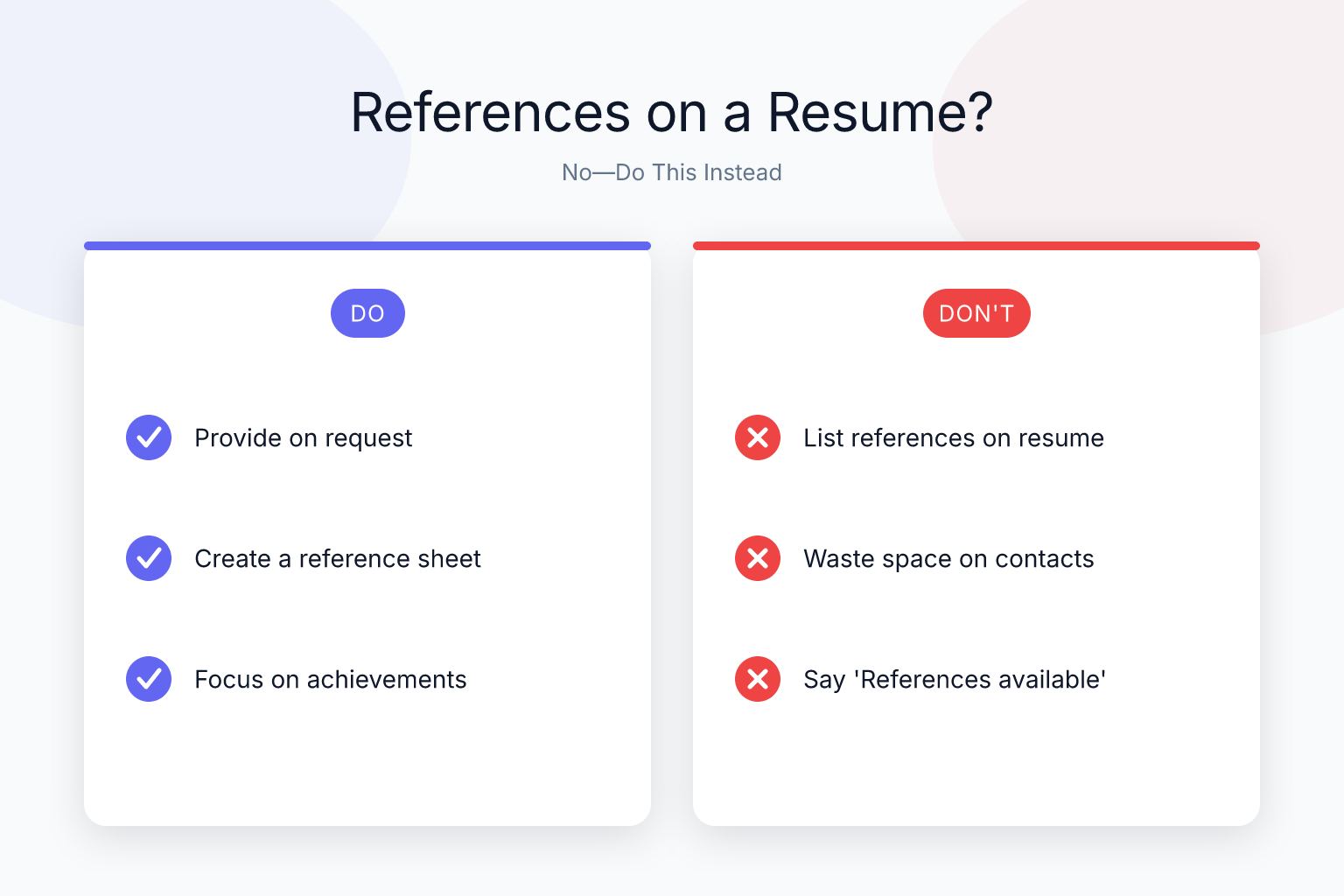
Best-Practice Rules (Do / Don’t)
| Do | Don’t |
|---|---|
| Provide references only when specifically asked | List “References available upon request” on your resume |
| Prepare a separate references sheet with full details | Include friends or irrelevant contacts |
| Ask permissions and inform your references | Share references without their consent |
| Keep contact info up-to-date and professional | Overwhelm recruiters with too many references |
Examples by Level & Industry
Example Reference Entry
Jane Smith
Former Manager, Marketing Team
ABC Company
Phone: (123) 456-7890
Email: jane.smith@example.com
Mid-Level Professional
For a mid-career candidate, a reference list should reflect a mix of managerial and peer perspectives. Here’s a sample list for a marketing manager applying to a senior role:
John Rivera
Director of Marketing, XYZ Corp
Phone: (555) 123-4567
Email: j.rivera@xyzcorp.com
Relationship: Former direct supervisor for 3 years; can speak to campaign leadership and cross-functional collaboration.
Priya Kapoor
Senior Product Manager, XYZ Corp
Phone: (555) 987-6543
Email: p.kapoor@xyzcorp.com
Relationship: Peer collaborator on three product launches; can speak to analytical skills and stakeholder management.
Marcus Chen
VP of Sales, ABC Inc. (former employer)
Phone: (555) 222-3333
Email: m.chen@abcinc.com
Relationship: Manager from previous role; can speak to leadership growth and revenue impact.
This list shows a clear hierarchy of relationships and gives the hiring team multiple angles on the candidate’s performance.
Entry-Level / Students
Entry-level candidates often worry they have no professional references. The key is to think broadly about who can speak to your work ethic and skills. A strong reference list for a new graduate might look like:
Dr. Emily Tran
Professor of Computer Science, State University
Phone: (555) 444-5555
Email: e.tran@stateuniv.edu
Relationship: Academic advisor and instructor for two advanced courses; can speak to technical ability and intellectual curiosity.
Sarah Lim
Volunteer Coordinator, Local Food Bank
Phone: (555) 666-7777
Email: s.lim@foodbank.org
Relationship: Supervisor during a 6-month volunteer commitment; can speak to reliability, teamwork, and communication.
Alex Martinez
Shift Lead, Campus Bookstore
Phone: (555) 888-9999
Email: a.martinez@bookstore.edu
Relationship: Direct supervisor for part-time job; can speak to punctuality, customer service, and handling responsibility.
Even without a corporate internship, these references demonstrate professionalism and character. For more on building a resume with limited experience, see our college student resume guide.
Executive / Senior-Level
At the executive level, references carry even more weight. Choose individuals who can speak to strategic impact, leadership style, and board-level interactions. A sample list:
Linda Washington
Former CEO, GlobalTech Solutions
Phone: (555) 111-2222
Email: l.washington@globaltech.com
Relationship: Reported directly for 5 years; can speak to P&L management, organizational transformation, and executive presence.
David Okonkwo
Board Member, Innovate Partners
Phone: (555) 333-4444
Email: d.okonkwo@innovatepartners.com
Relationship: Board-level interaction during tenure as COO; can speak to governance, strategic planning, and stakeholder relations.
Rachel Kim
Chief People Officer, MegaCorp
Phone: (555) 555-6666
Email: r.kim@megacorp.com
Relationship: Peer executive; can speak to leadership culture, talent development, and cross-functional collaboration.
For senior roles, it’s common to provide references only after a verbal offer is extended, but having this list ready shows preparedness.
How to Customize References for a Job Description
- Identify the most relevant references based on the role or industry.
- Choose individuals familiar with your skills related to the job.
- Brief your references on the position and resume highlights.
Customizing your reference list is not about gaming the system — it is about being strategic. If you are applying for a data analyst role, lead with a reference who worked alongside you on a data-heavy project. If you are applying for a leadership or management role, choose someone who observed you leading a team or project directly.
A brief email to your reference before they are contacted goes a long way. Something like: “Hi [Name], I’ve just applied for a senior marketing manager role at [Company]. I listed you as a reference and wanted to give you a heads-up. The role focuses heavily on campaign analytics and cross-functional collaboration — both areas you’ve seen me work in at [Previous Job]. Let me know if you have any questions.” That kind of prep leads to stronger, more specific endorsements.
If you’re changing industries, your reference list can help bridge the gap. A reference who can speak to transferable skills — like project management, communication, or data analysis — is more valuable than one tied to a specific sector. For more on positioning yourself for a career pivot, read our career change resume format guide.
Formatting Tips (ATS + Readability)
- Do not include reference details on the resume file itself.
- Create a separate document labeled clearly as “References” or “Reference List.”
- Use consistent formatting: name, title, company, phone, email.
- Keep references concise; 3-5 is standard.
- Save file in DOCX or ATS-friendly PDF for clean sharing.
Why a separate document matters. Modern applicant tracking systems (ATS) parse your resume to extract structured data. Adding references directly on the resume can clutter the file, confuse the parser, and waste space that should be devoted to skills and accomplishments. A clean, single-column resume without extraneous sections is the safest bet for ATS compatibility. For a deeper dive into what ATS actually do and don’t penalize, see our ATS myths vs. facts article.
File format. Most modern ATS (Workday, Greenhouse, Lever, iCIMS) parse text-based PDFs without issue. The problems arise from scanned or image-based PDFs, complex tables, and graphics — not from the PDF format itself. A clean PDF exported from a resume builder like ResumeMate’s free resume builder is ATS-friendly. DOCX is a safe fallback only when a specific job portal explicitly requests it. For your reference list, the same rules apply: a clean PDF or DOCX, matching the style of your resume, is ideal.
Consistency with your resume. Use the same header block (name, phone, email, LinkedIn) on your reference sheet. This creates a seamless professional package when the employer opens both documents.
Checklist & Templates
| References Section Checklist |
|---|
| Are references only provided when requested? |
| Is the separate reference list clearly formatted? |
| Are contact details correct and professional? |
| Have references been informed and agreed to? |
| Are references relevant to the applied role? |
Fill-in-the-Blank Reference Template:
“[Name]
[Relationship/Title], [Company]
Phone: [Phone Number]
Email: [Email Address]”
Common Mistakes People Make with References
- Listing references on the resume itself. This eats up space that should be devoted to your experience, skills, and accomplishments. Keep the reference list as a separate document.
- Writing “References available upon request.” This phrase is outdated and adds nothing. Employers already assume you have references. Remove it entirely.
- Not informing your references in advance. An unprepared reference can come across as vague or even hesitant. Always give them a heads-up before applying.
- Listing too few or too many references. Three to five is the right range. Fewer than three may raise questions; more than five can overwhelm the hiring team.
- Using the same reference list for every job. Just as you tailor your resume, consider swapping references based on which skills each reference can best speak to for a given role.
FAQ
Q: Do you need references on a resume?
A: No, you do not need to include references on your resume in 2026. The vast majority of employers will request them only after an interview or when you’re a finalist. Including them upfront wastes prime resume real estate that could showcase your skills, achievements, and experience. Instead, prepare a separate reference list and have it ready to send when asked.
Q: Are references required on a resume?
A: References are not required on a resume unless a job posting explicitly states “include references with your application.” Even then, many candidates attach a separate document rather than embedding them in the resume. Always read the job ad carefully; if it doesn’t ask for references, leave them off.
Q: How many references do you need on a resume?
A: You don’t need any references on the resume itself. When you prepare a separate reference list, aim for three to five professional references. This gives the employer enough perspectives without overwhelming them. Having at least three ensures you have a backup if one contact is unavailable.
Q: Does an ATS resume need references?
A: No, an ATS-friendly resume should not include references. Applicant tracking systems are designed to parse work history, skills, and education — not reference contact details. Adding references can clutter the file and may even cause parsing errors. Keep your resume clean and focused on the content that gets you through the ATS screen. You can check your resume’s ATS score for free to see how it performs.
Q: Should I put “References available upon request” on my resume?
A: No. This phrase is a relic of the past. Recruiters already assume you have references; stating it takes up space and adds zero value. Remove it entirely and use that line for a skill, certification, or achievement.
Q: What do recruiters want instead of references?
A: Recruiters typically want to verify your background after they’ve decided you’re a strong candidate. They’ll ask for references at the offer stage or just before. At that point, they’re looking for confirmation of your performance, not an introduction. Having a polished, separate reference list ready shows you’re organized and professional.
Q: Can I use personal references?
A: Professional references are strongly preferred. Personal references — neighbors, friends, clergy — are rarely accepted unless the employer specifically asks for a character reference as part of a background check. Stick to people who have seen your work in a professional, academic, or volunteer setting.
Q: What should I do if I have no professional references?
A: Use professors, academic advisors, coaches, or supervisors from volunteer positions. Anyone who can speak to your work ethic, reliability, and skills in a non-personal context qualifies. Even a shift lead from a part-time job can be a solid reference. Focus on people who can describe how you work, not just who you are.
Q: How long should I keep my reference list updated?
A: Review and update it before each job search cycle. Contact information changes, people leave companies, and relationships evolve. An outdated reference list can delay your hiring process at the worst possible moment. A quick check-in with your references every 6–12 months keeps everything current.
Related articles:
- Pronouns on Resume & LinkedIn: Should You Include Them?
- Answer ‘Where Do You See Yourself in 5 Years?’ Examples
- Do I Need a Cover Letter? A 2026 Guide for Job Seekers
- Proficiency on Resume: Skill Levels & Language Fluency
- ATS Myths vs. Facts in 2026 (With Recruiter Quotes)
- Career Change Resume Format (Combination Template)
- College Student Resume (Projects, Coursework & Skills)
Build, Score & Track Your Job Search with ResumeMate
Resume Builder → — Create an ATS-ready resume in minutes.
Resume Score Checker → — See how your resume scores against ATS systems instantly.
Job Board → — Browse jobs matched to your resume.
Job Tracker Chrome Extension → — Track every application, deadline, and follow-up in one place — free.