Requesting disability accommodations during a job interview is a legal right, not a special favor. If you have a disability that affects how you interview, asking for reasonable adjustments can level the playing field and let you show your true skills. Many candidates hesitate because they worry about stigma or rejection, but the law protects you, and most employers want to help. This guide walks you through when, how, and what to ask for — with scripts, templates, and answers to common questions.
Key Takeaways
- You have the legal right to request reasonable accommodations at any stage of the hiring process, including the interview, under the Americans with Disabilities Act (ADA) and similar laws in other countries.
- Request accommodations as early as possible, ideally when you schedule the interview, to give the employer time to arrange them.
- You do not have to disclose your specific disability or medical diagnosis; you only need to describe the functional limitation and the accommodation you need.
- Common interview accommodations include extra time, written questions in advance, accessible interview locations, sign language interpreters, and alternative formats for materials.
- If an employer denies or ignores your request, you can ask for the reason, request an alternative, and file a complaint with the EEOC or your local fair employment agency.
Key Takeaways
- You have the legal right to request reasonable accommodations at any stage of the hiring process, including the interview, under the Americans with Disabilities Act (ADA) and similar laws in other countries.
- Request accommodations as early as possible, ideally when you schedule the interview, to give the employer time to arrange them.
- You do not have to disclose your specific disability or medical diagnosis; you only need to describe the functional limitation and the accommodation you need.
- Common interview accommodations include extra time, written questions in advance, accessible interview locations, sign language interpreters, and alternative formats for materials.
- If an employer denies or ignores your request, you can ask for the reason, request an alternative, and file a complaint with the EEOC or your local fair employment agency.
What Are Disability Accommodations and Common Examples
Disability accommodations in a job interview are adjustments to the interview process that remove barriers related to a disability. They do not change the job requirements or lower the bar for performance — they simply give you an equal opportunity to demonstrate your qualifications. Accommodations can be physical, sensory, cognitive, or communication-related.
Common examples include:
- Extra time for written tests or assessments
- Receiving interview questions in writing ahead of time
- An accessible interview location (e.g., wheelchair access, quiet room, adjustable lighting)
- A sign language interpreter or real-time captioning (CART)
- Screen reader or magnification software for digital materials
- Alternative formats for documents (large print, Braille, electronic text)
- Flexible scheduling (e.g., morning interviews if you experience fatigue)
- Permission to bring a service animal or a support person
- Virtual interview accommodations like closed captions or extended response time
The key is that the accommodation addresses a specific functional limitation caused by your disability. For example, if you have a visual impairment, you might request digital materials in advance so you can use a screen reader. If you have anxiety, you might request a short break between interview segments. The request should be tailored to what you actually need to participate fully.
If your interview is virtual, many of the same principles apply. You can request closed captions, a slower pace, or the ability to type responses instead of speaking. For more on virtual interviews, see our guide on nailing your remote job interview.
Your Legal Right to Request Accommodations
In the United States, the Americans with Disabilities Act (ADA) requires employers with 15 or more employees to provide reasonable accommodations to qualified individuals with disabilities, unless doing so would cause undue hardship. This applies to all stages of employment, including the application and interview process. The U.S. Equal Employment Opportunity Commission (EEOC) enforces these rules and provides guidance on what counts as a reasonable accommodation.
Similar laws exist in other countries:
- United Kingdom: Equality Act 2010
- Canada: Canadian Human Rights Act and provincial laws
- Australia: Disability Discrimination Act 1992
- European Union: Employment Equality Directive
Under these laws, you have the right to request accommodations without fear of retaliation. You do not need to disclose your specific diagnosis or medical history. You only need to explain that you have a disability (or a medical condition) and describe the functional limitation that affects your ability to interview, along with the accommodation you are requesting.
For example, you might say: “I have a condition that affects my ability to process spoken information quickly. Could I receive the interview questions in writing in advance?” You do not need to say “I have ADHD” or “I have a hearing impairment” unless you choose to.
Employers are required to engage in an interactive process — a back-and-forth dialogue — to determine an effective accommodation. They cannot simply refuse without exploring options. If the requested accommodation would be too costly or disruptive, they must offer an alternative that would be effective.
When to Request Accommodations
The best time to request accommodations is as soon as you know you need them, ideally when you are invited to interview. This gives the employer time to arrange interpreters, prepare materials, or adjust the schedule. However, you can request accommodations at any point — even during the interview if you realize something is preventing you from performing well.
Here is a typical timeline:
- When you receive the interview invitation: Reply to the email or call the recruiter and make your request. This is the most common and effective approach.
- A few days before the interview: If you forgot or your needs changed, contact the employer as soon as possible. Most accommodations can be arranged quickly.
- During the interview: If you encounter an unexpected barrier (e.g., the room is too noisy, the font on a test is too small), speak up. You can say, “I’m having difficulty with this. Could we adjust [X]?”
- After the interview: If you realize you need an accommodation for a second round or a follow-up assessment, request it before that next step.
Requesting early has advantages: it shows professionalism, gives the employer time to comply, and reduces your stress. However, some candidates worry that disclosing a disability before the interview could lead to bias. While illegal, bias can happen. If you are concerned, you can wait until you have a better sense of the employer’s culture, but remember that the law protects you regardless of when you ask.
How to Request Accommodations: Scripts and Email Templates
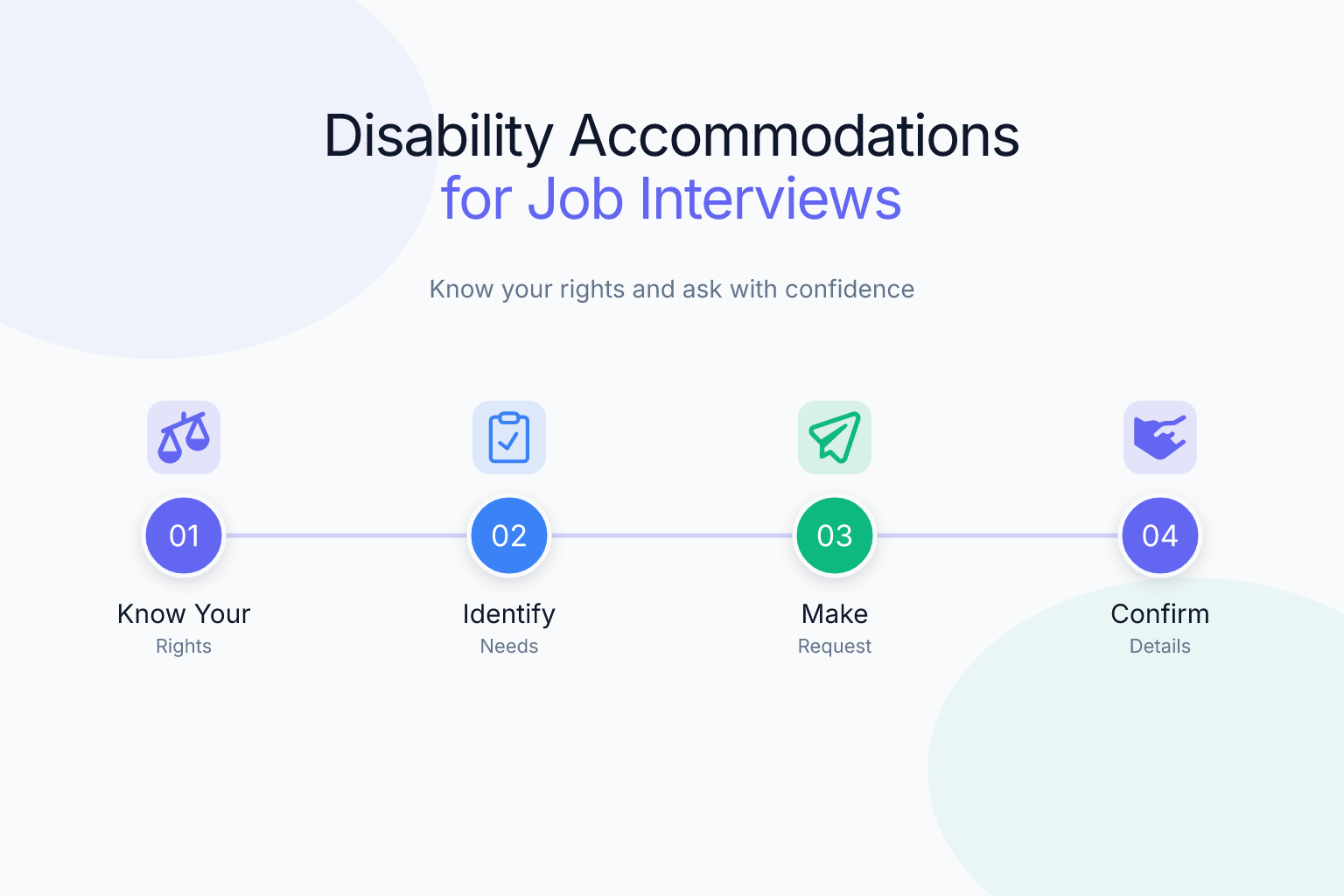
Requesting accommodations does not have to be complicated. Follow these steps:
- Identify what you need. Think about the specific barriers you expect in the interview. Do you need extra time? Written questions? A quiet room? Be specific.
- Decide how much to disclose. You can say “I have a disability” or “I have a medical condition” without naming it. You only need to describe the functional limitation.
- Contact the right person. Usually the recruiter, HR representative, or the person who scheduled the interview. If you are unsure, reply to the interview invitation email.
- Make the request in writing. Email is best because it creates a record. Keep it brief, polite, and clear.
- Follow up if needed. If you do not hear back within a few days, send a polite reminder.
Email Template
Subject: Accommodation request for interview on [date]
Dear [Name],
I am looking forward to my interview for the [Job Title] position on [date and time]. I have a disability that affects [brief functional limitation, e.g., “my ability to read small text quickly” or “my ability to process spoken information under time pressure”]. To participate fully in the interview, I would like to request [specific accommodation, e.g., “a digital copy of any written materials in advance” or “an additional 15 minutes for any written exercise”].
Please let me know if you need any additional information or if there is an alternative that would work better for your process.
Thank you for your consideration.
Best regards, [Your Name]
Phone Script
“Hi [Name], this is [Your Name]. I’m scheduled to interview for [Job Title] on [date]. I have a disability that affects [functional limitation]. Could I request [accommodation] for the interview? I’m happy to provide more details if needed.”
Remember: you are not asking for a favor. You are asserting a legal right. Keep your tone confident and matter-of-fact.
What to Do If Your Request Is Denied or Ignored
If an employer denies your accommodation request or simply does not respond, you have options. Start by asking for the reason. Under the ADA, an employer can only deny a request if it would cause undue hardship — meaning significant difficulty or expense relative to the employer’s size and resources. This is a high bar, and most accommodations are low-cost or free.
Here is a step-by-step response plan:
- Ask for the reason in writing. Send a polite email: “Thank you for considering my request. Could you explain why the accommodation cannot be provided? I would like to understand if there is an alternative that would work.”
- Propose an alternative. If the original request is denied, suggest a different accommodation that might be easier to implement. For example, if an interpreter is too expensive, ask for written questions instead.
- Escalate to HR or a higher authority. If the recruiter or hiring manager is unresponsive, contact the company’s HR department or diversity and inclusion office.
- Document everything. Keep copies of all emails, notes from phone calls, and any other communication. This will be important if you need to file a complaint.
- File a complaint. In the U.S., you can file a charge with the EEOC within 180 days of the discriminatory act. Many states have their own fair employment agencies with longer deadlines. In other countries, contact the relevant equality or human rights commission.
Remember that an employer’s failure to engage in the interactive process is itself a violation. You do not have to accept a denial without question. For more on what to watch for during the interview process, see our guide on signs you’ll get a job offer after an interview.
Tips for a Successful Interview with Accommodations
Once your accommodations are in place, focus on what you can control: your preparation and performance. Here are practical tips to help you make the most of your interview:
- Practice with your accommodations. If you requested extra time, take a timed practice test with that extra time. If you requested written questions, practice answering from a written prompt. Simulating the actual conditions will reduce anxiety and improve your performance.
- Arrive early (or log in early). Give yourself time to settle in, test any technology, and communicate any last-minute needs. This is especially important if you use assistive technology or need to adjust the environment.
- Do not apologize for needing accommodations. You have a right to them. A simple “Thank you for arranging this” is enough. Apologizing can undermine your confidence and shift focus away from your qualifications.
- Focus on your skills and experience. The interview is about whether you can do the job. Lead with your qualifications, not your disability. If the interviewer asks about your accommodation, answer briefly and redirect to your strengths.
- Ask clarifying questions. If a question is unclear or you need it repeated, ask. This is normal for any candidate and ensures you understand what is being asked.
- Send a thank-you note. After the interview, thank the interviewer and, if appropriate, acknowledge the accommodation without making it a big deal. This reinforces your professionalism and leaves a positive impression.
For a comprehensive interview preparation checklist, see our complete guide to interview prep.
How to Prepare Your Resume and Application When You Have a Disability
Your resume and application are your first impression. You are not required to disclose a disability on your resume, and in most cases, you should not. Focus on your achievements, skills, and experience — the same as any other candidate. If your disability is relevant to the job (e.g., you are applying for a role in disability advocacy), you may choose to mention it, but it is never mandatory.
However, if you need an accommodation for the application process itself — such as an alternative format for the application form or assistance submitting it — you can request that from the employer. The same legal protections apply.
To make sure your resume is ready for applicant tracking systems (ATS) and presents you in the best light, use a clean, single-column format. ResumeMate’s free AI resume builder creates ATS-friendly PDF resumes in minutes. You can also upload your existing resume to the free resume score checker to see how it scores and get section-by-section feedback.
If you are looking for employers known for inclusive hiring practices, browse the ResumeMate job board with filters for role, location, and remote work.
FAQ
Q: Do I have to disclose my disability when requesting an interview accommodation?
A: No. You only need to state that you have a disability or medical condition and describe the functional limitation that affects your ability to interview. You do not need to name your diagnosis or provide medical records unless the employer has a legitimate need for more information (which is rare at the interview stage).
Q: Can an employer ask me about my disability during an interview?
A: Under the ADA, employers cannot ask disability-related questions or require medical exams before making a job offer. They can ask whether you can perform the essential functions of the job with or without accommodation. If you bring up your disability, they may ask limited follow-up questions about the accommodation you need.
Q: What if I don’t know what accommodation to request?
A: Think about the specific barriers you expect. If you are unsure, you can say, “I have a disability that may affect my performance in [situation]. Could we discuss possible adjustments?” The employer is required to engage in an interactive process to find a solution.
Q: Is it better to request accommodations before or after the interview is scheduled?
A: Request as soon as you know you need them, ideally when you receive the interview invitation. This gives the employer time to arrange interpreters, materials, or schedule changes. However, you can request at any time, even during the interview.
Q: What counts as a “reasonable” accommodation?
A: A reasonable accommodation is any adjustment that removes a barrier related to your disability without causing undue hardship to the employer. Examples include extra time, written questions, accessible locations, interpreters, and alternative formats. Most accommodations are low-cost or free.
Q: Can I request accommodations for a virtual interview?
A: Yes. You can request closed captions, extended response time, the ability to type answers, or a slower pace. Many video platforms have built-in accessibility features. The same legal protections apply to virtual interviews as in-person ones.
Track Every Application While You Job Hunt
Stop losing track of where you’ve applied. The ResumeMate Job Tracker is a free Chrome extension that tracks every application, deadline, and follow-up in one place — right from your browser.