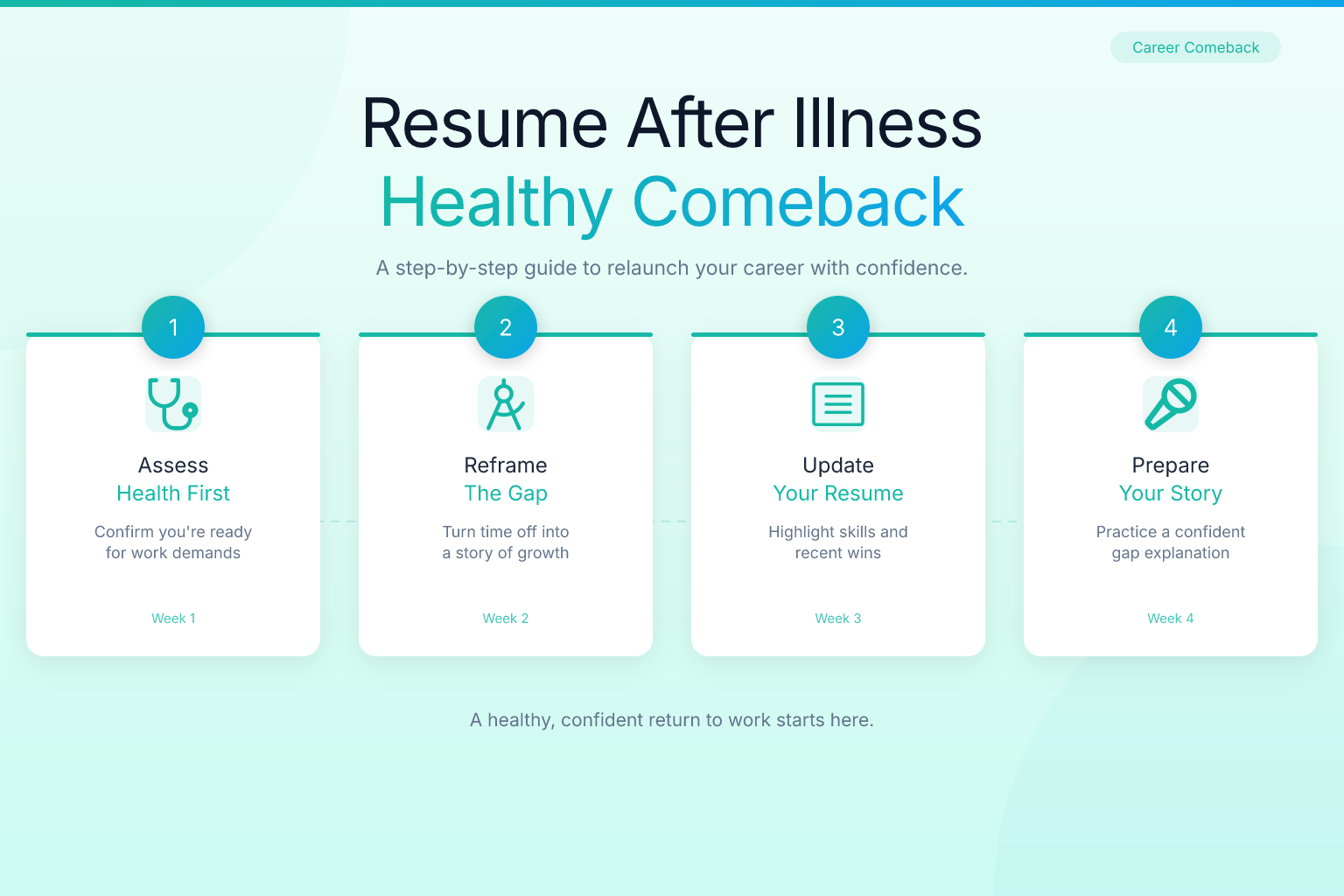
Resume After Illness: Your Healthy Comeback Guide
Returning to work after a career break due to illness can feel like standing at the base of a mountain. You’re not just updating a document — you’re rebuilding a professional identity after a period that may have been physically and emotionally draining. The good news: a well-crafted resume can turn your break into a story of resilience, not a red flag. This guide walks you through exactly how to write a resume that addresses your health-related gap honestly, strategically, and with confidence.
Key Takeaways
- You are not obligated to disclose your illness on your resume; you can frame the gap as a “career break” or “personal sabbatical” and address it in the cover letter or interview if you choose.
- Focus on what you did during the break — even small activities like online courses, volunteering, or caregiving — to show continuity and skill maintenance.
- Use a functional or hybrid resume format to shift attention from the timeline to your qualifications, and always tailor your resume to the job description.
- Prepare a brief, forward-looking explanation for the gap that emphasizes your readiness to return, and practice it until it feels natural.
- Leverage free tools like ResumeMate’s resume builder and score checker to create an ATS-friendly resume that highlights your strengths.
Summary Table
| What to Do | Why It Matters | Time |
|---|---|---|
| Choose a hybrid or functional resume format | Shifts focus from chronology to skills and achievements | 10 minutes |
| List any professional development during the break | Shows you stayed current and proactive | 15 minutes |
| Write a brief, positive gap explanation for your cover letter | Controls the narrative without oversharing | 20 minutes |
| Tailor your resume to each job description | Increases ATS compatibility and recruiter interest | 30 minutes per application |
| Practice your interview response about the gap | Builds confidence and reduces anxiety | 1 hour total |
Understanding the Stigma Around Health-Related Career Gaps
Many job seekers worry that a gap due to illness will be viewed as a weakness. The reality is more nuanced. Recruiters and hiring managers are human — they understand that life happens. What they care about most is whether you can do the job now and in the future. A gap for health reasons is not a moral failing; it’s a life event. The key is to present it in a way that doesn’t raise concerns about reliability or outdated skills.
If you’re returning after a long absence, you might feel your skills are rusty. That’s normal. But you’ve likely gained other strengths: resilience, perspective, and a renewed commitment to your career. These are assets, not liabilities. The goal of your resume is to redirect attention from the gap itself to what you bring to the table today.
How to Frame Your Career Break on a Resume
You have options when it comes to addressing the gap directly on your resume. The approach you choose depends on your comfort level and the length of the break.
Option 1: List the Break as a Career Sabbatical
If you’re comfortable acknowledging the time away without disclosing the reason, you can add a line in your experience section:
Career Sabbatical | January 2023 – Present
Focused on personal health and professional development. Completed certifications in [Skill] and [Skill].
This approach is honest without oversharing. It also lets you highlight any courses, volunteer work, or freelance projects you undertook during that time.
Option 2: Use a Functional or Hybrid Resume Format
A functional resume groups your experience under skill categories rather than listing jobs chronologically. This naturally downplays the timeline. A hybrid format combines a skills summary with a concise work history. Both formats help recruiters see your qualifications first, before they notice the gap.
If you use a chronological format, avoid leaving a blank space. Fill the gap with a brief entry like “Personal Sabbatical” or “Health and Wellness Break” — no need to elaborate. The goal is to prevent the reader from filling in the blank with assumptions.
Option 3: Don’t Mention It on the Resume at All
Many career coaches advise against putting any explanation on the resume itself. Instead, you can let the dates speak for themselves and address the gap in your cover letter or during the interview. This works best if the gap is relatively short (under a year) or if you have a strong, continuous work history before and after.
If you choose this route, make sure your resume’s formatting doesn’t draw attention to the gap. Use years only (not months) for employment dates, and avoid leaving a suspicious blank space. For example:
Marketing Manager, ABC Corp | 2019 – 2022
Senior Marketing Coordinator, XYZ Inc. | 2025 – Present
This smooths over a 2023–2024 gap without calling it out.
What to Include During the Gap Period
Even if you weren’t formally employed, you likely did things that kept your skills sharp or added new ones. List them in a “Professional Development” or “Additional Experience” section. Examples:
- Online courses or certifications: Platforms like Coursera, LinkedIn Learning, or edX offer certificates you can add to your resume. Even if you just watched tutorials, you can list the skills you practiced.
- Volunteer work: If you helped a local nonprofit, managed a community project, or even organized a support group, that’s relevant experience. Frame it with action verbs and results.
- Freelance or consulting: Even a single project counts. Describe it like any other job — what you did, what you achieved.
- Caregiving or health management: If your illness involved managing complex treatments, scheduling, or advocating for yourself, those are transferable skills (organization, research, communication). You don’t need to label it as “illness management” — you can call it “Personal Project Management” or simply list the skills you developed.
If you did absolutely nothing work-related, that’s okay too. Focus on the skills and experiences you had before the break, and use a strong summary statement to bridge the gap.
Writing a Resume Summary That Addresses the Gap
Your resume summary (or professional profile) is the first thing a recruiter reads. Use it to frame your return positively. Instead of apologizing, emphasize your readiness and the value you bring now.
Example:
Results-driven project manager with 8+ years of experience leading cross-functional teams in the tech sector. After a planned career break to focus on personal health, I am fully recharged and eager to apply my expertise in Agile methodologies and stakeholder management to drive product delivery at a forward-thinking company.
Notice how it acknowledges the break without making it the focal point. It also uses the phrase “planned career break” — even if the break wasn’t planned, this framing suggests intentionality and control.
If you’d rather not mention the break in the summary, that’s fine too. Focus entirely on your skills and what you want to do next.
How to Write a Cover Letter for a Health-Related Gap
Your cover letter is the ideal place to address the gap directly, because you can control the narrative and provide context. The key is to be brief, positive, and forward-looking. For a deeper dive, check out our guide on how to write a cover letter for an employment gap.
Here’s a template you can adapt:
Dear [Hiring Manager],
I’m excited to apply for the [Role] position at [Company]. With [X years] of experience in [field], I’ve developed a strong track record of [key achievement].
After stepping away from the workforce in [year] to address a health matter, I used the time to [briefly mention any professional development or reflection]. I’m now fully recovered and eager to return to a role where I can contribute [specific skill or value].
I’ve followed [Company]’s recent work in [project/initiative] and admire [something specific]. I’m confident my background in [skill] and my fresh perspective will make me an asset to your team.
Thank you for considering my application. I look forward to discussing how I can contribute.
This approach is honest without oversharing, and it redirects the conversation to your enthusiasm and qualifications.
Preparing for Interview Questions About Your Break
You’ll almost certainly be asked about the gap in an interview. The best strategy is to prepare a concise, confident answer and practice it until it feels natural. For more strategies, see our post on how to explain a career change in an interview — many of the same principles apply.
Your answer should have three parts:
- Acknowledge the gap briefly: “I took some time off to focus on my health.”
- Pivot to what you did during that time: “During that period, I completed a certification in data analytics and volunteered with a local nonprofit.”
- Reiterate your readiness: “I’m now fully recovered and excited to bring my skills back to the workforce.”
Never feel pressured to disclose medical details. It’s illegal for employers to ask about your specific diagnosis, and you have the right to keep that information private. If pressed, you can say, “It was a personal health matter that has since been resolved, and I’m ready to focus on my career.”
Resume Format and ATS Considerations
When you’re returning from a break, you want your resume to pass through applicant tracking systems (ATS) smoothly. Many ATS struggle with complex formatting, tables, or graphics. Stick to a clean, single-column layout with standard section headings. ResumeMate’s free resume builder offers ATS-friendly templates that export as PDF — a format that modern ATS parse reliably when the PDF is text-based (not scanned).
Before you submit, run your resume through the ResumeMate score checker to see how it performs against ATS criteria. It gives you section-by-section feedback on personal info, experience, education, and skills, so you can fix any issues before a recruiter sees them.
Rebuilding Confidence Alongside Your Resume
A career break due to illness can shake your professional confidence. You might worry that you’ve fallen behind or that employers will see you as a risk. Remember: you are not your gap. The skills, experience, and work ethic you built before the break are still there. The break itself may have given you new strengths — empathy, patience, and a clearer sense of what you want from your career.
As you update your resume, also update your mindset. Reach out to former colleagues, attend industry webinars, and start networking again. The more you reconnect with your professional community, the more natural the return will feel.
FAQ
Q: Should I mention my illness on my resume?
A: No, you are not required to disclose any medical condition on your resume. You can frame the gap as a “career break,” “personal sabbatical,” or simply leave it unexplained. The resume’s job is to showcase your qualifications, not your medical history.
Q: How do I explain a 2-year gap due to illness in an interview?
A: Keep it brief and forward-looking. Say something like, “I took a planned break to focus on my health. During that time, I stayed current by [taking courses/volunteering]. I’m now fully recovered and excited to return to work.” Practice your answer so you sound confident, not apologetic.
Q: What resume format is best for a health-related career gap?
A: A hybrid or functional resume works well because it emphasizes skills over chronology. If you prefer a chronological format, fill the gap with a brief entry like “Career Sabbatical” and list any professional development activities. Avoid leaving a blank space.
Q: Can I use a PDF resume after a career break?
A: Yes. Modern ATS parse clean, text-based PDFs without issue. ResumeMate exports your resume as a PDF that’s optimized for ATS. Only use a Word document if a specific job posting explicitly requests it.
Q: How do I address a gap on my resume if I didn’t do anything work-related during that time?
A: You can still list the gap as “Personal Sabbatical” or “Health and Wellness Break” without adding details. Focus your resume on your previous experience and use a strong summary statement to emphasize your readiness to return. The gap itself doesn’t need to be filled with activities if there were none.
Q: Will a career break due to illness hurt my chances of getting hired?
A: Not necessarily. Many employers value resilience and life experience. The key is to present your break as a deliberate, resolved period and to demonstrate that your skills are current. A well-crafted resume and confident interview can overcome most concerns.
Related articles:
- How to Format a Resume for a Career Break Due to Travel
- LinkedIn Articles for Personal Branding: Step-by-Step Guide
- LinkedIn Creator Mode for Job Search: Step-by-Step Guide
- Add Verified Skills to LinkedIn Profile (Step-by-Step)
- Explain Short Tenure Due to Company Closure (Samples)
Track Every Application While You Job Hunt
Stop losing track of where you’ve applied. The ResumeMate Job Tracker is a free Chrome extension that tracks every application, deadline, and follow-up in one place — right from your browser.