How to Write an Internship Resume with No Experience (2026 Guide)
You’re ready to land your first internship, but the application asks for a resume — and you’re stuck wondering how do I write a resume for an internship with no experience. The good news: employers don’t expect interns to have years of work history. They want to see potential, relevant skills, and a genuine interest in the field. This guide shows you exactly what to include, how to structure it, and where to find free tools that make the process painless.
Key Takeaways
- You can build a strong internship resume by highlighting academic projects, coursework, volunteer work, and transferable skills instead of paid work experience.
- A single-column, ATS-friendly format and a focused resume objective help your application get seen by recruiters and parsed correctly by applicant tracking systems.
- Including a tailored cover letter and using a free resume builder with built-in ATS scoring dramatically increases your chances of landing an interview.
| What to Do | Why It Matters | Time |
|---|---|---|
| Choose a clean, single-column resume template | Modern ATS parse text-based PDFs reliably; single-column layouts avoid parsing errors | 5 minutes |
| Write a targeted resume objective | Tells the recruiter exactly what you’re looking for and what you bring, even without job titles | 10 minutes |
| List 2–3 relevant academic or personal projects | Demonstrates hands-on skills and initiative better than a blank work history section | 20 minutes |
| Add a skills section with both hard and soft skills | Helps your resume rank for keywords and shows you’re ready to learn | 10 minutes |
| Run your resume through an ATS score checker | Identifies formatting issues and missing keywords before you hit submit | 2 minutes |
How to Write a Resume for an Internship with No Experience: Start with a Strong Foundation
When you have zero paid work experience, the structure of your resume does the heavy lifting. Recruiters spend an average of six to seven seconds on an initial resume scan, according to a study by TheLadders. That means your layout must guide their eyes to the most important information immediately.
Start with a clean, single-column design. While multi-column templates can look modern, they sometimes confuse older applicant tracking systems (ATS) that parse text left to right. Most ResumeMate templates are single-column and export as text-based PDFs — the format that modern ATS like Workday, Greenhouse, and Lever handle without issues. Avoid tables, graphics, and text boxes; they can cause your content to disappear during parsing.
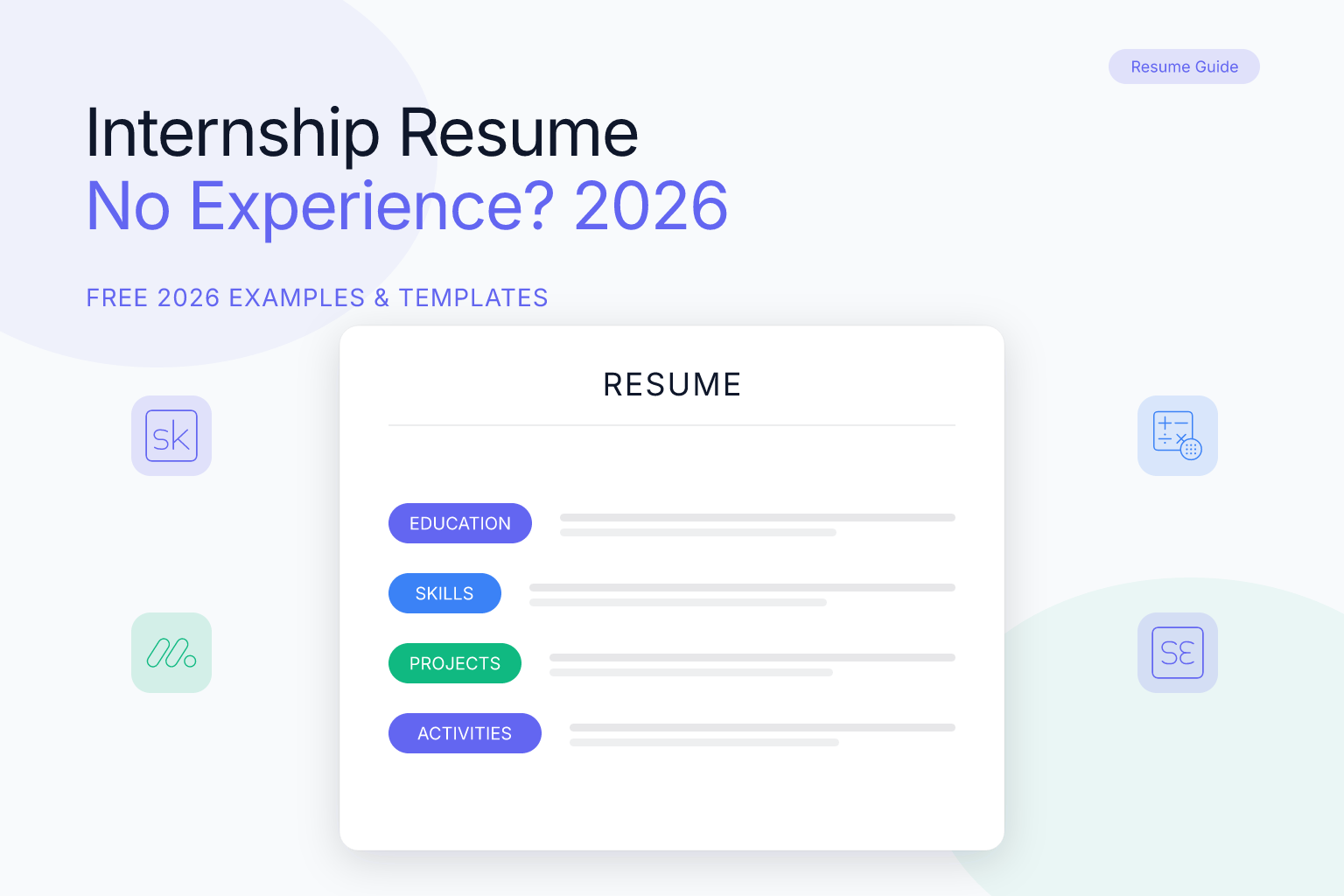
Your resume should have these sections in order:
- Contact information — full name, phone number, professional email, LinkedIn profile, and portfolio link if you have one.
- Resume objective — two to three lines stating your internship goal and top qualifications.
- Education — school name, degree (or expected degree), graduation date, and relevant coursework.
- Projects — academic, personal, or group projects that demonstrate skills.
- Experience — this can include volunteer work, part-time jobs, leadership roles, or freelance gigs.
- Skills — a bulleted list of hard and soft skills relevant to the internship.
If you’re unsure whether your layout will pass an ATS screen, use a free resume score checker to get instant feedback on formatting, keywords, and section completeness.
ATS-Friendly Resume for Internship: What Really Matters
Many internship applicants worry that their resume will be rejected by an ATS before a human ever sees it. The truth is less scary: modern ATS (Workday, Greenhouse, Lever, iCIMS) parse clean, text-based PDFs reliably. The problems come from scanned or image-based PDFs, tables, graphics, and unusual fonts. So an “ATS-friendly” resume is really just a simple, well-structured, keyword-rich document.
To make your internship resume ATS-proof:
- Use standard section headings (“Education,” “Projects,” “Skills”) — don’t get creative with labels like “My Journey” or “What I Know.”
- Stick to common fonts (Arial, Calibri, Helvetica) and 10–12 pt size.
- Avoid headers/footers for contact info; some ATS ignore content placed there.
- Save as a text-based PDF (not a scanned image). ResumeMate’s builder exports exactly this type of PDF automatically.
- Mirror keywords from the internship description in your skills and project bullets.
If you want to be certain, run your resume through the ResumeMate score checker — it flags ATS risks like missing sections, weak verbs, and keyword gaps in under a minute.
Choose the Right Resume Format for an Internship
For most internship seekers, the hybrid resume format (a blend of chronological and functional) works best. It puts your strongest qualifications — education and projects — near the top, while still including a brief work history if you have any. A purely functional resume that hides dates can raise red flags, so avoid it unless you have significant employment gaps.
If you’re a high school student, a one-page resume is the standard. College students can stretch to a second page only if they have substantial project work, publications, or leadership experience. For a deeper dive into formatting, see our complete guide on how to write a resume.
Resume vs CV for Internship: What’s the Difference?
In the United States and Canada, “resume” and “CV” are often used interchangeably for internship applications, but there is a technical difference. A resume is a concise, one-page (sometimes two-page) marketing document tailored to a specific job. A CV (curriculum vitae) is a longer, more detailed academic document that lists publications, research, presentations, and teaching experience.
For most internships — especially in business, tech, marketing, and engineering — you should submit a resume, not an academic CV. The only exception is if you’re applying for a research internship at a university or lab, where a CV might be expected. When in doubt, check the application instructions. If they ask for a “CV,” a well-structured one-page resume is usually acceptable for an internship.
Craft a Compelling Resume Objective (Not a Summary)
A resume summary is for professionals with years of experience. As an internship candidate, you need a resume objective — a short statement that explains what you’re seeking and what you offer. It should be tailored to each application.
A strong objective follows this formula:
- First sentence: State the internship title and company name, plus your field of study.
- Second sentence: Highlight two to three relevant skills or experiences (coursework, projects, volunteer work).
- Third sentence (optional): Mention a specific way you want to contribute.
Example for a marketing internship:
“Detail-oriented marketing student at State University seeking a summer 2026 marketing internship at XYZ Corp. Skilled in social media management, content creation, and data analysis through coursework and a semester-long brand audit project. Eager to support the team’s campaign analytics and content strategy.”
Avoid generic phrases like “hardworking” or “seeking a challenging position.” Every word should tie back to the internship description.
Turn Your Coursework into Relevant Experience
When you don’t have a job history, your classes become your experience. Create a “Relevant Coursework” subsection under Education, but don’t just list course titles. Describe what you did and the skills you gained.
Instead of:
- Introduction to Data Science
Write:
- Data Analysis & Visualization — Cleaned and analyzed a 10,000-row dataset using Python (Pandas, Matplotlib); built a dashboard to present findings to a panel of professors.
This approach shows employers you can apply knowledge, not just memorize it. If you’ve completed a capstone project, treat it like a job entry in a “Projects” section. Include the project name, your role, the tools used, and a quantifiable result if possible.
How to Rewrite Your Resume to Highlight Projects and Coursework
If you already have a resume but it feels empty because you lack work experience, the fix is to reposition your academic work as professional experience. Here’s a step-by-step method:
- Move Education above Experience — as a student, your education is your strongest credential.
- Create a dedicated “Projects” section — list 2–4 projects with bullet points that mirror job descriptions (action verb + task + result).
- Expand “Relevant Coursework” — instead of a comma-separated list, turn 2–3 key courses into mini project descriptions.
- Reframe part-time jobs and volunteer roles — even a cashier job shows customer service, cash handling, and reliability. Use those transferable skills.
- Add a skills bank — pull keywords from the internship posting and list them explicitly.
For example, if you’re applying for a software engineering internship and you built a class project, write it like this:
E-Commerce Web App (Course Project) — Developed a full-stack storefront using React and Node.js; implemented user authentication and payment simulation; deployed on Heroku; received top grade in class of 40.
That reads like work experience, even though it was for a grade.
Showcase Projects, Volunteer Work, and Extracurriculars
This is where you prove you’ve done more than attend class. A “Projects” section can include:
- Class assignments that required research, teamwork, or technical skills.
- Personal projects (a blog, an app, a social media campaign).
- Hackathons, case competitions, or student organization initiatives.
For each project, list:
- Project name and date.
- A one-line description of what you built or accomplished.
- The skills and tools you used.
- A measurable outcome (e.g., “increased Instagram engagement by 40% over two months”).
Volunteer work belongs in the “Experience” section if it’s substantial. Even unpaid roles demonstrate reliability, communication, and problem-solving. For example, organizing a food drive shows logistics and leadership. Learn how to present these experiences effectively in our guide on how to list volunteer work on a resume with no experience.
If you’re a high school student, extracurriculars like student government, sports, or clubs can fill the same space. Our high school resume with no experience templates offer examples of how to frame these activities.
List Skills That Prove You Can Learn Fast
Internship recruiters look for potential, not perfection. Your skills section should blend hard skills (tools, software, languages) and soft skills (communication, teamwork, adaptability). Pull keywords directly from the internship posting.
Hard skills examples:
- Programming languages (Python, Java, SQL)
- Design tools (Figma, Canva, Adobe Photoshop)
- Data analysis (Excel, Google Sheets, Tableau)
- Social media platforms (TikTok, LinkedIn, Instagram)
- Foreign languages
Soft skills examples:
- Written and verbal communication
- Time management
- Collaboration
- Problem-solving
- Attention to detail
Don’t just list “communication” — prove it elsewhere. If you gave presentations in class or wrote for the school newspaper, mention that in your project descriptions. The skills section acts as a keyword bank for ATS, while the rest of the resume provides evidence.
Add a Cover Letter to Fill the Gaps
A resume alone can feel thin when you lack experience. A tailored cover letter lets you connect the dots for the hiring manager. It’s your chance to explain why you’re interested in the company, how your coursework aligns with the role, and what you’ll bring despite a short work history.
Keep it to three short paragraphs:
- Introduction — name the internship and why you’re excited about the company.
- Body — connect one or two academic or project experiences to the internship requirements.
- Closing — thank them and express eagerness to discuss further.
Not every application requires a cover letter, but for competitive internships, it can set you apart. If you’re unsure whether to include one, read our guide on do I need a cover letter? for a clear decision framework.
Use a Free Resume Builder to Get Past ATS Filters
Building a resume from scratch in Word or Google Docs often leads to formatting headaches — especially when you try to export as a PDF that ATS can read. A dedicated resume builder handles the layout, fonts, and spacing automatically, so you can focus on content.
ResumeMate’s free AI resume builder gives you ATS-optimized templates that export clean, text-based PDFs. You can start with a blank template or upload an existing resume for scoring and improvement. The builder also suggests bullet points based on your input, which is helpful when you’re not sure how to phrase your project work.
After you’ve drafted your resume, run it through the resume score checker. It scans for missing sections, weak verbs, and keyword gaps — then gives you a score and specific fixes. Most internship candidates can boost their score by 20+ points just by adding a skills section and quantifying one project result.
Sample Internship Resume with No Experience (Text Example)
Here’s a complete sample resume for a college student applying to a marketing internship with no prior work experience. Use it as a structural reference — replace the details with your own.
JORDAN LEE
jordan.lee@email.com | (555) 123-4567 | linkedin.com/in/jordanlee | jordanleeportfolio.com

OBJECTIVE
Marketing student at State University seeking a summer 2026 digital marketing internship at Bright Media. Skilled in social media management, content creation, and Google Analytics through coursework and a semester-long brand audit project. Eager to support campaign analytics and content strategy.

EDUCATION
State University, Bachelor of Business Administration in Marketing
Expected Graduation: May 2027 | GPA: 3.6/4.0
Relevant Coursework: Digital Marketing, Consumer Behavior, Data Analysis for Marketers, Brand Management

PROJECTS
Brand Audit Project (Course Project) — Spring 2025
- Conducted a full brand audit of a local coffee chain; analyzed social media presence, customer reviews, and competitor positioning.
- Used Google Analytics and Excel to identify a 25% drop in engagement among 18–24 demographic.
- Presented recommendations to a panel of marketing professors; received top grade in class.

Personal Blog: "Campus Eats" — 2024–Present
- Write weekly reviews of local restaurants; grew Instagram following from 0 to 1,200 in six months.
- Use Canva to design graphics and Hootsuite to schedule posts; average engagement rate of 8%.

EXPERIENCE
Volunteer Social Media Coordinator, Local Animal Shelter — Summer 2025
- Managed Instagram and Facebook accounts; increased follower count by 30% in three months.
- Created a weekly adoption spotlight series that led to 12 successful adoptions.

SKILLS
Hard Skills: Google Analytics, Excel, Canva, Hootsuite, SEO basics, WordPress
Soft Skills: Written communication, teamwork, time management, creativity, adaptability
This sample hits all the key sections: objective, education with coursework, two projects with measurable outcomes, a volunteer role framed as experience, and a skills bank. You can adapt it for any field — just swap the projects and skills to match the internship description.
Do You Need a Resume for an Internship?
Yes, almost always. Even if an application portal doesn’t explicitly ask for a resume, having one ready shows professionalism and preparation. Some internships (especially at smaller companies or through personal connections) might only ask for a cover letter or a short application form, but a resume is still the standard document recruiters expect. If you’re applying through a job board or company career page, you’ll almost certainly need to upload a resume. If you’re not sure where to find internships, check out the ResumeMate job board — it has filters for role, location, and remote options.
FAQ
Q: What should I put on my resume if I have no work experience?
A: Focus on education, relevant coursework, academic or personal projects, volunteer work, extracurricular activities, and a strong skills section. A well-written resume objective can also frame your background positively. Employers hiring interns care more about potential and willingness to learn than a long job history.
Q: How do I write a resume for an internship as a high school student?
A: Use a one-page format with sections for contact info, objective, education (including GPA if it’s above 3.0), relevant coursework, extracurriculars, and skills. Highlight any leadership roles, club involvement, or volunteer work. Check out our high school resume templates for examples.
Q: Can I get an internship with no experience?
A: Yes. Many internships are designed for students with little to no professional experience. Companies use internships to train and evaluate future full-time hires. Emphasize your academic achievements, projects, and soft skills to show you’re ready to contribute.
Q: What skills should I list on an internship resume?
A: List a mix of hard skills (software, tools, languages) and soft skills (communication, teamwork, problem-solving) that match the internship description. Always prioritize skills mentioned in the job posting, and back them up with examples in your project or education sections.
Q: Should I include my GPA on an internship resume?
A: Include your GPA if it’s 3.0 or above and you’re a current student or recent graduate. If it’s lower, leave it off and let your projects and skills speak for themselves. For a more detailed breakdown, read our guide on when to include GPA on a resume.
Q: How long should an internship resume be?
A: One page is standard for most students and early-career candidates. If you have extensive project work, publications, or leadership experience, you can extend to a second page, but only if every line adds value. Recruiters prefer concise, scannable resumes.
Q: How do I create a resume for an internship with no experience?
A: Start with a clean single-column template, then fill in these sections in order: contact info, objective, education (with relevant coursework), projects, experience (volunteer/part-time), and skills. Use action verbs and quantify results where possible. Finally, run it through an ATS score checker to catch any issues. You can use a free builder like ResumeMate to handle formatting automatically.
Q: What is a biodata format for an internship?
A: A biodata is a document common in South Asia that includes personal details like age, gender, marital status, and a photograph, along with education and experience. For internships, especially with international or modern companies, a standard resume is preferred over a biodata because it focuses on skills and qualifications rather than personal information. If an employer specifically asks for a biodata, you can adapt your resume by adding a “Personal Details” section at the top, but keep it professional and avoid unnecessary personal data.
Q: Is a CV the same as a resume for an internship?
A: In most internship contexts, yes — employers use the terms interchangeably. However, a true CV is longer and more academic, listing publications and research. For a typical internship, submit a one-page resume unless the application explicitly requests a full academic CV.
Q: Do I need a cover letter for an internship if I have no experience?
A: Not always, but it’s highly recommended for competitive internships. A cover letter lets you explain your motivation, connect your coursework to the role, and show personality that a resume can’t. If the application says “cover letter optional,” write one anyway — it can only help.
Related articles:
- Resume Tips for Workers with Variable Income Streams
- Entry Level Project Manager Resume with No Experience
- LinkedIn About for Students: No Experience Examples
- Accounting Resume Examples: Land Your First Internship
- Accountant Resume Examples with CPA and GAAP Skills
Track Every Application While You Job Hunt
Stop losing track of where you’ve applied. The ResumeMate Job Tracker is a free Chrome extension that tracks every application, deadline, and follow-up in one place — right from your browser.