Writing a resume for returning to work after raising children can feel like a daunting task, especially when you’re staring at a years-long gap in your employment history. But that gap doesn’t erase the skills, discipline, and perspective you’ve gained while managing a household, volunteering at school, or navigating the chaos of family life. This guide will show you exactly how to frame your time away, structure your resume, and present yourself as the capable professional you are — so you can re-enter the workforce with confidence.
Key Takeaways
- A functional or hybrid resume format is often the best choice for parents returning to work because it shifts focus from chronological gaps to relevant skills and accomplishments.
- Your time at home counts as experience — volunteer work, freelance projects, and even household management can be framed as legitimate, transferable skills on a resume.
- Addressing the career gap directly with a brief, positive explanation in your summary or a dedicated section removes the elephant in the room and lets you control the narrative.
- Modern ATS systems parse clean, text-based PDFs without issue, so you can use a single-column layout and still be machine-readable — no need to default to Word unless a portal specifically requires it.
- Before applying, run your resume through a free ATS score checker to catch formatting issues and keyword gaps that could keep your application from reaching a human.
Key Takeaways
- A functional or hybrid resume format is often the best choice for parents returning to work because it shifts focus from chronological gaps to relevant skills and accomplishments.
- Your time at home counts as experience — volunteer work, freelance projects, and even household management can be framed as legitimate, transferable skills on a resume.
- Addressing the career gap directly with a brief, positive explanation in your summary or a dedicated section removes the elephant in the room and lets you control the narrative.
- Modern ATS systems parse clean, text-based PDFs without issue, so you can use a single-column layout and still be machine-readable — no need to default to Word unless a portal specifically requires it.
- Before applying, run your resume through a free ATS score checker to catch formatting issues and keyword gaps that could keep your application from reaching a human.
| What to Do | Why It Matters | Time |
|---|---|---|
| Choose a hybrid or functional resume format | Puts your skills and recent volunteer or freelance work front and center, minimizing the visual impact of the employment gap | 15 minutes |
| Write a strong summary that addresses the gap | Controls the narrative and immediately tells recruiters you’re returning with intention, not just filling space | 20 minutes |
| List volunteer, freelance, and caregiving roles in a “Relevant Experience” section | Transforms unpaid work into concrete, transferable achievements that hiring managers value | 30 minutes |
| Tailor your skills section to each job description | Ensures your resume passes ATS filters and shows you’ve kept your abilities current | 15 minutes per application |
| Get an ATS score and fix flagged issues | Catches formatting errors and missing keywords before a recruiter sees them, dramatically improving your callback rate | 10 minutes |
How to Write a Resume for Returning to Work After Raising Children
A resume for a parent returning to the workforce needs to do three things at once: acknowledge the career break without apologizing for it, prove you still have the skills the job requires, and show that you’re ready to hit the ground running. The best way to accomplish all three is to choose a format that puts your qualifications — not your timeline — first.
Most job seekers use a reverse-chronological resume, which lists work history from most recent to oldest. That format works against you when your most recent “job” was full-time parenting. Instead, consider a hybrid resume (also called a combination resume). This format leads with a skills summary and relevant experience, then follows with a condensed work history. It lets you group your volunteer work, freelance projects, and community leadership under a heading like “Relevant Experience” while still showing a straightforward employment timeline for the roles you held before your break.
A purely functional resume — one that omits dates entirely — is another option, but many recruiters dislike it because it can look like you’re hiding something. The hybrid approach is more transparent and still puts your current capabilities first. If you’re building your resume from scratch, a free tool like the ResumeMate AI resume builder can help you start with a clean, ATS-friendly template and then customize the sections to fit a return-to-work story.
How to Address the Gap and Frame Parenting as Experience
You don’t need to over-explain your time away, but you do need to address it. Leaving a multi-year gap unexplained invites the recruiter to fill in the blank — and they might assume the worst. A short, confident statement in your resume summary is often enough.
Instead of:
“Stay-at-home mom for 7 years looking to re-enter the workforce.”
Try:
“Marketing professional with 8 years of experience in content strategy and campaign management, returning to the workforce after a career break focused on family. During that time, managed a household budget of $80K annually, coordinated multiple school fundraisers, and maintained proficiency in Google Analytics and Adobe Creative Suite through freelance projects.”
This approach does three things: it names the gap without making it the headline, it quantifies relevant experience gained during the gap, and it shows you’ve kept your skills sharp. If you’d rather not lead with the gap, you can add a brief “Career Note” section just below your summary that says something like: “Took a planned career break from 2019 to 2026 to raise a family. During this time, I remained active in the field through volunteer board service and part-time consulting.”
One of the biggest mistakes returning parents make is assuming that running a household doesn’t count as experience. It does — but you have to translate it into the language of the workplace. Hiring managers don’t need to know that you packed 1,500 school lunches; they need to know that you managed a complex schedule, negotiated with vendors, and kept multiple projects on track simultaneously.
Here are common parenting and household responsibilities and how to reframe them as professional skills:
- Managing the family calendar and appointments → Scheduling and logistics coordination for a household of five, including medical, educational, and extracurricular commitments.
- Budgeting for groceries, activities, and household expenses → Managed an annual household budget of $65K, reducing discretionary spending by 12% year-over-year through vendor negotiation and expense tracking.
- Organizing school fundraisers and community events → Planned and executed fundraising events generating $15K+ annually, coordinating volunteers, vendors, and marketing.
- Volunteering in a classroom or on a PTA board → Served as PTA Treasurer, overseeing a $30K budget, managing accounts payable/receivable, and presenting financial reports to stakeholders.
- Coordinating medical appointments and care schedules → Managed complex scheduling for multiple family members, liaising with healthcare providers and insurance companies.
These aren’t exaggerations — they’re accurate descriptions of the work you’ve been doing. The key is to frame them in terms of outcomes and responsibilities that a hiring manager will recognize. If you’ve done any formal volunteer work, you can list it in a dedicated section. For more on that, see our guide on how to list volunteer work on a resume with no experience.
Choosing the Best Resume Format for Stay-at-Home Parents
As mentioned, a hybrid format is usually the strongest choice. Here’s a section-by-section breakdown of what that looks like:
- Contact Information — Name, phone, email, LinkedIn profile, and city/state (no full address).
- Professional Summary — 3-4 lines that state your target role, key qualifications, and a brief, positive mention of your career break.
- Core Competencies / Skills — A bulleted list of 8-12 hard and soft skills relevant to the job. Include software, methodologies, and certifications.
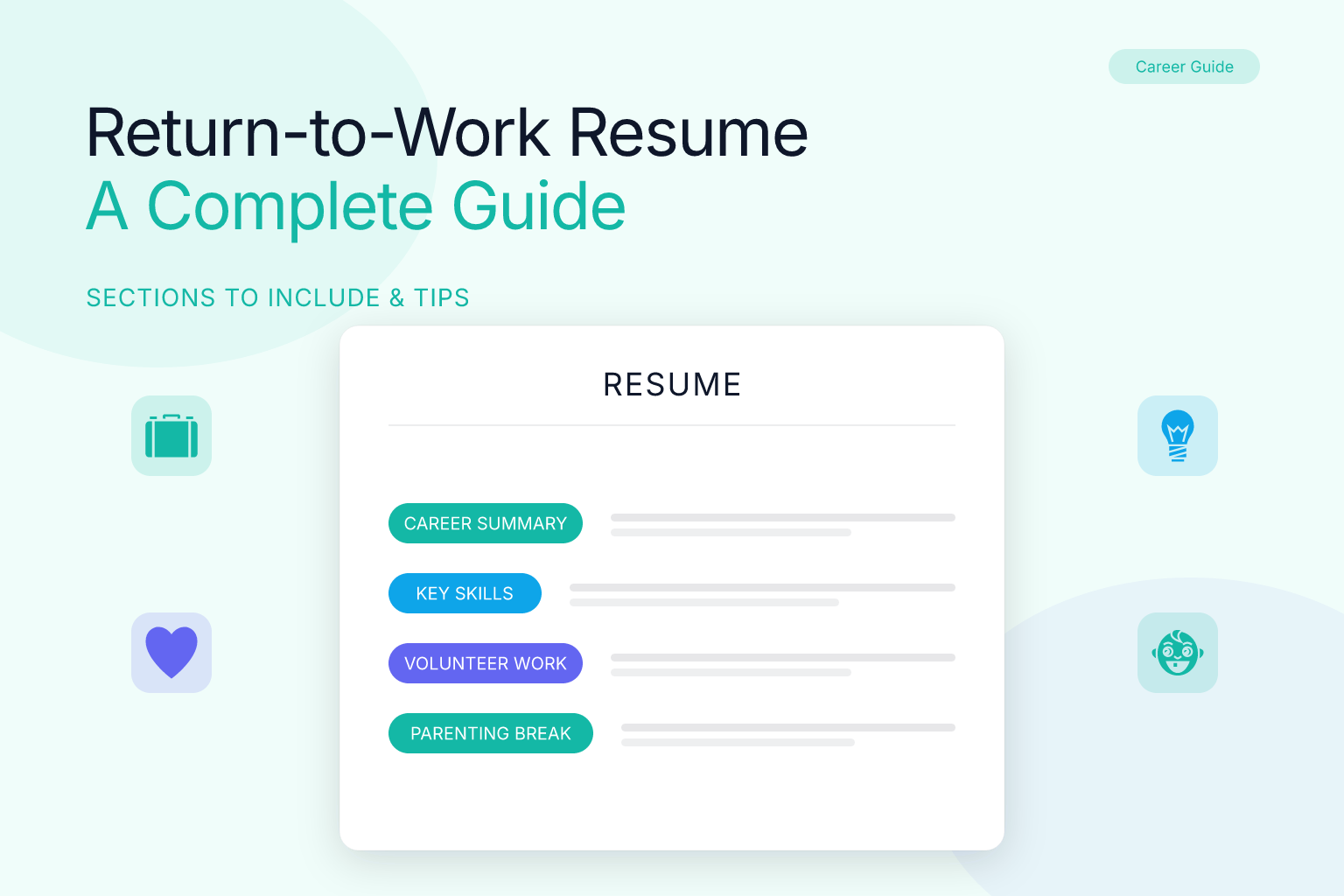
- Relevant Experience — This is where you list volunteer roles, freelance projects, consulting gigs, and significant household management responsibilities, formatted like a job entry with a title, organization, dates, and bullet points.
- Professional Experience — Your pre-break employment history in reverse-chronological order. Keep entries concise; you don’t need 10 bullets for a job you left in 2017.
- Education — Degree, school, and graduation year. If you’ve taken any courses or earned certifications during your break, list them here or in a separate “Professional Development” section.
- Volunteer Experience (optional) — If you have extensive volunteer work that doesn’t fit under Relevant Experience, give it its own section.
This structure puts your most current, relevant qualifications at the top while still providing the chronological history recruiters expect. For a deeper dive into resume structure, check out how to write a resume: the complete guide.
Updating Your Skills and Education for Today’s Market
If you’ve been out of the workforce for several years, some of your technical skills may be outdated. The good news: you’ve probably picked up new ones without realizing it. Did you manage a social media account for a school group? That’s social media management. Did you build a spreadsheet to track expenses? That’s data analysis. Did you use Zoom for virtual parent-teacher conferences? That’s remote collaboration.
Start by pulling up 5-10 job descriptions for the role you want. Highlight every skill, tool, and certification mentioned. Then compare that list to what you know. For any gaps, consider whether you can bridge them quickly with a free online course (Coursera, LinkedIn Learning, HubSpot Academy) before you start applying. Even one relevant certification earned during your break shows initiative and current knowledge.
When you list skills on your resume, be specific. Instead of “computer skills,” write “Microsoft Excel (pivot tables, VLOOKUP), Google Workspace, Slack, Zoom.” Instead of “communication,” write “stakeholder communication, presentation development, cross-functional collaboration.” For a comprehensive list of skills to consider, see skills for resumes: proven lists and how to pick yours.
If you earned a degree before your break, list it as you normally would — but consider whether you need to include the graduation year. If the year makes your age obvious and you’re concerned about age bias, you can leave it off. Focus instead on any recent coursework or certifications that demonstrate current knowledge. If you completed any education during your break — even a single online course — list it prominently. It shows you’ve been proactive. For a full breakdown of what to include and where, see education on a resume: what to include by experience level.
Should You Include a Cover Letter?
Yes — and for returning parents, a cover letter is especially valuable. It gives you space to tell your story in a way a resume can’t. Use the cover letter to:
- Briefly explain your career break in a positive, forward-looking way.
- Connect the skills you used during your break to the requirements of the job.
- Express genuine enthusiasm for returning to work and for the specific company.
Keep it to one page. Acknowledge the gap in one sentence, then spend the rest of the letter on why you’re the right person for the role right now. For example, an opening paragraph might read:
“After a planned career break to raise my children, I am excited to return to full-time marketing and apply my background in content strategy to the Senior Content Manager role at XYZ Corp. During my time away, I kept my skills sharp by managing social media for a local nonprofit, completing HubSpot’s Content Marketing Certification, and staying current with industry trends. I’m eager to bring that fresh perspective and my eight years of prior experience to your team.”
This approach immediately addresses the gap, demonstrates continued professional development, and pivots to enthusiasm. If you’re worried about being seen as overqualified because of your previous experience level, our article on overqualified and underqualified resume strategies can help you position yourself correctly.
How to Make Sure Your Resume Passes ATS Screening
Most companies use applicant tracking systems (ATS) to filter resumes before a human ever sees them. If your resume isn’t formatted correctly or doesn’t contain the right keywords, it may never reach a recruiter — regardless of how qualified you are.
For a returning parent, ATS optimization is critical because your resume may already be fighting an unconscious bias about the gap. You can’t afford to also lose points on formatting. Here’s what to do:
- Use a single-column layout. Multi-column designs can confuse older ATS, and while modern systems handle them better, single-column is the safest bet. Most ResumeMate templates are single-column for this reason.
- Stick to standard section headings like “Professional Experience,” “Education,” and “Skills.” Avoid creative labels like “What I Bring to the Table.”
- Incorporate keywords naturally from the job description into your summary, skills, and experience bullets. Don’t just stuff them in a list at the bottom.
- Export as a clean, text-based PDF. Modern ATS (Workday, Greenhouse, Lever, iCIMS) parse text-based PDFs reliably. The problems come from scanned documents, images, or heavy graphics — not from the PDF format itself. Only use DOCX if a specific application portal explicitly requests it.
- Run your resume through an ATS score checker before submitting. The ResumeMate score checker gives you a section-by-section breakdown of what’s working and what needs fixing, so you can catch issues early.
Preparing for Interviews and Networking After a Gap
Your resume gets you the interview; your interview performance gets you the job. As a returning parent, you’ll likely face questions about your gap. Prepare for them so you can answer with confidence instead of anxiety.
Common questions and how to approach them:
- “Can you tell me about the gap in your resume?” — Be direct and positive. “I took a planned career break to raise my children. During that time, I stayed engaged with the field by [volunteering, freelancing, taking courses]. I’m now excited to return full-time and bring both my previous experience and the perspective I’ve gained.”
- “Are your skills still current?” — Point to specific examples: “Yes, I completed a certification in [X] last year and have been using [Y tool] regularly for volunteer projects. I also make a point of staying up to date with industry news through [publication/podcast].”
- “How will you handle the transition back to full-time work?” — Show that you’ve thought about logistics: “I’ve already arranged childcare and have a support system in place. I’m genuinely looking forward to the structure and challenge of full-time work.”
Practice these answers out loud until they feel natural. The goal is to sound like someone who made a deliberate choice and is now making another deliberate choice — not someone who’s desperate or uncertain.
Networking is often the fastest path back to a job, but it can feel intimidating when your professional contacts have gone stale. Start with low-pressure steps:
- Update your LinkedIn profile to reflect your return-to-work status. Use the same summary language from your resume, and set your headline to something like “Marketing Professional | Returning to Workforce | Open to Opportunities.”
- Reach out to former colleagues with a simple message: “Hi [Name], I’m planning to return to work after a few years at home with my kids and would love to catch up and hear what you’re working on these days. Coffee on me?”
- Join industry groups on LinkedIn and Facebook. Comment on posts, share articles, and let people know you’re re-entering the field.
- Attend local meetups or virtual events in your industry. Many are free and low-commitment.
If you’re not sure how to ask for a referral once you’ve reconnected, our guide on how to ask for a LinkedIn referral with templates provides scripts you can adapt.
FAQ
Q: How do I explain a 10-year employment gap on my resume?
A: Address it briefly in your summary or a career note, then focus the rest of your resume on skills and relevant experience gained during the gap. Frame the break as a deliberate choice and highlight any volunteer work, freelance projects, or courses you completed during that time.
Q: Should I include “stay-at-home parent” as a job on my resume?
A: You can, but it’s usually more effective to list the specific responsibilities and achievements under a “Relevant Experience” section with a functional title like “Household Manager” or “Family Logistics Coordinator.” This frames the experience in professional terms without making the parenting role the headline.
Q: What if I have no volunteer work or freelance experience to show for my gap?
A: Focus on the skills you used daily — budgeting, scheduling, negotiation, conflict resolution — and list them in your skills section. You can also take a short online course now and add it to your resume before applying. Even one recent certification helps.
Q: Will a functional resume hide my employment gap?
A: A purely functional resume can obscure dates, but many recruiters are suspicious of it. A hybrid format that includes a condensed work history is more transparent and still puts your skills first.
Q: How do I know if my resume will pass an ATS?
A: Use a free ATS resume checker like the one at ResumeMate. It scans your resume against common ATS criteria and gives you a score with specific fixes for formatting, keywords, and missing sections.
Q: Should I apply for jobs I’m overqualified for after a long break?
A: It depends on your goals. If you want to ease back in, a role that’s a step below your previous level can be a smart re-entry point. Just be prepared to explain why you’re interested — and avoid sounding like you’ll leave the moment something better comes along. Our guide on overqualified and underqualified strategies can help you navigate this.
Related articles:
- Create a Portfolio Website for Resume Links (and Why)
- When to Include GPA on a Resume: A Clear Guide for 2025
- How to Write a Resume for a Data Scientist Role
- How to Find a Job After Being Fired: A Step-by-Step Guide
Track Every Application While You Job Hunt
Stop losing track of where you’ve applied. The ResumeMate Job Tracker is a free Chrome extension that tracks every application, deadline, and follow-up in one place — right from your browser.