Deciding between a resume objective vs summary is the first step to crafting a resume that grabs recruiters’ attention. Your resume’s opening statement is the first thing a recruiter reads — and it can determine whether they keep reading or move on. Both sit at the top of your resume, both are short, and both aim to grab attention. But they serve different purposes, target different audiences, and work best in different situations. Using the wrong one can make you look inexperienced or out of touch. This guide breaks down exactly what each one is, how they differ, and when to use which — with examples you can adapt right now.
Key Takeaways
- A resume objective states your career goals and what you want from a job; a resume summary highlights your qualifications and what you offer an employer.
- Use an objective when you’re changing careers, have little experience, or are targeting a very specific role; use a summary when you have relevant experience to showcase.
- Most experienced professionals should lead with a summary, not an objective — recruiters spend an average of only 6–8 seconds scanning a resume.
- A strong summary or objective is tailored to the job description, includes measurable achievements, and avoids generic filler phrases.
- You can check how well your summary or objective performs by running your resume through an ATS score checker before applying.
| What to Do | Why It Matters | Time |
|---|---|---|
| Decide between an objective and a summary based on your experience level and career goals | Using the wrong one can make you look inexperienced or unfocused | 2 minutes |
| Write a tailored statement that includes specific skills and achievements | Generic statements get ignored; tailored ones show you’ve done your homework | 10–15 minutes |
| Place the statement at the top of your resume, right after your contact information | Recruiters look here first — make it count | 1 minute |
| Test your resume with an ATS score checker to see if your statement is parsed correctly | Formatting issues can hide your best content from applicant tracking systems | 2 minutes |
What Are Resume Objectives and Summaries?
Resume Objective
A resume objective is a short statement — usually two to three sentences — that explains your career goals and the type of position you’re seeking. It focuses on what you want from the job, not what you bring to the table. Objectives were the standard resume opening for decades, but they’ve fallen out of favor for most experienced professionals because they center the candidate’s needs rather than the employer’s.
A typical objective reads something like:
“Seeking a challenging position in marketing where I can use my skills and grow professionally.”
This tells the recruiter nothing about what you can do for the company. It’s vague, self-focused, and wastes prime resume real estate. However, objectives aren’t dead — they still have a place in specific situations, which we’ll cover later.
In the 1990s and early 2000s, almost every resume started with an objective. The job market was different: resumes were often printed and mailed, and the objective served as a kind of cover letter shorthand. Today, applicant tracking systems (ATS) parse resumes for keywords, and recruiters spend seconds deciding whether to read further. A generic objective doesn’t help with either. That’s why the summary statement has largely replaced it — but the objective still has a role when used strategically.
Resume Summary
A resume summary (also called a professional summary or career summary) is a brief paragraph at the top of your resume that highlights your most relevant qualifications, experience, and achievements. Unlike an objective, a summary focuses on what you offer the employer. It answers the question: “Why should I hire you?”
A strong summary is specific, quantified where possible, and tailored to the job. For example:
“Results-driven sales manager with 8+ years of experience leading teams to exceed revenue targets by an average of 20% year-over-year. Skilled in consultative selling, pipeline management, and coaching. Seeking to leverage proven leadership and revenue growth expertise in a senior sales role at a B2B SaaS company.”
This immediately tells the recruiter: years of experience, industry, key skills, and a track record of success. It’s employer-focused and packed with keywords that an ATS will recognize.
Resume Objective vs Summary: The Key Differences
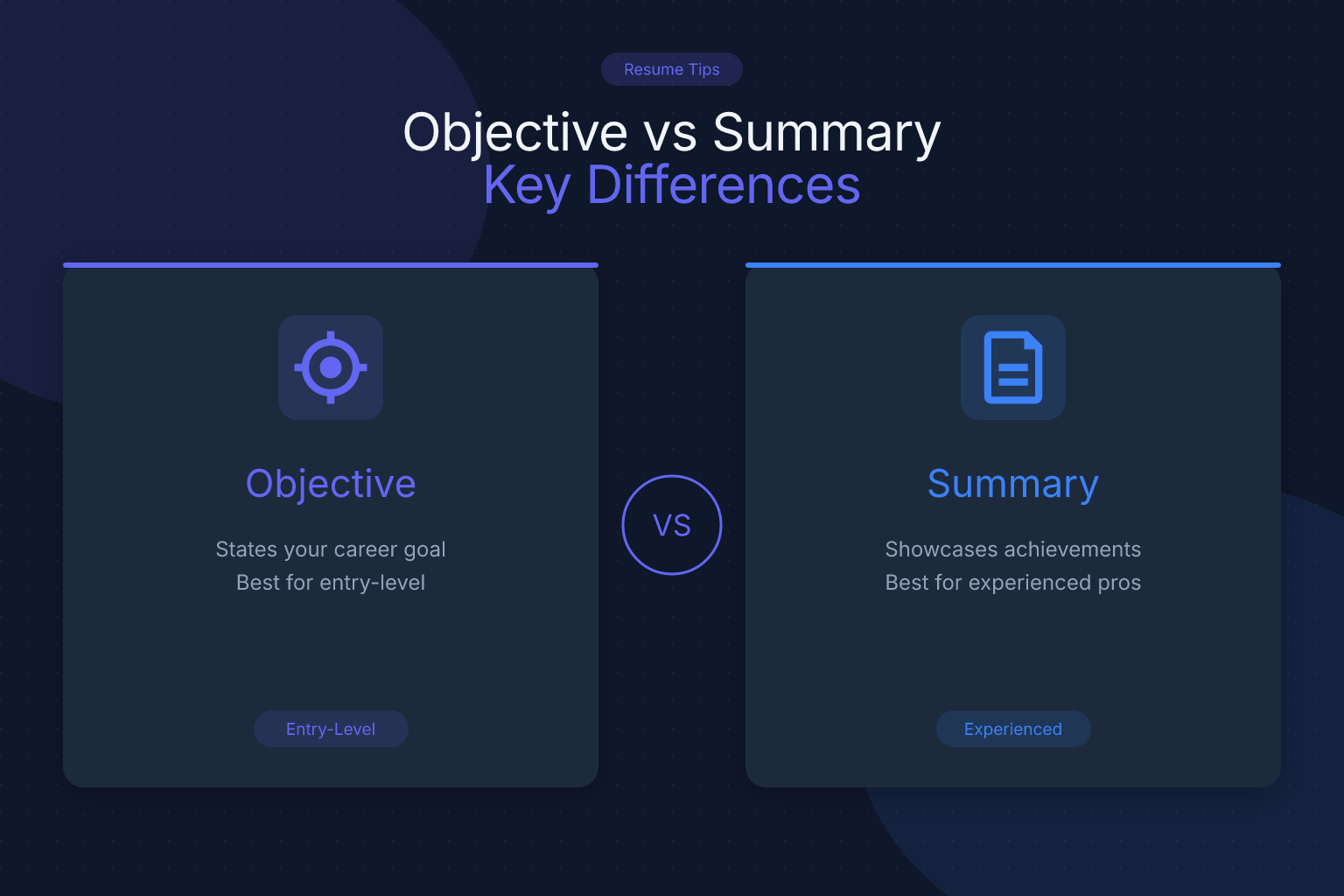
Understanding the resume objective vs summary difference comes down to three factors: focus, content, and when to use them. The table below breaks down the contrasts at a glance, but the real distinction lies in how each shapes a recruiter’s first impression. A summary immediately positions you as a qualified candidate by showcasing what you’ve already achieved. An objective, on the other hand, signals where you want to go — which can be powerful if your past experience doesn’t directly align with the target role. However, using an objective when you have relevant experience can make you appear junior or self-centered, because it emphasizes your goals over the employer’s needs. That’s why most career coaches now recommend summaries for anyone with at least some relevant experience. In a job market where recruiters scan resumes in seconds, leading with evidence of your value is almost always the stronger strategy.
| Factor | Resume Objective | Resume Summary |
|---|---|---|
| Focus | Your career goals and what you want | Your qualifications and what you offer |
| Content | Desired role, skills you want to use, career direction | Experience, achievements, skills, and value you bring |
| Best for | Career changers, entry-level candidates, targeted roles | Experienced professionals, those with relevant accomplishments |
| Tone | Aspirational, forward-looking | Confident, evidence-based |
| Length | 1–3 sentences | 3–5 sentences or bullet points |
Recruiters and hiring managers are looking for reasons to move you forward — or to move on. A summary gives them immediate evidence that you can do the job. An objective, when used incorrectly, signals that you’re more interested in what the company can do for you. The key is to match the statement type to your situation: if you can fill half a page with relevant accomplishments, a summary is the clear choice. If your background is light or unrelated, a well-crafted objective can bridge the gap and explain your motivation.
When to Use a Resume Objective or Summary
When to Use a Resume Objective
Use a resume objective when:
- You’re changing careers. If your work history doesn’t directly relate to the job you want, an objective can explain your pivot and connect transferable skills.
- You’re an entry-level candidate or recent graduate. With little professional experience, a well-written objective can show enthusiasm and direction.
- You’re targeting a very specific role or company. An objective can signal that you’re not just blasting out generic applications — you want this particular job.
- You’re returning to the workforce after a gap. An objective can address the gap briefly and refocus attention on your goals.
Examples of Effective Resume Objectives
Career changer (teacher to instructional designer):
“Former middle school science teacher transitioning to instructional design, bringing 5 years of curriculum development, e-learning tool proficiency, and a track record of improving student engagement by 30%. Seeking to apply learning science and content creation skills to build impactful corporate training programs.”
Recent graduate (marketing):
“Marketing graduate with internship experience in social media management and content creation. Skilled in Adobe Creative Suite, Google Analytics, and SEO. Eager to contribute to a fast-paced digital marketing team and grow as a data-driven marketer.”
Targeted role (specific company):
“Aspiring financial analyst with a CFA Level 1 candidacy and advanced Excel modeling skills, seeking to join Goldman Sachs’ risk management team to support data-driven investment decisions.”
Returning to the workforce (stay-at-home parent re-entering marketing):
“Marketing professional returning to the workforce after a 3-year career break focused on family. Previously managed multi-channel campaigns that increased brand awareness by 25% for a regional retailer. Eager to apply refreshed digital marketing skills and a renewed drive to a content marketing coordinator role.”
Entry-level accounting (recent graduate):
“Accounting graduate with a B.S. in Accounting and internship experience in accounts payable and bank reconciliations. Proficient in QuickBooks and Excel. Seeking to contribute to a public accounting firm’s audit team while pursuing CPA licensure.” For more examples tailored to accounting roles, see our accounting resume examples for landing your first internship.
Notice that even these objectives include skills and achievements — they’re not just “I want a job.” The best modern objectives blend goal-oriented language with evidence of capability.
When to Use a Resume Summary
If you have relevant experience — even just one or two years — a summary is almost always the better choice. Use a resume summary when:
- You have a consistent work history in the same field.
- You have measurable achievements that directly relate to the target job.
- You want to immediately establish credibility and expertise.
- You’re applying to roles where competition is high and you need to stand out fast.
Examples of Strong Resume Summaries
Experienced professional (project manager):
“PMP-certified project manager with 10+ years leading cross-functional teams to deliver complex software implementations on time and under budget. Managed portfolios up to $5M, reduced project delivery times by 25%, and maintained a 95% stakeholder satisfaction rate. Seeking to drive operational excellence at a growing tech firm.”
Mid-level professional (registered nurse):
“Compassionate registered nurse with 6 years of experience in critical care and emergency departments. Skilled in patient assessment, triage, and interdisciplinary collaboration. Recognized for reducing patient wait times by 15% through process improvements. Dedicated to providing high-quality, evidence-based care.”
Early-career professional (software developer):
“Full-stack developer with 2 years of experience building scalable web applications using React, Node.js, and PostgreSQL. Contributed to a product used by 50,000+ users and improved API response times by 40%. Passionate about clean code and user-centric design.”
Accountant (CPA track):
“Detail-oriented accountant with 4 years of experience in financial reporting, reconciliations, and tax preparation for small to mid-sized businesses. Reduced month-end close time by 30% through process automation. Proficient in GAAP, QuickBooks, and advanced Excel. Pursuing CPA licensure (2/4 exams passed).” For more ways to showcase accounting credentials, check out our accountant resume examples with CPA and GAAP skills.
Architect (design & technical focus):
“Licensed architect with 8 years of experience designing sustainable commercial and residential projects valued up to $20M. Led a team of 5 in delivering a LEED Gold-certified office complex that reduced energy consumption by 40%. Proficient in Revit, AutoCAD, and BIM coordination.” See our architect resume guide for more on presenting design and technical skills effectively.
Each summary leads with experience, backs it up with numbers, and ends with a forward-looking statement that ties to the target role.
How to Write a Strong Opening Statement
Writing a Resume Objective
If you’ve determined an objective is right for your situation, follow these steps to make it count:
- Start with your current status or background. Mention your degree, recent role, or career pivot context.
- Highlight 2–3 relevant skills or achievements. Even if they’re from a different field, connect them to the target job.
- State the role you’re targeting and what you aim to contribute. Avoid “seeking a challenging position” — be specific.
- Keep it to 2–3 sentences. Brevity is key; every word should earn its place.
Template:
“[Your background] with [relevant skills/achievements]. Seeking to apply [skill 1] and [skill 2] to [specific contribution] as a [target role] at [company or industry].”
Example using the template:
“Customer service professional with 4 years of experience resolving complex issues and training new hires, resulting in a 20% boost in team efficiency. Seeking to apply problem-solving and communication skills to a sales development role at a B2B software company.”
Writing a Resume Summary
A resume summary is your elevator pitch. Here’s how to craft one that gets results:
- Lead with your professional identity. Start with your title and years of experience (e.g., “Digital marketing specialist with 5 years of experience…”).
- Add your most impressive, relevant achievements. Use numbers whenever possible — percentages, dollar amounts, time saved.
- Mention key skills that match the job description. This helps with both ATS and human readers.
- End with a statement about the value you’ll bring to the next role. Tie it to the employer’s needs.
- Keep it to 3–5 sentences or 3–4 bullet points. Some formats use a short paragraph; others use bullets. Both work if they’re scannable.
Template:
“[Job title] with [X] years of experience in [industry/function]. Achieved [quantifiable result] by [action taken]. Skilled in [skill 1], [skill 2], and [skill 3]. Seeking to leverage [expertise] to drive [specific outcome] at [target company type].”
Example:
“Supply chain analyst with 7 years of experience in logistics and inventory optimization. Reduced warehousing costs by 18% through vendor renegotiation and demand forecasting improvements. Proficient in SAP, Tableau, and Lean Six Sigma methodologies. Seeking to bring data-driven supply chain solutions to a global manufacturing firm.”
Tailoring Your Statement for Each Job (and for ATS)
No matter which you choose, customization is non-negotiable. A generic statement won’t help you stand out — and it won’t impress an applicant tracking system. Here’s how to tailor your summary or objective quickly and effectively:
- Scan the job description for “must-have” keywords. Look for repeated skills, tools, certifications, and soft skills. If the posting mentions “cross-functional collaboration,” “SQL,” or “Agile,” and you have those, include them verbatim.
- Mirror the company’s language. If they say “client success” instead of “customer service,” use their term. This shows you’ve read the description carefully and helps with ATS keyword matching.
- Customize the final sentence. The last line of your summary or objective is the perfect place to name the target role or company type. Swap it out for each application — it takes seconds but signals genuine interest.
- Avoid overstuffing. Keywords should read naturally. If you force in every term, the statement becomes clunky and may be flagged by recruiters as keyword-stuffed.
For a deeper dive into tailoring, see our guide on how to tailor a resume to a job description. For more on optimizing for ATS, check out our ATS-friendly resume formatting tips.
Testing Your Opening Statement
Once you’ve written your opening statement, run it through a quick test:
- Does it mention at least one quantifiable achievement or specific skill?
- If you cover the name of the company you’re applying to, does the statement still make sense? (It should be tailored but not so specific that it falls apart without the company name.)
- Would a recruiter know within 5 seconds what role you’re targeting and why you’re qualified?
- Read it aloud. Does it sound natural and confident, or stilted and full of jargon?
- Check the keyword density. Pick the top 3 skills from the job description — are they present in your statement?
You can also use ResumeMate’s free resume score checker to see how your entire resume — including your summary or objective — performs against ATS criteria. It gives you section-by-section feedback so you can fix weak spots before you apply. Once your statement is polished, build a complete, ATS-friendly resume in minutes with the free AI resume builder.
Common Mistakes to Avoid
Even a well-intentioned summary or objective can backfire if you fall into these traps. Recruiters see hundreds of resumes a week, and small missteps can send your application to the rejection pile. The most frequent errors include using the wrong type of statement for your experience level, writing something so generic it could apply to anyone, and focusing on your own wants instead of the employer’s needs. Here are the specific pitfalls to watch for:
- Using an objective when a summary is more appropriate. If you have relevant experience, an objective makes you look entry-level. Default to a summary.
- Writing a generic, one-size-fits-all statement. “Seeking a position that utilizes my skills” tells the recruiter nothing. Always customize.
- Focusing on what you want instead of what you offer. Even in an objective, the emphasis should be on how your goals align with the employer’s needs.
- Including clichés and buzzwords. Phrases like “hardworking,” “team player,” and “go-getter” are filler. Show, don’t tell. Replace them with concrete examples: instead of “team player,” say “collaborated with cross-functional teams to launch a product ahead of schedule.”
- Making it too long. A dense, 8-sentence paragraph will be skipped. Keep it tight.
- Forgetting to update it for each application. Sending the same summary to every job is a missed opportunity.
- Using passive voice or weak verbs. “Was responsible for managing a team” is weaker than “Led a team of 5 to achieve a 20% revenue increase.” Start with action verbs.
- Neglecting to quantify achievements. Numbers catch the eye and provide instant credibility. Even estimates are better than nothing (e.g., “Improved customer satisfaction scores by approximately 15%”).
Before-and-after example:
Before (generic, self-focused):
“Hardworking professional seeking a challenging position where I can utilize my skills and grow within a reputable organization.”
After (specific, employer-focused):
“Digital marketing specialist with 3 years of experience managing $50K+ ad budgets and increasing ROAS by 35%. Skilled in Google Ads, Facebook Business Manager, and A/B testing. Seeking to drive paid acquisition growth for a DTC e-commerce brand.”
These mistakes can make even a strong candidate appear unfocused or lazy. The fix is simple: always put yourself in the recruiter’s shoes and ask, “Does this statement show I can solve their problem?” If not, revise until it does. A little extra effort here can dramatically increase your callback rate.
FAQ
Q: Can I use both a resume objective and a summary on the same resume?
A: It’s not recommended. Having both creates redundancy and takes up valuable space. Choose the one that best fits your situation. If you’re torn, lean toward a summary that includes a subtle forward-looking element — that often accomplishes the goal of an objective without the drawbacks.
Q: Is a resume objective outdated?
A: Not entirely, but it’s no longer the default. For experienced professionals, a summary is the modern standard. Objectives are still useful for career changers, students, and those with very specific job targets. The key is to write a modern objective that includes skills and achievements, not just a wish list.
Q: How long should a resume summary or objective be?
A: Aim for 2–5 sentences or 3–4 bullet points. The entire block should take up no more than 4–5 lines on the page. Recruiters scan quickly, so brevity and impact are essential.
Q: Should I include a resume objective if I’m applying for an internship?
A: Yes, an objective works well for internships because you likely have limited professional experience. Focus on your major, relevant coursework, projects, and what you hope to learn. For examples by major, check out our post on internship resume objectives.
Q: Do applicant tracking systems (ATS) read my summary or objective?
A: Yes, ATS software parses the text in your summary or objective just like any other section. That’s why it’s critical to include relevant keywords naturally. A well-optimized summary can improve your resume’s ATS score. Use a tool like the ResumeMate score checker to see exactly how your resume stacks up.
Q: What if I have no experience at all — can I still write a summary?
A: If you truly have zero work experience, an objective is usually a better fit. However, you can write a very short summary that highlights academic achievements, volunteer work, or projects. For example: “Honors computer science student with hands-on experience building three full-stack web apps using React and Node.js. Seeking to apply development skills in an entry-level software engineering role.” This blurs the line between summary and objective but works because it leads with evidence.
Q: What is an objective summary on a resume?
A: An objective summary is simply another term for a resume objective — a short statement that outlines your career goals and the type of role you’re targeting. It’s sometimes called a “career objective” or “objective statement.” The phrase “objective summary” can cause confusion because it sounds like a blend of the two, but in practice it refers to the same goal-focused opening that emphasizes what you want to achieve in your next position.
Q: What is the difference between a professional summary and a career objective?
A: A professional summary (or resume summary) highlights your past achievements, skills, and the value you bring to an employer. A career objective focuses on your future goals and the type of job you’re seeking. The summary is backward-looking and evidence-based; the objective is forward-looking and aspirational. Most hiring managers prefer a summary because it quickly shows what you’ve already accomplished.
Q: Should I use an objective or summary on my resume?
A: Use a summary if you have relevant work experience and measurable achievements in the same field as the job you’re applying for. Use an objective if you’re changing careers, just starting out, returning to the workforce after a gap, or targeting a very specific role where your background doesn’t directly align. When in doubt, a well-written summary is the safer choice for most applicants.
Q: How do I write an objective summary for a resume?
A: Start by stating your current status (student, career changer, etc.), then mention 2–3 relevant skills or accomplishments, and end with the specific role you’re pursuing and what you hope to contribute. Keep it to 2–3 sentences and avoid generic phrases like “seeking a challenging position.” For a step-by-step guide, see the “Writing a Resume Objective” section above.
Related articles:
- Internal vs External Recruiters: Differences & How to Work
- Gmail vs Outlook for Resume Email: Which Should You Use?
- Internal Transfer vs New Job Cover Letter: Key Differences
Track Every Application While You Job Hunt
Stop losing track of where you’ve applied. The ResumeMate Job Tracker is a free Chrome extension that tracks every application, deadline, and follow-up in one place — right from your browser.