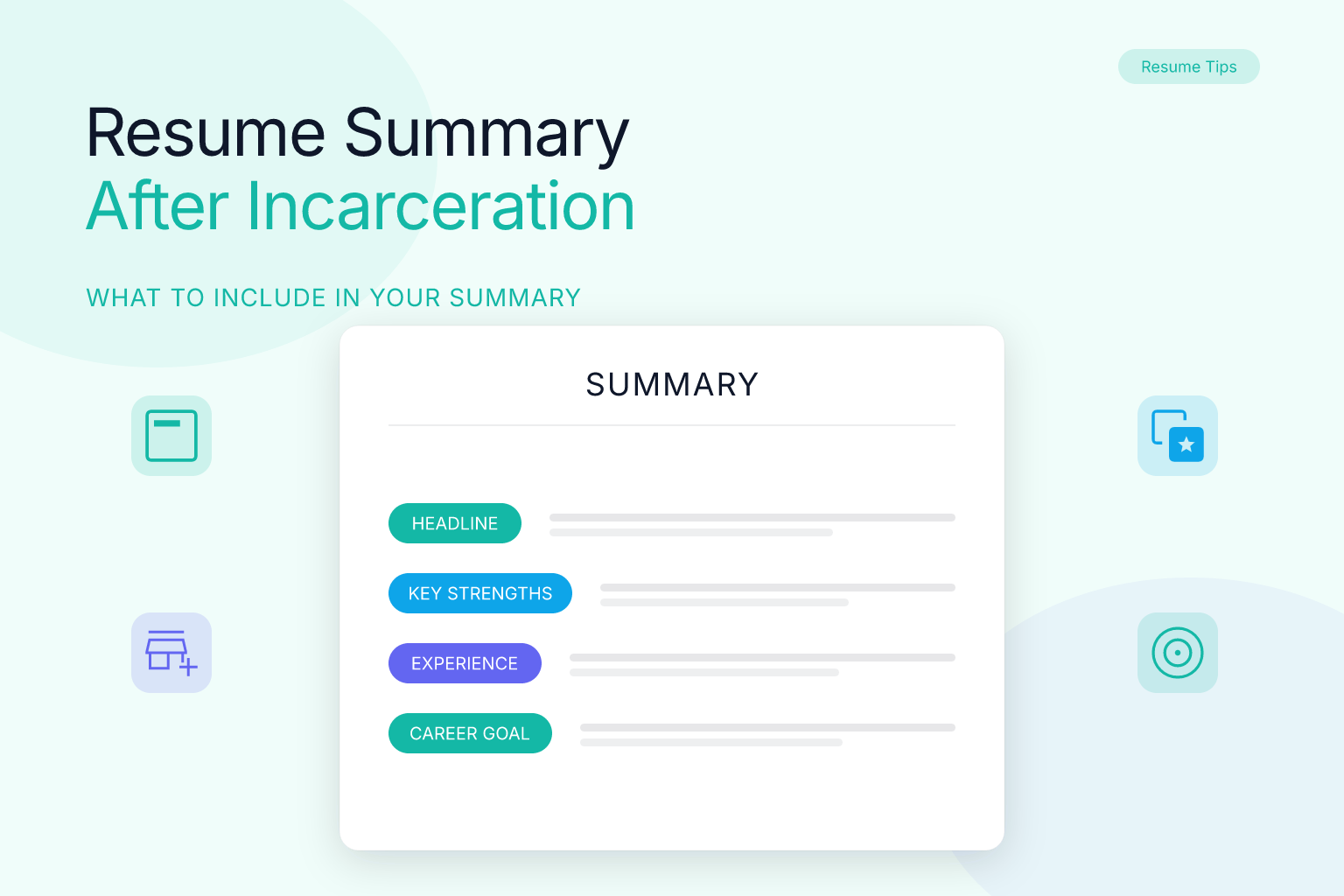
A resume summary for returning to work after incarceration is your first chance to show an employer who you are today — not who you were years ago. You’ve served your time, completed programs, and built skills that matter in the workplace. The summary at the top of your resume can frame that story before a hiring manager jumps to conclusions about the gap in your work history. This guide walks you through exactly what to say, what to leave out, and how to build a resume that gets you in the door.
Key Takeaways
- A strong resume summary shifts the focus from your past to the skills, training, and reliability you bring to the job right now.
- You do not need to mention incarceration in your resume summary; address the gap with neutral language like “career break” and save the full conversation for the interview.
- Highlighting recent certifications, volunteer work, and transferable skills from prison jobs or reentry programs makes your summary concrete and credible.
- A hybrid resume format that leads with a summary and skills section, followed by a condensed work history, is the most effective layout for returning citizens.
- Many employers actively hire people with records — your summary should speak to their needs, not your past.
Summary Table: Building a Resume That Works After Incarceration
| What to Do | Why It Matters | Time |
|---|---|---|
| Write a forward-looking summary that emphasizes skills and recent training | Employers scan the top third of a resume first; a strong summary sets the tone | 15–20 minutes |
| Replace “incarceration” with neutral gap language in the summary | Keeps the focus on your qualifications without hiding the truth | 5 minutes |
| List transferable skills from prison work, education, or volunteer roles | Shows you have relevant, recent experience even if it wasn’t traditional employment | 20–30 minutes |
| Use a hybrid resume format (summary + skills + condensed work history) | Prevents the gap from dominating the page while still showing a timeline | 30 minutes to reformat |
| Run your resume through an ATS score checker before applying | Ensures the document parses correctly so a human actually sees your summary | 2 minutes |
Why Your Summary Matters and How to Address the Gap
When you’re returning to work after incarceration, the top of your resume does heavy lifting. Most recruiters spend six to ten seconds scanning a resume before deciding whether to keep reading. If the first thing they see is a ten-year gap with no explanation, they may assume the worst — or simply move on. A well-written summary intercepts that snap judgment.
Your summary is not a confession. It’s a positioning statement. It tells the employer what you can do, what you’ve done recently to prepare, and why you’re a fit for the role. For returning citizens, that means leading with current skills, certifications, and work readiness — not with a chronological list that starts and stops abruptly.
Think of the summary as the answer to the question: “Why should I hire you today?” If you completed a welding program in the last year, earned a forklift certification, or managed a kitchen crew, that belongs in the first two sentences. The gap can be addressed later, briefly and on your terms.
You don’t need to spell out incarceration in the summary. In fact, doing so can backfire by making the gap the headline instead of your qualifications. Instead, use neutral, honest phrasing that acknowledges time away from the workforce without detailing the reason.
Acceptable phrases include:
- “After a career break, I’m eager to return to the workforce with updated skills in…”
- “Following a period away from traditional employment, I completed training in…”
- “Returning to the job market with recent certifications and a strong work ethic.”
These statements signal that you’re not hiding the gap, but they don’t invite bias before you’ve had a chance to present your case. The full explanation — including your incarceration — belongs in a face-to-face conversation or, if required, on the application form where the employer specifically asks about criminal history.
If you held jobs while incarcerated, frame them as work experience without naming the facility. For example, “Kitchen Supervisor, State Correctional Industries (2019–2023)” can appear in your work history section. The summary can then reference that experience: “Experienced kitchen supervisor with four years of leadership in high-volume food service.”
Skills to Highlight and Resume Summary Examples
Employers care about what you can do now. The time you spent inside often includes work assignments, education, and programs that translate directly to the outside job market. Your summary should pull the most relevant pieces forward.
Transferable skills to emphasize:
- Reliability and punctuality: Many reentry programs stress attendance and accountability. If you maintained a perfect attendance record in a work assignment, that’s a selling point.
- Technical skills: Welding, HVAC, carpentry, culinary arts, computer skills, and logistics are common prison vocational programs. List any certifications you earned.
- Soft skills: Conflict resolution, teamwork, and communication are often developed in structured environments. Mention them if they relate to the job.
- Supervisory experience: If you led a crew or trained others, that’s management experience — use it.
Recent training and education:
- GED or high school diploma earned during incarceration
- College courses completed through correspondence or in-facility programs
- Reentry program certificates (e.g., job readiness, financial literacy, substance abuse counseling completion)
- OSHA, ServSafe, or other industry credentials
Your summary can combine these elements: “Dependable warehouse professional with recent OSHA 10 certification and two years of inventory management experience. Completed a 12-week reentry job readiness program focused on workplace safety and team collaboration.”
Here are five resume summary examples tailored to different situations. Use them as templates and swap in your own details.
1. General labor / warehouse “Reliable general laborer with recent forklift certification and two years of warehouse experience. Known for perfect attendance and a strong safety record. Completed a reentry employment program emphasizing teamwork and accountability. Ready to contribute immediately in a fast-paced environment.”
2. Food service “Experienced kitchen supervisor with four years of high-volume food preparation and team leadership. ServSafe certified and trained in inventory management. Returning to the workforce with a renewed commitment to quality and efficiency.”
3. Administrative / office support “Detail-oriented administrative professional with strong data entry and Microsoft Office skills. Completed a 16-week office administration program and earned a certificate in business communication. Eager to apply organizational abilities in a support role.”
4. Construction / skilled trades “Skilled carpenter with apprenticeship training and three years of hands-on experience in framing, drywall, and finish work. OSHA 30 certified. Reliable, safety-focused, and ready to join a crew immediately.”
5. Entry-level / no recent work history “Motivated individual returning to the workforce after completing a comprehensive job readiness program. Strong work ethic, punctuality, and a willingness to learn. Recently earned a GED and a customer service certificate. Looking for an opportunity to prove myself in an entry-level role.”
Each example leads with a job title or descriptor, names specific skills or certifications, and closes with readiness. None mention incarceration. The gap is implied but not detailed.
Should You Mention Your Incarceration in the Summary?
No. The resume summary is a marketing document, not a legal disclosure. Its purpose is to get you an interview. Mentioning incarceration in the summary often does the opposite — it gives a reason to reject you before you’ve shown your value.
There is a time and place to discuss your record. That time is typically during the interview or on the job application if the employer asks a direct question about criminal history. Many states and cities have “ban the box” laws that prohibit employers from asking about convictions on the initial application. Even where it’s legal, you’re not obligated to volunteer the information on your resume.
If you’re worried about a background check revealing your record, prepare a short, honest explanation for the interview. Practice saying something like: “I made mistakes in the past, and I’ve taken full responsibility. Since then, I’ve completed these programs and I’m committed to building a stable career. I’m ready to work hard and prove myself.” Your resume summary sets the stage for that conversation by establishing your competence first.
Structuring Your Resume: Hybrid Format and Tips
A strong summary is only part of the equation. The rest of your resume needs to support the story you’ve started. For returning citizens, a hybrid resume format works best. It combines a summary and skills section at the top with a condensed chronological work history below. For more on choosing the right format, see our guide on resume formats.
Recommended section order:
- Contact information (name, phone, email, city/state)
- Resume summary (3–4 lines)
- Skills section (6–10 bullet points of hard and soft skills)
- Certifications and training (list with dates)
- Work history (job title, organization, dates — include prison jobs and any post-release work)
- Education (GED, diplomas, relevant coursework)
This layout puts your strongest, most recent qualifications first. The work history section can be brief. If you held multiple prison jobs, list the most relevant ones. Use functional job titles like “Kitchen Supervisor” or “Warehouse Associate” rather than “Inmate Worker.” The organization name can be neutral — “State Correctional Industries” or “Facility Work Program” — without specifying it’s a prison unless you choose to.
If you have a long gap with no work at all, you can still include a “Reentry Preparation” section that lists programs, workshops, and self-study. This shows you used the time productively.
A purely functional resume — one that lists skills but no dates or employers — is rarely the best choice. Many recruiters and applicant tracking systems (ATS) view functional resumes as an attempt to hide something, and they can be harder to parse. A hybrid format gives you the best of both worlds: a skills-forward approach that still provides a timeline.
With a hybrid resume, you can group your skills under categories like “Warehouse Operations,” “Leadership,” or “Customer Service,” and then follow with a brief work history that includes dates. This way, you’re not hiding the gap; you’re just not letting it dominate the page.
Before you send your resume out, run it through a free ATS score checker to make sure the format doesn’t confuse the software. The ResumeMate score checker scans your resume and gives you section-by-section feedback on what’s working and what might get filtered out. It’s a quick way to catch formatting issues that could keep your summary from ever being read.
How to Prepare for the Interview After Submitting Your Resume
Your resume summary got you the interview. Now you need to back it up. The conversation will likely turn to the gap in your work history, and you should be ready to address it directly, briefly, and without shame.
Prepare a 30-second explanation:
- Acknowledge the gap: “I was incarcerated for a period of time.”
- Take responsibility: “I made mistakes, and I’ve learned from them.”
- Pivot to the present: “Since my release, I’ve completed X training, earned Y certification, and I’m fully committed to building a career.”
- Connect to the job: “The skills I developed in that training are exactly what you’re looking for in this role.”
Practice this out loud until it feels natural. The goal is to answer the question honestly and then steer the conversation back to your qualifications. Most interviewers will follow your lead if you project confidence and readiness.
Also, research second-chance employers in your area. Many companies actively hire people with records — including large employers in manufacturing, construction, food service, and logistics. Walking into an interview knowing the company has a fair-chance hiring policy can ease your nerves and help you focus on the job, not your past.
Tools to Build and Check Your Resume
You don’t need to format everything from scratch. A free AI resume builder can help you create a clean, ATS-friendly resume in minutes. ResumeMate’s resume builder offers single-column templates that parse reliably in most applicant tracking systems, and you can export your finished resume as a PDF — the format most modern ATS handle without issues. Learn more about ATS-friendly resumes.
Once your resume is built, use the resume score checker to see how it stacks up. The tool gives you a score and pinpoints sections that need improvement, from your summary to your skills list. It’s free and takes less than two minutes.
If you’re also looking for openings, the ResumeMate job board lets you filter by role, location, and remote options. Pair it with the Chrome extension to track every application, deadline, and follow-up without leaving your browser.
Related articles:
FAQ
Q: Should I include my incarceration on my resume?
A: No. Your resume is a marketing document, not a background check form. You can address the gap with neutral language and discuss your record later in the process if asked. Many employers only learn about a conviction during a background check after a conditional offer.
Q: How do I explain a felony on a job application?
A: If the application asks directly about convictions, answer honestly and briefly. You can add a short statement like “Will discuss in interview” or “Have completed reentry programs and am ready to work.” Never lie on an application — that alone can disqualify you.
Q: What if I have no work experience after incarceration?
A: Focus on skills and training you completed during or after incarceration. List vocational programs, educational courses, volunteer work, and reentry workshops. A summary like “Motivated individual with recent GED and job readiness certificate, eager to start in an entry-level role” is honest and forward-looking.
Q: Can I use a functional resume to hide the gap?
A: A purely functional resume (no dates, no employers) often raises red flags with recruiters and ATS software. A hybrid format that leads with a summary and skills, followed by a condensed work history with dates, is more effective and transparent.
Q: What are the best jobs for someone with a criminal record?
A: Many industries hire returning citizens, including construction, manufacturing, warehousing, food service, trucking, and landscaping. Look for employers with fair-chance or second-chance hiring policies. Local reentry organizations often maintain lists of such employers.
Q: How do I handle a background check?
A: Be upfront once you have a conditional offer. You can say, “I want to let you know that my background check will show a conviction from [year]. I’ve completed my sentence and these programs since then. I’m happy to discuss it further.” This shows integrity and keeps you in control of the narrative.
Q: Should I use a resume objective instead of a summary?
A: For most returning citizens, a summary works better because it highlights what you bring to the employer, not what you want. An objective (“Seeking a position where I can use my skills…”) focuses on your needs. A summary (“Reliable warehouse associate with forklift certification…”) focuses on the employer’s needs. Read more about the difference in our guide on resume objective vs. summary.
Track Every Application While You Job Hunt
Stop losing track of where you’ve applied. The ResumeMate Job Tracker is a free Chrome extension that tracks every application, deadline, and follow-up in one place — right from your browser.