Resume Tips for Workers with Variable Income Streams
If your income comes from freelance projects, gig work, commission-based sales, seasonal jobs, or a mix of contracts, you already know that resume tips for workers with variable income streams are different from the standard advice. Most resume guides assume you have a single employer, a steady title, and a predictable career ladder. Your reality is more complex — and that complexity can actually work in your favor if you present it the right way.
Hiring managers don’t need you to hide your variable income history. They need you to show that you can deliver results, manage your own time, and adapt to changing demands. This guide walks you through exactly how to structure, write, and tailor a resume that turns your non-traditional work history into a competitive advantage.
Key Takeaways
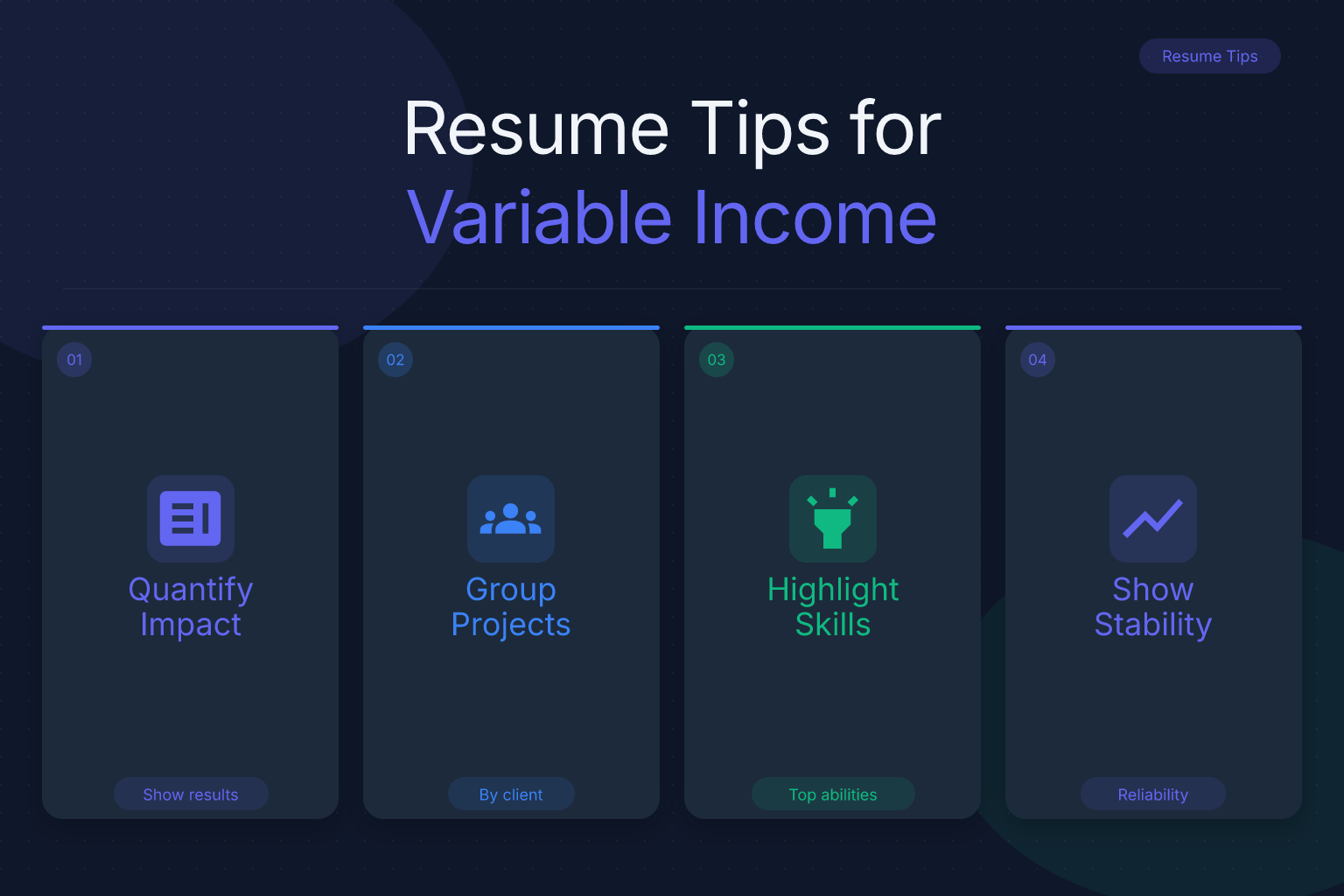
- Group all freelance, gig, and contract work under a single “Independent Consultant” or “Freelance [Role]” heading with date ranges, not as a list of disconnected short jobs.
- Quantify your variable income as a strength by showing revenue generated, number of clients served, repeat business rate, or project volume — not by listing exact income figures.
- Use a hybrid resume format that leads with a skills summary and selected project highlights, then lists your work history in reverse chronological order.
- Address gaps and income fluctuations directly in a short “Career Note” or summary statement, framing them as intentional choices or periods of skill-building.
- Tailor every resume to the specific job by pulling keywords from the posting and matching your project examples to the employer’s stated needs.
Summary Table
| What to Do | Why It Matters | Time |
|---|---|---|
| Group contract work under one heading | Prevents the “job hopper” label and shows continuity | 15 min |
| Quantify results with revenue, clients, or project counts | Proves you deliver value even without a traditional title | 30 min |
| Write a skills-based summary at the top | Immediately signals your core strengths to ATS and humans | 20 min |
| Add a one-line career note explaining your work model | Removes confusion and preempts questions about gaps | 10 min |
| Tailor keywords and project examples per application | Increases ATS match rate and recruiter relevance | 25 min per job |
Why Standard Resume Advice Fails Workers with Variable Income Streams
Traditional resume guidance assumes a linear career: one employer, one title, one salary. When you have variable income streams, that model breaks down. You might have three clients in a month, then none for six weeks. You might earn $8,000 one quarter and $1,200 the next. You might work as a rideshare driver, a freelance writer, and a seasonal retail associate all in the same year.
If you list each of those as a separate job with its own dates, your resume looks fragmented. If you leave gaps unexplained, recruiters assume the worst. If you try to force your experience into a single “job title,” you lose the richness of what you actually did.
The fix is not to hide your variable income history. It’s to reframe it. Employers increasingly value adaptability, self-direction, and the ability to juggle multiple priorities — all skills you’ve developed by necessity. Your resume needs to lead with those strengths, not apologize for the structure of your work.
Choose the Right Resume Format: Hybrid Works Best
For workers with variable income streams, a hybrid resume format (also called a combination resume) is usually the strongest choice. It combines a skills-focused summary with a reverse-chronological work history, giving you the best of both worlds.
Here’s why:
- A pure chronological resume forces you to list every gig, contract, and seasonal job in date order. That creates visual clutter and makes short engagements look like job hopping.
- A pure functional resume hides your work history entirely, which many ATS systems and recruiters distrust because it obscures when and where you worked.
- A hybrid resume opens with a strong skills summary and selected project highlights, then lists your work history in a condensed, grouped format. This lets you control the narrative while still providing the dates and employers that ATS and humans expect.
For example, instead of listing “Uber Driver, March–May 2025” and “Freelance Graphic Designer, June–August 2025” as separate entries, you could create one section titled “Independent Work & Freelance Projects” with a date range of “2024–Present” and bullet points that describe your combined client work. Under that, you can list individual clients or projects as sub-bullets without separate date ranges.
If you’re unsure how your current resume will parse in an ATS, run it through a free resume score checker to see exactly what a system reads and where you might be losing points.
How to List Freelance, Gig, and Contract Work Without Looking Like a Job Hopper
The single most effective resume tip for workers with variable income streams is to group related work under one umbrella heading. This creates continuity and signals that your varied engagements are part of a deliberate career strategy, not a series of random jobs.
Here’s a step-by-step approach:
- Choose a professional title that describes the core of what you do. Options include “Independent Consultant,” “Freelance [Your Role],” “Contract [Your Role],” or “Self-Employed [Your Role].” Avoid vague titles like “Gig Worker” or “Various Jobs.”
- Set a date range that covers the entire period you’ve been doing this type of work. For example, “Freelance Marketing Consultant, 2022–Present.” If you had a full-time job in between, you can still list that separately.
- Write 3–5 bullet points that summarize your overall impact across all clients. Focus on results: “Generated $120K in client revenue across 14 projects,” “Maintained a 90% client retention rate over three years,” “Delivered 40+ completed projects on time and under budget.”
- List 2–3 representative clients or projects as sub-bullets with a one-line description each. This gives concrete evidence without overwhelming the reader.
- If you had a mix of unrelated gigs (e.g., rideshare driving and freelance writing), create two separate grouped sections: one for “Freelance Writing & Content” and one for “Rideshare & Delivery Services.” This keeps each section coherent.
This approach mirrors the advice in our guide on how to list temp agency work on a resume, which covers similar grouping strategies for short-term assignments.
Quantify Your Variable Income as a Strength — Not a Liability
Many workers with variable income streams hesitate to include numbers because they worry that fluctuating income looks unstable. The opposite is true: quantifying your results shows that you can deliver value regardless of how your income is structured.
You don’t need to list your exact income. Instead, focus on metrics that demonstrate impact:
- Revenue generated: “Brought in $75,000 in new client revenue over 18 months.”
- Number of clients or projects: “Completed 25+ freelance projects for 12 different clients.”
- Repeat business rate: “Achieved an 80% repeat client rate, reducing the need for constant prospecting.”
- Project volume or throughput: “Handled an average of 6 concurrent projects per month during peak season.”
- Cost savings or efficiency gains: “Reduced client onboarding time by 30% through standardized processes.”
- Income stability within variability: “Maintained an average monthly income of $4,500 across a 24-month period, with a low of $2,800 and a high of $7,200.” (Only include this if you’re comfortable; it can actually demonstrate financial management skill.)
If you’re a commission-based salesperson, quantify your sales volume, conversion rate, or territory growth. If you’re a seasonal worker, quantify the revenue or output during your peak season and note that you consistently return year after year — that’s a signal of reliability.
The key is to frame variability as adaptability and resilience, not as inconsistency. You managed your own pipeline, budgeted for lean months, and kept clients happy. Those are exactly the skills employers want.
Highlight Transferable Skills That Employers Actually Care About
Variable income work builds a specific set of skills that traditional employees often lack. Make sure your resume calls them out explicitly.
Here are the top transferable skills to highlight, with example bullet points:
- Self-management and time management: “Managed a fluctuating workload of 3–8 concurrent projects without missing a deadline.”
- Client communication and relationship building: “Maintained ongoing relationships with 10+ repeat clients through proactive updates and clear expectation-setting.”
- Budgeting and financial planning: “Planned personal and business finances around variable monthly income, maintaining a 6-month emergency fund.”
- Adaptability and problem-solving: “Quickly pivoted between industries (retail, logistics, content) to meet changing market demand.”
- Sales and negotiation: “Negotiated project rates and scope with clients, increasing average project value by 20% year over year.”
- Technical skills: Depending on your field, list the tools and platforms you use. For guidance on how to present these effectively, see our post on computer skills for your resume.
Don’t bury these skills in a long list at the bottom. Weave them into your summary statement and your bullet points. For example:
Summary: “Freelance marketing consultant with 5 years of experience managing variable client loads, generating $200K+ in revenue, and maintaining a 90% client retention rate. Skilled in self-directed project management, client communication, and budget planning under fluctuating income conditions.”
Address Employment Gaps and Income Fluctuations Head-On
Gaps between contracts or gigs are normal for variable income workers, but they can raise red flags if left unexplained. The solution is not to hide them — it’s to address them proactively in a way that frames them as intentional.
Here are three ways to handle gaps:
- Use a “Career Note” section near the top of your resume. A single line like “Periods between contracts were used for skill development, certification, and client prospecting” removes ambiguity.
- Incorporate the explanation into your summary. For example: “Freelance web developer with a consistent track record of client work since 2021, including intentional breaks for upskilling in React and Node.js.”
- List the gap as a purposeful activity. If you took a course, earned a certification, or did volunteer work during a lean period, list it as its own entry. For example: “Professional Development, Jan–Mar 2025: Completed Google UX Design Certificate and rebuilt personal portfolio.”
Never leave a gap completely blank. ATS systems and recruiters will assume the worst, and you’ll lose the chance to tell your own story.
Tailor Your Resume for Each Job Application
Because your work history is varied, a one-size-fits-all resume won’t work. You need to customize your resume for every application by matching your project examples and skills to the specific job description.
Here’s a simple process:
- Read the job posting carefully and highlight the top 5–7 required skills and qualifications.
- Reorder your skills summary so the most relevant skills appear first.
- Swap out project examples to feature the ones that best match the employer’s industry or needs. If you’re applying for a marketing role, lead with your marketing clients; if it’s a sales role, lead with your commission-based sales results.
- Mirror the language of the job posting. If the posting says “client relationship management,” use that exact phrase instead of “customer service.”
- Adjust your grouped work section to emphasize the type of work most relevant to the role. You can rename the heading from “Freelance Marketing Consultant” to “Contract Marketing Specialist” if that matches the posting better.
After tailoring, run your resume through a free ATS score checker to see how well it matches the job description and where you can improve keyword usage.
Common Mistakes to Avoid
Even with the right strategy, it’s easy to fall into traps that undermine your resume. Avoid these common mistakes:
- Listing every gig as a separate job entry. This creates a fragmented, job-hopper appearance. Group related work under one heading.
- Using vague or generic titles like “Freelancer” or “Self-Employed.” Be specific: “Freelance Graphic Designer,” “Independent Sales Consultant,” “Contract Data Analyst.”
- Omitting metrics entirely. Without numbers, your achievements sound like duties. Quantify revenue, clients, projects, or outcomes.
- Ignoring ATS formatting. Multi-column layouts, tables, and graphics can confuse older ATS systems. Stick to a clean, single-column format. If you’re unsure which template to use, see our guide on choosing the best resume builder template.
- Not explaining your work model. If a recruiter can’t tell whether you were employed or self-employed, they may assume the worst. Add a clear title and a brief note.
- Apologizing for variable income. Never write “only freelance work” or “no steady job.” Frame your experience as a strength: you built a client base, managed your own finances, and delivered results without a safety net.
FAQ
Q: How do I list freelance work on a resume without looking like a job hopper?
A: Group all freelance work under a single heading like “Freelance [Your Role]” with a date range covering the entire period. Then list 3–5 bullet points summarizing your overall impact across clients, followed by 2–3 representative client or project examples. This shows continuity and prevents the fragmented look of listing each gig separately.
Q: Should I include my income on my resume?
A: No, you should not list your exact income or hourly rate on a resume. Instead, quantify your results using metrics like revenue generated, number of clients served, repeat business rate, or project volume. These numbers demonstrate value without revealing personal financial details.
Q: What resume format is best for gig workers and freelancers?
A: A hybrid (combination) resume format works best. It opens with a skills summary and selected project highlights, then lists your work history in a condensed, grouped format. This lets you lead with your strengths while still providing the dates and employers that ATS systems and recruiters expect.
Q: How do I explain gaps between contracts or gigs?
A: Address gaps proactively with a one-line “Career Note” near the top of your resume, or incorporate the explanation into your summary. For example: “Periods between contracts were used for skill development, certification, and client prospecting.” If you took a course or did volunteer work during a gap, list it as its own entry.
Q: Can I use a functional resume to hide my variable income history?
A: Avoid a pure functional resume. Many ATS systems and recruiters distrust it because it obscures when and where you worked. A hybrid resume gives you the same ability to lead with skills while still providing a clear work history, which is safer for both ATS parsing and human review.
Q: How do I quantify variable income if I don’t want to share exact numbers?
A: Use ranges, percentages, or counts instead of exact dollar amounts. For example: “Generated over $50K in client revenue,” “Increased repeat business by 25%,” or “Completed 30+ projects for 15 different clients.” These metrics prove impact without revealing your personal income.
Q: What if my variable income work is in completely different fields?
A: Create separate grouped sections for each field. For example, one section for “Freelance Writing & Content” and another for “Rideshare & Delivery Services.” This keeps each section coherent and lets you tailor the most relevant section to each job application.
Track Every Application While You Job Hunt
Stop losing track of where you’ve applied. The ResumeMate Job Tracker is a free Chrome extension that tracks every application, deadline, and follow-up in one place — right from your browser.