Scrum Master Resume Examples and Certifications: A Practical Guide for 2026
A scrum master resume that lands interviews does more than list your certifications — it shows how you removed obstacles, coached teams, and delivered value sprint after sprint. Hiring managers see dozens of resumes that say “facilitated daily standups.” The ones that get callbacks prove impact with numbers: cycle time reduced, velocity increased, team satisfaction improved. This guide walks you through exactly what to include, which certifications matter most, and how to format your resume so both ATS software and human recruiters can read it quickly.
Key Takeaways
- A scrum master resume should lead with measurable outcomes: sprint velocity improvements, cycle time reductions, or team satisfaction scores — not just a list of ceremonies you ran.
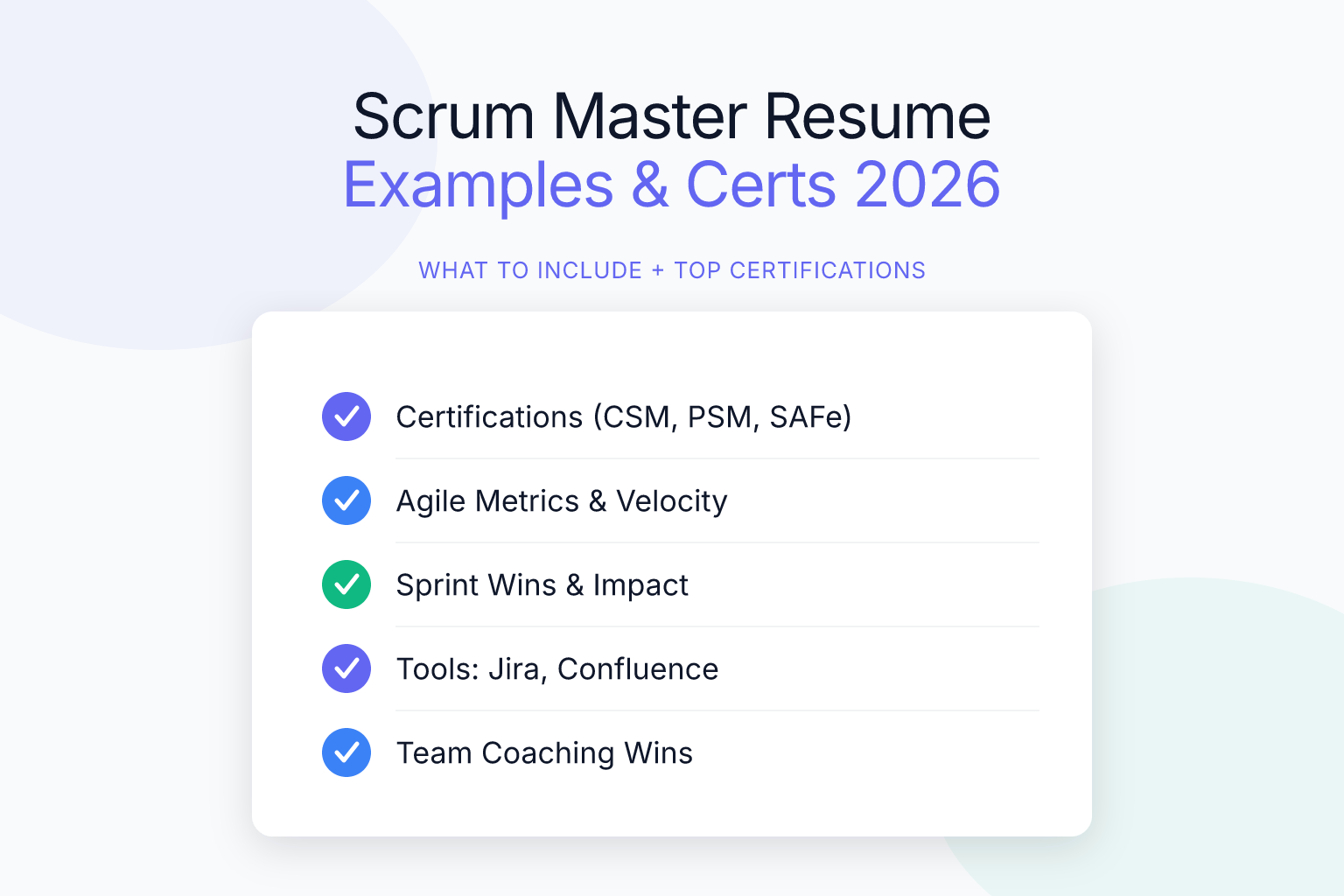
- The two most recognized certifications are Certified ScrumMaster (CSM) from Scrum Alliance and Professional Scrum Master (PSM) from Scrum.org; list them in a dedicated certifications section near the top.
- Use a single-column, ATS-friendly PDF format and include keywords from the job description like “sprint planning,” “retrospective,” and “impediment removal.”
- Quantify your impact: “Coached a team of 8 to reduce cycle time by 30% over 6 months” beats “Facilitated scrum ceremonies” every time.
- Run your resume through a free ATS score checker before applying to catch parsing issues and keyword gaps.
| What to Do | Why It Matters | Time |
|---|---|---|
| List CSM, PSM, or SAFe certification near the top | Recruiters filter by certifications first | 5 min |
| Rewrite experience bullets with metrics (velocity, cycle time, team size) | Shows you deliver outcomes, not just run meetings | 30 min |
| Use a single-column PDF template | Ensures ATS parses your resume correctly | 10 min |
| Tailor skills to the job description (Jira, Confluence, Kanban) | Passes keyword filters and shows fit | 15 min |
| Check your resume’s ATS score before submitting | Catches formatting or keyword gaps | 5 min |
Scrum Master Resume Examples and Certifications: What Recruiters Actually Look For
When a recruiter opens your scrum master resume, they scan for three things in the first 10 seconds: your certifications, your years of hands-on agile experience, and evidence that you understand servant leadership — not command-and-control project management. A scrum master is not a project manager. You don’t assign tasks or own the budget. You coach the team, remove blockers, and protect the process.
That distinction shows up in your word choice. Compare these two experience bullets:
- Weak: “Responsible for running scrum ceremonies and tracking progress.”
- Strong: “Facilitated sprint planning, daily standups, and retrospectives for a cross-functional team of 9, reducing average cycle time from 12 days to 8 days over two quarters.”
The first bullet describes a meeting scheduler. The second describes someone who improved delivery. Recruiters look for the second kind. They also look for specific agile vocabulary: sprint goal, definition of done, impediment removal, continuous improvement, empirical process control. If your resume reads like a generic project coordinator resume, it will get passed over.
Which Scrum Certifications Should You List on Your Resume?
Certifications are the fastest way to signal baseline competence. Most scrum master job postings list at least one certification as required or preferred. The three you’ll see most often:
- Certified ScrumMaster (CSM) from Scrum Alliance — the most widely recognized entry-level certification. Requires a two-day course and an exam.
- Professional Scrum Master (PSM I) from Scrum.org — no course required, just a challenging exam. Often seen as more rigorous because you can’t buy the certification by attending a class.
- SAFe Scrum Master (SSM) from Scaled Agile — valuable if you’re targeting large enterprises that use the Scaled Agile Framework.
If you have multiple certifications, list the most relevant one first based on the job description. For example, if the posting mentions SAFe, put SSM at the top. If it’s a startup using vanilla Scrum, lead with PSM or CSM.
Where do certifications go on a resume? In a dedicated section, usually right after your summary or after your experience — whichever is stronger. For a detailed breakdown of placement and formatting, see our guide on where and how to list certifications and licenses on a resume.
Here’s a sample certifications section:
Certifications
- Professional Scrum Master I (PSM I), Scrum.org — 2024
- Certified ScrumMaster (CSM), Scrum Alliance — 2023
- SAFe 6 Scrum Master (SSM), Scaled Agile — 2025
Don’t list expired certifications unless you note the expiration date. And don’t list a certification you’re “pursuing” — either you have it or you don’t.
Write a Scrum Master Resume Summary That Shows Impact
Your resume summary is the first paragraph a human reads after the ATS passes your resume through. It should be 2–3 sentences that answer three questions: What kind of scrum master are you? What have you delivered? What makes you different?
Here are three examples for different experience levels:
Entry-level (career changer or new CSM): “Certified ScrumMaster with 3 years of experience as a business analyst on agile teams. Facilitated 20+ sprint retrospectives and coached two teams through their first Scrum adoption. Reduced meeting overhead by 25% by introducing timeboxed standups and async status updates.”
Mid-level (3–5 years as scrum master): “Scrum Master with 4 years of experience coaching cross-functional teams in fintech. Improved team velocity by 35% across three teams by introducing WIP limits and refining backlog grooming practices. PSM II certified, experienced with Jira, Confluence, and Kanban.”
Senior (5+ years, multiple teams or scaled agile): “Senior Scrum Master and agile coach with 7 years of experience leading transformations in healthcare and e-commerce. Scaled Scrum from one team to five using SAFe, reducing release cycle time by 40%. Mentored 6 junior scrum masters and facilitated 100+ retrospectives.”
Notice the pattern: certification, years, domain, metric, tool. No fluff like “passionate about agile” or “strong communication skills.” For more summary examples across roles, check out our resume summary examples for 20 roles.
How to Write Experience Bullets That Prove You Can Remove Impediments
The core of a scrum master’s job is removing impediments — but that’s hard to quantify. You can’t always say “removed 12 blockers per sprint” because blockers vary in size and impact. Instead, focus on the outcomes that resulted from your facilitation and coaching.
Follow this formula for each bullet:
Action verb + what you did + team size or context + measurable result
Examples:
- “Coached a team of 8 developers and QA engineers to adopt test-driven development, reducing production defects by 22% over 6 months.”
- “Facilitated 30+ sprint retrospectives, turning feedback into 15 actionable process improvements that increased sprint commitment reliability from 70% to 90%.”
- “Removed a recurring dependency on an external API team by introducing a mock service, cutting average cycle time from 10 days to 6 days.”
- “Trained 3 product owners on backlog refinement techniques, reducing sprint planning time from 4 hours to 2 hours.”
If you’re early in your career and don’t have scrum master experience yet, pull from adjacent roles: business analyst, QA tester, developer, or project coordinator. Did you facilitate meetings? Coach a colleague? Introduce a new tool? Frame those as scrum-adjacent achievements. For more on how to present non-traditional experience, see our guide on formatting freelance or non-standard work on a resume.
List the Right Skills: Technical, Facilitation, and Coaching
Scrum master skills fall into three buckets. List them in a dedicated skills section, and tailor the order to the job description.
Agile frameworks and methods:
- Scrum, Kanban, Scrumban, SAFe, Lean, XP
- Sprint planning, backlog refinement, release planning, user stories, estimation (story points, planning poker)
Tools:
- Jira, Confluence, Azure DevOps, Trello, Miro, Mural, Slack, Microsoft Teams
- Version control basics (Git) — not required, but helpful for speaking the team’s language
Facilitation and coaching:
- Retrospective facilitation, conflict resolution, active listening, feedback delivery, mentoring, servant leadership, change management
Don’t list every tool you’ve ever touched. If the job description mentions Jira and Confluence, put those first. If it mentions Azure DevOps, swap it in. A scrum master who lists 20 tools looks unfocused. A scrum master who lists 6 relevant tools looks like a fit.
Format Your Scrum Master Resume for ATS and Human Readers
Most companies use an applicant tracking system (ATS) to parse resumes before a human sees them. The good news: modern ATS like Workday, Greenhouse, and Lever parse clean, text-based PDFs reliably. The bad news: scanned PDFs, tables, graphics, and multi-column layouts can still cause parsing errors.
Here’s how to format your scrum master resume for both ATS and human readers:
- Use a single-column layout. It’s the safest choice for ATS parsing. Most ResumeMate templates are single-column, and they export as clean, text-based PDFs.
- Use standard section headings: Summary, Certifications, Experience, Skills, Education. Don’t get creative with “My Agile Journey” or “What I Bring.”
- Avoid tables, text boxes, and images. They can confuse ATS parsers.
- Keep it to one page if you have less than 10 years of experience. Two pages is fine for senior roles, but don’t pad.
- Export as PDF. ResumeMate’s free resume builder exports ATS-safe PDFs with single-column templates. Avoid DOCX unless a specific portal explicitly requests it.
Before you submit, run your resume through a free ATS score checker. ResumeMate’s resume score checker uploads your resume and gives you a section-by-section breakdown of how well it parses, what keywords are missing, and where to improve. It takes 30 seconds and catches issues you’d never notice on your own.
Common Mistakes That Get Scrum Master Resumes Rejected
Even strong scrum masters get rejected for avoidable resume mistakes. Here are the most common ones:
- Listing duties instead of outcomes. “Facilitated daily standups” tells me nothing. “Facilitated daily standups that reduced meeting time by 15 minutes per day, saving the team 5 hours per sprint” tells me you think about efficiency.
- Omitting certifications. If you have a CSM or PSM, it should be near the top. Recruiters filter by certification first. If it’s buried at the bottom, you might get filtered out before a human reads it.
- Using project manager language. Words like “managed,” “assigned,” “tracked,” and “reported” signal command-and-control. Scrum masters use “coached,” “facilitated,” “removed,” “enabled,” and “mentored.”
- Including irrelevant technical skills. Listing C++, Python, or AWS on a scrum master resume doesn’t help unless the role specifically asks for it. It dilutes your focus.
- Using a two-column layout with graphics. It might look pretty, but it can break ATS parsing. Stick to single-column.
- Writing a generic summary. “Scrum Master with 5 years of experience seeking a challenging role” is wasted space. Lead with a metric and a certification.
Full Scrum Master Resume Example (Text Version)
Here’s a complete example you can adapt. This is for a mid-level scrum master targeting a fintech role.
JORDAN REYES jordan.reyes@email.com | (555) 123-4567 | linkedin.com/in/jordanreyes
Summary Scrum Master with 4 years of experience coaching cross-functional teams in fintech. Improved team velocity by 35% across three teams by introducing WIP limits and refining backlog grooming practices. PSM II certified, experienced with Jira, Confluence, and Kanban.
Certifications
- Professional Scrum Master II (PSM II), Scrum.org — 2025
- Professional Scrum Master I (PSM I), Scrum.org — 2023
- Certified ScrumMaster (CSM), Scrum Alliance — 2022
Experience
Scrum Master | FinPay Solutions | 2023–Present
- Coached a team of 9 engineers and product managers to adopt Kanban for support work, reducing average resolution time from 5 days to 3 days.
- Facilitated 40+ sprint retrospectives, turning feedback into 12 process improvements that increased sprint commitment reliability from 72% to 88%.
- Removed a recurring dependency on a legacy payment API by introducing a contract-testing suite, cutting integration defects by 30%.
- Trained 2 new product owners on backlog refinement, reducing sprint planning time from 3 hours to 1.5 hours.
Junior Scrum Master | DataCore Labs | 2021–2023
- Supported a senior scrum master in facilitating ceremonies for two teams of 6–8 people.
- Introduced a retrospective template that increased team participation from 60% to 95%.
- Tracked sprint metrics in Jira and created a dashboard that reduced status meeting time by 50%.
Skills
- Agile: Scrum, Kanban, Scrumban, SAFe
- Tools: Jira, Confluence, Miro, Slack, Azure DevOps
- Facilitation: Retrospectives, conflict resolution, active listening, feedback delivery
- Coaching: Servant leadership, mentoring, change management
Education B.S. in Information Systems, University of Texas at Austin — 2020
FAQ
Q: What certifications should a scrum master have on a resume?
A: The two most recognized are Certified ScrumMaster (CSM) from Scrum Alliance and Professional Scrum Master (PSM) from Scrum.org. If you target large enterprises, add SAFe Scrum Master (SSM). List them in a dedicated certifications section near the top of your resume.
Q: How do I write a scrum master resume with no experience?
A: Pull from adjacent roles like business analyst, QA tester, or project coordinator. Highlight any facilitation, coaching, or process improvement you did, even informally. Get a CSM or PSM certification to signal baseline knowledge, and frame your experience bullets around outcomes like “reduced meeting time” or “improved team communication.”
Q: Should I list CSM or PSM first on my resume?
A: List the certification most relevant to the job description first. If the posting mentions Scrum.org or a rigorous exam, lead with PSM. If it’s a general agile role, CSM is fine. If you have both, order them by recency or relevance.
Q: What is the best resume format for a scrum master?
A: A single-column, text-based PDF is the safest format for ATS parsing. Use standard headings (Summary, Certifications, Experience, Skills, Education), avoid tables and graphics, and keep it to one page if you have less than 10 years of experience.
Q: How do I quantify scrum master achievements?
A: Focus on outcomes from your facilitation and coaching: team velocity change, cycle time reduction, defect rate decrease, sprint commitment reliability, meeting time saved, or team satisfaction scores. Even small numbers are better than no numbers.
Q: Can I use a two-column resume for scrum master roles?
A: You can, but it’s riskier. Modern ATS often parse two-column layouts fine, but some older systems don’t. Single-column is the safest choice, and it’s what most ResumeMate templates use. If you’re unsure, run your resume through an ATS score checker first.
Track Every Application While You Job Hunt
Stop losing track of where you’ve applied. The ResumeMate Job Tracker is a free Chrome extension that tracks every application, deadline, and follow-up in one place — right from your browser.