Short Cover Letter Examples for Busy Recruiters
A short cover letter is essential when recruiters spend just six to seven seconds scanning a resume. If you attach a dense, multi-paragraph cover letter, you risk losing their attention before they even reach your qualifications. A short cover letter — one that gets straight to the point — shows you respect their time and understand how hiring works. This guide gives you the exact format, three examples you can adapt today, and the rules that make a brief cover letter more effective than a long one. In short: keep it under 150 words, lead with the job title and your top qualification, use bullet points for achievements, and always include a call to action with your contact info.
Before we dive in, let’s clarify a common point of confusion. When people search for a “recruiter cover letter,” they usually mean one of two things: a cover letter addressed to a recruiter (which is what this guide covers) or a cover letter written by a recruiter applying for a recruiting role. If you’re a recruiter or talent acquisition professional looking for a new role, the same principles apply — you just need to tailor your achievements to recruiting metrics like time-to-fill, offer acceptance rate, or candidate satisfaction scores. We’ll include an example for that scenario below.
Key Takeaways
- Keep your cover letter under 150 words and use a four-part structure: a hook stating the role and your top qualification, 2-3 bullet points of quantified achievements, a sentence connecting your skills to the company, and a call to action with your contact information.
- Start the letter with the job title and your strongest relevant qualification instead of a generic opening like ‘I am writing to apply.’
- Use bullet points to highlight specific, measurable achievements that match the job description, adding context your resume alone cannot provide.
- Customize the letter by mentioning a specific company project, product, or mission to show you’ve researched the organization.
- Always include your phone number and email in the cover letter itself, even if they appear on your resume, so recruiters can contact you without searching.
Why Short Cover Letters Work: The Recruiter’s Perspective
Most recruiters are managing 30 to 40 open requisitions at once. They don’t have time to read a 400-word narrative about your career philosophy. A short cover letter — sometimes called a “recruiter cover letter” or “bullet cover letter” — gives them exactly what they need in under 15 seconds: the role you’re targeting, two or three reasons you’re qualified, and how to reach you.
This format works because it mirrors how recruiters actually read. Eye-tracking studies from job boards like TheLadders show that recruiters scan in an F-shaped pattern, focusing on headings, bullet points, and the first few words of each line. A wall of text gets skipped. A short, scannable letter gets read.
Before you write, understand the sequence. A recruiter typically opens your application and looks at:
- Your resume (6–7 seconds)
- Your cover letter — if it’s short and scannable (another 5–10 seconds)
- Your LinkedIn profile or portfolio (if they’re interested)
If your cover letter is a dense block of text, they’ll skip it entirely. That’s not a guess; it’s what recruiters report in survey after survey. A short cover letter, on the other hand, gets consumed because it doesn’t ask for more time than the recruiter has.
Here’s what that means for you:
- Put your most compelling point in the first line.
- Use white space aggressively.
- Never repeat your resume; add context your resume can’t.
When you send a short cover letter, you’re not being lazy. You’re being strategic. You’re signaling that you understand the hiring process and that you can communicate clearly — a skill every employer values.
How to Write a Short Cover Letter: Structure and Examples
A short cover letter has four parts. No more.
1. The Hook (1 sentence) State the job you’re applying for and your top qualification. Example: “I’m a B2B sales rep who exceeded quota by 40% in 2025, applying for the Senior Account Executive role.”
2. The Proof (2–3 bullet points) List achievements that match the job description. Use numbers when you can. Each bullet should be one line.
3. The Fit (1 sentence) Connect your skills to the company’s goal. Example: “I’ve helped two startups scale from $2M to $8M in ARR, and I’d bring that same growth mindset to your team.”
4. The Call to Action (1 sentence) Invite a conversation and provide your contact info. Example: “I’d welcome a quick call to discuss how I can contribute. Reach me at 555-123-4567 or [email].”
That’s it. No paragraphs about your passion, no summary of your entire career. If you’re attaching the letter as a PDF, add a subject line and a brief email body (see the next section).
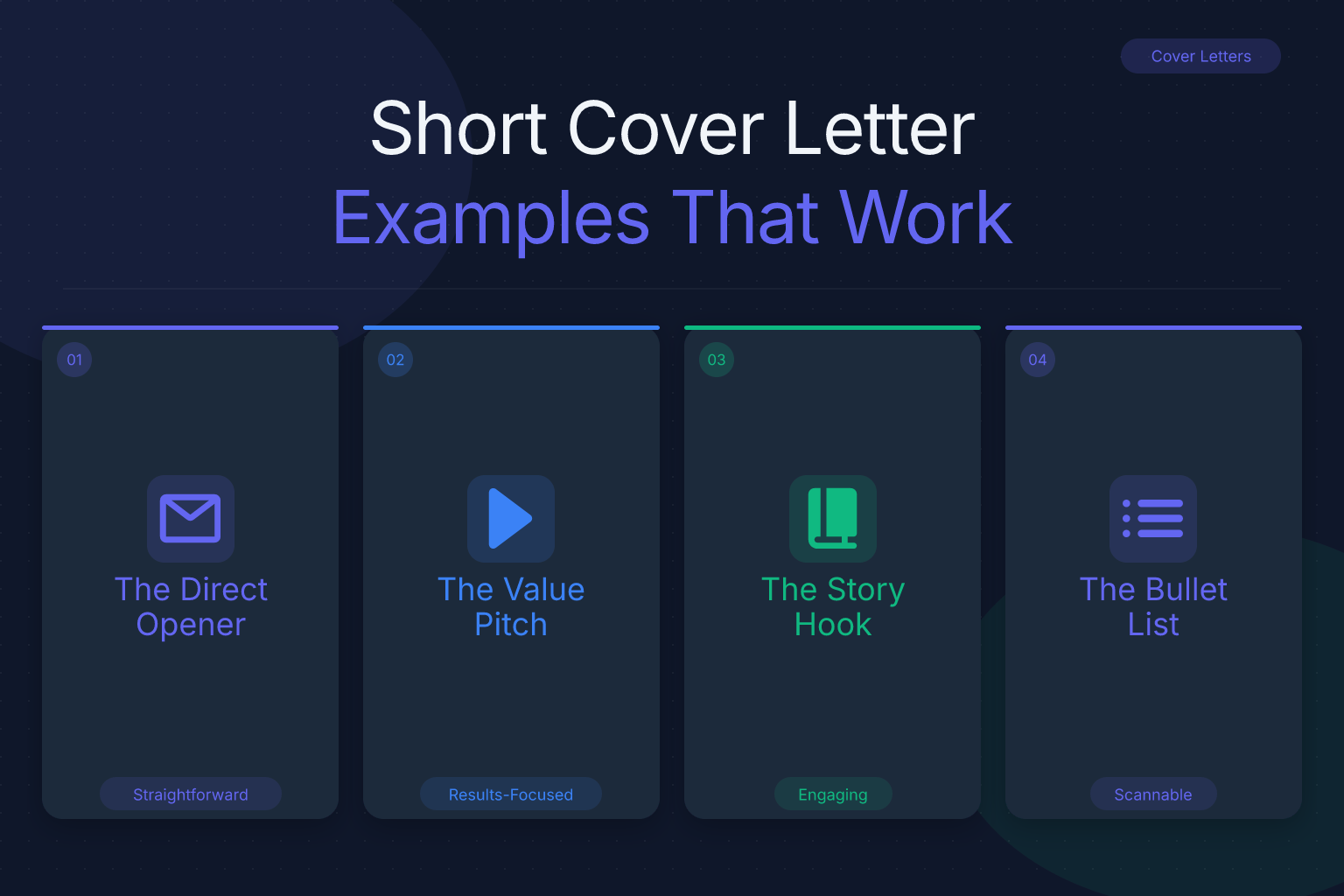
Here are four examples you can adapt. The first two are for email applications; the third is a PDF attachment format; the fourth is specifically for recruiters applying to recruiting roles.
Example 1: Email Body (Marketing Manager)
Subject: Marketing Manager Application — Jane Doe
Hi [Name],
I’m applying for the Marketing Manager role. In my current position at [Company], I grew organic traffic by 110% and led a rebrand that increased conversion rates by 22%.
- Managed a $500K annual marketing budget and delivered 3.2x ROI
- Built a content team of 4 that produced 200+ SEO articles per year
- Launched an email nurture sequence that generated $1.2M in pipeline
I’d love to bring this results-driven approach to [Target Company]. I’m available for a call this week at 555-123-4567.
Best, Jane Doe
Example 2: Email Body (Software Engineer)
Subject: Software Engineer Application — Alex Chen
Hi [Name],
I’m a full-stack engineer with 5 years of experience in React and Node.js, applying for the Software Engineer position.
- Reduced page load time by 40% for a customer-facing dashboard used by 50K+ users
- Led migration from monolith to microservices, cutting deployment time by 60%
- Mentored 3 junior developers who were promoted within 12 months
I’ve followed [Target Company]’s work on [specific project] and would love to contribute. You can reach me at 555-987-6543.
Thanks, Alex Chen
Example 3: PDF Attachment (Career Change to Data Analytics)
Subject: Data Analyst Application — Maria Gonzalez
Dear Hiring Team,
I’m transitioning from operations management to data analytics, bringing 7 years of experience using data to drive decisions. I recently completed the Google Data Analytics Certificate and have applied my skills to real business problems.
- Built a dashboard in Tableau that reduced reporting time by 15 hours per week for a 200-person team
- Analyzed customer churn data and identified a $300K retention opportunity
- Proficient in SQL, Python, and Excel; comfortable presenting insights to executives
I’m excited about the chance to turn [Target Company]’s data into actionable strategy. My resume is attached, and I’m available at 555-456-7890.
Sincerely, Maria Gonzalez
Example 4: Email Body (Recruiter Applying to a Recruiting Role)
Subject: Senior Technical Recruiter Application — Priya Patel
Hi [Name],
I’m a technical recruiter with 6 years of experience filling hard-to-hire engineering roles, applying for the Senior Technical Recruiter position at [Target Company].
- Maintained a 92% offer acceptance rate across 140+ hires in 2025
- Reduced average time-to-fill for senior engineering roles from 68 to 41 days
- Built a sourcing pipeline of 3,000+ passive candidates using LinkedIn Recruiter and GitHub
I’ve followed [Target Company]’s engineering blog and would love to help scale your team. Let’s connect at 555-321-7890.
Best, Priya Patel
Each of these examples is under 120 words. They give the recruiter everything they need without a single wasted sentence. For more role-specific templates, check out our cover letter templates and examples by role.
Customize and Speed Up Your Cover Letter Writing
You don’t need to write a new letter from scratch for every job. Use this 5-minute customization process:
- Copy the job title and 3 key requirements from the posting. Paste them at the top of a blank document.
- Write your hook by combining the job title with your most relevant qualification. If the posting asks for “3+ years of project management,” and you have 5, lead with that.
- Pick 2–3 achievements from your resume that match those requirements. Turn each into a one-line bullet with a number. If you don’t have exact numbers, use scope (e.g., “managed a team of 8” or “supported 200+ clients”).
- Add one sentence about the company. Mention a recent news item, product launch, or mission statement. This shows you did your homework.
- Paste your contact info and a call to action. Then proofread once out loud.
If you’re applying to multiple roles, save a master document with your bullet points organized by skill area. Then you can mix and match in under two minutes. For help building a resume that pairs perfectly with these short letters, use the free AI resume builder to create a clean, ATS-friendly PDF in minutes.
Here are a few tools that can speed up your process:
- ResumeMate AI Resume Builder: Build a clean, ATS-optimized resume in minutes. Then pull your bullet points directly into your short cover letter. The builder is free and exports as a PDF that modern ATS systems parse without issues.
- ResumeMate Score Checker: Upload your resume and get a section-by-section score. It highlights missing keywords and formatting problems, so you know exactly what to emphasize in your cover letter.
- ResumeMate Job Tracker (Chrome Extension): When you’re sending dozens of short cover letters, it’s easy to lose track. The free extension logs every application, deadline, and follow-up right from your browser.
- Grammarly or Hemingway: Catch typos and overly complex sentences. A short cover letter must be error-free.
- Google Docs Voice Typing: Speak your bullet points aloud, then edit. This often produces more natural, conversational language than typing.
When and How to Send Your Short Cover Letter
A short cover letter isn’t always the right choice. Here’s when to use each:
Use a short cover letter (under 150 words) when:
- Applying through an online portal with a text box
- Sending a cold email to a recruiter or hiring manager
- The job posting says “cover letter optional”
- You’re applying for a role where speed and clarity are valued (sales, tech, operations)
Use a traditional full-page cover letter when:
- The application explicitly requires a “detailed cover letter”
- You’re applying for a role in academia, nonprofits, or government
- You need to explain a career change, employment gap, or relocation in depth
- The company culture is formal (law firms, consulting, executive roles)
If you’re unsure, default to short. A concise letter rarely hurts you; a long one often gets ignored. For more on whether you even need a cover letter, read our guide on do you need a cover letter?.
The delivery method matters as much as the content. Here’s how to handle the two most common scenarios:
If you’re pasting into an email body:
- Use the subject line format: “[Job Title] Application — [Your Name]”
- Address the recipient by name if you can find it. If not, “Hi” or “Dear Hiring Team” is fine.
- Paste the short cover letter directly. No attachments for the cover letter itself.
- Attach your resume as a PDF with a clear filename: “FirstName-LastName-Resume.pdf”
If you’re attaching a PDF cover letter:
- The email body should be a single sentence: “Dear [Name], Please find my application for the [Job Title] role attached. I look forward to hearing from you. Best, [Your Name]”
- Save the cover letter as “FirstName-LastName-Cover-Letter.pdf”
- Use a clean, single-column layout. Avoid headers, footers, or graphics that can confuse ATS software.
For a deeper dive into the email vs. attachment decision, read cover letter email body vs. attached: which gets hired.
Common Mistakes That Make Short Cover Letters Fail
Even a 100-word letter can backfire if you make these errors:
- Starting with “I am writing to apply.” The recruiter already knows that. Use those words to state your value instead.
- Repeating your resume verbatim. A short cover letter should add context, not duplicate. If your resume says “Increased sales by 30%,” the cover letter can explain how you did it.
- Using generic flattery. “I admire your company’s commitment to excellence” means nothing. Be specific: “I saw your Q4 product launch and was impressed by the customer adoption numbers.”
- Forgetting contact information. Even if it’s in your resume, put your phone number and email in the letter. Recruiters shouldn’t have to hunt.
- Sending without proofreading. A typo in a 100-word letter is far more noticeable than in a long one. Read it aloud, or use a tool like Grammarly.
- Ignoring ATS keywords. If the job description mentions “Agile methodology” and you have that experience, include the exact phrase. Many companies use applicant tracking systems to filter cover letters too. You can check your entire application package with the free resume score checker to see how well it matches the job description.
FAQ
Q: How short should a cover letter be?
A: Aim for 100–150 words. That’s roughly 3–4 short paragraphs or a few sentences plus bullet points. The goal is to fit everything on a single screen without scrolling, so a busy recruiter can absorb it in under 15 seconds.
Q: Can I use bullet points in a cover letter?
A: Yes, and you should. Bullet points make your achievements scannable. Use 2–3 bullets that highlight quantified results or specific skills that match the job description. Just make sure the letter still has a brief opening and closing sentence.
Q: What if the job posting doesn’t ask for a cover letter?
A: You can still include a short cover letter in the email body or as an optional attachment. It won’t hurt, and it can set you apart from candidates who only submit a resume. Keep it under 100 words and focus on one or two key points that aren’t obvious from your resume.
Q: Should I attach a short cover letter or put it in the email body?
A: If you’re applying via email, put the cover letter in the body. If the application system has a separate upload field for a cover letter, attach it as a PDF. When in doubt, follow the instructions in the job posting. For email applications, a short cover letter in the body with a resume attached is the standard.
Q: How do I write a short cover letter with no experience?
A: Lead with your education, relevant coursework, projects, or transferable skills. Use bullet points to highlight academic achievements, volunteer work, or personal projects that demonstrate the abilities the job requires. For example: “Built a personal finance app using React as part of a coding bootcamp, which now has 500 active users.” For more guidance, see our cover letter with no experience examples.
Q: What’s the best format for a short cover letter?
A: Use a clean, single-column format with plenty of white space. If you’re pasting into an email, plain text is best. If you’re attaching a PDF, use a simple font like Arial or Calibri at 11–12pt, with 1.15 line spacing. Avoid graphics, tables, or columns that can confuse applicant tracking systems.
Q: How do I address a cover letter to a recruiter when I don’t know their name?
A: If the job posting doesn’t list a specific recruiter, use “Dear Hiring Team” or “Dear [Company] Recruiting Team.” Avoid outdated greetings like “To Whom It May Concern” or “Dear Sir/Madam.” If you can find the recruiter’s name on LinkedIn or the company’s careers page, use it — personalization shows initiative.
Q: What should a recruiter cover letter include if I’m applying for a recruiting role?
A: Focus on recruiting-specific metrics: time-to-fill, offer acceptance rate, candidate satisfaction scores, or the number of roles you’ve filled in a given period. Mention the types of roles you specialize in (technical, executive, healthcare, etc.) and any sourcing tools you’re proficient with, like LinkedIn Recruiter, Gem, or Greenhouse. See Example 4 above for a template.
Q: Can a very short cover letter (under 50 words) work?
A: Yes, for certain situations. A 2–3 sentence cover letter can work when you’re sending a cold email to a recruiter or applying through a text box with a character limit. Example: “I’m a product manager with 4 years of experience in fintech, applying for the Senior PM role. I led a mobile app launch that reached 1M downloads in 6 months. I’d love to discuss how I can help [Company] scale. Reach me at 555-123-4567.” Just make sure you still include the job title, one key achievement, and your contact info.
Q: How do I write a short cover letter for a career change?
A: Lead with your transferable skills and the reason for your transition, then use bullet points to show how your past experience applies to the new field. Example: “I’m transitioning from teaching to instructional design, bringing 5 years of experience creating engaging lesson plans and assessing learning outcomes.” Then list 2–3 relevant achievements, like “Designed a curriculum used by 500+ students” or “Completed a certificate in instructional design from [Institution].” See Example 3 above for a full template.
Track Every Application While You Job Hunt
Stop losing track of where you’ve applied. The ResumeMate Job Tracker is a free Chrome extension that tracks every application, deadline, and follow-up in one place — right from your browser.