Wondering about the signs you will get a job offer after interview? Waiting to hear back after a job interview is one of the most stressful parts of a job search. You replay every answer, second-guess your handshake, and refresh your inbox obsessively. The good news: there are signs you can spot in real time — if you know what to look for. No single signal guarantees an offer, but when several of these signs appear together, your chances are strong. This guide breaks down the verbal, behavioral, and post-interview cues that suggest a hiring manager wants to move forward, plus realistic timelines for hearing back and what to do while you wait.
Key Takeaways
- Interviewers who discuss next steps, start dates, or introduce you to team members are often signaling they see you in the role.
- A longer-than-scheduled interview that turns into a two-way conversation is one of the strongest signs you will get a job offer after interview.
- Being asked about salary expectations, notice period, or references usually means you’ve cleared the initial screening and are a serious contender.
- A follow-up email or call within 24–48 hours with specific next steps is a positive indicator, though slower responses don’t automatically mean rejection.
- Multiple positive signs together increase the likelihood of an offer, but no single cue is definitive — keep applying until you have a written offer.
| What to Do | Why It Matters | Time |
|---|---|---|
| Send a thank-you email within 24 hours | Keeps you top of mind and reinforces your interest | 15 minutes |
| Note whether the interviewer uses “when” vs “if” about you starting | Reveals their mental picture of you in the role | During interview |
| Ask about next steps and timeline at the end of the interview | Gives you a concrete expectation and shows engagement | 2 minutes |
| Follow up politely if you haven’t heard by the stated date | Demonstrates persistence without being pushy | 1 week after interview |
| Prepare for a potential offer by reviewing salary data and your priorities | Ensures you can respond confidently and negotiate if needed | 1–2 hours |
Signs You Will Get a Job Offer After Interview
Some signals are subtle, others are unmistakable. Here are the most common positive indicators that a hiring manager is leaning toward making you an offer. Watch for these during and after the interview.
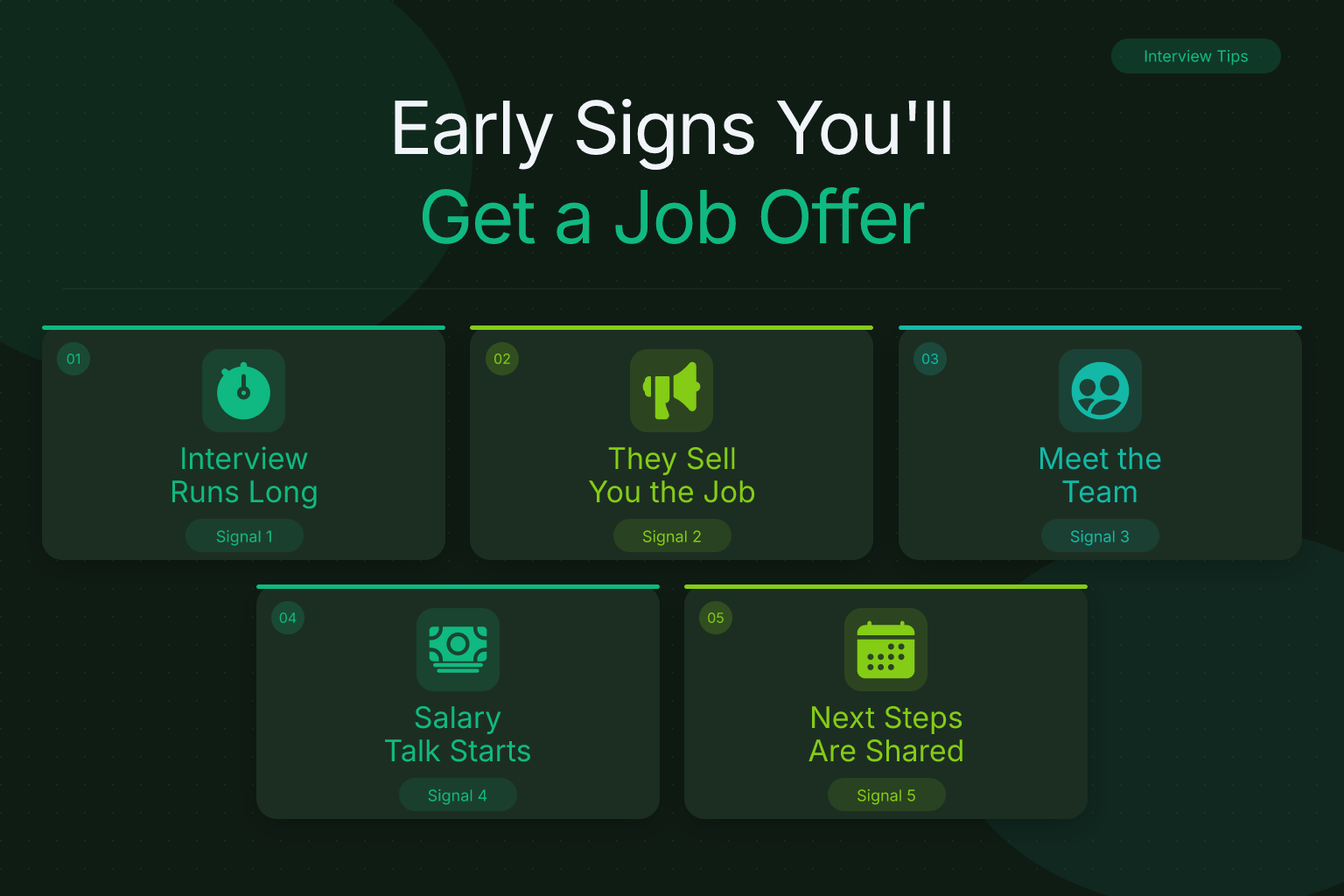
- The interview runs long. If a 30-minute slot stretches to 45 or 60 minutes, the interviewer is investing extra time in you. They wouldn’t do that for a candidate they’ve already ruled out.
- They introduce you to other team members. Being walked around the office or introduced to potential colleagues on the spot is a strong sign. It means they want to see how you fit with the group — and they’re already picturing you as part of it.
- They ask about your salary expectations and notice period. These questions are practical, not casual. Hiring managers don’t ask about compensation or availability unless they’re seriously considering you for the role.
- They discuss specific projects or challenges you’d handle. When the conversation shifts from hypotheticals to “here’s what you’d be working on in your first 90 days,” they’re mentally onboarding you.
- They use “when” instead of “if” about you starting. Phrases like “when you join the team” or “once you’re onboarded” reveal that the interviewer has already placed you in the role.
- They ask for references or mention background checks. Requesting references is a late-stage step. It means you’ve passed the core evaluation and they’re verifying details before extending an offer.
- They sell you on the company or team. If the interviewer spends time talking up the culture, growth opportunities, or why people love working there, they’re trying to close you — not just evaluate you.
- They ask about other interviews or offers you have. This question signals they’re worried about losing you to a competitor. It’s a clear sign of interest.
- They give you a clear timeline for next steps. A specific statement like “we’ll get back to you by Thursday” shows they have a process and you’re part of it. Vague answers like “we’ll be in touch” are less promising.
- They respond quickly to your thank-you email. A reply within a few hours or the next day — especially one that adds detail or reiterates enthusiasm — is a strong positive signal.
Verbal Cues That Point to an Offer
Pay attention to the exact words your interviewer uses. Certain phrases are almost accidental admissions that they want to hire you.
- “When you start, you’ll be working with…” — The future tense with “you” as the subject is a giveaway.
- “We’d like to move quickly on this.” — Urgency usually means they’ve found their candidate and don’t want to lose them.
- “What would it take for you to say yes?” — This is a direct attempt to understand your decision criteria and remove obstacles.
- “You’ll be reporting to [name], who I think you’ll really like.” — They’re already describing your working relationship.
- “We’re looking for someone who can start by [date].” — If they’re aligning your availability with their timeline, you’re likely the person they have in mind.
These verbal cues are not guarantees, but they’re far more common in interviews that end with an offer than in those that end with a rejection.
Behavioral Signals During the Interview
Body language and engagement level can tell you a lot about how the interview is going.
- The interviewer leans forward and maintains eye contact. Engaged body language shows genuine interest in what you’re saying.
- They take notes on your answers. Note-taking is a sign they’re documenting your qualifications for the hiring committee — not just going through the motions.
- They ask follow-up questions that go deeper. If they probe into your examples, ask for more detail, or challenge you in a constructive way, they’re testing whether you’re the real deal.
- They laugh at your jokes or share personal anecdotes. Rapport-building is a sign they enjoy talking to you and can see you as a colleague.
- They check their watch less and less as the interview goes on. A distracted interviewer who keeps glancing at the clock is often mentally checked out. The opposite is a good sign.
Post-Interview Signals
What happens after you leave the room (or log off the video call) can be just as telling as the interview itself.
- A recruiter or hiring manager reaches out within 24–48 hours. Quick follow-up with a specific update — “the team loved you, we’re scheduling a final round” — is a strong indicator.
- They ask for references or initiate a background check. This is a concrete step that only happens for candidates they intend to hire.
- They schedule a second or third interview quickly. Fast turnaround between rounds means you’re a priority.
- They connect with you on LinkedIn or send a personalized note. This shows they’re investing in the relationship beyond the formal process.
- They ask about your availability for a start date. This is one of the clearest signs an offer is coming.
If you haven’t sent a thank-you email yet, do it now. A well-crafted message can reinforce the positive impression you made. For templates and timing advice, see our guide on thank-you email after interview.
How Soon to Get a Job Offer After Interview
There’s no universal answer, but most offers come within a few days to a few weeks. The timeline depends on several factors:
- Company size. Small startups and family-owned businesses often decide within 24–72 hours because there are fewer decision-makers. Large corporations with multiple interview rounds and HR approvals can take 2–4 weeks or longer.
- Number of candidates. If you’re the last person interviewed, the decision may come quickly. If there are still candidates in the pipeline, you’ll wait longer.
- Hiring manager availability. If the hiring manager goes on vacation or gets pulled into a big project, the process stalls — through no fault of yours.
- Role seniority. Entry-level roles often move faster than executive positions, which require more stakeholder alignment.
A good rule of thumb: if the interviewer gave you a specific date, wait until that date passes before following up. If they didn’t give a date, wait 5–7 business days before sending a polite check-in.
When Should You Hear Back From a Job After Interview
If you were told “we’ll let you know by Friday” and Friday comes and goes, it’s reasonable to follow up on Monday or Tuesday. Silence doesn’t always mean rejection — hiring processes get delayed for mundane reasons. But it’s also smart to keep your expectations in check.
Here’s a simple follow-up timeline:
- Day 0: Send your thank-you email within 24 hours.
- Day 5–7: If you haven’t heard and no timeline was given, send a brief, polite follow-up.
- Day 10–14: If still no response, send one final check-in. After that, assume the role is filled or on hold and move on.
Your follow-up should be short and professional. For example: “Hi [Name], I’m writing to check on the status of my application for [Role]. I remain very interested and would welcome any update you can share. Thank you again for the opportunity to interview.”
What to Do While You Wait
The waiting period is uncomfortable, but you can use it productively.
- Keep applying to other jobs. Never stop your search until you have a signed offer. Even a great interview can fall through for reasons outside your control.
- Send your thank-you email. If you haven’t already, do it now. It’s a small effort that can make a real difference.
- Reflect on the interview. Note what went well and what you’d improve. This helps you prepare for future rounds or other opportunities.
- Prepare for a potential offer. Research salary ranges for the role, know your minimum acceptable number, and think about what you’d negotiate (remote work, PTO, start date).
- Track your applications. If you’re juggling multiple interviews, use a tool to stay organized. The free ResumeMate Job Tracker Chrome extension logs every application, deadline, and follow-up in one place — so you never lose track of where you stand.
Red Flags That Suggest You Won’t Get an Offer
Just as positive signals point toward an offer, certain signals suggest the opposite. Watch for these:
- The interview is cut short. If a scheduled 45-minute interview ends in 20 minutes, the interviewer likely made up their mind early — and not in your favor.
- No discussion of next steps. If you ask about the timeline and get a vague “we’ll be in touch,” that’s often a polite brush-off.
- The interviewer seems distracted or disengaged. Checking emails, looking at the clock, or giving one-word answers are bad signs.
- They don’t ask about your interest or availability. A hiring manager who is excited about you will want to know if you’re still interested and when you can start.
- They focus only on your weaknesses. If the entire interview is spent probing gaps in your resume without acknowledging your strengths, they may be looking for reasons to reject you.
If you recognize several of these red flags, don’t panic — but do keep your job search active. And if you’re worried you made a mistake during the interview, review our list of interview mistakes that cost you the job to avoid repeating them.
FAQ
Q: How do you know if you will get hired after an interview?
A: Look for a combination of positive signals: the interview runs long, they ask about salary and start date, they introduce you to team members, and they respond quickly to your follow-up. No single sign is definitive, but three or more together strongly suggest an offer is likely.
Q: How soon to get a job offer after interview?
A: Most offers come within a few days to a few weeks. Small companies may decide in 24–72 hours, while large corporations often take 2–4 weeks due to multiple approval layers. If the interviewer gave you a specific date, wait until that passes before following up.
Q: When should I hear back from a job after interview?
A: If a timeline was given, expect to hear by that date. If not, a reasonable window is 5–7 business days. If you haven’t heard after two weeks and have followed up once or twice, it’s safe to assume the role is filled or on hold and move on.
Q: How long should it take to get a job offer after an interview?
A: There’s no fixed rule, but most offers are extended within 1–3 weeks. Senior roles or positions at large companies can take longer. The key is to follow up politely if the stated timeline passes, rather than waiting indefinitely.
Q: How long to hear back from job after interview?
A: Typically 5–10 business days. If you haven’t heard after two weeks and have sent a follow-up, the process may have stalled or you may not be the top candidate. Keep applying elsewhere regardless.
Q: What are the strongest signs you will get a job offer?
A: The strongest signs are being asked for references, discussing a start date, being introduced to future colleagues, and receiving a quick, enthusiastic response to your thank-you email. These indicate the hiring team is already treating you as a near-certain hire.
Q: Can you get a job offer without any signs?
A: Yes, it happens. Some interviewers are reserved or follow a strict script, so you may see few positive signals even if they plan to hire you. That’s why you should never read too much into a single interview — and why you should keep applying until you have a written offer.
Track Every Application While You Job Hunt
Stop losing track of where you’ve applied. The ResumeMate Job Tracker is a free Chrome extension that tracks every application, deadline, and follow-up in one place — right from your browser.