A software engineer behavioral interview is your chance to show hiring managers how you think, collaborate, and handle real-world challenges — not just how well you code. While your technical skills get you in the door, your behavioral answers often decide whether you get the offer. This guide gives you a step-by-step system to prepare stories, structure answers, and walk into the interview with confidence.
Key Takeaways
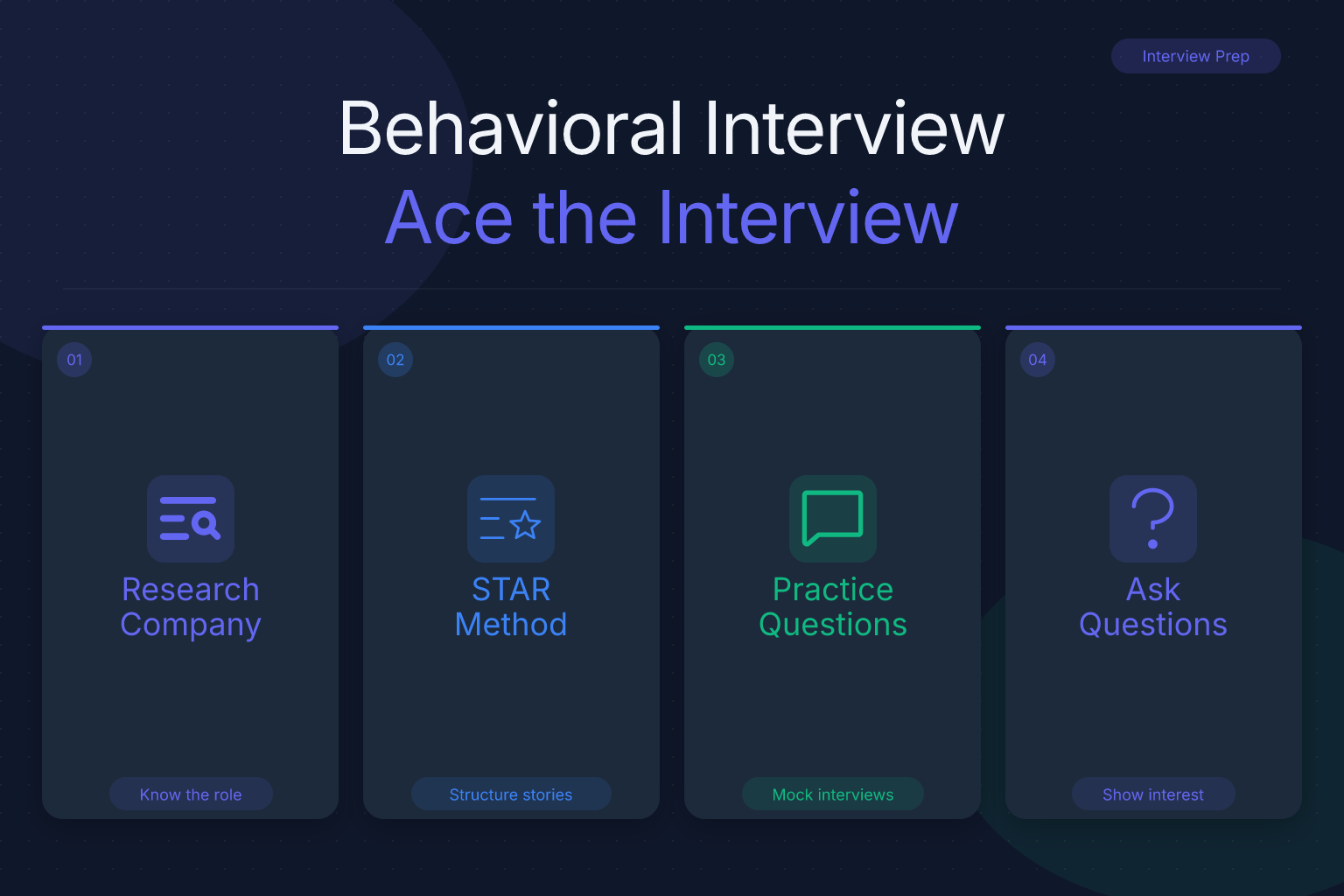
- Build a story bank of 8–10 specific experiences from work, internships, or side projects that cover teamwork, conflict, failure, leadership, and problem-solving so you have ready examples for common behavioral questions.
- Structure every answer with the STAR method (Situation, Task, Action, Result) to keep responses focused, under two minutes, and clearly highlight your individual contribution.
- Research the company’s engineering values and leadership principles, then tailor your stories to emphasize the traits they prioritize, such as ownership, customer focus, or data-driven decision-making.
- Practice your answers out loud using recordings or mock interviews to eliminate filler words, improve pacing, and ensure confident delivery.
- Prepare 3–5 specific questions about the team’s technical challenges, on-call rotations, or development processes to show genuine interest and engineering maturity.
Preparation at a Glance
- Build a story bank of 8–10 specific experiences that cover teamwork, conflict, failure, leadership, and problem-solving — not just coding wins.
- Use the STAR method (Situation, Task, Action, Result) to keep answers clear, concise, and under two minutes.
- Research the company’s engineering values and leadership principles so your examples align with what they care about.
- Practice out loud, record yourself, and get feedback — delivery matters as much as content.
- Prepare 3–5 thoughtful questions that show you understand the team’s tech stack, challenges, and culture.
| What to Do | Why It Matters | Time |
|---|---|---|
| Build a story bank of 8–10 experiences | Covers the most common behavioral questions without scrambling for examples | 2–3 hours |
| Structure each story with the STAR framework | Keeps answers focused and easy for interviewers to follow | 30 minutes per story |
| Research the company’s engineering culture and values | Lets you tailor answers to what the team prioritizes | 1 hour |
| Practice with mock interviews or recording tools | Reduces filler words, improves pacing, and builds confidence | 2–3 sessions |
| Prepare questions for the interviewer | Demonstrates genuine interest and engineering maturity | 30 minutes |
Understanding the Software Engineer Behavioral Interview
A software engineer behavioral interview is a structured conversation where the interviewer asks about your past experiences to predict how you’ll perform in the future. Instead of coding challenges or system design, you’ll answer questions like “Tell me about a time you disagreed with a teammate” or “Describe a project you’re proud of.”
The goal is to assess soft skills that technical rounds can’t measure: communication, collaboration, conflict resolution, ownership, and adaptability. Companies like Amazon, Google, and Stripe weigh behavioral rounds heavily — sometimes as much as the coding interview. For Amazon, the entire interview loop is built around Leadership Principles, and every answer must tie back to them.
If you’re new to interview prep in general, start with our complete guide to interview preparation to build a strong foundation.
Why Behavioral Interviews Matter for Engineers
Many engineers assume that if they ace the coding test, the job is theirs. That’s a mistake. Hiring managers use behavioral interviews to answer three critical questions:
- Will you be easy to work with? Engineering is a team sport. If you can’t collaborate, you’ll slow everyone down.
- Do you take ownership? Can you drive a project from ambiguity to completion without constant hand-holding?
- How do you handle pressure and setbacks? Production incidents, missed deadlines, and shifting priorities are part of the job.
A candidate who writes flawless code but can’t explain how they resolved a conflict or learned from a failure is a red flag. Behavioral interviews also help interviewers spot exaggeration. If you claim you “led a major migration” but can’t describe the trade-offs or the people involved, your credibility crumbles.
Common Behavioral Questions and the STAR Method
While every company has its own flavor, certain questions appear again and again. Prepare stories that can answer these:
- Tell me about a time you had a conflict with a coworker. How did you handle it?
- Describe a project you’re most proud of. What was your role?
- Give me an example of a time you failed. What did you learn?
- Tell me about a time you had to meet a tight deadline.
- Describe a situation where you had to influence a team without authority.
- How do you handle disagreements about technical decisions?
- Tell me about a time you went above and beyond for a customer or user.
- Give an example of how you’ve mentored or helped a junior engineer.
For a deep dive into one of the trickiest questions, read our post on how to answer the difficult coworker interview question.
The STAR Method: Your Secret Weapon
Interviewers aren’t looking for rambling monologues. The STAR method gives you a repeatable structure that keeps answers tight and impactful.
STAR stands for:
- Situation – Set the scene. Give just enough context (team, project, timeline).
- Task – What was your responsibility or the specific challenge you faced?
- Action – What did you do? Use “I” not “we.” Be specific about the steps you took.
- Result – What happened? Quantify the outcome if possible (time saved, bugs reduced, user impact).
Here’s a software engineering example for “Tell me about a time you had a conflict with a teammate.”
Situation: On a four-person backend team, we were designing a new API for payment processing. A senior engineer wanted to use a synchronous REST approach, but I believed an event-driven architecture would scale better for our expected traffic.
Task: I needed to advocate for my idea without damaging the working relationship or slowing down the sprint.
Action: I didn’t argue in the meeting. Instead, I spent an evening building a small proof-of-concept that simulated 10x our current load. I shared the results in a one-page doc, comparing latency and error rates between the two approaches. Then I asked for a 15-minute follow-up discussion, framing it as “here’s data that might help us decide.”
Result: The team agreed to adopt the event-driven pattern. Six months later, the system handled a Black Friday spike with zero downtime. The senior engineer later thanked me for the thorough analysis, and we collaborated smoothly on future projects.
Notice how the answer focuses on a specific, real situation, uses “I” for actions, and ends with a measurable result. That’s the power of STAR. Apply this same structure to any of the common questions above, and you’ll deliver answers that are clear, credible, and memorable.
Building Your Story Bank of Experiences
Don’t try to invent stories on the spot. Before the interview, create a story bank — a document with 8–10 experiences that map to common behavioral themes.
Step 1: List your projects and situations. Think beyond your job title. Pull from:
- Work projects (shipping features, fixing bugs, leading migrations)
- Internships or freelance work
- Open-source contributions
- Hackathons or side projects
- School group projects (if you’re early career)
Step 2: Tag each story with themes. For each experience, note which behavioral traits it demonstrates:
- Teamwork / Collaboration
- Conflict resolution
- Leadership / Initiative
- Failure / Learning
- Handling ambiguity
- Customer focus
- Mentorship
One story can often serve multiple themes. The API conflict example above works for conflict resolution, technical influence, and data-driven decision-making.
Step 3: Write a STAR outline for each story. Don’t script word-for-word — you’ll sound robotic. Instead, write bullet points for each STAR component. Keep the outline handy during practice.
Step 4: Prioritize recent, high-impact examples. Interviewers prefer stories from the last 2–3 years. If you’re a new grad, a compelling internship or capstone project works fine.
Tailoring Your Answers to the Company’s Engineering Culture
Generic answers won’t cut it at top tech companies. Each organization has explicit or implicit values that should shape your stories.
- Amazon: Every answer must connect to a Leadership Principle (e.g., “Customer Obsession,” “Bias for Action”). Before the interview, pick 2–3 principles that match your strongest stories and practice framing them explicitly.
- Google: Emphasizes “Googleyness” — intellectual humility, comfort with ambiguity, and collaboration. Stories that show you changed your mind based on data or helped a teammate succeed resonate well.
- Startups: Value ownership and speed. Highlight times you shipped something quickly, wore multiple hats, or made decisions with incomplete information.
Research the company’s engineering blog, mission statement, and core values. Then review your story bank and ask: “Which of my stories best reflect what this team cares about?” Adjust the emphasis — not the facts — to align.
Practice Techniques for Confident Delivery
Even great stories fall flat if delivered poorly. Use these practice methods to sharpen your delivery.
Record yourself. Use your phone or a tool like Loom to record a few answers. Watch for:
- Filler words (“um,” “like,” “you know”)
- Pacing — are you rushing or dragging?
- Eye contact and body language (if video)
Mock interviews. Practice with a friend, mentor, or use a platform like Pramp. If you’re preparing for a panel interview, check out our guide to panel interview questions for specific strategies.
Time your answers. Aim for 1.5–2 minutes per story. If you’re under a minute, you’re likely missing detail. Over 2.5 minutes, you’re probably rambling. Use a timer during practice.
Questions to Ask & Common Mistakes to Avoid
Smart Questions to Ask Your Interviewer
Behavioral interviews are a two-way street. The questions you ask reveal your engineering maturity and genuine interest. Avoid generic queries like “What’s the culture like?” Instead, ask specific, team-focused questions:
- “What’s the biggest technical challenge your team is facing right now?”
- “How does the team handle on-call rotations and incident response?”
- “Can you walk me through how a feature goes from idea to production here?”
- “What does success look like in this role after six months?”
- “How does the engineering team balance new feature work with technical debt?”
Prepare 3–5 questions and prioritize the ones that matter most to you. This is your chance to evaluate whether the role fits your goals.
Common Mistakes That Undermine Your Answers
Even strong engineers sabotage their behavioral interviews with avoidable errors. Watch out for these:
- Vague, hypothetical answers. “I would probably talk to them” is not a story. Always anchor answers in a specific, real situation.
- Using “we” instead of “I.” The interviewer wants to know what you did. It’s fine to acknowledge the team, but make your individual contribution crystal clear.
- Choosing a story where you’re the hero with no flaws. The best failure or conflict stories show self-awareness and growth. If you’ve never made a mistake, you’re either not self-reflective or not taking risks.
- Memorizing scripts. You’ll sound stiff and struggle if the interviewer asks a follow-up. Know your bullet points, not a monologue.
- Skipping the result. Without a concrete outcome, your story feels incomplete. Even if the result was “we learned what not to do,” state it clearly.
FAQ
Q: How is a software engineer behavioral interview different from a technical interview?
A: A technical interview tests your coding, system design, or problem-solving skills through hands-on exercises. A behavioral interview evaluates soft skills — communication, teamwork, leadership — by asking about your past experiences. Both are critical, and many companies weigh them equally in hiring decisions.
Q: What are the most common behavioral questions for software engineers?
A: The most frequent questions ask about conflict with a teammate, a project you’re proud of, a time you failed, meeting a tight deadline, influencing without authority, and handling technical disagreements. Prepare at least one STAR story for each category.
Q: How do I answer “Tell me about a time you failed” as a software engineer?
A: Choose a real, non-catastrophic failure (a missed deadline, a bug that reached production, a miscommunication). Use STAR to describe the situation, your responsibility, the actions you took to fix it, and — crucially — what you learned and changed afterward. The focus should be on growth, not the mistake itself.
Q: How long should my behavioral interview answers be?
A: Aim for 1.5 to 2 minutes. Shorter answers often lack depth; longer ones lose the interviewer’s attention. Practice with a timer to hit this sweet spot consistently.
Q: Can I use the same story for multiple behavioral questions?
A: Yes, but reframe the emphasis. A story about leading a migration can answer questions about leadership, conflict (if you had to persuade skeptics), or failure (if something went wrong and you adapted). Just make sure the STAR details you highlight match the question asked.
Q: How do I prepare for a behavioral interview at a FAANG company?
A: Research the company’s specific leadership principles or values. For Amazon, map your stories to their principles explicitly. For Google, emphasize collaboration and intellectual humility. Practice with mock interviews that simulate the company’s style, and use the STAR method rigorously.
Related articles:
Track Every Application While You Job Hunt
Stop losing track of where you’ve applied. The ResumeMate Job Tracker is a free Chrome extension that tracks every application, deadline, and follow-up in one place — right from your browser.