Software Engineer Cover Letter: How to Write One That Gets You Hired
A cover letter for a software engineer job is your chance to connect the dots between your technical skills and the company’s real-world problems. While some candidates treat it as an afterthought, a well-crafted letter shows you understand the role beyond the bullet points on your resume. It tells the story of why you build, how you think, and what you’ll bring to the team — and in a competitive market, that story can be the difference between an interview and a rejection.
Key Takeaways
- A software engineer cover letter should focus on one or two specific projects that align with the company’s tech stack and business goals, not just list every language you know.
- Opening with a concrete problem you’d love to solve for the company is far more effective than a generic “I’m excited to apply” line.
- You must tailor each cover letter to the job description; hiring managers can spot a template in seconds, and it signals low effort.
- Keep the letter under 300 words, use a clean single-column format, and always submit it as a PDF to preserve formatting.
- Even if a cover letter is optional, including one demonstrates initiative and gives you an edge over candidates who skip it.
| What to Do | Why It Matters | Time |
|---|---|---|
| Research the company’s tech stack and recent projects | Shows genuine interest and lets you speak their language | 15-20 min |
| Write a problem-focused opening paragraph | Grabs attention immediately and proves you understand the role | 10 min |
| Connect one past project to the company’s needs | Demonstrates relevant experience without repeating your resume | 15 min |
| Use a clean, single-column PDF format | Ensures ATS and human readability; avoids parsing errors | 5 min |
| Proofread and test all links | Typos in a cover letter signal carelessness to engineering managers | 10 min |
Why a Software Engineer Cover Letter Still Matters
You might have heard that cover letters are dead. In some industries, that’s almost true. But for software engineering roles — especially at mid-size companies, startups, and any organization where a human reads your application — a cover letter is still a powerful tool. It’s your chance to explain the “why” behind your resume: why you chose certain projects, why you’re interested in this specific company, and why you’d be a good culture fit.
Many applicant tracking systems (ATS) don’t require a cover letter, but they often include an optional upload field. When you skip it, you’re passing up free real estate to make your case. A short, focused letter can also help you stand out if the hiring manager is on the fence after scanning your resume. If you’re unsure whether a cover letter is expected, check out our guide on do you need a cover letter for a job application — the short answer for software engineers is almost always yes.
Prepare and Structure Your Cover Letter
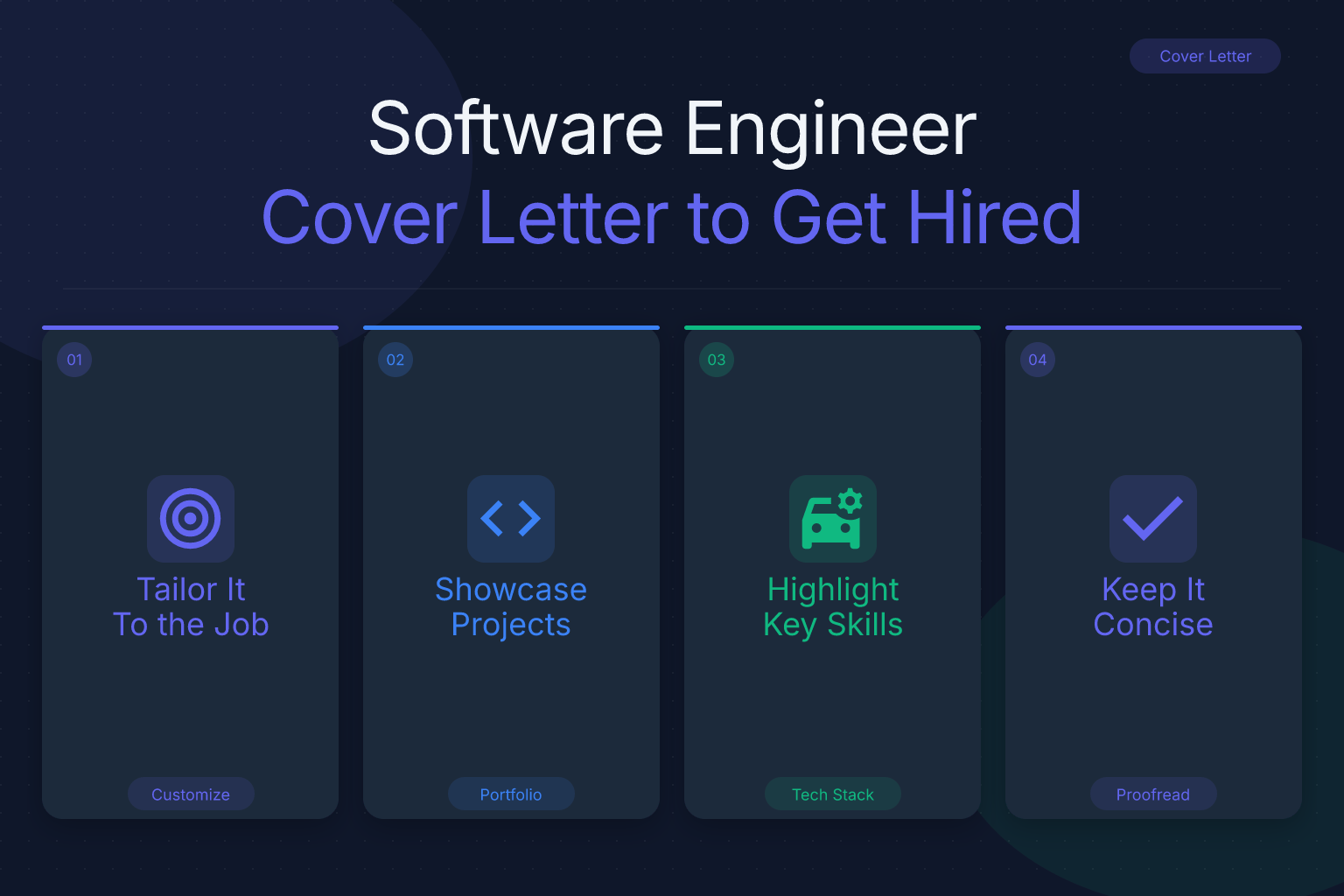
A generic cover letter is worse than no cover letter. Engineering managers can spot a template in seconds, and it tells them you didn’t care enough to learn about the team or product. Before you write a single word, spend 20 minutes digging into:
- The company’s tech stack. Check their engineering blog, GitHub repos, StackShare profile, or job description for clues. Are they a Python shop? Do they use React on the frontend? Mention the specific technologies you’d be working with.
- Recent product launches or technical challenges. Read their blog, press releases, or Hacker News discussions. If they just migrated to microservices or launched a new API, reference it.
- The team and culture. Look at LinkedIn profiles of current engineers. Do they contribute to open source? Speak at conferences? Mention what excites you about joining that specific group.
This research gives you the raw material to write a letter that feels personal and informed — not like you blasted the same PDF to 50 companies.
Once you’ve done your homework, structure your letter for clarity. A software engineer cover letter should be clean, scannable, and professional. Stick to this four-paragraph structure:
- Opening: State the role you’re applying for and immediately connect to a company-specific problem or project.
- Technical proof: Describe one project or accomplishment that directly relates to the company’s work. Include a specific result (e.g., “reduced latency by 40%”).
- Soft skills and collaboration: Show you can work on a team, communicate with non-engineers, or mentor others.
- Closing: Reiterate your interest, include a call to action, and thank them.
Keep the entire letter under 300 words. Hiring managers spend less than 30 seconds on a cover letter — make every sentence count. For example, a backend engineer applying to a fintech startup might open with: “When I saw that Acme Corp is rebuilding its payment processing pipeline to handle 10x transaction volume, I knew I wanted to be part of that effort.” That immediately shows research and relevance.
Craft a Compelling Opening and Showcase Projects
Most cover letters start with some variation of “I’m excited to apply for the Software Engineer role at [Company].” That’s forgettable. Instead, lead with a specific observation about the company’s work and how you’d contribute.
Weak opening:
I am writing to express my interest in the Backend Engineer position at Acme Corp. I have 5 years of experience in Python and Django.
Strong opening:
When I saw that Acme Corp is rebuilding its payment processing pipeline to handle 10x transaction volume, I knew I wanted to be part of that effort. At my current role, I led a similar migration from a monolithic architecture to event-driven microservices, cutting processing time by 40%.
The strong opening shows you’ve researched the company, identifies a specific challenge, and immediately connects your experience to it. That’s the kind of letter an engineering manager reads twice.
After the opening, don’t just list your skills — your resume already does that. Instead, pick one or two projects that demonstrate your technical depth and align with the company’s needs. For each project, briefly describe the problem you solved, the technologies you used, and the measurable outcome.
Example:
Last year, I designed and built a real-time data pipeline using Apache Kafka and Go that processes 2 million events per day. The system replaced a batch-processing workflow that ran every 6 hours, enabling the analytics team to make same-day decisions that improved customer retention by 12%.
This approach proves you can deliver results, not just write code. If the company uses a different stack, acknowledge it and emphasize your ability to learn quickly: “While my experience is primarily in Go, I’ve been diving into Rust through personal projects and would welcome the chance to apply it professionally.”
Tailor Your Letter and Highlight Soft Skills
Tailoring is the single most important step — and the one most candidates skip. A tailored cover letter references specific requirements from the job posting and explains how you meet them. This isn’t about keyword stuffing; it’s about showing you read the description carefully.
Here’s a simple process:
- Copy the job description into a document.
- Highlight every required skill, tool, and responsibility.
- For each highlighted item, ask: “Do I have a concrete example that demonstrates this?”
- Choose the two or three strongest matches and weave them into your letter.
Example: If the job description asks for “experience with cloud infrastructure (AWS, GCP, or Azure)” and you’ve used AWS, don’t just say “I have experience with AWS.” Say: “I used AWS Lambda and DynamoDB to build a serverless API that handles 50,000 requests per day at a cost of under $10/month.” This same principle applies to your resume. For a deeper dive, read our guide on how to tailor your resume to a job description.
Technical skills get you noticed, but soft skills get you hired. Engineering managers want to know you can communicate clearly, collaborate with product and design teams, and handle code reviews constructively. Use the cover letter to show — not just tell — that you have these qualities.
Instead of: “I have strong communication skills.” Try: “I led weekly knowledge-sharing sessions for a team of 8 engineers, covering topics from system design to debugging techniques, which reduced onboarding time for new hires by two weeks.”
Other soft skills worth highlighting for software engineers include mentoring junior developers, writing technical documentation, collaborating with non-technical stakeholders, and participating in incident response or on-call rotations. If you’re transitioning into software engineering from another field, your previous career likely gave you unique soft skills. Our guide on how to write a career change cover letter walks through how to frame that experience effectively.
Avoid Common Mistakes and Format Correctly
Even strong engineers make avoidable mistakes. Here are the most common ones and how to fix them:
- Using a generic salutation. “To Whom It May Concern” signals you didn’t try. If you can’t find the hiring manager’s name, use “Dear [Team Name] Hiring Team” or “Dear Engineering Team.”
- Rehashing your resume. The cover letter should complement your resume, not duplicate it. If you’re just listing jobs and dates, you’re wasting space.
- Writing too much. A 500-word cover letter is too long. Aim for 200–300 words. If you can’t make your case in that space, you need to focus your message.
- Ignoring the company’s mission. A letter that only talks about your skills misses the point. Connect your work to the company’s impact.
- Typos and formatting errors. Run your letter through a spell checker, then read it aloud. Better yet, have a friend review it. A typo in a cover letter for an engineering role suggests you don’t pay attention to detail.
- Submitting as a Word document. Always export to PDF unless the application specifically requests another format. A PDF preserves your formatting and ensures your letter looks the same on any device. ResumeMate’s free resume builder exports clean, ATS-friendly PDFs — the same principle applies to your cover letter.
Formatting matters more than you think. A poorly formatted letter can be hard to read, and if it doesn’t parse correctly in an ATS, it might never reach a human. Follow these guidelines:
- Use a clean, single-column layout. Avoid multi-column designs, tables, or graphics. They can confuse ATS software and look cluttered on mobile.
- Stick to standard fonts. Arial, Calibri, or Helvetica at 10–12pt. No need for creative typography.
- Match your resume header. Use the same name, contact info, and styling as your resume so the two documents feel like a cohesive package.
- Save as a PDF. Name the file something professional like
FirstName-LastName-Cover-Letter.pdf. - Follow submission instructions exactly. If the portal says “paste cover letter in the text box,” do that instead of attaching a file. If it asks for a specific file format, comply.
Before you submit, run your cover letter through a quick ATS check. You can upload your resume and cover letter to ResumeMate’s free resume score checker to see how well they align with the job description and identify any formatting issues.
Cover Letter Example for a Software Engineer
Here’s a complete example tailored for a mid-level backend role at a fictional fintech company. Use it as a template, but always customize it to the specific job and company.
Dear Acme Engineering Team,
When I read that Acme is scaling its fraud detection system to handle real-time analysis across 5 million daily transactions, I immediately thought of the streaming pipeline I built at my current company. We faced a similar challenge moving from batch processing to real-time event streaming, and I’d love to bring that experience to Acme.
At FinTechCo, I designed and implemented a Kafka-based pipeline in Java that processes 3 million events per day with sub-100ms latency. I chose Kafka Streams for stateful processing and wrote custom SerDes to handle our proprietary data formats. The system reduced false-positive fraud alerts by 28% in the first quarter after launch.
Beyond the technical work, I collaborated closely with our data science team to translate their models into production code and led a migration from a legacy Python monolith to microservices. I also mentored two junior engineers through their first production deployments.
I’m drawn to Acme’s engineering culture — particularly your emphasis on blameless postmortems and the open-source contributions I’ve seen from your team on GitHub. I’d welcome the chance to discuss how I can contribute to the fraud detection platform and the broader engineering organization.
Thank you for your time and consideration.
Best, [Your Name]
Frequently Asked Questions
Q: Do I really need a cover letter for a software engineering job?
A: In most cases, yes. While some large tech companies have moved away from requiring them, many startups, mid-size companies, and non-tech organizations still expect a cover letter. Even when it’s optional, submitting one shows initiative and gives you a chance to explain why you’re a great fit beyond your resume bullet points.
Q: How long should a software engineer cover letter be?
A: Aim for 200–300 words, or roughly half a page. Hiring managers spend less than 30 seconds on an initial scan, so a concise letter that gets straight to the point is more effective than a lengthy one.
Q: What if I don’t have experience with the company’s exact tech stack?
A: Acknowledge the gap and emphasize your ability to learn quickly. Mention any adjacent technologies you’ve used and, if possible, point to a personal project or open-source contribution that shows you’re already picking up the new stack. Many companies value adaptability over a perfect tech stack match.
Q: Should I mention salary expectations in my cover letter?
A: No. A cover letter is for selling your skills and fit, not negotiating compensation. Save salary discussions for later in the interview process, after you’ve received an offer.
Q: Can I use the same cover letter for multiple applications?
A: You can use a base template, but you must customize the opening paragraph and the project example for each company. A generic letter is easy to spot and often does more harm than good. Tailoring takes 15–20 minutes per application and significantly increases your chances of getting an interview.
Q: How do I address a cover letter if I don’t know the hiring manager’s name?
A: Use “Dear [Company Name] Engineering Team” or “Dear Hiring Team.” Avoid outdated salutations like “To Whom It May Concern” or “Dear Sir/Madam.” If you can find the engineering manager or team lead on LinkedIn, addressing them by name is even better.
Related articles:
Track Every Application While You Job Hunt
Stop losing track of where you’ve applied. The ResumeMate Job Tracker is a free Chrome extension that tracks every application, deadline, and follow-up in one place — right from your browser.