Tell Me About a Time You Solved a Problem — Interview Answer Guide (With Examples)
When an interviewer asks for a tell me about a time you solved a problem interview answer, they’re not just making conversation. They’re testing how you think under pressure, how you approach obstacles, and whether you take ownership of outcomes. This is one of the most common behavioral interview questions, and a weak answer can cost you the job even if your resume is strong.
The good news: you can prepare a compelling answer in under an hour. The key is to pick the right story, structure it with the STAR method, and deliver it with specific, measurable details. This guide walks you through exactly how to do that, with three full sample answers you can adapt to your own experience.
Key Takeaways
- Use the STAR method (Situation, Task, Action, Result) to structure your answer in under two minutes.
- Choose a problem that was significant, had a clear cause, and produced a measurable outcome you can quantify.
- Focus on your specific actions and decisions — not what the team collectively did.
- Prepare two to three problem-solving stories from different contexts (work, school, volunteer) so you can adapt on the spot.
- Avoid vague answers; include numbers, timelines, and the exact steps you took to solve the problem.
| What to Do | Why It Matters | Time |
|---|---|---|
| Choose a problem with a clear before/after | Shows impact and analytical thinking | 5 min prep |
| Use the STAR structure | Keeps your answer focused and easy to follow | 2 min delivery |
| Quantify the result | Proves you actually solved it, not just tried | 1 min |
| Mention a mistake or obstacle you overcame | Demonstrates resilience and learning | 30 sec |
| Practice out loud | Reduces rambling and nerves | 15 min |
Why “Tell Me About a Time You Solved a Problem” Is a Make-or-Break Interview Answer
Interviewers ask this question because past behavior is the best predictor of future performance. If you can show that you’ve successfully navigated a difficult situation before, they’ll trust you can do it again in the new role. But they’re not just looking for a happy ending — they want to see your thought process.
Specifically, they’re evaluating:
- Analytical skills: Did you identify the root cause, or just treat symptoms?
- Initiative: Did you wait for instructions, or did you step up?
- Resourcefulness: Did you use available tools, people, or data creatively?
- Accountability: Did you own the problem, or blame others?
- Communication: Can you explain a complex situation clearly and concisely?
A strong answer hits all five. A weak answer — like “I once fixed a bug in the code” with no context — leaves the interviewer guessing. That’s why preparation matters. If you’re also preparing for other common behavioral questions, check out our guide on how to answer “tell me about a time you failed” — the same STAR framework applies, but with a different emphasis on learning.
The STAR Method: Your Blueprint for a Problem-Solving Answer
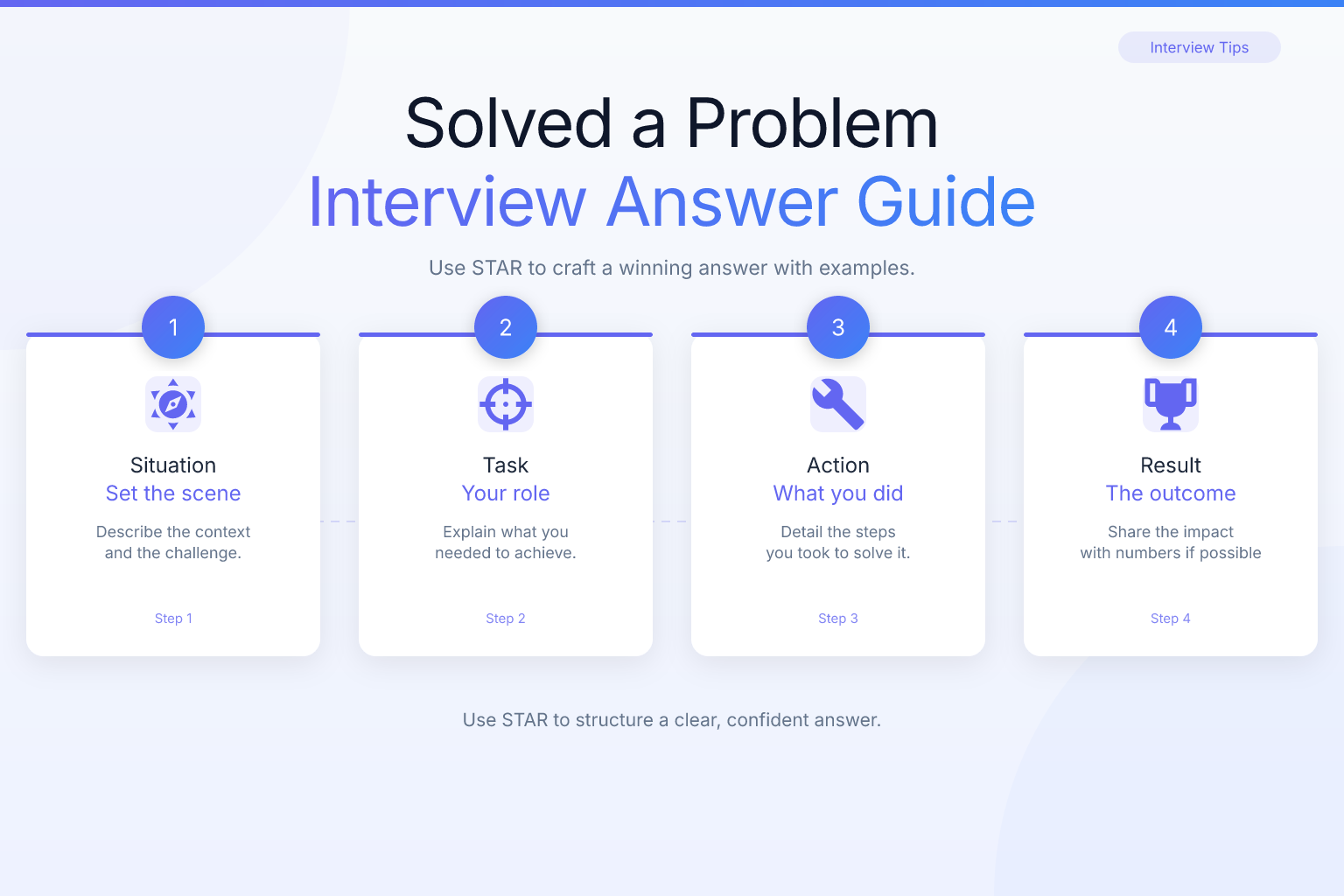
The STAR method is the gold standard for behavioral interview answers. It stands for Situation, Task, Action, Result. Here’s how to apply it to a problem-solving story:
Situation (30 seconds): Set the scene. Where were you, what was the context, and what was the specific problem? Keep it brief — one or two sentences max.
Task (15 seconds): What was your responsibility in that situation? What goal were you trying to achieve? This clarifies your role.
Action (60–90 seconds): This is the heart of your answer. Walk through the specific steps you took to solve the problem. Use “I” statements, not “we.” Explain your reasoning at each step. If you hit a dead end, mention it and how you pivoted.
Result (30 seconds): What was the outcome? Quantify it if possible — time saved, money saved, error rate reduced, customer satisfaction improved. If the result wasn’t perfect, be honest and explain what you learned.
Here’s a quick example of the STAR skeleton:
- S: “In my last role as a customer support rep, our ticket backlog doubled after a product launch.”
- T: “I was responsible for triaging tickets and reducing response time.”
- A: “I analyzed the backlog and found 40% were repetitive password-reset requests. I created a self-service FAQ and a canned response template, then trained the team on it.”
- R: “Within two weeks, average response time dropped from 48 hours to 12 hours, and customer satisfaction scores rose 15%.”
That’s a complete answer in under two minutes. For more on structuring success stories, see our post on how to answer “tell me about a time you were successful”.
How to Choose the Right Problem to Talk About
Not every problem is worth sharing. The best stories have three qualities:
- It was a real problem, not a minor inconvenience. A missed deadline, a broken process, a dissatisfied customer, a technical failure — something with stakes.
- You played a central role in solving it. If the solution came from a team effort, make sure you can articulate your specific contribution.
- The outcome is measurable or clearly positive. Even if the result was “we avoided a $10,000 loss,” that’s better than “things got better.”
Avoid these types of problems:
- Problems you caused through negligence (unless you’re using it as a learning story, which is better for the “failure” question).
- Problems that were solved by someone else and you just observed.
- Problems with no clear resolution or a negative outcome that you can’t frame as a learning experience.
- Problems that are too technical or jargon-heavy for a non-specialist interviewer.
If you’re early in your career and lack work examples, draw from school projects, internships, volunteer work, or even personal challenges (like organizing a community event). The key is to show the same problem-solving muscles. For more on answering behavioral questions when you’re new to the workforce, read our guide on how to answer “tell me about yourself” in an interview.
Step-by-Step: Crafting Your Answer (With a Full Example)
Let’s build a complete answer from scratch. Follow these steps:
Step 1: Brainstorm three problem-solving stories. Write down every time you faced a challenge at work, school, or in a volunteer role. For each, note the problem, your action, and the result.
Step 2: Pick the strongest one. Rank them by impact, your level of involvement, and how well you can quantify the result.
Step 3: Write out the STAR details. Don’t script word-for-word — just bullet points for each section.
Step 4: Add numbers and specifics. Replace vague phrases like “improved efficiency” with “reduced processing time by 30%.” Replace “worked with the team” with “I led a three-person team to redesign the workflow.”
Step 5: Practice out loud. Time yourself. Aim for 90 seconds to 2 minutes. Cut anything that doesn’t move the story forward.
Here’s a full example for a mid-career marketing professional:
Situation: “At my previous company, our email open rates had been declining for six months, and the sales team was complaining about low lead quality.”
Task: “As the marketing manager, I was responsible for turning around engagement and generating qualified leads.”
Action: “I started by analyzing the last 12 months of email data and found that our subject lines were too generic and our send times didn’t match our audience’s behavior. I A/B tested 10 new subject line formats and shifted our sends to Tuesday and Thursday mornings. I also segmented our list by past purchase behavior and created targeted content for each segment. When the first test underperformed, I dug into the click data and realized our call-to-action buttons were below the fold, so I redesigned the template.”
Result: “Within one quarter, open rates increased from 18% to 27%, click-through rates doubled, and the sales team reported a 40% increase in qualified leads from email. That campaign became the template for all future sends.”
Notice how the action section shows a process: analyze, test, iterate, pivot. That’s what interviewers want to see.
Common Mistakes That Sink Problem-Solving Answers
Even a good story can fall flat if you make these errors:
- Rambling without structure. If you jump around chronologically or include irrelevant details, the interviewer loses the thread. Stick to STAR.
- Using “we” instead of “I.” Interviewers want to know what you did. It’s fine to mention collaboration, but make your individual contribution explicit.
- Choosing a problem with no stakes. “I once reorganized the supply closet” doesn’t demonstrate problem-solving ability.
- Focusing on the problem, not the solution. Spend 20% of your answer on the problem and 80% on your actions and results.
- Ending without a result. Always close the loop. If the result was negative, explain what you learned and how you’d do it differently.
- Memorizing a script. You’ll sound robotic. Use bullet points and practice until it flows naturally.
If you’re worried about coming across as arrogant when talking about your successes, our guide on how to answer “describe a time you disagreed with a manager” offers tips on balancing confidence with humility.
Three Sample Answers for Different Scenarios
Here are three complete answers tailored to different career stages. Adapt the details to your own experience.
Entry-Level / Recent Graduate
S: “During my final year of college, I was part of a group project to build a mobile app for a local nonprofit. Two weeks before the deadline, our lead developer dropped out.”
T: “I was responsible for the front-end design, but suddenly I had to take over the entire development.”
A: “I assessed what was already built and realized 60% of the backend was incomplete. I reached out to a classmate who had experience with the framework and asked for a crash-course session. I then divided the remaining work into daily sprints, taught myself the missing pieces using online tutorials, and worked late nights to integrate the front-end with the backend. When I hit a bug I couldn’t solve, I posted on a developer forum and got a solution within hours.”
R: “We delivered the app on time, and the nonprofit used it to register 200 volunteers in the first month. I received an A on the project and a recommendation from the professor.”
Mid-Career Professional
S: “In my role as an operations analyst, our company’s inventory system kept showing discrepancies between the warehouse and the accounting records, causing weekly write-offs of about $5,000.”
T: “I was asked to find the root cause and fix it.”
A: “I spent a week shadowing the warehouse team and discovered that returns were being logged in two different systems that didn’t sync. I mapped the entire returns process, identified the data entry points, and proposed a single-entry workflow. I then worked with IT to build a simple integration script and trained the warehouse staff on the new process. When the first month still showed a small discrepancy, I traced it to a legacy barcode scanner and had it replaced.”
R: “Within two months, write-offs dropped to under $500 per month, saving the company over $50,000 annually. The new process was adopted across all three warehouse locations.”
Leadership / Management
S: “As a team lead, I inherited a team of eight engineers with a 30% annual turnover rate and low morale after a failed product launch.”
T: “My goal was to stabilize the team and improve retention within six months.”
A: “I conducted one-on-one interviews with every team member to understand their frustrations. The top issues were unclear priorities, lack of growth opportunities, and a blame culture. I implemented a weekly prioritization meeting where the team voted on the top three tasks. I created a skills matrix and assigned each engineer a mentor for a new technology they wanted to learn. I also changed our retrospective format to focus on process improvements, not individual blame. When one senior engineer resigned anyway, I used the exit interview to identify a gap in our onboarding and fixed it.”
R: “After six months, turnover dropped to 10%, and the team shipped two successful features on schedule. Employee engagement scores rose from 3.2 to 4.5 out of 5.”
How to Adapt Your Answer for Different Industries
The core STAR structure works everywhere, but the emphasis shifts by industry:
- Tech / Engineering: Focus on your debugging process, how you isolated variables, and the technical trade-offs you considered. Quantify performance improvements.
- Healthcare: Emphasize patient safety, collaboration with other providers, and adherence to protocols. Use outcomes like reduced wait times or improved patient satisfaction.
- Sales / Customer Service: Highlight how you turned a negative situation into a positive one. Use metrics like retention rate, upsell value, or resolution time.
- Education / Nonprofit: Show how you worked with limited resources, engaged stakeholders, and measured impact on students or beneficiaries.
- Finance / Consulting: Stress analytical rigor, risk assessment, and the financial impact of your solution.
No matter the industry, avoid jargon that a non-specialist interviewer won’t understand. If you must use a technical term, briefly explain it.
Practice Tips to Deliver Your Answer Confidently
Preparation is the difference between a rambling story and a polished answer. Here’s how to practice effectively:
- Record yourself. Use your phone to record a practice answer. Listen for filler words (“um,” “like”), pacing, and clarity.
- Time yourself. Aim for 90 seconds to 2 minutes. If you’re over, cut details from the Situation or Action sections.
- Get feedback. Ask a friend or mentor to listen and tell you if your answer is clear and compelling. Better yet, do a mock interview.
- Prepare multiple stories. Have at least three problem-solving examples ready: one technical, one interpersonal, one process-related. That way you can adapt to any variation of the question.
- Review your resume. Your answer should align with the skills and experiences on your resume. If you claim to be a problem-solver, your resume should show evidence. Use a free resume score checker to make sure your resume highlights those problem-solving achievements before the interview.
Finally, remember that the interviewer wants you to succeed. They’re not trying to trip you up — they’re giving you a chance to showcase your best self. Walk in with a clear story and a confident delivery, and you’ll stand out.
FAQ
Q: What is the best way to answer “tell me about a time you solved a problem”?
A: Use the STAR method: describe the Situation, your Task, the Actions you took, and the Result. Keep it under two minutes, focus on your specific contributions, and quantify the outcome whenever possible.
Q: How long should my answer be?
A: Aim for 90 seconds to 2 minutes. That’s enough time to tell a complete story without losing the interviewer’s attention. If you go over two minutes, you’re likely including unnecessary details.
Q: Can I use a personal problem instead of a work problem?
A: Yes, especially if you’re early in your career or the personal problem demonstrates transferable skills like organization, persistence, or resourcefulness. Just make sure the problem is substantial and the outcome is clear.
Q: What if I don’t have a work-related problem-solving example?
A: Draw from school projects, internships, volunteer work, or even a significant personal challenge (like planning a large event or overcoming a logistical hurdle). The key is to show the same analytical and action-oriented mindset.
Q: How do I quantify results if my job doesn’t have numbers?
A: Use qualitative measures: customer feedback, team morale, process improvements, or time saved. For example, “reduced the time to onboard a new client from two weeks to three days” or “received positive feedback from three department heads.”
Q: Should I mention a problem I failed to solve?
A: Only if you can frame it as a learning experience and show what you’d do differently. That’s better suited for the “tell me about a time you failed” question. For the problem-solving question, choose a story with a positive or at least neutral outcome.
Q: How many problem-solving stories should I prepare?
A: Prepare at least three: one technical, one interpersonal, and one process-related. That way you can adapt to any variation of the question, such as “tell me about a time you solved a problem under pressure” or “tell me about a time you solved a problem with a difficult coworker.”
Track Every Application While You Job Hunt
Stop losing track of where you’ve applied. The ResumeMate Job Tracker is a free Chrome extension that tracks every application, deadline, and follow-up in one place — right from your browser.