South Africa CV Format: Template, Guidelines & Expert Tips for 2025
A South Africa CV format follows a distinct set of conventions that blend British Commonwealth traditions with local expectations. While it shares DNA with UK and Australian CVs, the South African version has its own rules around personal details, length, and structure. Getting the format right can mean the difference between landing an interview and being filtered out by an applicant tracking system (ATS) or a recruiter who scans your document for just six seconds. This guide walks you through every element of a winning South African CV, from the header to the final references, with actionable advice you can use today.
Key Takeaways
- A South African CV is typically 2–3 pages long and includes personal details like your ID number, date of birth, and driver’s licence status — but only if they strengthen your application.
- Use a clean, single‑column layout with standard fonts and no graphics to pass ATS scans and keep recruiters focused on your content.
- Photos are optional and generally discouraged unless you’re applying for a role where appearance matters (e.g. acting, modelling).
- Tailor your CV to each job by mirroring keywords from the job description and highlighting achievements with numbers.
- Always export your CV as a text‑based PDF to preserve formatting across devices and ATS platforms.
Summary Table
| What to Do | Why It Matters | Time |
|---|---|---|
| Keep your CV to 2–3 pages | Recruiters scan quickly; a concise CV shows you can prioritise | 10–15 min to trim |
| Include a professional summary | Gives a snapshot of your value before they read the details | 15–20 min to write |
| Use a single‑column, ATS‑friendly template | Prevents parsing errors and keeps the focus on your content | 5 min to choose |
| Add measurable achievements | Numbers prove your impact and make your CV stand out | 20–30 min to quantify |
| Proofread for spelling and grammar | Errors signal carelessness and can cost you the interview | 10 min per review |
What Makes a South African CV Format Different?
South Africa’s job market draws on British, European, and local influences, so the CV format sits somewhere between a traditional UK curriculum vitae and a modern resume. Unlike the US, where a one‑page resume is the norm, South African employers expect a 2‑ to 3‑page CV that provides a full career history. It’s not unusual to see a three‑page document for a mid‑career professional, but anything longer risks losing the recruiter’s attention.
Another key difference is the inclusion of personal details. While many countries have moved away from listing date of birth, marital status, or nationality to avoid bias, South African CVs still commonly include these fields. That said, the trend is shifting — especially in multinational companies and tech startups — so you’ll need to judge each application individually. We’ll cover exactly what to include (and what to leave out) later in this guide.
If you’ve previously written a CV for the UK or Australian market, you’ll find the South African format familiar. For a direct comparison, check out our UK CV format guide and Australian CV format guide. The core structure — personal details, professional summary, work experience, education, skills — is the same, but the emphasis on certain sections and the level of detail differ.
How Long Should a South African CV Be?
Aim for two pages if you have less than 10 years of experience, and three pages if you’re a senior professional or academic. School leavers and recent graduates can usually fit everything onto one page, but don’t force it — a clean one‑and‑a‑half page CV is better than a cramped single page.
Recruiters in South Africa often spend less than 30 seconds on an initial CV scan. A document that’s too long gets skimmed; one that’s too short may look like you lack substance. The sweet spot is a CV that tells your career story without repeating information. Use bullet points instead of long paragraphs, and cut any experience older than 10–15 years unless it’s highly relevant.
If you’re struggling to condense your CV, try the ResumeMate score checker. It analyses your document and flags sections that are too long, missing keywords, or poorly formatted — giving you a clear roadmap for trimming.
Personal Details: What to Include (and What to Skip)
South African CVs traditionally open with a block of personal information. Here’s what you’ll typically see — and what you should actually include in 2025.
Standard personal details
- Full name (as it appears on your ID)
- ID number — still widely requested, especially for background checks and B‑BBEE verification
- Date of birth — common but not mandatory; include it if you’re comfortable, but know that age discrimination exists
- Nationality / work permit status — critical if you’re not a South African citizen; state “South African citizen” or specify your visa type
- Driver’s licence — include the code (e.g. Code 8 / B) if the role requires driving
- Contact details — phone number (with country code +27) and a professional email address
- Location — city and province are enough; never put your full street address for privacy reasons
Details you can safely omit
- Marital status — no longer required and can lead to bias
- Number of dependants — irrelevant to your ability to do the job
- Religion and ethnicity — never include these; they open the door to discrimination
- Full residential address — a suburb or city is sufficient
If you’re applying to a conservative industry like government, law, or education, you may still see requests for a full set of personal details. In that case, follow the employer’s instructions. For most private‑sector roles, a leaner personal section is perfectly acceptable and often preferred.
CV Sections and Order: A Step‑by‑Step Breakdown
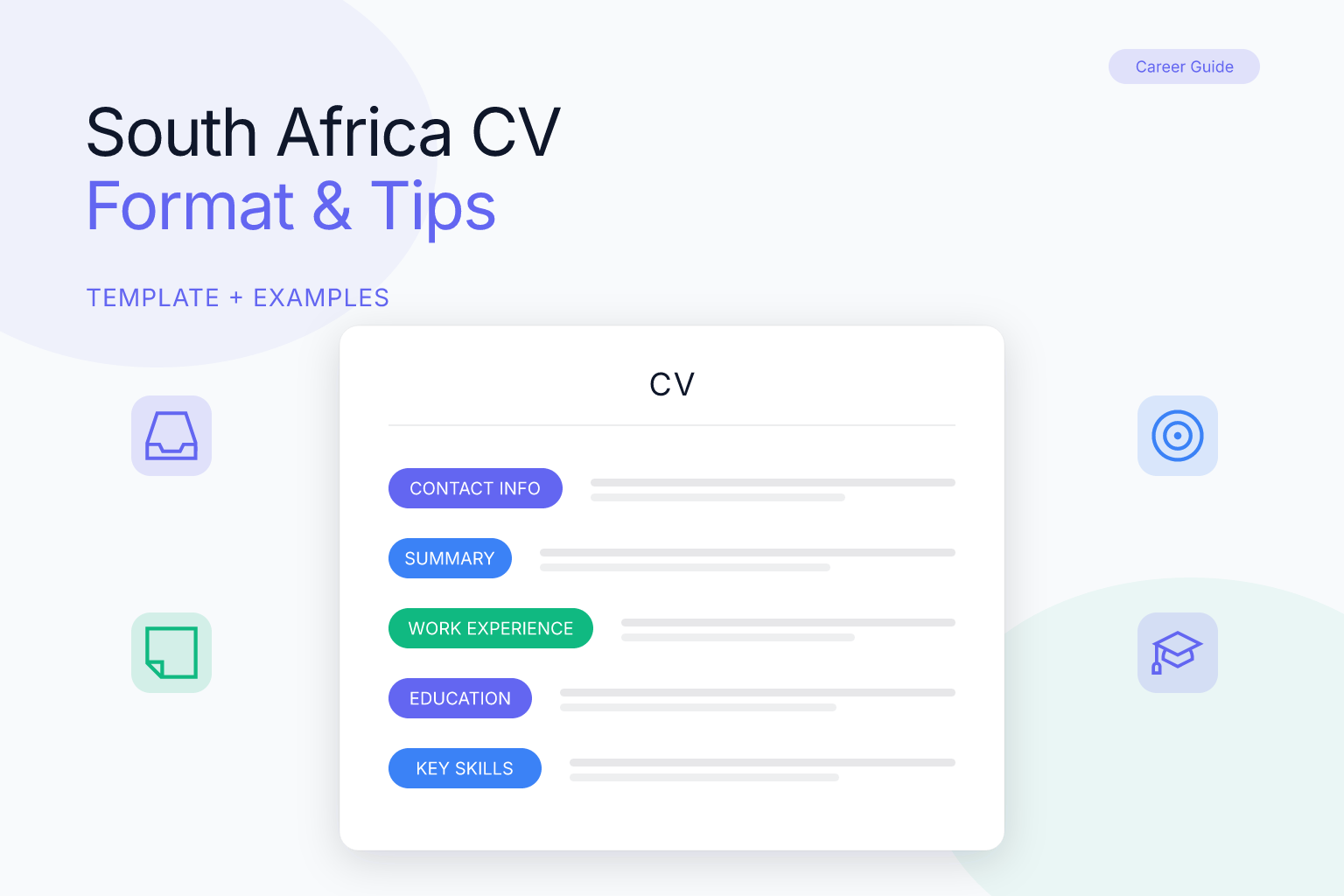
A South African CV follows a logical flow that recruiters expect. Here’s the recommended order, with tips for each section.
1. Contact Header
Place your name prominently at the top, followed by your phone number, email, LinkedIn profile (optional but recommended), and location. Use a larger font for your name — it’s your personal brand.
2. Professional Summary
Write 3–4 lines that summarise your experience, key skills, and what you bring to the role. Avoid generic phrases like “hard‑working team player.” Instead, be specific: “Results‑driven marketing manager with 8 years of experience in FMCG, increasing market share by 12% through digital campaigns.”
3. Work Experience (Reverse Chronological)
List your roles starting with the most recent. For each position, include:
- Job title, company name, location
- Dates of employment (month and year)
- 3–5 bullet points describing your responsibilities and achievements
Use action verbs and quantify results wherever possible. For example: “Managed a team of 15 sales representatives, exceeding quarterly targets by 20%.”
4. Education
List your qualifications in reverse chronological order. Include:
- Degree or diploma name
- Institution name
- Year of completion (or expected)
If you have a university degree, you don’t need to list your matric certificate unless you’re a recent graduate. Include any professional certifications (e.g. SAICA, PMP) in this section or a separate “Certifications” block.
5. Skills
Create a bulleted list of hard and soft skills relevant to the job. Hard skills might include “SAP,” “Python,” or “financial modelling.” Soft skills could be “stakeholder management” or “cross‑cultural communication.” Match these to the job description to improve ATS keyword matching.
6. Additional Sections (Optional)
Depending on your background, you might add:
- Languages — especially valuable in multilingual South Africa (e.g. English, Afrikaans, isiZulu)
- Volunteer work — shows community involvement and transferable skills
- Projects — highlight specific achievements outside your day‑to‑day role
- Professional memberships — e.g. ECSA, SAICA, HPCSA
7. References
It’s standard to state “References available on request” at the bottom of your CV. You don’t need to list names and contact details unless the employer specifically asks. This saves space and protects your referees’ privacy.
Formatting and Design: Keep It Clean and ATS‑Friendly
Many South African companies use ATS software to screen CVs before a human ever sees them. A poorly formatted CV can get rejected instantly, no matter how qualified you are. Follow these rules to stay ATS‑safe.
- Use a single‑column layout. Multi‑column designs can confuse parsing algorithms. Most ResumeMate templates are single‑column, which is the safest choice for ATS compatibility.
- Stick to standard fonts like Arial, Calibri, or Helvetica at 10–12pt. Avoid decorative fonts.
- No tables, text boxes, or graphics. These elements often break when parsed by an ATS.
- Use clear section headings (e.g. “Work Experience,” not “My Journey”).
- Save as a text‑based PDF. ResumeMate exports clean, ATS‑safe PDFs — never use scanned or image‑based PDFs. DOCX is only a fallback if a specific portal explicitly requests it.
If you’re unsure whether your current CV will pass an ATS scan, upload it to the ResumeMate score checker. You’ll get a detailed breakdown of formatting issues, missing keywords, and section‑by‑section feedback — all free.
Photo on a South African CV: Yes or No?
Unlike in Germany or France, where a professional photo is often expected, South African CVs generally do not include a photo. Including one can introduce unconscious bias and take up valuable space. Most recruiters and HR professionals in South Africa advise against it.
There are a few exceptions:
- Acting, modelling, or media roles where appearance is part of the job
- Customer‑facing positions in industries like hospitality or luxury retail, where some employers still request a headshot
If you do include a photo, use a professional headshot against a neutral background. Place it in the top corner, and make sure it doesn’t disrupt the single‑column flow of your CV. For a deeper dive into photo norms in other countries, see our France CV format guide.
Tailoring Your CV for Specific Industries in South Africa
A generic CV rarely works. Tailoring your document to the industry and role shows you’ve done your homework. Here’s how to adapt your South African CV for three common sectors.
Corporate and Finance
- Emphasise qualifications (CA(SA), CFA, MBA) and technical skills (Excel, SAP, Power BI)
- Use a conservative, clean design — no colours or graphics
- Include measurable business impact: “Reduced operational costs by 15% through process automation”
Tech and Startups
- Highlight programming languages, frameworks, and tools
- Link to your GitHub, portfolio, or Stack Overflow profile
- A one‑page CV is often acceptable if you’re early‑career; focus on projects and outcomes
Government and Public Sector
- Follow the exact instructions in the job advert — many government posts require a Z83 form alongside your CV
- Include all personal details (ID number, citizenship, driver’s licence) as they’re often mandatory
- Use formal language and list your full employment history with no gaps
For more on tailoring your CV when switching fields, read our career change resume format guide.
Common Mistakes to Avoid on a South African CV
Even small errors can sink your application. Here are the most frequent pitfalls — and how to dodge them.
- Spelling and grammar mistakes. South African English uses British spelling (e.g. “organise,” not “organize”). Run a spell check, then read your CV aloud.
- Using an unprofessional email address. Create a simple firstname.lastname@gmail.com address if yours is outdated.
- Including irrelevant personal information. Your hobbies, political views, and primary school details don’t belong on a CV.
- Writing in paragraphs. Recruiters skim; use bullet points to make your achievements scannable.
- Lying or exaggerating. Background checks are common, and a false claim can get you blacklisted.
- Sending a generic CV. Always tweak your professional summary and skills to match the job description.
How to Build a South African CV with ResumeMate
You don’t need to start from a blank page. ResumeMate’s free AI‑powered builder gives you a head start with ATS‑friendly templates designed for the South African market.
- Choose a template. Pick a clean, single‑column design that keeps the focus on your content.
- Fill in your details. The builder guides you through each section — personal details, summary, experience, education, and skills.
- Let AI suggest improvements. ResumeMate can rephrase bullet points to be more impactful and help you quantify achievements.
- Check your ATS score. Before downloading, run your CV through the score checker to catch formatting issues and missing keywords.
- Export as PDF. Download a text‑based PDF that’s ready to upload to any job portal.
Try the free ResumeMate builder →
FAQ
Q: What is the standard CV format in South Africa?
A: The standard South African CV is a 2–3 page document that includes personal details (ID number, date of birth, driver’s licence), a professional summary, work experience in reverse chronological order, education, and skills. It uses a clean, single‑column layout and is typically saved as a PDF.
Q: Should I include my ID number on my South African CV?
A: Yes, it’s still common practice to include your South African ID number, especially for background checks and B‑BBEE verification. If you’re concerned about privacy, you can omit it and provide it later when requested, but many recruiters expect to see it.
Q: Do I need a photo on my CV in South Africa?
A: No, photos are not required and are generally discouraged. Including a photo can introduce bias and take up space. Only add one if you’re applying for a role where appearance is directly relevant, such as acting or modelling.
Q: How many pages should a South African CV be?
A: Aim for 2 pages if you have under 10 years of experience, and up to 3 pages for senior roles. Graduates and school leavers can often fit everything on 1 page. Never exceed 3 pages unless you’re in academia or a field that requires a full publication list.
Q: Is a CV different from a resume in South Africa?
A: In South Africa, the terms “CV” and “resume” are used interchangeably. Both refer to a comprehensive document detailing your work history, education, and skills. There’s no distinction like in the US, where a resume is shorter and a CV is academic.
Q: What file format should I use for my South African CV?
A: Always send your CV as a text‑based PDF to preserve formatting. Modern ATS systems parse PDFs reliably. Only use DOCX if the employer’s portal specifically requests it. Avoid scanned or image‑based PDFs, as they can’t be read by ATS software.
Q: Can I use a template for my South African CV?
A: Absolutely. A well‑designed template saves time and ensures your CV is ATS‑friendly. ResumeMate offers free, single‑column templates that are ideal for the South African job market. Just remember to customise the content for each application.
Track Every Application While You Job Hunt
Stop losing track of where you’ve applied. The ResumeMate Job Tracker is a free Chrome extension that tracks every application, deadline, and follow‑up in one place — right from your browser.