Speculative Application Cold Email: How to Get Noticed
A cold email cover letter for a speculative application is your chance to open a door that isn’t advertised. When you send a well-crafted message to a company that hasn’t posted a vacancy, you skip the applicant tracking system and land directly in a real person’s inbox. Done right, it shows initiative, research, and a clear understanding of how you can help — exactly what hiring managers want to see.
Key Takeaways
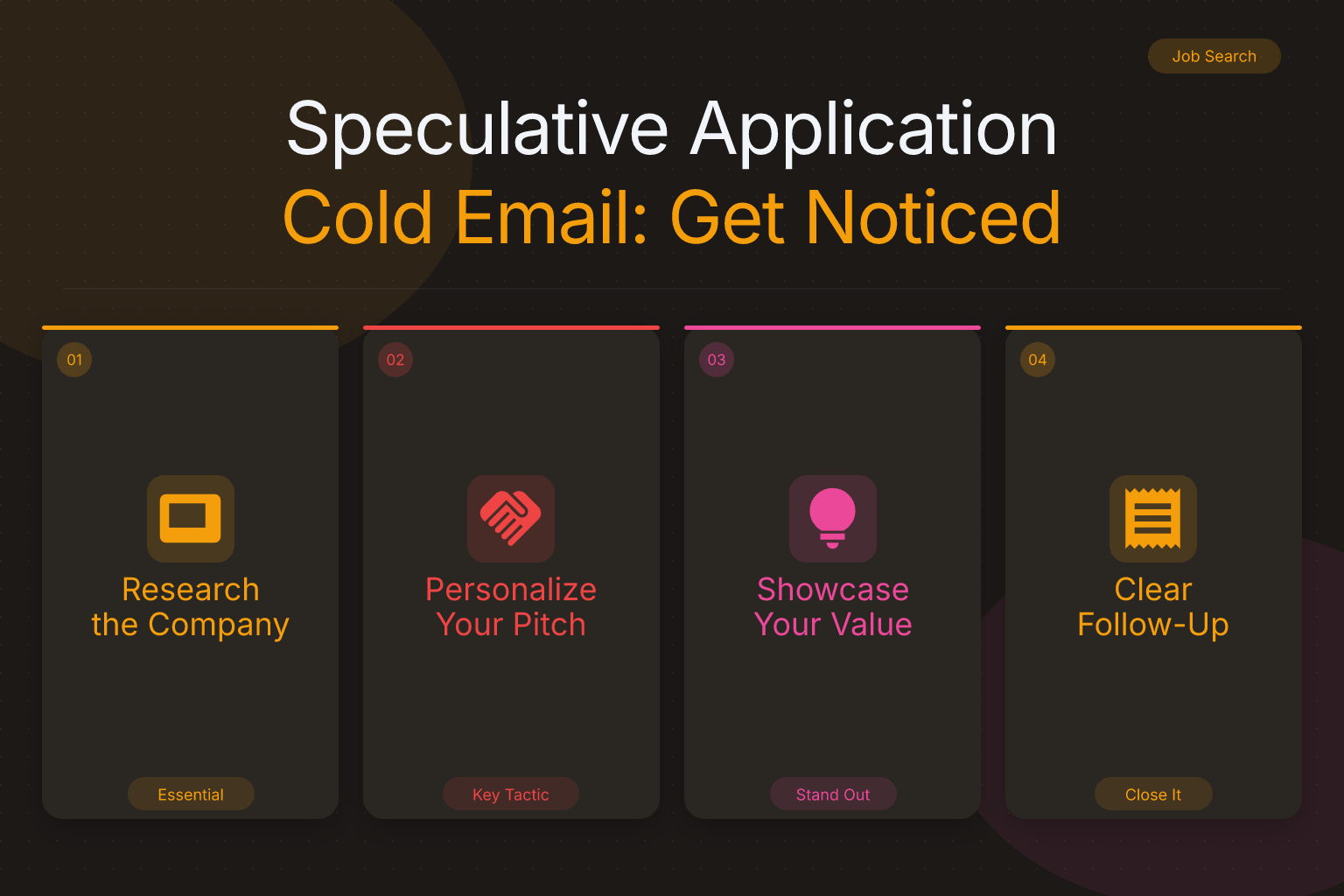
- Research the company and find a specific contact person to personalize your email, which can triple your chance of a reply.
- Write a concise email of 3–4 sentences that connects your value to the company’s goals, serving as the cover letter itself.
- Attach a one-page, tailored PDF resume to make it easy for the recipient to review and forward.
- Follow up once after a week with a new insight or article to show genuine interest without being pushy.
Key Takeaways:
| What to Do | Why It Matters | Time |
|---|---|---|
| Research the company and find a specific contact | Personalization triples your chance of a reply | 15–20 min |
| Write a 3–4 sentence email body that connects your value to their goals | Busy professionals read short, relevant messages | 10 min |
| Attach a one-page PDF resume tailored to the company | A clean, ATS-friendly PDF shows professionalism and makes it easy to forward | 5 min |
| Follow up once after a week with a new insight or article | Most replies happen after the follow-up; it shows persistence without being pushy | 5 min |
What Is a Speculative Application? (And What “Cold Apply” Means)
A speculative application is when you reach out to a company that hasn’t advertised an open role. Instead of responding to a job posting, you proactively introduce yourself and explain how you could contribute. The term “cold apply” (or “cold applying”) means the same thing: contacting an employer without a warm introduction or a known vacancy.
This approach is sometimes called a speculative enquiry or a speculative job application. The email you send is often referred to as a cold cover letter or a speculative cover letter — it’s the message that introduces you, highlights your value, and asks for a conversation. Unlike a traditional cover letter that accompanies a formal application, a speculative cover letter lives entirely in the email body (no separate attachment) and is designed to start a relationship, not just check a box.
You may also hear the terms cold call cover letter, cold contact cover letter, or cold call letter. These all refer to the same concept: an unsolicited message to a company about potential opportunities. The word “call” can be misleading — in this context, it almost always means an email, not a phone call. A cold call cover letter is simply a speculative cover letter sent via email, and it follows the same principles: personalization, a clear value proposition, and a small ask. Whether you call it a cold email, a speculative application email, or a cold cover letter, the goal is the same: get a hiring manager’s attention before a job is even listed.
Understanding these terms helps you search for the right advice and templates. The core strategy remains identical across all labels.
Why a Cold Email Cover Letter Works for Speculative Applications
Most jobs are never posted publicly. Companies often fill roles through referrals, internal moves, or by creating a position for someone who impressed them at the right time. A cold email cover letter for a speculative application puts you in that second category. Instead of waiting for a job ad, you introduce yourself when the company isn’t actively filtering hundreds of applicants.
This approach works because it bypasses the noise. Hiring managers and team leads get far fewer thoughtful, unsolicited emails than they do applications through a job board. When your message lands in their inbox, it’s personal. It shows you’ve done your homework. And it gives them a reason to start a conversation — even if they don’t have an open headcount today.
To make this work, you need to treat the email as a mini cover letter. It’s not a full-page document, but it must still answer three questions: why you’re reaching out, what you can do for them, and what you’re asking for. The best cold emails read like a natural, confident introduction — not a form letter.
If you’re unsure whether a cover letter is even necessary for speculative applications, the short answer is yes. A well-written message acts as both your introduction and your pitch. For more on when cover letters matter, read our guide on whether you need a cover letter for every application.
Research the Company and Contact Before You Write
A generic “To Whom It May Concern” email will almost always get deleted. Before you type a single word, spend 15–20 minutes learning about the company and finding the right person to contact.
Start with the company’s website. Read their recent blog posts, press releases, and the “About” page. Look for clues about their current challenges, growth areas, or new initiatives. If they just launched a product, expanded into a new market, or published a thought leadership piece, that’s your hook. For example, if you’re targeting cloud roles, tailoring your research to the specific technologies and business problems the company faces is critical — our AWS jobs guide shows how to align your skills with what top employers look for. Similarly, if you’re aiming for a niche like Azure development in a specific region, our Azure Developer Israel guide demonstrates how to research local market demands and tailor your outreach accordingly.
Next, find a specific person. LinkedIn is your best tool. Search for the company and filter by department — look for a team lead, director, or hiring manager in the area you want to work. If you can’t find a direct manager, a senior person in the department or even a recruiter who focuses on that team is a good alternative. Avoid emailing the CEO unless the company is very small; your message is more likely to be read by someone who directly oversees the work you’d do.
If you have a mutual connection, mention it in the first sentence. A warm introduction — even a loose one — increases your open rate dramatically. If you don’t have a connection, reference something specific about the company that shows you’ve done your research.
For more strategies on finding roles that aren’t advertised, see our post on how to find hidden jobs in the unadvertised market.
Craft a Subject Line That Gets Opened
Your subject line determines whether your email gets opened or ignored. Research shows that personalized subject lines can increase open rates by 22%, and for a cold email cover letter for a speculative application, that personal touch is everything. You want to signal immediately that this isn’t a mass email — it’s written for one person at one company.
Avoid vague phrases like “Job Inquiry” or “Resume Attached.” They scream template and often get filtered or ignored. Instead, use one of these proven formats:
- Mutual connection: “Referred by [Name] — interested in [role/area]”
- Specific project or news: “Loved your recent launch of [product] — quick question”
- Skill + value: “Data analyst with experience in [industry-specific tool] — could I help with [goal]?”
- Direct and professional: “Exploring opportunities to support your [team/department]”
- Speculative application: “Speculative application: [Your Role] — [One Key Strength]”
Keep it under 50 characters if possible. Many professionals read email on mobile, where longer subject lines get cut off. If you’re sending multiple speculative emails, test a few variations — even small tweaks like adding the company name or using a casual, lowercase style can boost opens. A subject line that feels like a message from a colleague often outperforms a formal one, especially in creative or startup environments. The goal is to sound like a real person, not a mass email. Consider A/B testing two subject lines with a small batch of contacts to see which gets more opens before scaling up.
Structure Your Cold Email Cover Letter (Template)
A cold email cover letter should be short enough to read in under 30 seconds. Use this four-part structure:
- Personalized opening — Mention how you found them, a mutual connection, or something specific about the company.
- One-sentence value proposition — State what you do and how it relates to their work. Focus on a result or skill, not a job title.
- The ask — Be clear about what you want. A 15-minute call, a coffee chat, or simply permission to send your resume for future openings.
- Polite close — Thank them for their time and make it easy to say yes.
Here’s a template you can adapt:
Subject: Referred by Alex Chen — interested in your content team
Hi [First Name],
Alex Chen suggested I reach out after I mentioned my interest in [Company]’s work on [specific project]. I’ve been following your content strategy for the past year, and I’m impressed by how you’ve grown organic traffic through long-form guides.
I’m a content writer with three years of experience in B2B SaaS, and I’ve helped two startups increase blog traffic by over 80% in six months. I’d love to learn more about your team’s goals and see if my background could be useful — even if you’re not hiring right now.
Would you be open to a 10-minute call next week? I’m happy to work around your schedule.
Best, [Your Name] [LinkedIn Profile] [Phone Number]
Notice the email body is the cover letter. You don’t need a separate attached document. The message itself does the job of introducing you and making the case. For a deeper look at when to put your cover letter in the email body versus an attachment, check out our comparison of cover letter email body vs. attached.
Attach your resume as a PDF. Always attach your resume as a clean, single-page PDF. A PDF preserves formatting across devices and looks professional. It also avoids the security concerns some companies have with Word documents. Before you hit send, tailor your resume to the company’s industry and recent projects. If you need a quick, ATS-friendly resume, you can build one free with ResumeMate’s AI resume builder and then check its score to see how it reads to hiring systems. For a detailed breakdown of why PDF is the right choice, read our guide on PDF vs. DOCX for resumes.
Example Cold Email Cover Letters for Different Scenarios
Different situations call for slightly different approaches. Here are four examples you can modify.
Example 1: Recent graduate reaching out to a startup
Subject: Computer science grad — impressed by your work on AI note-taking
Hi [First Name],
I’ve been following [Company] since your Product Hunt launch, and I’m really impressed by how you’ve simplified meeting notes with AI. As a recent computer science graduate from [University] with two internships in NLP, I’d love to contribute to a team building tools like yours.
I noticed you’re expanding your engineering team based on recent hires on LinkedIn. If you’re open to it, I’d be grateful for 10 minutes to hear about the challenges you’re tackling and share how my background in transformer models might help.
Thanks for considering — I’ve attached my resume for context.
Best, [Your Name]
Example 2: Career changer targeting a specific department
Subject: Former teacher transitioning to instructional design — loved your recent course launch
Hi [First Name],
I recently completed [Company]’s new data science course and was blown away by the instructional design. As a former high school math teacher now transitioning into corporate L&D, I’ve spent five years breaking down complex topics into digestible lessons — a skill I see reflected in your content.
I’m reaching out to see if your team ever works with freelance instructional designers or if you’d be open to a brief chat about how you approach course development. I’d love to learn from your process and explore whether my background could add value.
Thank you for your time — my resume is attached.
Best, [Your Name]
Example 3: Experienced professional targeting a specific manager
Subject: 8 years in supply chain ops — could I help with your East Coast expansion?
Hi [First Name],
I read about [Company]’s plans to open a new distribution center in New Jersey, and I wanted to reach out. I’ve spent the last eight years managing logistics for a mid-sized retailer, including two warehouse launches that came in under budget and ahead of schedule.
I’m not sure if you’re actively hiring for operations roles, but I’d welcome the chance to connect and learn more about your expansion timeline. If there’s a fit down the road, I’d love to be on your radar.
I’ve attached my resume. Thanks for considering — I know you’re busy.
Best, [Your Name]
Example 4: Speculative cover letter for a corporate role
Subject: Speculative application: Marketing Manager — 5 years in B2B SaaS
Dear [First Name],
I’ve admired [Company]’s brand positioning in the enterprise space, particularly the recent “Future of Work” campaign. As a marketing manager with five years of experience driving demand generation for B2B SaaS companies, I see a strong alignment between my background and the direction your team is heading.
At [Current Company], I led a content-led strategy that increased qualified leads by 40% in one year. I’d love to explore whether a similar approach could support your growth goals — even if you’re not actively hiring for a marketing role right now.
Would you be open to a brief call in the coming weeks? I’m happy to work around your schedule.
Kind regards, [Your Name] [LinkedIn Profile]
Each example follows the same structure: personal, specific, and respectful of the recipient’s time. The ask is small — a call or a future connection — which makes it easy to say yes.
Follow Up Without Being Annoying
Most replies to cold emails come after the follow-up. People are busy, and your first message may get buried. A single, well-timed follow-up can double your response rate without making you look pushy.
Wait 5–7 business days after your initial email. Then send a brief message that references your first email and adds something new — a relevant article, a comment on a recent company announcement, or a quick insight. This shows you’re genuinely interested, not just checking a box.
Example follow-up:
Subject: Quick follow-up on my note last week
Hi [First Name],
I wanted to circle back on the email I sent last week. I know you’re busy, so no worries if the timing isn’t right.
I also saw your team’s post about the new partnership with [Company] — really interesting move. If you ever have 10 minutes to chat about your content strategy, I’d still love to connect.
Best, [Your Name]
If you don’t hear back after the follow-up, let it go. Sending more than one follow-up can hurt your chances and damage your professional reputation. Move on to the next opportunity and keep track of who you’ve contacted. And if your outreach eventually leads to an offer, you might want to negotiate a signing bonus — here’s how to ask for a signing bonus with examples and scripts.
Common Mistakes to Avoid
Even a well-intentioned cold email can fail if you make these mistakes:
- Sending a generic template. If you could swap the company name and send the same email to ten other places, it’s not personalized enough. Hiring managers can spot a copy-paste job instantly.
- Making the email too long. Anything over 150 words risks losing the reader. Stick to the four-part structure and cut every sentence that doesn’t add value.
- Asking for a job directly. A cold email is for starting a conversation, not demanding an interview. Frame your ask as a request for advice, a brief call, or permission to stay in touch.
- Forgetting to proofread. Typos and grammar mistakes signal carelessness. Read your email aloud, use a spell-checker, and have someone else review it if possible.
- Attaching a resume without context. Your email should explain why you’re sending it and what you hope will happen next. An attachment with no explanation feels like spam.
- Not tracking your outreach. If you send five cold emails and don’t record who you contacted, when, and what you said, you’ll lose track of follow-ups and miss opportunities. Use a simple spreadsheet or a tool like the ResumeMate Job Tracker to log every speculative application.
FAQ
Q: Should I attach a separate cover letter document to a cold email?
A: No. The email body itself serves as your cover letter. Attaching a separate cover letter file adds friction and often goes unopened. Keep your message concise in the email and attach only your resume as a PDF.
Q: How long should a cold email cover letter be?
A: Aim for 100–150 words in the body. That’s roughly three to four short paragraphs. The goal is to be read in under 30 seconds while still conveying who you are, why you’re writing, and what you’re asking for.
Q: What if I can’t find a specific person to email?
A: If you can’t identify a team lead or manager, look for a recruiter or HR contact who focuses on the department you’re targeting. As a last resort, use a general department email (like “careers@company.com”) but personalize the message as much as possible by referencing the team’s work.
Q: How many speculative applications should I send?
A: Quality matters more than quantity. Send 5–10 highly personalized cold emails per week rather than blasting 50 generic ones. Track your responses and refine your approach based on what works.
Q: Is it okay to follow up more than once?
A: One follow-up is acceptable and often effective. Sending a second or third follow-up can come across as pushy and may annoy the recipient. If you don’t hear back after one follow-up, move on.
Q: Should I use a cold email for a speculative application if the company has a careers page?
A: Yes. A careers page only shows open positions. A speculative application targets roles that may exist but aren’t listed. Even if the company has a formal application process, a well-timed cold email can get you noticed before a job is posted.
Q: What is a speculative application?
A: A speculative application is when you contact a company about potential job opportunities without a specific vacancy being advertised. It’s a proactive way to express interest and demonstrate how you could add value, often through a cold email or speculative cover letter.
Q: What does “cold apply” mean?
A: “Cold apply” (or cold applying) means reaching out to an employer without a prior connection or a known job opening. It’s the same as sending a speculative application — you’re introducing yourself cold, hoping to spark a conversation that could lead to a role.
Q: What is a cold cover letter?
A: A cold cover letter is the email message you send as part of a speculative application. It’s called “cold” because there’s no existing relationship or job posting. The email body acts as your cover letter, highlighting your skills and asking for a conversation, not a specific job.
Q: What is a speculative cover letter example?
A: A speculative cover letter example is a sample email that shows how to introduce yourself to a company without a job opening. For instance, the examples in this post (like the marketing manager reaching out to a B2B SaaS company) are speculative cover letters. They focus on the company’s needs, include a clear value proposition, and end with a small ask.
Q: Should you attach a resume to a cold email?
A: Yes, always attach your resume as a PDF. The email body explains who you are and why you’re writing; the attached resume gives the recipient a full picture of your background. Make sure the resume is tailored to the company and no longer than one page.
Q: What is a speculative email?
A: A speculative email is any message you send to a company to explore unadvertised job opportunities. It’s the same as a cold email for a speculative application. The email should be personalized, concise, and focused on how you can help the company, not just what you want.
Q: How do I write a speculative application email?
A: Start with a personalized subject line. Open with a specific compliment or connection. In one or two sentences, explain what you do and how it relates to the company’s work. Then make a small ask (a call, a coffee chat, or permission to stay in touch). Attach your resume as a PDF and close politely. Use the template and examples in this guide as a starting point.
Q: What is a cold call cover letter?
A: A cold call cover letter is another term for a speculative cover letter sent via email. Despite the word “call,” it almost always refers to an email, not a phone call. It’s an unsolicited message introducing yourself to a company without a known vacancy, with the goal of starting a conversation.
Q: What is a cold contact cover letter?
A: A cold contact cover letter is the same as a cold cover letter or speculative cover letter. It’s a message you send to a company you have no prior relationship with, expressing interest in potential opportunities. The key is to personalize it enough that it doesn’t feel like a mass email.
Q: What is a cold call letter?
A: A cold call letter is an older term for a speculative application letter, traditionally sent by mail but now almost always sent by email. It’s a proactive introduction to a company about unadvertised roles. The principles are identical to a cold email cover letter: research, personalization, and a clear value proposition.
Q: How do I find companies to send speculative applications to?
A: Start with companies you admire or that align with your skills. Use LinkedIn to identify growing teams, recent funding announcements, or new product launches. You can also browse job boards like ResumeMate’s job board to spot companies that are hiring in your field — even if they don’t have your exact role listed, they may be open to speculative inquiries. Additionally, our guide on finding hidden jobs offers more strategies.
Q: Should I send a speculative application if I’m not actively job searching?
A: Yes, speculative applications can be valuable even when you’re employed. They help you build relationships, stay on a company’s radar for future roles, and potentially uncover opportunities that aren’t advertised. Just be clear in your email that you’re exploring options and not in a rush, which can make the conversation more relaxed.
Related articles:
Track Every Application While You Job Hunt
Stop losing track of where you’ve applied. The ResumeMate Job Tracker is a free Chrome extension that tracks every application, deadline, and follow-up in one place — right from your browser.