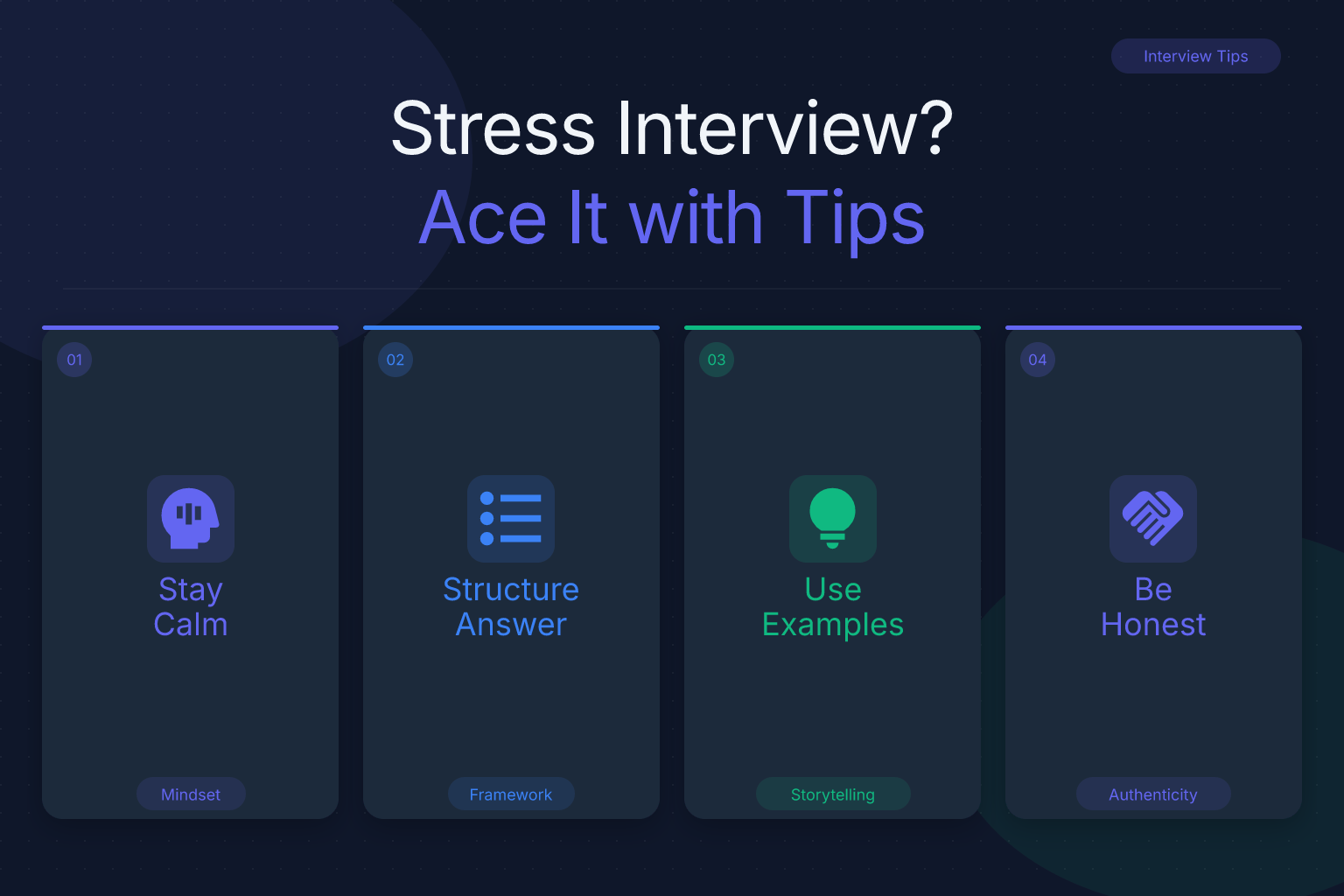
When an interviewer asks how to handle stress and pressure interview question, they aren’t just making conversation — they’re testing your emotional intelligence, resilience, and self-awareness. Every job comes with deadlines, difficult stakeholders, and unexpected problems. Your answer tells them whether you’ll fold under the weight or stay productive when things get tough.
Key Takeaways
- Structure your answer using the STAR method (Situation, Task, Action, Result) to clearly show how you managed a specific stressful situation and achieved a positive outcome.
- Avoid common pitfalls like claiming you never get stressed, blaming others, or describing unhealthy coping mechanisms; instead, demonstrate self-awareness and a constructive approach.
- Prepare by brainstorming real examples from any area of your life—work, school, or personal projects—where you successfully navigated pressure, and identify the specific strategy you used.
- Tailor your example to the role and industry by highlighting stressors relevant to the job, such as tight deadlines for tech roles or emotional resilience for healthcare positions.
- Practice your answer out loud using a brief outline rather than a script, and aim for a 90-second to 2-minute response that sounds natural and focused.
This guide breaks down exactly what interviewers look for, how to structure a memorable answer using the STAR method, and provides sample answers you can adapt whether you’re a fresher or a seasoned professional. You’ll also learn the most common mistakes that sink otherwise strong candidates and how to practice so your response feels natural, not rehearsed.
Why Interviewers Ask “How Do You Handle Stress and Pressure?”
This question isn’t a trap — it’s a genuine attempt to predict your future performance. Every role has stressors: tight deadlines, demanding clients, shifting priorities, or high-stakes decisions. Interviewers want to know if you’ve developed healthy ways to navigate those moments without burning out, making errors, or damaging team morale.
They’re also listening for self-awareness. Candidates who claim they “never get stressed” often come across as either dishonest or lacking emotional intelligence. Stress is a normal human response. The interviewer wants to see that you recognize your own stress signals and have built a toolkit to manage them. This is especially true in fields like healthcare, customer service, project management, and any role with tight turnaround times.
Finally, this question reveals your problem-solving approach. Do you get overwhelmed and shut down, or do you break the situation into manageable steps? Your answer gives the interviewer a preview of how you’ll behave when a launch deadline slips or a key client threatens to leave.
The STAR Method: Your Blueprint for Answering Behavioral Questions
Behavioral interview questions like this one are best answered using the STAR method — Situation, Task, Action, Result. It forces you to tell a structured story with a clear beginning, middle, and end, which makes your answer easy to follow and remember.
- Situation: Set the scene. Give just enough context so the interviewer understands the pressure you were under. Example: “We were three days from a product launch when our lead developer had a family emergency and had to take leave.”
- Task: Explain your responsibility in that moment. What was expected of you? “As the project coordinator, I had to either find a replacement or redistribute the work without delaying the launch.”
- Action: This is the most important part. Describe the specific steps you took to handle the stress and solve the problem. Focus on what you did, not the team. “I immediately called a 15-minute stand-up, reassigned the critical-path tasks to two senior developers, and took on the testing myself. I also communicated the change to the client within the hour, setting realistic expectations.”
- Result: Share the outcome, ideally with a quantifiable result. “We launched on time with zero critical bugs. The client appreciated the transparency, and the team felt supported rather than panicked.”
If you’re new to behavioral interviews, our guide on how to answer tell me about yourself in an interview covers the STAR method in more detail and helps you build a strong narrative from the first question.
Sample Answers for “How Do You Handle Stress and Pressure?”
Below are sample answers tailored to different experience levels. Use these as inspiration, but always replace the example with a real story from your own life. Authenticity beats perfection every time.
Sample Answer for Freshers
“During my final year of university, I was juggling a capstone project, a part-time internship, and three exams in the same week. The stress peaked when my project partner fell ill two days before our presentation. I felt the pressure, but I knew panicking wouldn’t help. I made a list of everything that needed to be done and prioritized the tasks that only I could complete. I communicated with my professor to explain the situation and asked for a 24-hour extension on one deliverable. Then I focused on the presentation slides and rehearsed alone. We delivered the presentation, and the professor commended our clarity under the circumstances. That experience taught me that breaking a big stressful situation into small, actionable steps and communicating early are my go-to strategies when pressure builds.”
Why this works: It’s specific, shows a healthy coping mechanism (prioritization, communication), and ends with a lesson learned. It also acknowledges stress without sounding overwhelmed.
Sample Answer for Experienced Professionals
“In my previous role as a marketing manager, we had a product launch scheduled for a Monday, and on the Friday before, our email automation platform went down. Our entire go-to-market plan relied on a sequenced email campaign to 50,000 subscribers. I felt the pressure immediately — the CMO was counting on this launch to hit our quarterly targets. I took five minutes to step away from my desk and breathe, which helps me reset. Then I gathered my team, and we identified three alternative paths: use a backup platform, manually send in batches, or delay by 48 hours. I presented the options to leadership with a recommendation to use the backup platform and manually segment the list over the weekend. I volunteered to lead the manual work. We launched on time, and the campaign achieved a 22% open rate — slightly above our average. The CMO later told me my calm under pressure kept the team focused.”
This answer demonstrates leadership, decision-making, and a concrete result. It also shows a personal stress-management tactic (stepping away to breathe) that humanizes the candidate.
Sample Answer for Customer-Facing Roles
“Working in retail management, Black Friday was always the ultimate stress test. One year, our point-of-sale system crashed 20 minutes after opening, with a line of 60 customers. I could feel my heart racing, but I knew the team was watching me. I immediately assigned one associate to hand out water and apologize to customers, another to process transactions manually with a calculator and receipt book, and I called tech support while simultaneously announcing updates over the store intercom every 10 minutes. We kept the line moving, and by the time the system was back up, we’d only lost two customers. The district manager later used our store as an example of crisis management. That day reinforced that staying visible, communicating constantly, and giving your team clear roles cuts through chaos.”
This answer is vivid and shows you can lead by example in a high-stress, public-facing situation.
Common Mistakes and How to Build a Strong Answer
Even well-intentioned candidates sabotage this question with predictable missteps. Avoid these at all costs.
- Saying you never get stressed. It sounds either arrogant or oblivious. Everyone experiences stress. The interviewer wants to see how you manage it, not that you’re immune.
- Blaming others for the stressful situation. “My manager dumped a last-minute project on me” makes you sound like a victim, not a problem-solver. Frame the situation neutrally.
- Describing an unhealthy coping mechanism. “I just work through the night until it’s done” signals poor boundaries and a risk of burnout. Similarly, “I go for a smoke” or “I vent to coworkers” can raise red flags.
- Choosing an example where you failed to handle the pressure. The question is about how you handle stress, not how you crumbled. If you must share a learning experience, pivot quickly to what you changed afterward.
- Rambling without a clear structure. Without STAR, your answer can become a meandering story that loses the interviewer’s attention. Practice keeping it under two minutes.
To build your own answer from scratch, follow this process:
- Brainstorm 3-5 stressful situations from your past — tight deadlines, conflicts, high-stakes presentations, technical failures, or times you had to do more with less. Include academic, volunteer, or personal projects if you’re early in your career.
- Pick the one with the clearest positive outcome. The best story is one where your actions directly led to a good result — a saved client, a met deadline, a team that stayed motivated.
- Identify the specific coping strategy you used. Did you prioritize tasks? Practice deep breathing? Communicate proactively? Ask for help? This is the “how you handle stress” part, so make it explicit.
- Write a bullet-point outline using STAR. Don’t write a full script — just the key beats. This keeps your delivery natural.
- Add a closing statement that ties to the new role. Example: “I’m confident I can bring that same calm, structured approach to your fast-paced environment.”
- Practice out loud and record yourself. Listen for filler words, length, and whether the story makes sense to someone who wasn’t there. Trim anything that doesn’t serve the narrative.
If you’re also working on other common behavioral questions, our guide on what are your weaknesses — how to answer in an interview uses a similar framework and can help you prepare a cohesive set of stories.
Staying Calm and Practicing Your Answer
Sometimes the stress question itself makes you stressed. Here are practical techniques to keep your composure in the moment and practice so your answer sounds natural.
- Pause before you answer. A 3-second pause feels long to you but shows the interviewer you’re thoughtful. Use it to take a slow breath and recall your STAR outline.
- Have a glass of water nearby. Sipping water buys you a few extra seconds and physically calms your nervous system.
- Reframe the question as a conversation. You’re not being interrogated; you’re sharing a story with a colleague. This mental shift reduces performance anxiety.
- If your mind goes blank, buy time. Say, “That’s a great question. Let me think of a specific example.” Then mentally scan your prepared stories.
- Use grounding techniques. Press your feet into the floor, notice the texture of the chair, or focus on the interviewer’s words rather than your internal panic.
To practice effectively:
- Record a voice memo of your raw story. Just tell it like you would to a friend. Don’t worry about structure yet.
- Identify the STAR elements in your recording. Did you include all four? If not, fill the gaps.
- Write a 5-bullet outline, not a script. Each bullet is one sentence max. This becomes your mental cue card.
- Practice with the outline 5-7 times over several days. Spacing out practice improves retention and makes the story feel like second nature.
- Do a mock interview with a friend or use an AI tool. Ask them to throw in a follow-up question like, “Can you give me another example?” to test your flexibility.
- Time yourself. Aim for 90 seconds to 2 minutes. If you’re over, cut unnecessary details from the Situation and Task sections.
Tailoring Your Answer to Your Experience and Industry
While the STAR structure remains constant, the type of stress you highlight should match the role and your background.
By industry:
- Healthcare: Focus on life-or-death decisions, emotional resilience, and following protocols under pressure.
- Tech/Engineering: Emphasize debugging under time pressure, system outages, or shipping code with tight deadlines.
- Sales: Highlight quota pressure, losing a key account, or handling rejection without losing motivation.
- Education: Discuss managing disruptive classrooms, last-minute curriculum changes, or supporting students in crisis.
- Creative fields: Talk about creative blocks, demanding clients, or juggling multiple projects with conflicting feedback.
Research the company’s pain points beforehand. If they mention “fast-paced environment” in the job description, choose an example that proves you thrive in speed. If they emphasize “attention to detail,” show how you maintain accuracy under pressure.
If you don’t have a work-related example:
Freshers and career changers often worry they lack professional stress stories. You have more material than you think.
- Academic projects: A group project where a member dropped out, a thesis defense with a strict deadline, or balancing a full course load with a part-time job.
- Volunteer work: Organizing an event with limited resources, handling a crisis during a fundraising drive, or managing conflicting personalities on a volunteer team.
- Personal challenges: Training for a marathon while job hunting, caring for a family member while meeting commitments, or relocating to a new city and building a network from scratch. Frame these carefully — focus on the transferable skills, not the personal drama.
- Extracurriculars: Leading a student club through a budget cut, resolving a conflict between team members, or performing under pressure in sports or debate.
The key is to connect the dots for the interviewer. Explicitly state, “While this wasn’t in a professional setting, the skills I used — prioritization, clear communication, staying calm — are the same ones I’ll bring to this role.”
Track Every Application While You Job Hunt
Stop losing track of where you’ve applied. The ResumeMate Job Tracker is a free Chrome extension that tracks every application, deadline, and follow-up in one place — right from your browser.