Technical Interview for Non-Coding Roles: How to Prepare
A technical interview for non-coding roles can feel like a curveball — you’re not a software engineer, yet you’re being asked to demonstrate technical depth. Whether you’re targeting product management, data analysis, technical writing, solutions engineering, or IT support, many companies now include a technical screen to assess your ability to think critically about technology, data, and systems. This guide gives you concrete, actionable strategies to prepare for and excel in these interviews, even if you’ve never written a line of production code.
Key Takeaways
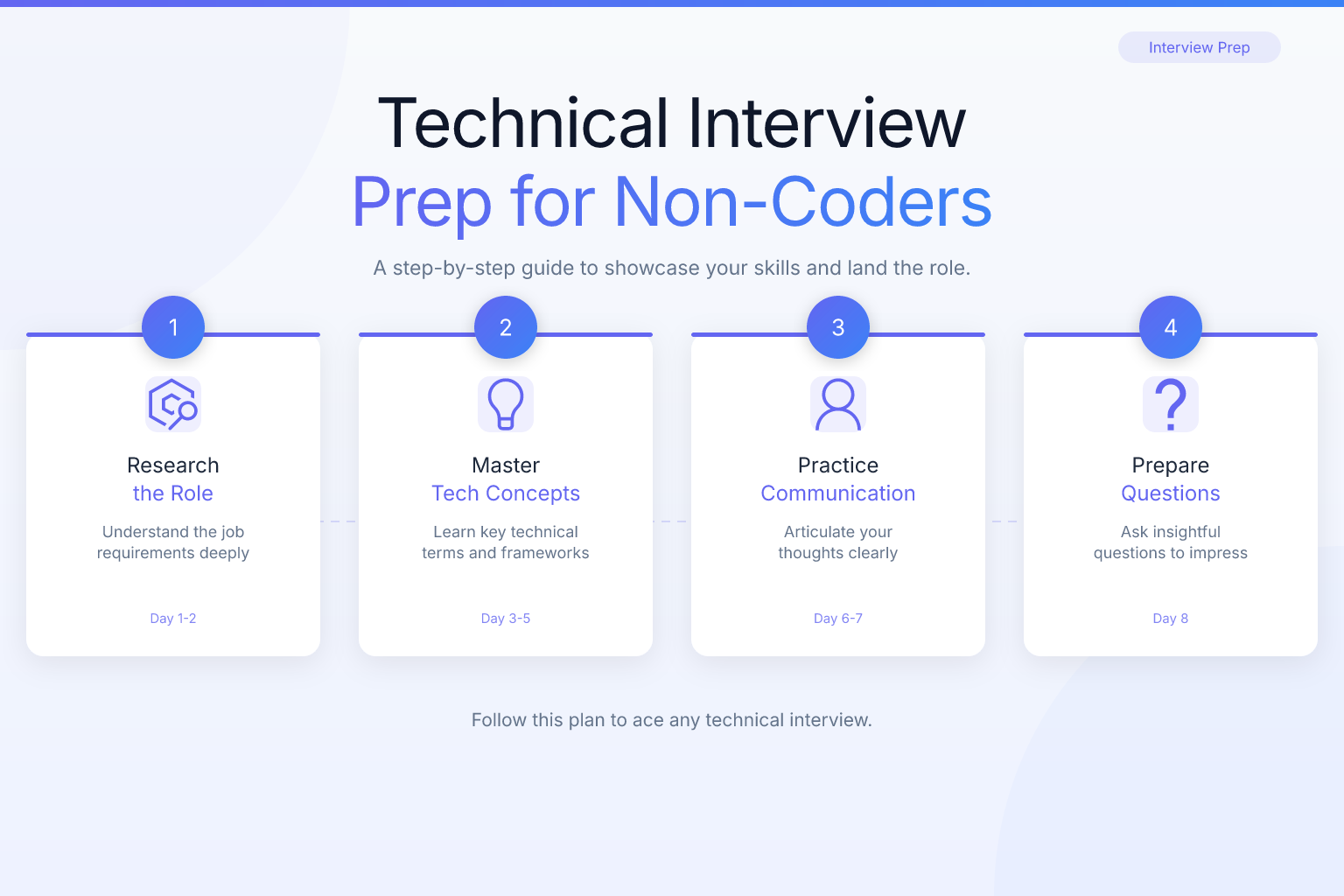
- Research the company’s tech stack, products, and recent technical challenges to tailor your answers and ask informed questions during the interview.
- Practice explaining technical concepts in simple terms to non-technical people, as clear communication is a core evaluation criterion for non-coding roles.
- Prepare STAR stories that highlight your technical problem-solving and cross-functional collaboration, quantifying the impact where possible.
- During case studies or system design exercises, use a structured framework (clarify requirements, outline components, discuss trade-offs) and think out loud to demonstrate your analytical approach.
- Send a post-interview thank-you email that references a specific technical discussion and connects your skills to the role’s challenges, reinforcing your technical curiosity and fit.
| What to Do | Why It Matters | Time |
|---|---|---|
| Research the company’s products, tech stack, and recent technical challenges | Shows genuine interest and helps you tailor answers | 2–3 hours |
| Practice explaining technical concepts to a non-technical friend | Proves you can communicate clearly with cross-functional teams | 1 hour |
| Prepare 3–4 STAR stories that highlight technical problem-solving | Gives you concrete examples to draw from during behavioral questions | 2 hours |
| Review common technical interview formats for your role (case studies, system design, troubleshooting) | Reduces anxiety and helps you structure your thinking on the spot | 1–2 hours |
| Draft a post-interview thank-you note template that references technical discussion points | Reinforces your technical competence and attention to detail | 30 minutes |
What to Expect in a Technical Interview for Non-Coding Roles
A technical interview for non-coding roles is a structured conversation where you demonstrate your ability to understand, apply, and communicate technical concepts — without writing code. Companies use these interviews to assess whether you can collaborate with engineers, make data-informed decisions, or troubleshoot technical issues, depending on the role.
For example:
- A product manager might be asked to design a feature and discuss the technical trade-offs.
- A data analyst might walk through a dataset and explain how they’d clean and analyze it.
- A technical writer might be given a complex API and asked to explain it to a non-technical audience.
- A solutions engineer might troubleshoot a hypothetical customer integration problem.
The common thread: you’re not being tested on syntax or algorithms, but on your technical fluency, problem-solving approach, and communication skills.
How Technical Interviews Differ from Coding Interviews
Coding interviews for software engineers focus on data structures, algorithms, and writing clean, efficient code on a whiteboard or shared editor. Technical interviews for non-coding roles are broader and more role-specific. Here’s how they differ:
- Focus on application, not implementation. You’ll rarely be asked to write code. Instead, you might explain how a system works, identify potential bottlenecks, or suggest improvements.
- Emphasis on communication. Interviewers want to see that you can translate technical concepts for different audiences — engineers, executives, customers.
- Real-world scenarios. Questions often mirror actual challenges the team faces, such as “How would you prioritize a bug fix versus a new feature?” or “Walk me through how you’d analyze a sudden drop in user engagement.”
- Cross-functional collaboration. You’ll be evaluated on how you’d work with engineering, design, and business teams to solve problems.
Understanding these differences helps you focus your preparation on the right skills.
Common Formats for Non-Coding Technical Interviews
Technical interviews for non-coding roles can take several forms. Knowing what to expect lets you practice the right way.
1. Case Study or Business Problem
You’re given a scenario — e.g., “Our mobile app’s daily active users dropped 15% last month. How would you investigate?” — and asked to walk through your approach. This tests analytical thinking, data literacy, and structured problem-solving.
2. System Design or Architecture Discussion
Even if you’re not an engineer, you may be asked to design a high-level system. For a PM role, you might sketch out the components of a ride-sharing app. The goal is to see if you understand how different pieces fit together, not to produce a perfect technical diagram.
3. Technical Deep-Dive on Your Past Work
Interviewers may drill into a project on your resume: “Tell me about the most technically complex project you’ve led. What were the challenges, and how did you overcome them?” This tests your hands-on experience and ability to articulate technical details.
4. Troubleshooting or Debugging Scenario
Common for support, QA, or solutions roles. You’re given a vague error report and must ask clarifying questions, form hypotheses, and narrow down the root cause.
5. Presentation or Whiteboard Exercise
You might be asked to present a technical topic or draw a workflow on a whiteboard. This evaluates your ability to structure information and communicate visually.
5 Key Areas to Prepare Before Your Interview
1. The Company’s Tech Stack and Products
Spend time on the company’s engineering blog, GitHub repos, and product documentation. Understand the main technologies they use (cloud providers, databases, frameworks) and any recent technical challenges they’ve publicly discussed. This knowledge lets you ask informed questions and tailor your answers.
2. Core Concepts in Your Domain
Identify the fundamental technical concepts relevant to your role. For a data analyst, that might be SQL, A/B testing, and statistical significance. For a PM, it could be APIs, microservices, and agile development. You don’t need to be an expert, but you should be able to discuss these concepts fluently.
3. Your Own Technical Experience
Review your resume and be ready to discuss any technical projects in detail. Use the STAR method to structure your answers: Situation, Task, Action, Result. Quantify the impact where possible.
4. Communication and Simplification
Practice explaining a technical concept to a friend who isn’t in your field. Can you describe how the internet works in two minutes? Or what an API is? This skill is often tested directly. For more on remote communication, see our remote interview tips.
5. Problem-Solving Frameworks
Learn a few structured approaches, like the CIRCLES method for product design or the 5 Whys for root cause analysis. Having a framework prevents you from rambling and shows you can think methodically.
How to Showcase Your Technical Knowledge Without Writing Code
Your goal is to demonstrate technical competence through conversation. Here’s how:
- Use precise terminology correctly. If you say “latency” when you mean “throughput,” it can raise red flags. Brush up on key terms.
- Draw diagrams. Even on a virtual whiteboard, a simple box-and-arrow diagram can clarify your thinking. Label components and explain trade-offs.
- Ask clarifying questions. This shows you don’t jump to conclusions and that you consider edge cases. For example, “What’s the scale of users we’re designing for?” or “Are there any legacy systems I should be aware of?”
- Think out loud. Walk the interviewer through your reasoning step by step. This is more important than getting the “right” answer.
- Connect technical decisions to business outcomes. For instance, “Choosing a NoSQL database here would let us scale horizontally and reduce costs, but we’d lose transactional guarantees — which matters if we’re handling payments.”
Sample Questions and How to Answer Them
Here are typical technical interview questions for non-coding roles, along with strategies for answering.
“How would you design a URL shortener like bit.ly?”
This is a system design question often asked of PMs or TPMs. Start by clarifying requirements: expected traffic, character length, analytics needs. Then outline high-level components: a web server, a database to store mappings, a hash function to generate short codes, and a redirect service. Discuss trade-offs: hash collisions, database scaling, caching. You don’t need to dive into code; focus on the architecture and why you’d make certain choices.
“Walk me through how you’d analyze a 20% drop in user sign-ups.”
For data or product roles, structure your answer: define the metric, segment the data (by platform, geography, marketing channel), check for external factors (seasonality, competitor launch), and form hypotheses. Then explain how you’d validate each hypothesis using data. Mention tools you’d use (SQL, Excel, Tableau) and how you’d present findings to stakeholders.
“Explain a technical concept to a non-technical stakeholder.”
The interviewer might ask you to explain cloud computing, machine learning, or an API. Choose a simple analogy and avoid jargon. For example, “Cloud computing is like renting a storage unit instead of building a warehouse — you pay for what you use and can scale up or down easily.”
“Tell me about a time you resolved a technical disagreement.”
Use a STAR story. Describe the situation, the technical conflict, how you facilitated discussion, the compromise or decision, and the outcome. Highlight your ability to balance technical constraints with business needs.
How to Handle Whiteboard and Case Study Exercises
Whiteboard exercises can be intimidating, but they’re a chance to show your thought process. Follow these steps:
- Clarify the problem. Repeat it back and ask questions to confirm scope.
- Outline your approach. Before diving in, say, “I’ll start by listing the key components, then discuss how they interact, and finally address potential bottlenecks.”
- Draw and label. Use simple shapes. Don’t worry about artistic quality.
- Narrate as you go. Explain why you’re adding each element and what trade-offs you’re considering.
- Invite feedback. Ask, “Does this align with what you had in mind?” or “Would you like me to go deeper on any part?”
For case studies, structure your answer using a framework like:
- Problem definition
- Data gathering
- Analysis and hypotheses
- Recommendations
- Risks and next steps
Practice with a friend or record yourself to get comfortable thinking on your feet.
Post-Interview Follow-Up That Reinforces Your Technical Fit
A well-crafted thank-you email can reinforce your technical strengths and keep you top of mind. It’s not just a courtesy — it’s a strategic opportunity to remind the interviewer of your technical acumen and genuine interest in the role. Here’s how to make it count.
Reference a specific technical discussion. Mention a problem you solved together or a concept you explored. For example:
“I really enjoyed our conversation about scaling the recommendation engine. After we spoke, I read a case study on how Company X handled a similar challenge using event-driven architecture — it reinforced my thinking that a message queue could decouple the services effectively.”
This shows you’re still engaged and thinking critically about the team’s work.
Add a brief insight or resource. If you discussed a tool or framework, share a relevant article or your own takeaway. For instance, “I came across this article on [topic] that aligns with our discussion about reducing latency — thought you might find it interesting.” This positions you as a proactive, resourceful candidate.
Reiterate your technical fit. Connect your skills directly to the role’s challenges. For example, “My experience leading a data migration project with similar scale constraints makes me confident I can contribute to your team’s upcoming infrastructure overhaul.”
Keep it concise and timely. Send the email within 24 hours. A short, focused message is more effective than a lengthy one. For more templates and timing advice, see our guide on thank-you emails after an interview.
A thoughtful follow-up not only demonstrates your communication skills but also reinforces the technical curiosity and problem-solving mindset that interviewers look for in non-coding roles.
Frequently Asked Questions
Q: What is a technical interview for non-coding roles?
A: It’s an interview that assesses your ability to understand and apply technical concepts relevant to the role — such as system design, data analysis, or troubleshooting — without requiring you to write code. The focus is on problem-solving, communication, and domain knowledge.
Q: How do I prepare for a technical interview if I don’t have a technical background?
A: Start by learning the fundamentals of the technology your role interacts with. Use free online resources, take introductory courses, and practice explaining concepts in simple terms. Focus on the “why” behind technical decisions, not the “how” of implementation.
Q: What kind of technical questions are asked in product manager interviews?
A: PMs often face product design questions (“Design a feature for X”), system design questions (“How would you build Y?”), and analytical questions (“How would you measure the success of Z?”). They may also be asked to prioritize features or discuss technical trade-offs.
Q: Do I need to know how to code for a technical interview in a non-engineering role?
A: Usually not. Most non-coding roles don’t require writing code during the interview. However, familiarity with basic programming concepts (like what an API is or how databases work) can be helpful and is often expected for technical roles like data analyst or solutions engineer.
Q: How can I demonstrate technical skills if I can’t show code?
A: Use past projects, case studies, and whiteboard exercises to illustrate your thinking. Discuss the technical challenges you’ve navigated, the tools you’ve used, and the outcomes you’ve driven. Clear communication and structured problem-solving are your strongest assets.
Q: What if I get a technical question I don’t know the answer to?
A: Don’t panic. Acknowledge that you’re not familiar with the specific topic, but then walk through how you’d approach finding the answer. Say something like, “I haven’t worked directly with Kubernetes, but based on my understanding of containerization, I’d start by researching how it handles load balancing…” This shows resourcefulness and a growth mindset.
Related articles:
- Jobs Requiring Credit Checks: How to Prepare
- Careers for Artificial Intelligence: Top Roles & Salaries
- Software Engineer Behavioral Interview: How to Prepare
- How to Prepare for an Employment Background Check
- How to Prepare for a Group Interview: 7 Steps to Stand Out
Track Every Application While You Job Hunt
Stop losing track of where you’ve applied. The ResumeMate Job Tracker is a free Chrome extension that tracks every application, deadline, and follow-up in one place — right from your browser.