Tell Me About a Time You Failed: How to Answer (Examples)
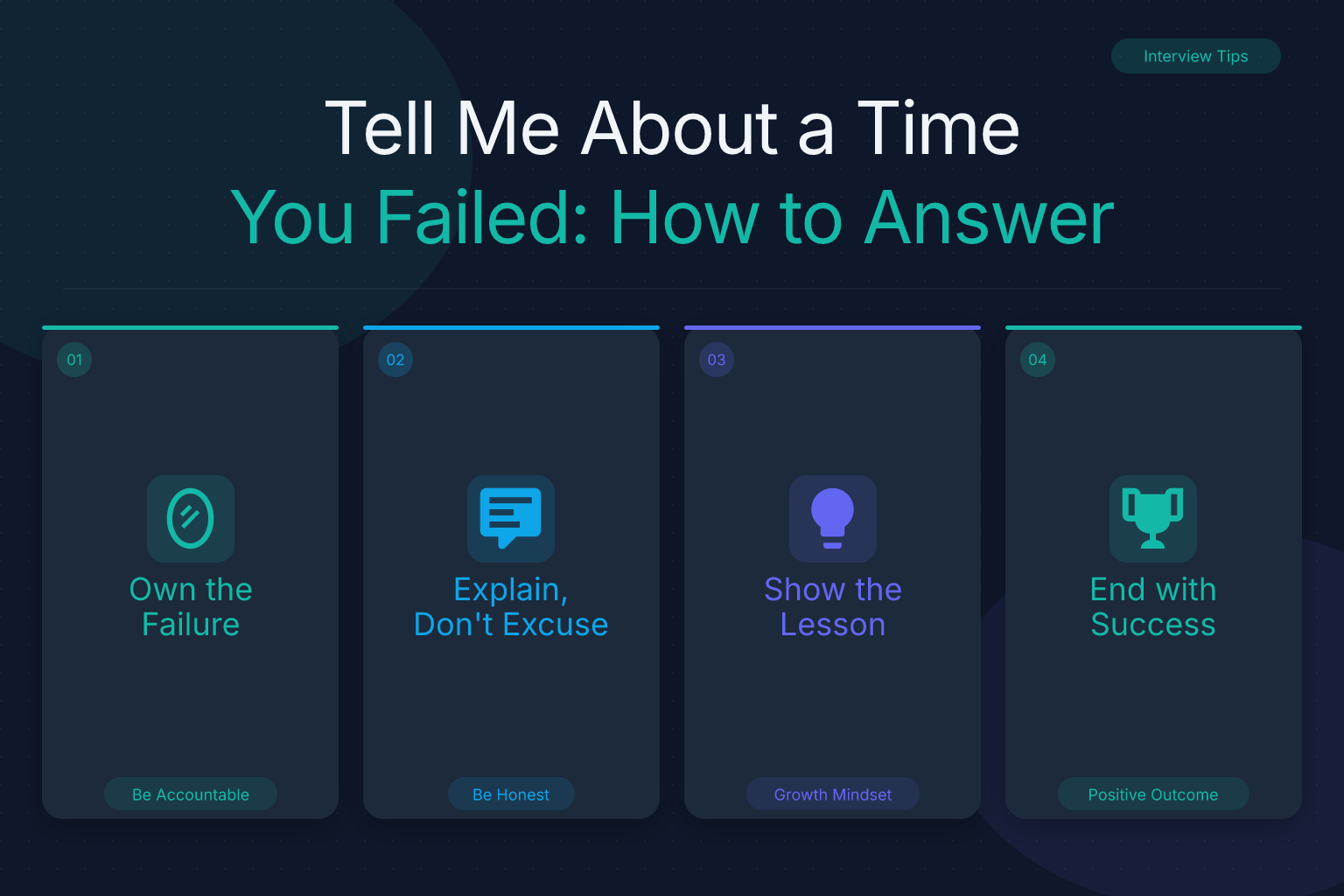
When an interviewer asks, “Tell me about a time you failed,” it can feel like a trap. You’re there to sell yourself, not to highlight your mistakes. But this question isn’t about exposing your flaws — it’s one of the most revealing behavioral questions you’ll face. Employers use it to gauge your self-awareness, resilience, and ability to learn. A well-structured answer can turn a moment of failure into a powerful demonstration of growth. This guide shows you exactly how to craft that answer, with examples you can adapt.
Key Takeaways
The “tell me about a time you failed” question is a behavioral interview staple that tests your honesty, accountability, and ability to learn. To answer it effectively, you need a real story that shows growth. Here are the essential points to remember, with concrete examples:
- Choose a genuine professional failure with real stakes. For instance, a missed deadline that delayed a product launch is better than a typo in an email. Avoid failures that question your core job skills—if you’re applying for an accounting role, don’t mention a major budgeting error.
- Use the STAR method, but emphasize the lesson. Structure your answer with Situation, Task, Action, Result, and then explicitly state what you learned and how you applied it. For example, after a miscommunication with a designer caused rework, you might explain that you now start every UI project with a 15-minute alignment walkthrough.
- Take ownership and avoid blame. Even if external factors contributed, focus on your role. Saying “I didn’t confirm the requirements” is stronger than “the designer wasn’t clear.”
- End with a concrete change. Show how you’ve improved. If you once failed to speak up in a meeting, describe how you now prepare one risk flag before every client call and have become known for proactive risk identification.
- Practice to sound natural, not rehearsed. Record yourself and aim for a 2-3 minute answer. Be ready for follow-ups like “What would you do differently today?”
By internalizing these takeaways, you’ll turn a potential weakness into a compelling demonstration of self-awareness and resilience.
Why Interviewers Ask “Tell Me About a Time You Failed” (And What They’re Really Looking For)
This question isn’t about making you squirm. Interviewers use it to assess three things that resumes and rehearsed success stories can’t reveal:
- Self-awareness — Can you recognize and admit a mistake without making excuses?
- Accountability — Do you own your part in the failure, or do you blame external factors?
- Learning agility — Did you extract a lesson and change your behavior afterward?
Hiring managers know everyone fails. What separates strong candidates is the ability to reflect, adapt, and avoid repeating the same error. When you answer well, you show that you’re coachable, resilient, and unlikely to hide problems — traits that every team values. A weak answer, on the other hand, can raise red flags. If you claim you’ve never failed, you sound dishonest. If you blame others entirely, you seem defensive. If you pick a trivial failure, you look like you’re dodging the question. The key is to choose a real, professional failure that you’ve genuinely learned from — and to tell that story with clarity and humility.
How to Choose the Right Failure Story
Not every failure makes a good interview answer. The story you pick should meet four criteria:
- It’s a genuine professional failure. A workplace example is usually safer than a personal one, unless the personal story directly relates to a job skill.
- It had real consequences. A missed deadline that cost the team a day of rework is better than a minor typo. The stakes should be high enough to show you care.
- It’s not a core competency for the job. If you’re applying for an accounting role, don’t talk about a major budgeting error. Choose a failure in a secondary skill — like communication, delegation, or time management — that you’ve since improved.
- You can clearly show what you learned and changed. The story must have a positive, concrete ending. If you haven’t applied the lesson yet, pick a different failure.
For example, a project manager might discuss a time they failed to set clear expectations with a stakeholder, leading to scope creep and a delayed launch. That’s a real failure, but it’s not a core PM skill (like planning) — it’s a soft skill they’ve since mastered. An engineer might talk about a time they didn’t speak up when they spotted a potential bug, and it later caused a production issue. The lesson: always voice concerns early, even if you’re unsure.
The STAR Method for Answering Failure Questions
Behavioral interview questions are best answered with the STAR framework: Situation, Task, Action, Result. For a failure question, you’ll adapt it slightly to emphasize the learning. Here’s the structure:
- Situation — Set the context briefly. What was the project, team, or goal?
- Task — What was your responsibility in that situation?
- Action — What did you do (or fail to do) that led to the failure? Be honest and specific.
- Result — What was the negative outcome? Quantify it if possible (e.g., “we lost two weeks of development time”).
- Lesson & Application — This is the most important part. Explain what you learned and how you applied it afterward. Give a concrete example of a time you handled a similar situation better because of that failure.
Many candidates stop at the result, leaving the interviewer with a negative impression. The lesson and application turn the story into a success. For instance, after missing a deadline because you overcommitted, you might explain that you now use a capacity planner and have not missed a deadline in 18 months.
Step-by-Step: Crafting Your Answer
Follow these steps to build a compelling, interview-ready response.
1. Brainstorm 3–5 Professional Failures
Think back over your career. List moments where something went wrong and you were at least partially responsible. Include times you made a bad decision, mishandled a relationship, or failed to deliver. Don’t filter yet — just write them down.
2. Evaluate Each Story Against the Criteria
For each failure, ask:
- Is it professional?
- Did it have meaningful consequences?
- Is it unrelated to the core skills of the job I’m targeting?
- Can I clearly articulate what I learned and how I changed?
Pick the one that scores highest. If you’re early in your career, a failure from a volunteer role, academic project, or internship works too.
3. Outline Using the STAR + Lesson Format
Write bullet points for each part. Keep the situation and task brief — no more than 30 seconds. Spend most of your time on the action, result, and lesson.
4. Write a Draft, Then Cut It Down
Your answer should be 2–3 minutes long. Read it aloud and trim any unnecessary details. The interviewer doesn’t need the full project history — just enough to understand the failure.
5. Add the “What I’d Do Differently” Statement
Even if you’ve already applied the lesson, explicitly state what you would do if faced with the same situation today. This shows you’ve internalized the learning.
6. Connect It to the Role
End by tying the lesson to the job you’re interviewing for. For example: “That experience taught me to over-communicate during transitions, which is why I’m so focused on stakeholder alignment — something I know is critical in this product role.”
Sample Answers for Different Scenarios
Here are three example answers using the STAR + Lesson method. Adapt them to your own experience.
Example 1: Missed Deadline Due to Poor Prioritization
Situation: As a marketing coordinator, I was responsible for a campaign launch deck for a new product line. The deadline was tight, and I was also handling daily social media requests.
Task: I needed to create a 20-slide deck with market analysis, creative assets, and a launch timeline.
Action: I underestimated the research time and didn’t block my calendar. I kept getting pulled into ad-hoc requests and assumed I could catch up in the evenings. I didn’t communicate my bandwidth concerns to my manager.
Result: I delivered the deck two days late, pushing back the VP review. The campaign launch was delayed by a week, and the team had to scramble to adjust the media schedule.
Lesson & Application: I realized I needed a better prioritization system. I started time-blocking and using an “impact vs. urgency” matrix for incoming requests. I also set a rule to flag capacity issues within 24 hours. Six months later, I led a larger product launch and delivered all milestones on time by applying that same system. If I faced a similar situation today, I’d immediately communicate the trade-offs and ask for help prioritizing.
Example 2: Miscommunication with a Cross-Functional Team
Situation: As a junior software developer, I was part of a team building a customer-facing dashboard. We worked closely with the design team, but we were in different time zones.
Task: I was responsible for implementing a complex filtering feature based on the design specs.
Action: I interpreted a design element differently than intended and didn’t confirm my understanding with the designer. I assumed I had it right and built the feature over two sprints.
Result: During the demo, the designer pointed out that the interaction was wrong. We had to redo a significant portion of the front-end work, costing about 40 hours of rework and delaying the beta release.
Lesson & Application: I learned never to assume alignment without explicit confirmation. I now schedule a quick 15-minute walkthrough with the designer before starting any major UI work. I also document my interpretation in a shared comment so there’s a written record. Since then, I’ve had zero rework due to misinterpretation. If I were in that situation again, I’d send a Loom video of my understanding before writing a single line of code.
Example 3: Failed to Speak Up in a Meeting
Situation: Early in my career as a business analyst, I was in a requirements-gathering meeting with a client and our internal team. The client proposed a feature that I knew would be technically unfeasible within the timeline.
Task: My role was to capture requirements and flag any risks.
Action: I hesitated to speak up because I was the most junior person in the room. I told myself someone else would catch it. I stayed silent and documented the requirement as stated.
Result: Two weeks later, the development team flagged the issue. We had to go back to the client and renegotiate the scope, which damaged trust and made us look disorganized.
Lesson & Application: I learned that my perspective matters regardless of seniority. I started preparing one “risk flag” before every client meeting so I’d have a rehearsed way to raise concerns. I also asked my manager to call on me early in meetings to help me build the habit. Within a few months, I became known for proactively identifying scope risks. Now, I always voice concerns with a solution-oriented framing: “I see a potential challenge with X; could we consider Y?”
Common Mistakes to Avoid
Even a well-chosen failure can fall flat if you make these errors.
- Picking a non-failure. Saying “I work too hard” or “I care too much” is a cliché that signals you’re avoiding the question. Interviewers see right through it.
- Blaming others. Even if external factors contributed, focus on your role. Use “I” statements, not “we” or “they.”
- Choosing a failure that’s too catastrophic. Don’t mention a failure that got you fired or caused a lawsuit. It raises unnecessary red flags.
- Ending on a negative note. Always close with the lesson and how you’ve improved. Without that, the interviewer remembers only the failure.
- Rambling. A 5-minute answer loses impact. Practice until you can deliver it in under 3 minutes.
- Sounding rehearsed. You want a structured story, not a script. Vary your wording slightly each time you practice so it sounds natural.
How to Practice Your Answer
A great answer only works if you can deliver it smoothly under pressure. Here’s a practice routine:
- Write bullet points, not a script. Use the STAR + Lesson outline. This keeps you on track without making you sound robotic.
- Record yourself on your phone. Listen for filler words, pacing, and tone. You’ll catch parts that sound awkward or defensive.
- Time it. Aim for 2–3 minutes. If it’s too long, cut situational details — the interviewer doesn’t need the full backstory.
- Practice with a friend or mentor. Ask them to play the role of an interviewer and give honest feedback. They can also throw in a follow-up question like “What would you do differently now?”
- Prepare for variations. The question might be phrased as “Tell me about a time you made a mistake” or “Describe a situation where things didn’t go as planned.” Your story should work for all of them.
If you’re preparing for a full interview, pair this answer with other common behavioral questions. Our guide on how to answer “tell me about yourself” in an interview can help you build a complete interview narrative. For a deeper dive into structuring behavioral answers, check out our guide on the STAR method.
Turning Failure into a Strength: The Follow-Up
Sometimes the interviewer will ask a follow-up question to dig deeper. Be ready for:
- “What would you do differently today?” — You should already have this in your answer, but be prepared to expand.
- “How did your manager react?” — Be honest but diplomatic. Focus on what you learned from their feedback.
- “Have you ever made a similar mistake again?” — If the answer is no, explain the systems you put in place to prevent it. If yes, be honest and show how you caught it earlier or handled it better.
These follow-ups are a good sign — they mean the interviewer is engaged. Use them to reinforce your growth mindset.
Remember, the “tell me about a time you failed” question is an opportunity to show that you’re self-aware, resilient, and constantly improving. When you answer with a real story, a clear lesson, and a concrete change, you turn a potential weakness into one of the strongest moments of your interview.
Frequently Asked Questions
Q: What if I can’t think of a professional failure?
A: Everyone has failures, but you might be filtering them out because they seem too small or too personal. Think about times you missed a deadline, misunderstood an assignment, lost a client, or had a conflict with a coworker. Academic, volunteer, or internship failures also count. The key is to pick something real where you can show learning.
Q: Can I use a personal failure instead of a work-related one?
A: Yes, if it demonstrates a relevant professional skill. For example, a failure in organizing a community event could show project management lessons. But a work example is usually safer because it directly relates to the job context. If you use a personal story, make sure the connection to the workplace is clear.
Q: Should I mention a failure that was entirely my fault?
A: Yes, as long as it’s not a core competency for the role. Taking full ownership shows integrity. Avoid stories where you were a victim of circumstances — interviewers want to see accountability. Just be sure to balance it with a strong lesson and evidence that you’ve changed.
Q: How long should my answer be?
A: Aim for 2 to 3 minutes. That’s enough time to set the scene, describe the failure, and explain the lesson without losing the interviewer’s attention. Practice with a timer to hit this range consistently.
Q: What if the interviewer asks about a failure I haven’t fully resolved?
A: Choose a failure where you’ve already applied the lesson. If you’re still in the middle of fixing the situation, it’s harder to show a positive outcome. If you must use an ongoing failure, be honest about where you are and what you’re doing differently now, but emphasize the learning so far.
Q: Is it okay to use the STAR method for all behavioral questions?
A: Absolutely. The STAR method works for almost any behavioral question, including “tell me about a time you failed,” “describe a conflict,” or “give an example of leadership.” For more on handling other tough questions, see our guide on how to answer “what are your weaknesses” in an interview.
Related articles:
- What Do You Know About Our Company? How to Answer
- What Makes You Unique? How to Answer (Examples)
- Why Work for This Company? Answer Examples to Get Hired
- Job Offer Expiration Date: How to Request More Time
- How to Answer ‘Describe a Time You Disagreed with a Manager’
- How to Answer ‘Tell Me About a Time You Were Successful’
Track Every Application While You Job Hunt
Stop losing track of where you’ve applied. The ResumeMate Job Tracker is a free Chrome extension that tracks every application, deadline, and follow-up in one place — right from your browser.