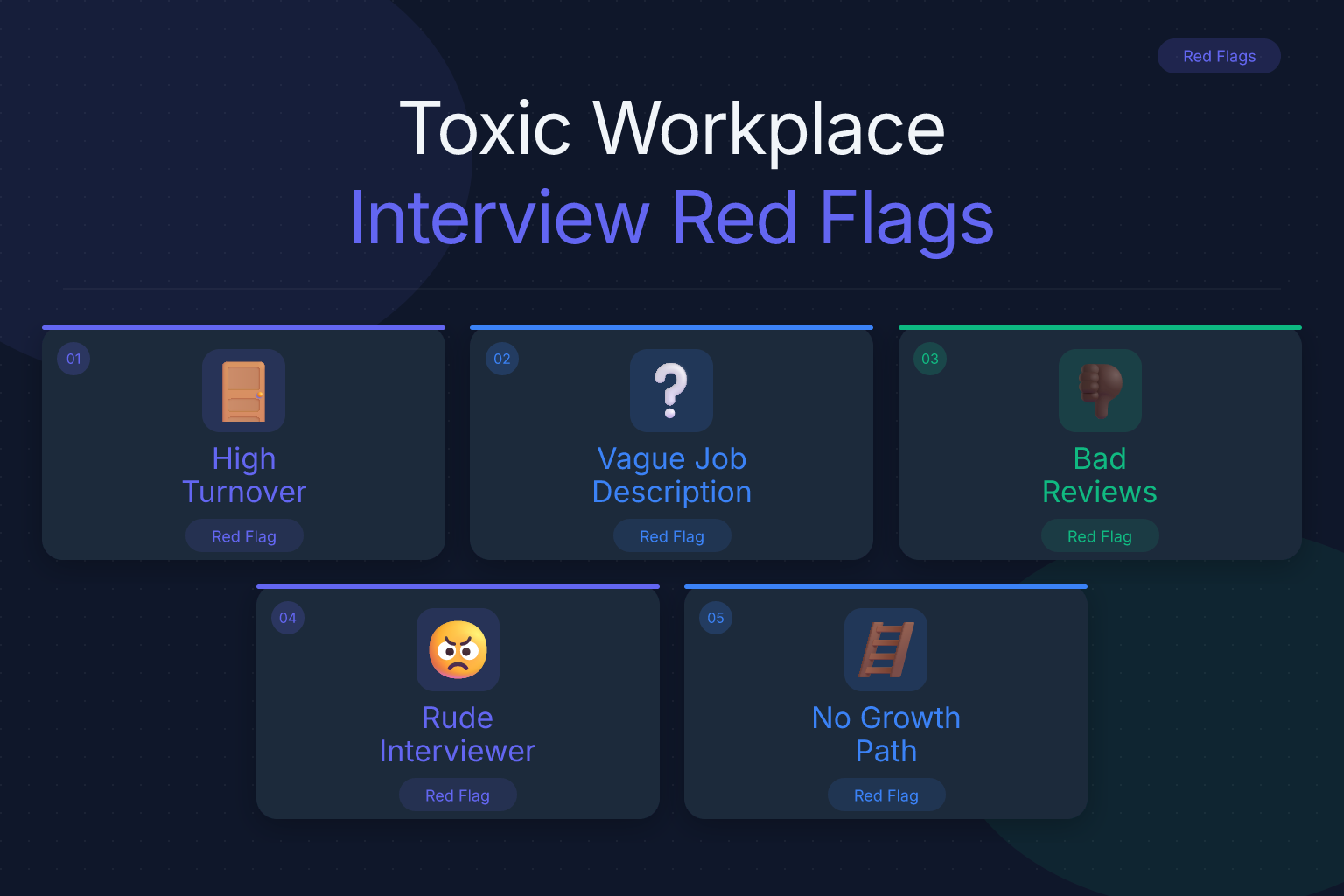
Signs of a Toxic Workplace During an Interview: Red Flags to Watch For
You’ve polished your resume, practiced your answers, and landed the interview. But while you’re busy selling yourself, the company is also on display — and sometimes the signs of a toxic workplace during an interview are right in front of you. A job that looks great on paper can turn into a nightmare if the culture is broken. The interview is your best chance to spot trouble before you’re stuck in it.
This guide walks you through the concrete red flags that surface during interviews, the questions you should ask to uncover them, and what to do when your gut says something is off.
Key Takeaways
- Interviewers who badmouth current or former employees, dodge culture questions, or pressure you to accept on the spot are waving red flags you shouldn’t ignore.
- High turnover, vague job descriptions, and a chaotic interview process often point to deeper organizational problems.
- Asking direct questions about work-life balance, management style, and why the last person left can reveal a toxic environment before you commit.
- Trust your instincts — if the interview feels disrespectful, rushed, or makes you uneasy, the day-to-day reality is likely worse.
- You can always walk away; a job offer isn’t an obligation, and protecting your mental health is worth more than a paycheck.
Summary Table
| What to Do | Why It Matters | When |
|---|---|---|
| Ask why the position is open | Uncovers turnover or growth patterns | During the interview |
| Observe how interviewers treat each other | Reveals team dynamics and respect levels | On-site or panel interviews |
| Request concrete examples of work-life balance | Vague answers often mask a burnout culture | When discussing company culture |
| Note if the job description keeps changing | Signals disorganization or a bait-and-switch | Throughout the process |
| Trust physical and emotional cues | Your subconscious picks up on danger before your logic does | The entire interview day |
1. Signs of a Toxic Workplace During the Interview: The Interviewer Badmouths Current or Former Employees
One of the clearest signs of a toxic workplace during an interview is when the person across the table trashes the people who used to sit in your chair. If a hiring manager says things like, “The last person just couldn’t handle the pace,” or “Our team has a few weak links we’re trying to push out,” pay attention. That’s not transparency — it’s a preview of how they’ll talk about you someday.
Healthy organizations focus on the role and the future, not on blaming individuals. When an interviewer volunteers negative opinions about colleagues, it suggests a culture of finger-pointing and low psychological safety. According to the U.S. Surgeon General’s framework on workplace well-being, environments where blame and disrespect are common erode mental health and increase burnout risk.
What to do: If you hear this, ask a neutral follow-up: “What qualities are you looking for in the person who fills this role that may have been missing before?” A defensive or evasive answer confirms the red flag.
2. They Dodge Questions About Culture, Turnover, or Work-Life Balance
You ask, “Can you tell me about the team’s work-life balance?” and the interviewer laughs, changes the subject, or gives you a rehearsed line like, “We work hard and play hard.” That’s a dodge. A company with a healthy culture can give you specific examples: “We have a no-email-after-7pm policy,” or “Every Friday we do a team lunch and then leave early.”
When you ask about turnover and get a vague “People come and go, it’s normal,” dig deeper. High turnover is expensive and disruptive. The Society for Human Resource Management (SHRM) notes that replacing an employee can cost up to 50-60% of their annual salary, so stable companies track and address it. If they can’t or won’t tell you why the last person left, that’s a problem.
Questions to ask:
- “What’s the average tenure on this team?”
- “Can you walk me through a typical week for someone in this role — including start and end times?”
- “What’s the last thing the team celebrated together?”
If the answers are all about “hustle” and “grind” with no mention of rest or recognition, you’re likely looking at a burnout factory.
3. The Job Description Keeps Changing or Is Dangerously Vague
You applied for a marketing coordinator role, but by the second interview they’re talking about sales targets and event planning. A shifting job description isn’t just disorganized — it can be a sign of a toxic workplace where roles are poorly defined and you’ll be expected to “wear many hats” without extra pay or support.
Some variation is normal in startups, but if the responsibilities, title, or reporting structure change significantly between conversations, ask for clarity. A company that can’t articulate what they need from you will likely blame you later for not meeting unspoken expectations.
Red flag phrases:
- “We’re looking for a rockstar who can do it all.”
- “The role will evolve — we need someone flexible.”
- “We’ll figure out the details once you’re on board.”
Before your next interview, use a tool like the ResumeMate score checker to make sure your resume is tailored to the role as it’s actually described — not the moving target they’re presenting. A clear, consistent job description is a baseline expectation.
4. You’re Asked Inappropriate or Illegal Questions
Questions about your age, marital status, religion, health, or plans to have children are not just rude — they’re illegal in many jurisdictions. But even when they’re not technically against the law, they signal a workplace that doesn’t respect boundaries. If an interviewer asks, “Are you planning to start a family soon?” or “How do you handle working with much younger colleagues?” they’re telling you that bias is baked into their decision-making.
A toxic workplace often normalizes invasive behavior. If they’re comfortable crossing lines during an interview when they’re supposed to be on their best behavior, imagine what happens after you’re hired.
How to respond: You can redirect with, “I’m confident I can meet the demands of this role. Can you tell me more about the team’s current projects?” If they persist, consider it a dealbreaker.
5. The Interview Feels Like an Interrogation, Not a Conversation
Interviews are two-way streets. If you’re being grilled with rapid-fire questions, interrupted constantly, or given no chance to ask your own, the power dynamic is already skewed. A toxic workplace often reveals itself through disrespect during the hiring process.
Pay attention to how the interviewer listens. Do they make eye contact? Do they acknowledge your answers or just move to the next scripted question? Are they checking their phone or laptop while you’re speaking? These small behaviors reflect the day-to-day communication style you’ll experience.
One candidate shared on Glassdoor that during a panel interview, two interviewers had a side conversation while she was answering a question. She took the job anyway and later found that cross-talk and dismissiveness were the norm in meetings. The interview was a preview.
What to do: If the interview feels disrespectful, it’s okay to end it early. You can say, “I’m not sure this is the right fit for me. Thank you for your time.” You don’t owe anyone your dignity.
6. They Pressure You to Accept on the Spot or Use High-Pressure Tactics
“We need an answer by tomorrow” or “We have other candidates waiting, so if you want this, you need to decide now” are classic pressure tactics. While some urgency is legitimate, a company that won’t give you 48 hours to think over an offer is either disorganized or trying to prevent you from noticing red flags.
A toxic workplace often relies on emotional manipulation to get people in the door. They might love-bomb you with praise, then rush you into a decision before you can talk to your family or compare other offers. This is a control tactic, not a sign of enthusiasm.
Healthy alternative: A good employer will say, “Take a few days to think it over. We want you to be sure this is the right move for you.” If you’re deciding between multiple offers, our guide on how to decide between two job offers can help you weigh the pros and cons without pressure.
7. You Notice Physical Signs of a Toxic Environment During the On-Site Visit
If you’re invited for an in-person interview, use your senses. Look around. Are people smiling, making eye contact, or do they look tense and avoid each other? Is the office eerily quiet except for keyboard clacking, or is there a healthy hum of collaboration? Do you see personal items on desks, or does it feel sterile and temporary?
Physical environment cues can be subtle but telling:
- No one talks to each other — could indicate fear or a culture of silence.
- Cluttered, messy common areas — may reflect a lack of respect for shared space.
- Security cameras everywhere or overly restrictive badge access — might signal trust issues.
- Employees who look exhausted or unhappy — burnout is visible.
One job seeker reported that during her interview tour, she passed a break room where a manager was loudly berating an employee. The interviewer hurried her past and pretended it didn’t happen. She didn’t take the job.
8. Your Gut Tells You Something Is Off — Listen to It
You might not be able to articulate why, but if you leave the interview feeling drained, anxious, or uneasy, don’t dismiss it. Your brain processes subtle social signals faster than your conscious mind can analyze them. Research on intuition shows that gut feelings are often based on real pattern recognition.
A toxic workplace can be charming during the interview. The manipulation can feel like flattery. But if something feels wrong, it probably is. Write down what bothered you immediately after the interview while it’s fresh. Then ask yourself: “If a friend described this experience to me, what would I tell them?”
Action step: Before you accept any offer, do a reference check in reverse. Look up current and former employees on LinkedIn and politely ask about their experience. Most people will be honest if you approach them respectfully. You can also check company review sites, but take extreme reviews with a grain of salt — look for patterns.
FAQ
Q: What are the red flags of a toxic workplace during an interview?
A: The biggest red flags include interviewers badmouthing current or former employees, dodging questions about culture or turnover, pressuring you to accept on the spot, asking inappropriate personal questions, and a generally disrespectful or chaotic interview process. If the job description keeps changing or the interviewer can’t explain why the role is open, proceed with caution.
Q: How can you tell if a company has a toxic culture before accepting a job?
A: Ask direct questions about work-life balance, management style, and why the last person left. Pay attention to how interviewers treat each other and how they make you feel. Research the company on LinkedIn and reach out to former employees for off-the-record insights. If you notice a pattern of high turnover or vague, defensive answers, trust that data.
Q: What questions should I ask to uncover a toxic work environment?
A: Ask: “What does success look like in this role after six months?” “How does the team handle conflict or disagreement?” “Can you give me an example of how the company supported an employee’s mental health or work-life balance recently?” “What’s the turnover rate on this team, and what are the main reasons people leave?” The answers — or lack of them — will tell you a lot.
Q: What if I already accepted a job and then realize it’s toxic?
A: First, document everything: emails, messages, specific incidents. Then assess whether the issues are fixable — can you transfer teams, set boundaries, or address the problem with HR? If not, start a discreet job search while still employed. You don’t need to list a short-tenure job on your resume if it’s under a few months, but be prepared to explain the gap honestly if asked. Your mental health comes first.
Q: How do I leave a toxic job without burning bridges?
A: Give standard notice, keep your resignation letter brief and professional, and avoid venting in exit interviews. You can say, “I’ve decided to pursue an opportunity that better aligns with my long-term goals.” Don’t badmouth the company, even if they deserve it. Your reputation follows you, and you never know when you’ll cross paths with a former colleague again.
Q: Can a toxic workplace affect my health even before I start?
A: Yes. The stress of anticipating a toxic environment can cause anxiety, sleep problems, and second-guessing your decision. If you’re already feeling dread before day one, that’s a strong signal to reconsider. No job is worth your well-being.
Q: How do I know if a coworker is toxic during the interview process?
A: If you meet potential teammates and they seem overly competitive, dismissive, or gossip about others, that’s a warning sign. A toxic coworker often reveals themselves through subtle put-downs, eye-rolling, or an unwillingness to answer your questions. If you sense tension among team members during a group interview, trust that dynamic will continue once you’re hired. For more on handling difficult colleagues, read our guide on how to deal with a difficult coworker interview question.
Track Every Application While You Job Hunt
Stop losing track of where you’ve applied. The ResumeMate Job Tracker is a free Chrome extension that tracks every application, deadline, and follow-up in one place — right from your browser.