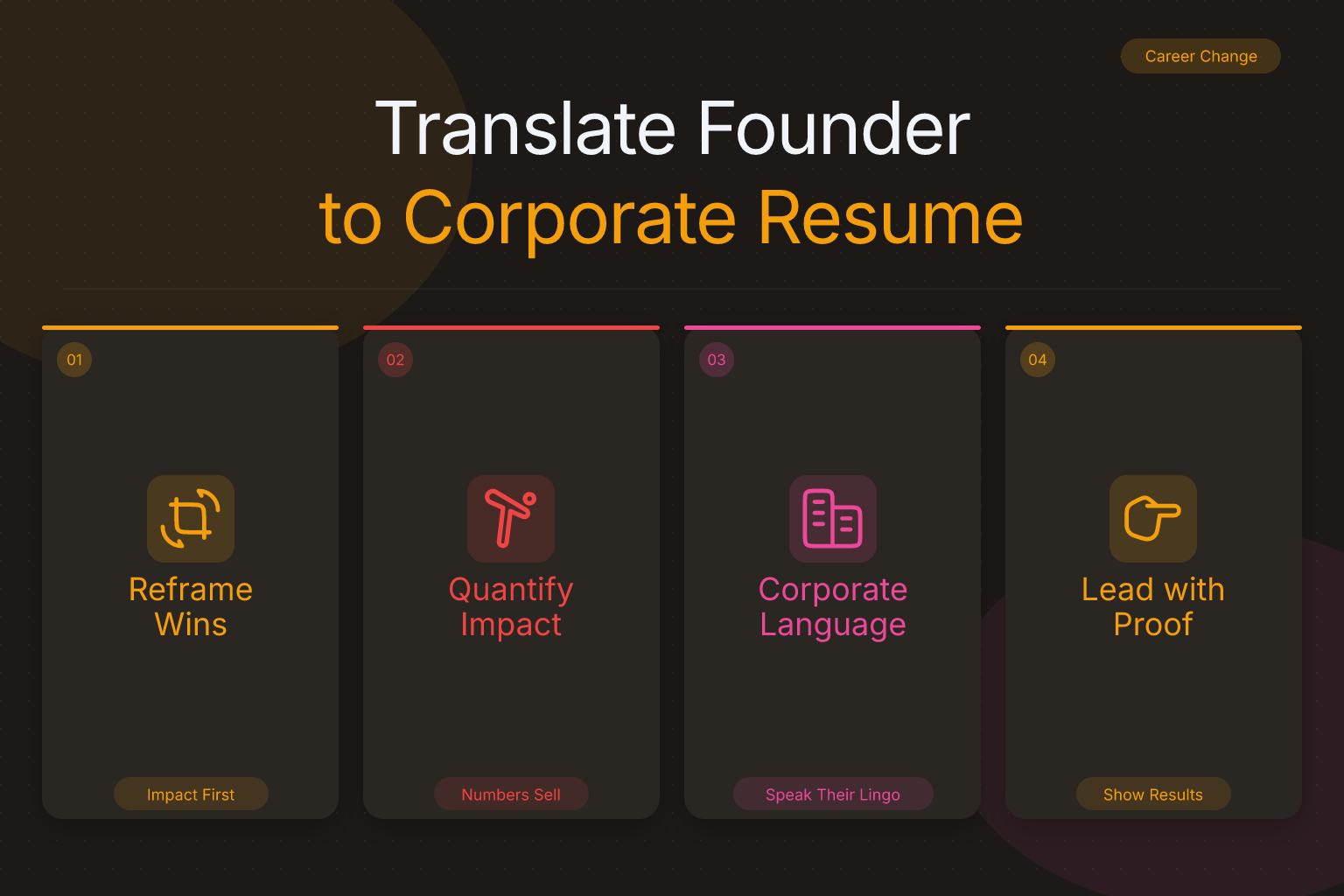
How to Translate Entrepreneur Experience to a Corporate Resume
Translating entrepreneur experience to a corporate resume is one of the most common — and most misunderstood — challenges facing founders, freelancers, and small business owners who want to move into a traditional employee role. You’ve built something from scratch, managed every function, and learned more in three years than most people do in a decade. But when you sit down to write a resume, that experience often looks like a confusing block of “self-employed” with no clear title, no obvious progression, and no corporate keywords. The good news: your entrepreneurial background is a massive asset — if you know how to frame it. This guide walks you through exactly how to translate your founder experience into language corporate recruiters and applicant tracking systems (ATS) understand, so you can land interviews for roles you’re genuinely qualified for.
Key Takeaways
- Replace founder-specific titles like “CEO” or “Owner” with functional corporate titles such as “General Manager” or “Head of Operations” to pass ATS filters and recruiter keyword searches.
- Quantify your business results using revenue, cost savings, team size, and customer metrics — even if you don’t have exact numbers, use ranges or percentages.
- Frame your entrepreneurial journey as a series of corporate-equivalent projects, not as a single “self-employed” block, to show progressive responsibility.
- Address the “can you work for someone else?” objection head-on in your summary and cover letter by emphasizing collaboration, reporting structures, and adaptability.
- Use a free ATS score checker to verify your translated resume parses correctly before submitting.
| What to Do | Why It Matters | Time |
|---|---|---|
| Rewrite your job title to a corporate equivalent | Passes ATS filters and recruiter searches | 15 min |
| Convert business metrics into bullet points with numbers | Shows impact and scale in corporate language | 30 min |
| Reframe your experience as projects with start/end dates | Demonstrates progressive responsibility and accountability | 20 min |
| Add a career-change summary at the top | Addresses the “why corporate now?” question upfront | 10 min |
| Run your resume through an ATS score checker | Catches formatting and keyword gaps before you apply | 5 min |
How to Translate Entrepreneur Experience to a Corporate Resume: Start With Your Job Title
The first thing a recruiter or ATS sees is your job title. If your resume says “Founder & CEO” or “Owner,” you’ve already created a mismatch. Corporate recruiters search for titles like “Operations Manager,” “Product Manager,” “Marketing Director,” or “Business Development Lead.” They don’t search for “Entrepreneur.” So your first translation task is to map your actual responsibilities to a corporate title that matches the roles you’re targeting.
Here’s how to do it:
- List every function you performed in your business: sales, marketing, operations, finance, product development, customer service, hiring, etc.
- Identify the corporate title that best matches the majority of your work. If you spent 60% of your time on sales and account management, “Sales Manager” or “Account Director” is more accurate than “CEO.”
- Use a hybrid title if needed. For example, “Founder & General Manager (Operations)” or “Owner / Head of Product” — but put the corporate title first so it’s what the ATS and recruiter see first.
- Never lie about your title. You can use a functional title as long as it accurately reflects what you did. If you were the sole employee, “Director of Operations” is fine; “VP of Operations” might be a stretch unless you managed a team or had significant scope.
A common mistake is keeping “Founder” as the only title because it feels authentic. But authenticity doesn’t get you past the ATS. Translate the title, and you’ll immediately increase your match rate for corporate job descriptions.
Reframe Your Business as a Series of Corporate Projects
Corporate resumes are built around projects, initiatives, and measurable outcomes — not around the fact that you owned a company. Instead of listing one long entry for “Self-Employed, 2018–2024,” break your entrepreneurial experience into 2–4 distinct roles or project blocks, each with its own title, dates, and bullet points.
For example, if you ran an e-commerce business, you might create three entries:
- E-commerce Operations Manager (2022–2024) — focused on logistics, inventory, and customer fulfillment.
- Digital Marketing Lead (2020–2022) — focused on paid acquisition, SEO, and email campaigns.
- Product Development Specialist (2018–2020) — focused on sourcing, supplier relationships, and product launches.
This approach does three things: it shows progressive responsibility, it gives the ATS multiple keyword-rich titles to match against, and it makes your experience look like a series of corporate roles rather than a single ambiguous block. If your business closed or you sold it, this framing also helps you avoid the “failed startup” narrative — you’re simply showing the distinct functions you performed. For more on handling a business that ended, see our guide on how to list startup experience on a resume after closure.
If you did freelance or contract work alongside your business, you can apply the same project-based framing. Check out how to list contract vs. freelance work on a resume for additional strategies.
Quantify Your Impact Without Revenue Numbers
Corporate recruiters love numbers, but many entrepreneurs hesitate to share revenue figures — either because they’re modest, confidential, or inconsistent. You don’t need to reveal your exact P&L to demonstrate impact. Instead, quantify the scope and outcomes of your work using metrics that translate to corporate language.
Here are examples of entrepreneur experience translated into quantified corporate bullet points:
Instead of: “Ran my own marketing agency.” Write: “Led a 3-person marketing team serving 12 B2B clients, increasing average client retention from 6 to 14 months.”
Instead of: “Sold products online.” Write: “Managed end-to-end e-commerce operations for a product line generating $250K in annual revenue, reducing fulfillment costs by 18% through vendor renegotiation.”
Instead of: “Handled all customer service.” Write: “Resolved 500+ customer inquiries annually with a 95% satisfaction rating, implementing a ticketing system that cut response time from 48 hours to 4 hours.”
If you don’t have exact numbers, use ranges or percentages: “increased sales by 30–40%,” “managed a budget of $50K–$75K,” “grew email list from 1,000 to 5,000 subscribers.” The key is to show scale, responsibility, and results — not just activities. For more ideas on adding numbers when you lack hard data, read how to add numbers to your resume when you don’t have data.
Write a Career-Change Summary That Answers “Why Corporate Now?”
Your resume summary is the first paragraph a human reads, and for entrepreneurs, it’s the perfect place to preempt the biggest objection: “Why do you want a regular job after running your own business?” A strong career-change summary does three things: it states your target role, it translates your entrepreneurial experience into corporate value, and it signals your commitment to being an employee.
Here’s a template you can adapt:
Operations Manager with 6 years of entrepreneurial experience building and scaling a consumer services business from $0 to $500K in annual revenue. Proven ability to manage budgets, lead cross-functional teams, and optimize processes in fast-paced environments. Seeking to apply hands-on operational expertise to a corporate operations role where I can drive efficiency and growth as part of a collaborative team.
Notice what this summary does: it uses a corporate title (“Operations Manager”), it quantifies impact, and it explicitly says “as part of a collaborative team” — which addresses the “can you work for someone else?” concern without sounding defensive. For a deeper dive on writing summaries when you’re changing careers, see how to write a career change resume summary with no experience.
Address the “Can You Work for Someone Else?” Objection
This is the elephant in the room for every entrepreneur applying to corporate jobs. Recruiters and hiring managers worry that you’ll struggle with authority, get bored, or leave to start another business. You can’t ignore this concern — you have to address it directly, both on your resume and in interviews.
On your resume, use language that emphasizes collaboration, reporting, and adaptability:
- Use phrases like “reported to a board of advisors,” “collaborated with external partners,” “managed vendor relationships,” or “worked within client-defined constraints.”
- Highlight any experience where you had a boss, a client with strict requirements, or an investor with oversight. Even if you were the owner, you likely answered to someone — a bank, a landlord, a key client, or a regulatory body.
- In your cover letter or summary, state plainly: “After six years of running my own business, I’m ready to bring my operational and leadership skills to a team where I can focus on execution and contribute to a larger mission.”
This doesn’t mean apologizing for your background. It means framing your entrepreneurial experience as evidence that you can work within structures, meet deadlines, and deliver results — not as a liability.
Tailor Your Resume for ATS and Recruiter Keywords
Corporate job applications go through an ATS before a human ever sees them. If your resume is full of entrepreneurial jargon — “bootstrapped,” “wore many hats,” “growth hacking” — the ATS may not match you to the job description. You need to translate your language into the exact keywords from the job posting.
Here’s a step-by-step process:
- Pull 3–5 job descriptions for the corporate role you’re targeting.
- Highlight recurring keywords — things like “budget management,” “cross-functional collaboration,” “P&L responsibility,” “vendor negotiation,” “KPI tracking.”
- Replace your entrepreneurial terms with those keywords. For example, “wore many hats” becomes “managed cross-functional responsibilities including operations, marketing, and finance.”
- Use a single-column, ATS-friendly format. Most modern ATS parse clean, text-based PDFs without issue, but avoid tables, graphics, and multi-column layouts that can confuse older systems. If you’re unsure, check your resume’s ATS score free to see exactly how it parses.
- Run your resume through a score checker after you’ve made changes. The ResumeMate score checker gives you section-by-section feedback on keywords, formatting, and readability — so you can fix issues before you apply.
For a complete walkthrough of tailoring a resume to a job description, see how to tailor a resume to a job description for ATS.
Common Mistakes to Avoid When Translating Founder Experience
Even with the right strategy, entrepreneurs often make a few predictable mistakes. Here are the most common ones — and how to fix them:
- Using “Self-Employed” as your only title. This tells the ATS nothing about your function. Always use a functional corporate title.
- Listing every single responsibility. You did everything, but the recruiter only cares about the 5–7 skills most relevant to the job. Cut the rest.
- Writing in first person or storytelling style. Corporate resumes are third-person, bullet-point driven, and results-focused. No “I started my business because…”
- Including a link to your defunct business website. If your business closed, don’t link to a dead site. Instead, describe the work in your bullet points.
- Downplaying your experience because it wasn’t “corporate.” Running a business is harder than most corporate jobs. Own it — just translate it into the right language.
- Forgetting to update your LinkedIn to match your resume. Recruiters will check both. Make sure your LinkedIn headline uses the same corporate title and keywords as your resume.
Example: Before and After Entrepreneur Resume Bullet Points
Let’s look at a real-world translation. Suppose you ran a small digital marketing agency for four years. Here’s how a typical entrepreneur might write their bullet points — and how to translate them for a corporate resume.
Before (entrepreneur language):
- Ran my own marketing agency and did everything myself.
- Helped clients grow their businesses.
- Managed social media, email, and ads.
- Handled all the money and invoicing.
After (corporate language):
- Digital Marketing Manager | Self-Founded Agency | 2020–2024
- Led end-to-end marketing strategy for 15+ B2B and B2C clients across SaaS, e-commerce, and professional services, achieving an average 40% increase in client lead generation within 6 months.
- Managed a $120K annual marketing budget, allocating spend across paid search, social, and email to deliver a 3.2x average return on ad spend.
- Built and led a team of 3 freelance specialists, establishing weekly reporting cadences and performance dashboards that improved campaign delivery time by 25%.
- Negotiated vendor contracts and client retainers, increasing agency profit margin from 18% to 27% over two years.
Notice the difference: the “after” version uses a corporate title, quantifies results, shows team leadership, and uses keywords like “budget,” “ROAS,” “vendor contracts,” and “performance dashboards.” That’s the translation in action.
If you want to build a resume with this kind of structure from scratch, the ResumeMate AI resume builder offers free, ATS-safe templates that make it easy to plug in your translated bullet points and export a clean PDF.
FAQ
Q: How do I list my own business on a resume without looking like a job hopper?
A: Break your business into 2–4 distinct functional roles (e.g., Operations Manager, Marketing Lead) with separate date ranges. This shows progressive responsibility and avoids the appearance of a single long, ambiguous block. Use corporate titles that match the jobs you’re targeting.
Q: What job title should I use as a founder on my resume?
A: Use a functional corporate title that reflects the majority of your work — such as “General Manager,” “Head of Product,” or “Sales Director.” You can include “Founder” as a secondary descriptor (e.g., “Founder & General Manager”), but put the corporate title first so ATS and recruiters see it immediately.
Q: How do I explain a failed startup on my resume?
A: Focus on the skills and results you delivered, not the business outcome. Use project-based framing, quantify what you achieved (revenue, customers, cost savings), and avoid language like “failed” or “shut down.” If asked in an interview, frame it as a learning experience that sharpened your operational and decision-making skills.
Q: Will corporate recruiters take entrepreneur experience seriously?
A: Yes, if you translate it correctly. Recruiters value the breadth of skills, resilience, and ownership mindset that entrepreneurs bring. The key is to present your experience in corporate language — functional titles, quantified results, and keywords from the job description — so it’s easy for them to see the match.
Q: How do I quantify entrepreneur experience without revenue numbers?
A: Use non-revenue metrics like team size, number of clients, customer satisfaction scores, process improvements, cost reductions, or percentage growth. For example, “managed a team of 4,” “reduced fulfillment time by 30%,” or “grew email list from 1,000 to 5,000 subscribers.” Ranges and percentages work well when exact figures aren’t available.
Q: Should I include my business on LinkedIn differently than on my resume?
A: No — keep them consistent. Use the same functional corporate title, keywords, and quantified bullet points on both. Recruiters will cross-reference, and inconsistencies can raise red flags. Update your LinkedIn headline to match your target role, not just “Entrepreneur.”
Q: How do I address the “why do you want a regular job?” question in an interview?
A: Be direct and positive. Say something like: “Running my own business taught me I’m most effective when I can focus on execution within a larger team and mission. I’m looking for a role where I can apply my operational and leadership skills without the administrative burden of running an entire company.” This shows self-awareness and commitment.
Related articles:
Track Every Application While You Job Hunt
Stop losing track of where you’ve applied. The ResumeMate Job Tracker is a free Chrome extension that tracks every application, deadline, and follow-up in one place — right from your browser.