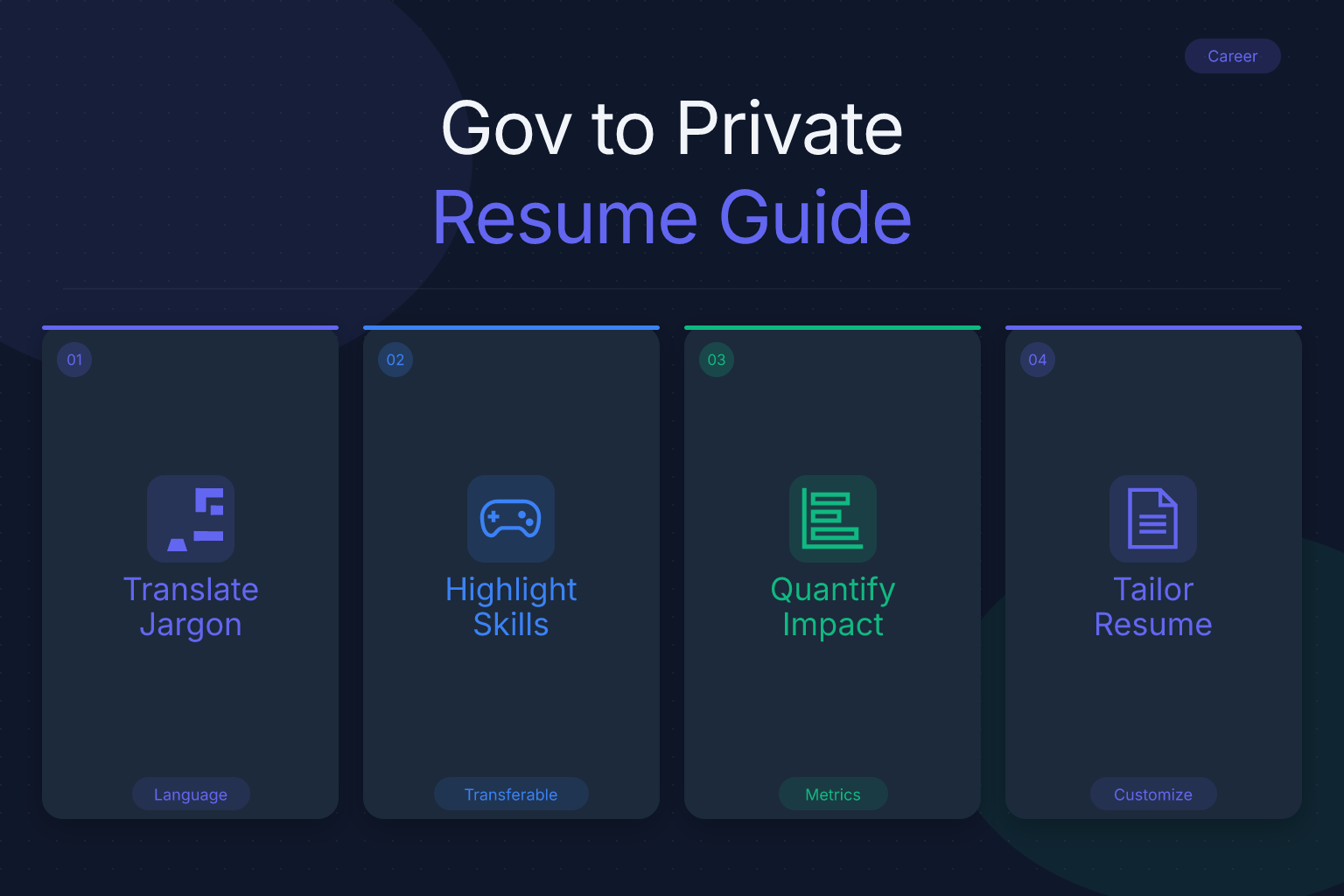
Translate Government Experience to Private Sector Resume
Translating government experience to a private sector resume is one of the most common challenges federal, state, and local employees face when they decide to leave public service. Your government resume likely runs five to ten pages, uses job series codes and agency-specific acronyms, and emphasizes compliance over results. Private sector recruiters, on the other hand, expect a one- to two-page document written in plain business language that shows measurable impact. The good news: your experience is valuable. You just need to reframe it.
Key Takeaways
- Government resumes are typically 3–10 pages, but private sector resumes should be 1–2 pages — cut everything that doesn’t directly support the target role.
- Replace government-specific acronyms and job series codes with plain-language titles and descriptions that private sector hiring managers understand.
- Quantify your impact using business metrics (dollars saved, time reduced, people served) instead of compliance language.
- A security clearance is a valuable asset — list it prominently if the employer works with government contracts.
- Use a free resume score checker to verify your translated resume passes ATS filters before you apply.
| What to Do | Why It Matters | Time |
|---|---|---|
| Rewrite your job titles in plain English | Recruiters search by common titles, not government series codes | 30 min |
| Convert duties into quantified achievements | Private sector hiring managers want results, not responsibilities | 1–2 hours |
| Trim to 1–2 pages | Long government resumes get skipped by ATS and recruiters | 1 hour |
| Add a skills section with business keywords | ATS filters for specific skills before a human reads your resume | 45 min |
| Run your resume through an ATS checker | Catch formatting and keyword gaps before you apply | 10 min |
Start by Rethinking Your Format
The first step is accepting that your government resume format won’t work in the private sector. Federal resumes, especially those built for USAJOBS, are designed for a different audience: HR specialists who need to verify qualifications against a job announcement. They expect long, detailed descriptions, job series codes, and grade levels. Private sector recruiters and applicant tracking systems (ATS) want the opposite: a clean, scannable document that highlights your most relevant experience in seconds.
Start by opening a blank document or using a free resume builder with a single-column template. Remove these government-specific elements:
- Job series codes (e.g., GS-0343, GS-2210)
- Grade levels and step numbers
- KSA (Knowledge, Skills, and Abilities) statements
- SF-50 references or other personnel action forms
- Lengthy training course lists
- Agency-specific acronyms without explanation
Replace them with the standard private sector sections: a professional summary, work experience with bullet points, education, and a skills section. Keep your layout simple — no tables, text boxes, or graphics, because many ATS cannot parse those elements. A single-column format is the safest choice.
Replace Government Jargon with Business Language
Government job titles and terminology rarely translate directly. A “GS-12 Management and Program Analyst” means little to a private sector hiring manager, but “Senior Business Analyst” or “Operations Manager” does. The same goes for internal acronyms: COR, COTR, OPM, GSA, and hundreds of others are meaningless outside your agency.
Here are common government terms and their private sector equivalents:
- Contracting Officer’s Representative (COR) → Contract Manager or Vendor Relationship Manager
- Program Analyst → Business Analyst or Operations Analyst
- Budget Analyst → Financial Analyst or Budget Manager
- Human Resources Specialist → HR Generalist or Talent Acquisition Specialist
- IT Specialist (INFOSEC) → Information Security Analyst or Cybersecurity Specialist
- Administrative Officer → Office Manager or Operations Coordinator
When rewriting your job titles and bullet points, ask yourself: “Would a hiring manager at a private company understand this without a government background?” If not, simplify it. Use the same language you’d find in private sector job postings. Search LinkedIn for people who made a similar transition and see what titles they use now — that’s a fast way to find the right translation.
Convert Duties into Quantified Achievements
Government resumes often read like a list of responsibilities: “Responsible for managing a team of 10 analysts,” “Oversaw the budget for a regional office,” “Processed grant applications.” Private sector resumes need results, not duties. Hiring managers want to know what you accomplished and how it moved the needle.
Use this formula for every bullet point: Action verb + task + result + metric.
Examples of weak government bullets and their translated versions:
Weak: “Responsible for managing a team of 10 analysts.”
Strong: “Led a team of 10 analysts to reduce processing time by 30%, saving $200K annually.”
Weak: “Oversaw the budget for a regional office.”
Strong: “Managed a $5M annual budget, identifying $350K in cost savings through vendor renegotiation.”
Weak: “Processed grant applications.”
Strong: “Processed 500+ grant applications per quarter with a 98% accuracy rate, reducing review time by two weeks.”
If you don’t have exact numbers, estimate based on scope. How many people did you serve? How large was the budget? How many cases did you handle? Even approximate figures are better than none. The goal is to show scale and impact in terms a business leader understands.
Shorten Your Resume to 1–2 Pages
This is the hardest step for most government employees, but it’s non-negotiable. Private sector recruiters often spend only a few seconds on an initial resume scan, and ATS systems may reject documents that are too long or poorly formatted. A 10-page federal resume will not get read.
Here’s how to cut ruthlessly:
- Remove every bullet that doesn’t support the target role. If you’re applying for a project management job, your experience processing FOIA requests may not matter.
- Combine similar roles. If you held three progressively responsible analyst positions, list them under one heading with a combined date range and a few strong bullets.
- Delete training courses and certifications unless they’re directly relevant (e.g., PMP, CISSP, CPA).
- Cut the summary to 2–3 sentences. Focus on your current role, years of experience, and the value you bring to the target industry.
- Use bullet points, not paragraphs. Each bullet should be one or two lines max.
Aim for one page if you have less than 10 years of experience, two pages if you have more. If you’re struggling, start by cutting 50% of your current content, then cut another 25%.
Highlight Transferable Skills (and Security Clearance)
Your government experience has given you skills that private sector employers desperately need. The key is to name them in business terms. Common transferable skills from government roles include:
- Project management — leading cross-functional teams, managing timelines, and delivering on deadlines
- Budgeting and financial analysis — managing multi-million-dollar budgets, forecasting, and cost control
- Compliance and risk management — navigating complex regulations and ensuring adherence
- Stakeholder communication — briefing executives, coordinating with external partners, and writing reports
- Data analysis — using data to inform decisions and improve processes
- Procurement and contract management — negotiating with vendors and managing contracts
Create a dedicated skills section that lists these in plain language, and weave them into your experience bullets. If you have a security clearance, that’s a major asset for defense contractors, consulting firms, and tech companies with government clients. List it prominently near the top of your resume — for example, “Active Top Secret Clearance” — and see our guide on how to include a security clearance on your resume for formatting tips. If you don’t have a clearance, don’t worry; focus on the other skills.
Tailor Your Resume for Each Private Sector Role
You cannot use one generic resume for every private sector application. Each job description contains specific keywords and requirements that ATS systems scan for. If your resume doesn’t include those keywords, it may never reach a human.
Before you apply, read the job description carefully and identify the top 5–10 skills and qualifications. Then mirror that language in your resume. For example, if the job asks for “stakeholder management,” use that exact phrase instead of “interagency coordination.” If it asks for “budget forecasting,” use that instead of “resource allocation.”
Your professional summary should also be tailored. Instead of a generic statement, write 2–3 sentences that directly address the role. For help crafting a summary that works for a career change, see our guide on writing a career change resume summary with no experience. And when you’re ready to find roles, use a job board with filters for industry, location, and remote work to target the right opportunities.
Use an ATS Checker to Validate Your Translation
Even after you’ve rewritten your resume, you need to make sure it passes the automated filters that most private sector companies use. Government resumes often fail ATS scans because of formatting issues (tables, headers, graphics) and missing keywords. A clean, text-based PDF is the safest format — and that’s exactly what a good resume builder exports.
Before you submit your resume anywhere, run it through a free resume score checker. Upload your translated resume and you’ll get an ATS-readiness score with section-by-section feedback on your personal information, experience, education, skills, and projects. The checker will flag missing keywords, formatting problems, and weak bullet points so you can fix them before a recruiter ever sees your document.
This step takes 10 minutes and can mean the difference between an interview and a rejection. Do it for every version of your resume you create.
FAQ
Q: How do I translate my government job title to a private sector title?
A: Look at the core function of your role and find the closest private sector equivalent. For example, a “GS-12 Management Analyst” might become “Senior Business Analyst” or “Operations Manager.” Use LinkedIn to search for people with similar government backgrounds who now work in the private sector and see what titles they use.
Q: Should I include my security clearance on a private sector resume?
A: Yes, if the employer does government contract work or is in defense, aerospace, or cybersecurity. List it near the top of your resume, e.g., “Active Top Secret Clearance.” If the employer has no government ties, you can omit it or mention it briefly in a skills section.
Q: How long should my private sector resume be after a government career?
A: One to two pages. Cut any content that doesn’t directly support the target role. Federal resumes are often 5–10 pages, but private sector recruiters expect concise, scannable documents.
Q: What government-specific sections should I remove from my resume?
A: Remove job series codes, grade levels, SF-50 references, KSA statements, and lengthy training lists. Replace them with a standard summary, experience bullets, education, and skills sections.
Q: How do I quantify achievements if my government work didn’t track metrics?
A: Estimate based on scope. For example, if you managed a budget, state the dollar amount. If you supervised staff, state the number. If you processed applications, estimate volume and turnaround time. Even approximate numbers are better than none.
Q: Can I use the same resume for government and private sector applications?
A: No. Government resumes follow a different format and often require specific information like job series and grade. Keep two separate versions: one for USAJOBS and one for private sector job boards.
Track Every Application While You Job Hunt
Stop losing track of where you’ve applied. The ResumeMate Job Tracker is a free Chrome extension that tracks every application, deadline, and follow-up in one place — right from your browser.