Types of Drugs Tested in Pre-Employment Screening: A Complete Guide for 2026
If you’re applying for a new job, you may be wondering about the types of drugs tested in pre-employment screening and what it means for your candidacy. Drug testing is a standard part of the hiring process for many employers, especially in safety-sensitive industries like transportation, healthcare, and manufacturing. But the specific substances screened for can vary widely depending on the employer, the job role, and state laws. This guide breaks down the most common drug panels, how testing works, and what you need to know to navigate the process with confidence.
Key Takeaways
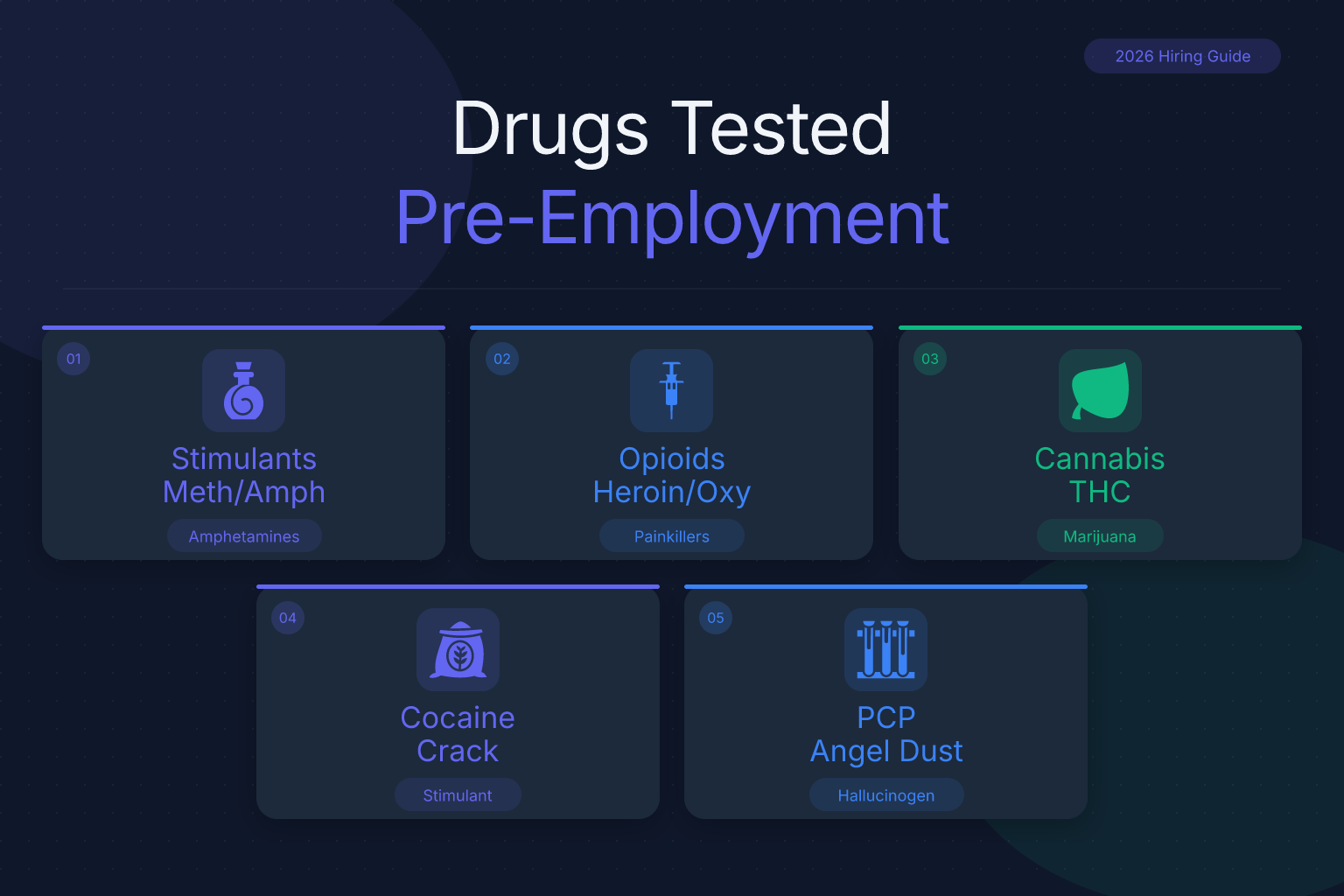
- Most U.S. employers use a standard 5-panel urine test that screens for marijuana, cocaine, amphetamines, opiates, and PCP.
- A 10-panel test adds benzodiazepines, barbiturates, methadone, propoxyphene, and methaqualone to the standard five substances.
- Prescription medications can trigger false positives, so always disclose valid prescriptions to the testing facility before your sample is collected.
- State laws vary widely on marijuana testing; some states prohibit employers from taking adverse action based solely on a positive test for off-duty cannabis use.
- Hair follicle tests can detect drug use up to 90 days back, while urine tests typically cover a window of 1 to 30 days depending on the substance.
Summary Table
| What to Do | Why It Matters | Time |
|---|---|---|
| Know which panel your employer uses | Helps you understand exactly what substances are being screened | 5 min |
| Disclose all prescription medications | Prevents false positives and protects your candidacy | 10 min |
| Check your state’s marijuana testing laws | You may have legal protections against adverse action | 15 min |
| Schedule your test promptly after an offer | Delays can slow down your start date or raise red flags | 5 min |
| Stay normally hydrated before a urine test | Over-dilution can be flagged as a tampered sample | Ongoing |
What Is a Pre-Employment Drug Test?
A pre-employment drug test is a screening that employers use to detect the presence of illegal drugs or controlled substances in a job candidate’s system before making a final hiring decision. The types of drugs tested in pre-employment screening depend on the testing panel the employer selects. The most common panels are the 5-panel and 10-panel urine tests, but employers may also use hair, saliva, or blood tests for more comprehensive or faster results.
Drug testing is most common in industries regulated by the Department of Transportation (DOT), healthcare, government, and any role involving heavy machinery or public safety. However, many private employers in non-safety-sensitive roles also test as a condition of employment. According to the Substance Abuse and Mental Health Services Administration (SAMHSA), the federal government’s standard drug testing panel includes five specific drug classes, which form the basis for most employer tests.
If you’re in the middle of a job search, understanding what to expect can reduce anxiety and help you prepare. For tips on navigating the screening call that often precedes a drug test, see our guide on phone interview tips to ace the screening call.
The Standard 5-Panel Drug Test
The 5-panel test is the most widely used pre-employment drug screen in the United States. It checks for five categories of drugs, often abbreviated as the “SAMHSA-5” because they align with federal workplace testing guidelines. The substances tested are:
- Marijuana (THC) – The psychoactive compound in cannabis. Detection windows vary: occasional use may be detectable for 1–3 days, while heavy use can be detected for 30 days or more in urine.
- Cocaine – A stimulant typically detectable for 2–4 days after use.
- Amphetamines – Includes methamphetamine, MDMA (ecstasy), and prescription stimulants like Adderall. Detection window is usually 2–4 days.
- Opiates – Covers natural opiates like morphine, codeine, and heroin. Synthetic opioids like fentanyl and oxycodone are not always included in a basic 5-panel test; they require an expanded panel.
- Phencyclidine (PCP) – A dissociative drug detectable for up to 8 days in urine, though it is rarely used today.
Most employers that use a 5-panel test do so because it is cost-effective and covers the most commonly abused illegal substances. If you’re applying for a job that requires a DOT physical (such as commercial driving), the DOT mandates a 5-panel urine test with these exact substances. You can find the official DOT drug testing panel on the U.S. Department of Transportation website.
The Expanded 10-Panel Drug Test
A 10-panel drug test includes everything in the 5-panel test plus five additional drug classes. Employers in healthcare, law enforcement, and other high-trust roles often use this more comprehensive screen. The additional substances are:
- Benzodiazepines – Anti-anxiety medications like Xanax, Valium, and Ativan. These are commonly prescribed, so a valid prescription is essential to avoid a failed test.
- Barbiturates – Sedatives like phenobarbital and butalbital. Less commonly prescribed today but still screened.
- Methadone – Used to treat opioid addiction and chronic pain. It is not typically included in a 5-panel test.
- Propoxyphene – A pain reliever that was withdrawn from the U.S. market in 2010 but is still included in some panels.
- Methaqualone – A sedative (Quaalude) that is rarely used but remains on the standard 10-panel list.
Some employers use a modified 10-panel that swaps out propoxyphene and methaqualone for more relevant substances like oxycodone, fentanyl, or tramadol. Always ask your employer or the testing facility which specific panel will be used so you know what to expect.
Other Drug Panels and Specialty Tests
Beyond the 5-panel and 10-panel, employers may use custom panels or alternative testing methods. Here are the most common variations:
- 4-Panel Test – Excludes marijuana, often used by employers in states where cannabis is legal for recreational or medical use.
- 7-Panel Test – Adds benzodiazepines and barbiturates to the 5-panel, or sometimes includes oxycodone and methadone.
- 12-Panel Test – Expands further to include synthetic opioids (fentanyl, oxycodone), tramadol, and sometimes alcohol metabolites.
- Hair Follicle Test – Detects drug use over a 90-day period by analyzing a small hair sample. It cannot detect very recent use (within the last 5–7 days) but is harder to adulterate than urine.
- Saliva (Oral Fluid) Test – Detects recent drug use, typically within the past 24–48 hours. It is becoming more popular for on-site testing because it is non-invasive and difficult to cheat.
- Blood Test – Rarely used for pre-employment screening because it is invasive and has a short detection window (hours to a few days). It is more common in post-accident or reasonable-suspicion testing.
If you’re applying for a job that requires a specific type of test, the employer should inform you in advance. For roles in safety-sensitive industries, the DOT requires urine testing only, but private employers have more flexibility.
How Drug Testing Works: Urine, Hair, Saliva, and Blood
The most common specimen for pre-employment drug testing is urine, but each method has its own detection window and collection process.
Urine testing is the industry standard because it is relatively inexpensive, non-invasive, and can detect a wide range of substances. You will be asked to provide a sample in a private restroom, often under monitored conditions to prevent tampering. The sample is then sent to a laboratory for initial immunoassay screening, followed by confirmatory testing (usually gas chromatography-mass spectrometry) if the initial screen is positive.
Hair testing involves cutting a small sample of hair (about 1.5 inches from the scalp) and analyzing it for drug metabolites. It provides a 90-day history of drug use but cannot detect use within the last week. Hair testing is more expensive and less common for pre-employment, but some employers in finance, law enforcement, and executive roles use it.
Saliva testing is gaining popularity because it can be administered on-site and detects very recent drug use. It is less invasive than urine and harder to adulterate, but it has a shorter detection window (typically 24–48 hours).
Blood testing is the most accurate for determining current impairment but is rarely used for pre-employment screening due to cost and invasiveness. It is more common in post-accident investigations.
Regardless of the method, you should never attempt to tamper with a sample. Laboratories test for dilution, adulterants, and temperature, and a tampered sample is treated as a failed test.
Legal Considerations and State Laws
Drug testing laws vary significantly by state, especially when it comes to marijuana. As of 2026, 24 states and the District of Columbia have legalized recreational cannabis, and many more allow medical use. However, federal law still classifies marijuana as a Schedule I controlled substance, which creates a patchwork of employer policies.
Key legal points to know:
- State protections for off-duty use: Some states, including California, New York, and Nevada, prohibit employers from discriminating against employees or applicants for lawful off-duty marijuana use. However, exceptions exist for safety-sensitive positions and federal contractors.
- Medical marijuana: Many states require employers to accommodate medical marijuana patients, but federal law does not protect them. If you have a medical marijuana card, check your state’s specific protections.
- Prescription medications: Employers cannot discriminate against you for taking legally prescribed medications, but you must disclose them to the testing facility. A positive result for a prescribed substance is typically reported as negative after verification with your pharmacy.
- DOT-regulated positions: If you apply for a job that requires a commercial driver’s license or other DOT-regulated role, marijuana use is prohibited regardless of state law. A positive test will disqualify you.
Before you take a pre-employment drug test, research your state’s laws. The National Conference of State Legislatures maintains an up-to-date database of state drug testing statutes.
What to Do If You Have a Prescription or Medical Need
If you take any prescription medication that could appear on a drug test, you must disclose it before your sample is collected. This includes:
- ADHD medications (Adderall, Ritalin) – amphetamines
- Anti-anxiety medications (Xanax, Valium) – benzodiazepines
- Pain medications (Vicodin, OxyContin) – opiates or synthetic opioids
- Sleep aids (Ambien) – may trigger a false positive for benzodiazepines in rare cases
- Certain antidepressants (Wellbutrin) – can cause a false positive for amphetamines
When you arrive at the testing facility, bring your prescription bottles or a letter from your doctor. The medical review officer (MRO) will contact you if your test comes back positive for a substance you have a valid prescription for. They will verify the prescription with your pharmacy and report the result as negative to the employer.
Never stop taking a prescribed medication just to pass a drug test. That can be dangerous and is not necessary if you disclose it properly. If you have concerns about a specific medication, talk to your doctor or the MRO before the test.
How to Prepare for a Pre-Employment Drug Test
Preparation for a drug test is mostly about logistics and honesty. Here’s a step-by-step checklist:
- Confirm the test details – Ask your employer which panel will be used, what specimen type (urine, hair, saliva), and where to go. This information is usually provided in the offer letter or by HR.
- Schedule the test promptly – Most employers require the test within 24–72 hours of accepting an offer. Delaying can raise concerns.
- Bring identification – A government-issued photo ID is required at the testing facility.
- Disclose all medications – Bring a list of all prescription and over-the-counter medications, including supplements, to the testing site.
- Stay normally hydrated – Drink water as you normally would. Over-hydrating to dilute your urine can be flagged as a tampered sample and result in a retest or automatic failure.
- Avoid poppy seeds – Poppy seeds can cause a false positive for opiates. Avoid eating them for 48 hours before the test.
- Be honest – If you have used a substance that will show up, it’s better to discuss it with the employer before the test than to fail and be disqualified. Some employers may allow a retest after a waiting period, but this is rare.
If you’re still in the application phase and want to streamline your job search, consider using the ResumeMate job board to find employers with transparent hiring policies. And once you land an interview, our guide on mastering the follow-up after your application can help you stay organized through the screening process.
Frequently Asked Questions
Q: What is the most common drug test for pre-employment?
A: The most common pre-employment drug test is a 5-panel urine test that screens for marijuana, cocaine, amphetamines, opiates, and PCP. It is used by the majority of U.S. employers and is the standard for DOT-regulated positions.
Q: How far back does a pre-employment drug test go?
A: It depends on the specimen type. Urine tests typically detect drug use from 1 to 30 days back, depending on the substance and frequency of use. Hair follicle tests can detect use up to 90 days back, while saliva tests only detect use within the past 24–48 hours.
Q: Can a prescription medication cause a failed drug test?
A: Yes, many prescription medications can trigger a positive result on a drug test. For example, Adderall can show up as an amphetamine, and Xanax can show up as a benzodiazepine. If you disclose your prescription to the testing facility, the medical review officer will verify it and report the result as negative.
Q: Is marijuana tested in all pre-employment drug screens?
A: Not always. While the standard 5-panel test includes marijuana, some employers use a 4-panel test that excludes it, especially in states where cannabis is legal. However, DOT-regulated positions and federal contractors always test for marijuana.
Q: What happens if I fail a pre-employment drug test?
A: In most cases, a failed drug test results in the withdrawal of the job offer. Some employers may allow a retest if you can prove a false positive, but this is uncommon. If you have a valid prescription, the result will be reported as negative after verification.
Q: Can I refuse to take a pre-employment drug test?
A: You can refuse, but the employer can legally rescind the job offer. Drug testing is a condition of employment for many roles, and refusal is treated the same as a failed test in most cases.
Q: How long does it take to get pre-employment drug test results?
A: Negative results are typically available within 1–3 business days. Positive results take longer because they require confirmatory testing and review by a medical review officer, which can add 2–5 days.
Track Every Application While You Job Hunt
Stop losing track of where you’ve applied. The ResumeMate Job Tracker is a free Chrome extension that tracks every application, deadline, and follow-up in one place — right from your browser.