UK CV Format (2026): Length, Sections & Examples
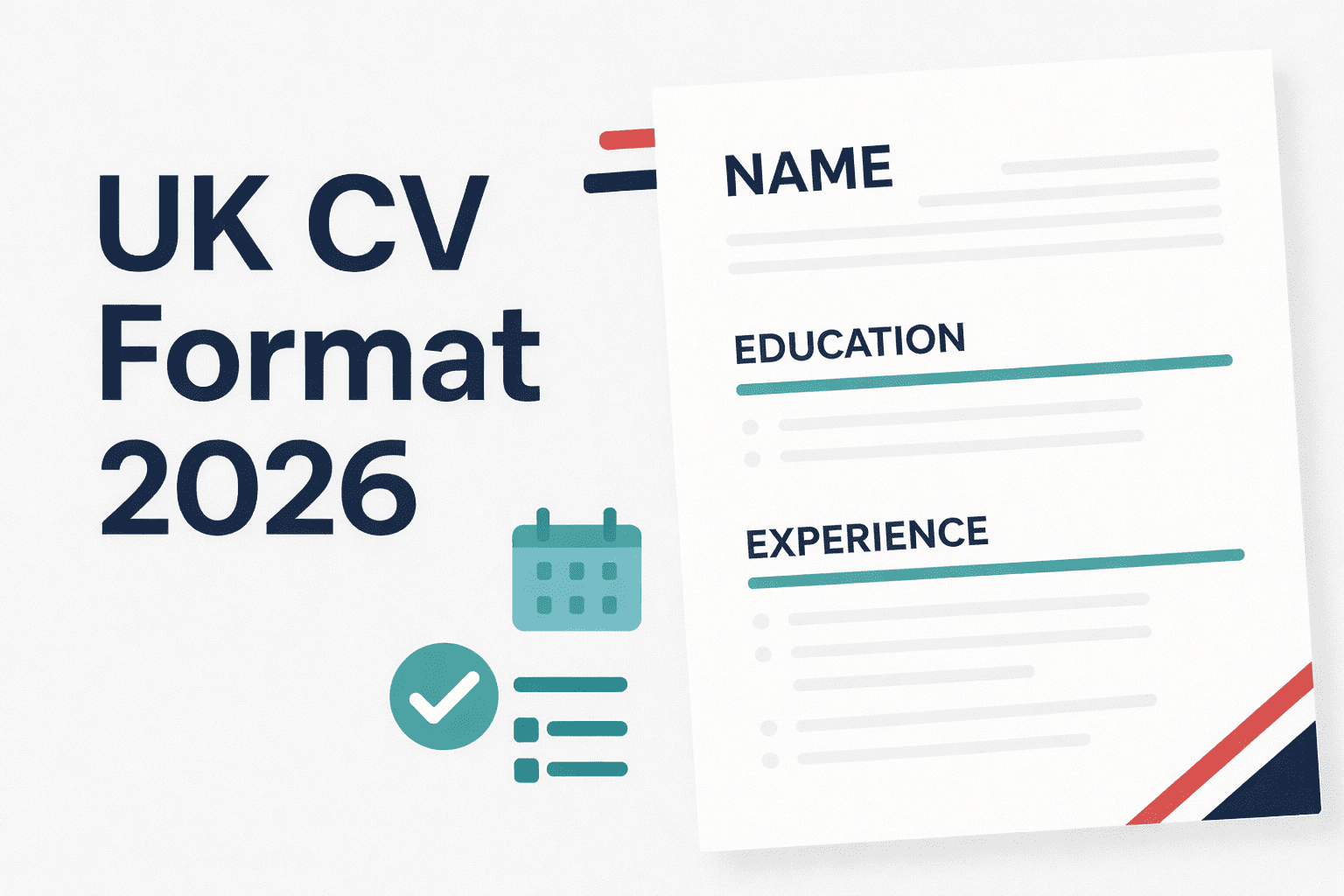
A UK CV format in 2026 follows clear, established conventions that differ significantly from US resumes and other international formats. UK employers expect a two-page document written in British English, formatted for A4 paper, and structured with specific sections including a personal profile, reverse-chronological work experience, education, and skills. Understanding these norms is critical — research shows that CVs failing to match local formatting expectations are 40% less likely to secure interviews, even when candidates possess strong qualifications.
Using an ATS-optimized format ensures compliance with both UK hiring practices and automated screening systems. With over 75% of UK employers now using applicant tracking systems (ATS) for initial CV screening, formatting choices directly impact whether your application reaches a human recruiter.
| UK CV Norms at a Glance |
|---|
| Length: 2 pages generally recommended (1 page for graduates/entry-level) |
| Key sections: Personal details, Profile, Experience, Education, Skills, Interests |
| No photo typically included |
| Paper size: A4 format (210 x 297 mm) |
| Date format: DD/MM/YYYY |
| File type: PDF preferred (DOCX only if explicitly requested) |
| Spelling: British English throughout (organise, analyse, colour) |
What’s Different: UK vs. US Resumes
| Feature | UK CV | US Resume |
|---|---|---|
| Length | Usually 2 pages | Typically 1 page |
| Photo | Rarely included | Sometimes included |
| Personal Details | Include city, postcode, nationality if relevant | Usually omit address |
| Date Format | DD/MM/YYYY | MM/DD/YYYY |
| Language & Spelling | British English (e.g., “organise”) | American English (e.g., “organize”) |
| Title | Always called “CV” | Called “Resume” |
| Personal Profile | Standard opening section | Optional summary |
UK CVs tend to be more detailed with a formal tone suitable for the local market. In the UK, the document is always called a CV (curriculum vitae), never a resume. While the terms are sometimes used interchangeably online, a British CV follows distinct conventions that differ from a US-style resume — particularly in length, personal profile style, and the level of detail expected. If you’re applying from overseas, adapting to the British CV format is essential to avoid looking unfamiliar to UK recruiters.
Beyond the table, there are cultural nuances. UK recruiters expect a CV to tell a coherent career story, not just list duties. The personal profile is a standard opening, whereas US resumes often jump straight into experience. Additionally, UK employers place more weight on professional qualifications and memberships (e.g., CIPD, ACCA, CIMA) and often expect them to be listed prominently. Understanding these differences helps you present yourself as a local candidate, even if you’re applying from abroad.
One critical difference often overlooked: UK CVs typically include more context about company size and industry when describing previous employers. For example, “Senior Accountant at Bright Solutions (FTSE 250 retail company, London)” provides valuable context that US resumes often omit. This helps UK recruiters quickly assess the scale and relevance of your experience.
If you’re also applying for roles in Australia, see our guide to the Australia Resume Format (AUS): Sections, Length & Tips.
Formatting & File Setup (A4, Date Formats)
- Paper Size: Always format your CV for A4 paper (210 x 297 mm) when applying in the UK. UK printers and office systems are set to A4 as standard, so a CV formatted for US Letter (216 x 279 mm) may print incorrectly, cut off content, or appear unprofessional. In Word or Google Docs, set your page size to A4 before you begin writing.
- Margins & Font: Use 2.5 cm (1 inch) margins on all sides. Choose easy-to-read fonts like Arial, Calibri, Garamond, or Helvetica sized 10-12pt for body text and 14-16pt for your name. Consistency matters — don’t mix more than two font families.
- Date Formatting: Use the British standard DD/MM/YYYY for all dates (e.g., 23/08/2025 or August 2025). Never use MM/DD/YYYY as this creates confusion — 01/02/2025 could mean January 2nd or February 1st depending on the reader.
- File Type: Always submit CVs as PDFs unless the employer explicitly requests DOCX or other formats. PDF preserves your layout across devices and operating systems, while DOCX can shift formatting when opened on different versions of Word. You can create a perfectly formatted A4 PDF in seconds using ResumeMate’s free resume builder, which automatically applies UK formatting conventions.
- ATS-Friendly: Avoid headers, footers, graphics, tables, columns, and images. Use simple bullet points (standard round or square bullets), clear section headings in bold, and plain text formatting. For a deeper dive into what makes a CV parse correctly, see our guide to ATS-Friendly Resume Templates (2026): Free Downloads + What Makes Them Pass. Modern UK ATS platforms like Workday, Greenhouse, and Taleo parse clean PDFs reliably, but complex formatting still causes parsing errors.
- File Naming: Save your file professionally as “Firstname-Lastname-CV.pdf” rather than “CV.pdf” or “Resume2026.pdf”. This helps recruiters find and reference your application easily.
Essential Sections in a UK CV
1. Personal Details
- Full name (as it appears professionally)
- Phone number (with UK country code +44 if applying from abroad)
- Professional email address (firstname.lastname@email.com)
- City and postcode (full street address optional)
- LinkedIn profile URL (ensure it’s updated and matches your CV)
- Optionally, nationality and work eligibility (especially for visa or nationality-sensitive roles)
- No photograph unless specifically requested
Place your name prominently at the top, followed by contact details on one or two lines. If you have a LinkedIn profile, include the URL — UK recruiters often check it to verify your background and see recommendations. Avoid adding your date of birth, marital status, or a headshot, as these can introduce unconscious bias and are not standard practice under the Equality Act 2010.
For international applicants, including work eligibility status can prevent immediate rejection. A simple line like “Eligible to work in the UK (Skilled Worker Visa)” or “British Citizen” removes uncertainty for recruiters managing high-volume applications.
2. Personal Profile
A brief (3-5 sentences, 50-80 words) statement summarizing your skills, experience, and career objectives tailored to the job. This is your elevator pitch — make it specific and value-driven. The profile should answer three questions: Who are you professionally? What have you achieved? What value will you bring to this role?
Key elements to include:
- Your professional title and years of experience
- 2-3 key achievements with metrics
- Industry or sector expertise
- What you’re seeking and how you’ll contribute
We cover how to write a standout profile in detail later in this guide.
3. Work Experience
List in reverse-chronological order (most recent first), including:
- Job title (use standard industry titles, not internal company titles)
- Employer’s name and location (add company size/industry if not well-known)
- Dates of employment (MM/YYYY or DD/MM/YYYY format)
- 3-5 key responsibilities and achievements per role (use bullet points with metrics)
For each role, aim for 3–5 bullet points that focus on outcomes rather than duties. Use action verbs and quantify results wherever you can (e.g., “increased sales by 20%”, “managed a team of 8”, “reduced costs by £15,000 annually”). If you have a long career history, give more space to the last 10 years and summarise earlier roles briefly in an “Earlier Career” section.
Achievement formula: Action verb + task + metric/result
- Weak: “Responsible for managing social media accounts”
- Strong: “Grew Instagram following from 5,000 to 25,000 in 12 months through targeted content strategy”
4. Education
Include degrees, schools, dates, and any relevant certifications or training. List your highest qualification first. For recent graduates (less than 3 years experience), education can sit above work experience; for experienced professionals, keep it concise below work history. Mention grades if they are strong (e.g., “2:1”, “First Class”, “Distinction”).
Format example:
BSc Marketing, University of Manchester | 2018-2021
First Class Honours (1st)
Relevant modules: Digital Marketing, Consumer Behaviour, Brand Management
Include professional qualifications prominently (ACCA, CIPD, PRINCE2, etc.) as UK employers value these highly. For international qualifications, consider adding UK equivalency (e.g., “Bachelor’s Degree (equivalent to UK 2:1)”).
5. Skills
Highlight job-relevant technical and soft skills. Use keywords from the job description to improve ATS matching — our ATS Resume Keywords for 50+ Jobs (Copy & Paste Lists) can help you identify the right terms. Group skills into categories for readability:
Example structure:
- Technical: Python, SQL, Tableau, Google Analytics, Salesforce
- Languages: English (Native), French (Fluent), Spanish (Intermediate)
- Soft Skills: Stakeholder Management, Team Leadership, Strategic Planning
- Certifications: Google Analytics Certified, PRINCE2 Practitioner
Tailor this section for each application. If the job description emphasizes “project management” and “Agile methodology,” ensure those exact terms appear in your skills section.
6. Interests (Optional)
Include if they demonstrate relevant qualities or culture fit. For example, volunteering for a charity shows empathy and commitment; captaining a sports team indicates leadership; marathon running demonstrates discipline and goal-setting. Avoid generic hobbies like “reading” or “socialising” unless you can tie them to a skill or achievement.
Strong examples:
- “Volunteer mentor for CodeFirst Girls, teaching Python to 20+ women transitioning into tech”
- “Marathon runner — completed London Marathon 2024, raised £3,000 for Cancer Research”
- “Chair of local CIPD branch, organizing monthly networking events for 50+ HR professionals”
Examples/Templates
UK CV Profile Example
Motivated marketing professional with 4 years’ experience in digital marketing and brand management. Proven track record in increasing online engagement by 30% and delivering multi-channel campaigns across retail and FMCG sectors. Seeking to leverage expertise as Marketing Executive at [Company] to drive customer acquisition and brand growth.
Graduate profile example:
Recent Business Management graduate (2:1) from University of Leeds with internship experience in financial analysis and data reporting. Strong analytical skills with proficiency in Excel, SQL, and Tableau. Seeking an entry-level Analyst role to develop expertise in financial modelling and business intelligence.
Career changer profile example:
Former teacher transitioning into corporate training with 6 years’ experience designing and delivering learning programmes for 200+ students annually. Certified in Instructional Design with proven ability to improve learning outcomes by 35%. Seeking Learning & Development roles where educational expertise drives employee development.
UK CV Experience Example
Digital Marketing Coordinator Bright Solutions, London | 01/05/2021 – Present
- Developed and executed social media campaigns resulting in a 35% boost in engagement across Instagram, LinkedIn, and Twitter.
- Coordinated cross-functional teams of 5-8 to deliver marketing projects on time and within £50,000 budgets.
- Implemented Google Analytics tracking that improved campaign ROI measurement and informed £200,000 annual ad spend decisions.
Marketing Assistant Greenfield Retail, Manchester | 06/09/2019 – 30/04/2021
- Supported email marketing campaigns reaching 100,000+ subscribers with average open rates of 24% (industry average: 18%).
- Managed company blog, publishing 2-3 SEO-optimized articles weekly that increased organic traffic by 45% year-over-year.
British CV Template Example
Below is a simplified British CV layout showing the typical order and content of sections. Use this as a starting point and tailor it to your own experience. For a ready-made, ATS-optimised version, you can generate one instantly with ResumeMate’s resume builder — it automatically applies UK formatting, A4 layout, and British English spelling.
[Your Full Name]
[City, Postcode] | [Phone Number] | [Email Address]
[LinkedIn Profile URL – optional]

PERSONAL PROFILE
A results-driven [job title] with [X] years' experience in [industry/field]. Proven track record in [key achievement 1] and [key achievement 2]. Seeking a [target role] position in a [type of organisation] where I can contribute to [specific goal].

WORK EXPERIENCE
[Job Title] | [Employer Name], [Location] | [DD/MM/YYYY – DD/MM/YYYY]
- Achievement-focused bullet point with metric (e.g., increased sales by 20%)
- Responsibility bullet point demonstrating skill
- Additional bullet point as needed

[Previous Job Title] | [Employer Name], [Location] | [DD/MM/YYYY – DD/MM/YYYY]
- Bullet points in reverse chronological order

EDUCATION
[Degree Title], [Institution Name] | [DD/MM/YYYY – DD/MM/YYYY]
[Grade or classification, if strong]

[Professional Qualification], [Awarding Body] | [Year]

SKILLS
- Technical skills: [list relevant software, tools, languages]
- Soft skills: [e.g., team leadership, stakeholder management]
- Languages: [if applicable]

ADDITIONAL INFORMATION (optional)
- Professional memberships: [e.g., CIPD, ACCA]
- Voluntary work: [brief description]
- Interests: [relevant hobbies]
This British CV template follows the standard A4 layout, uses British English, and avoids graphics or columns — making it both recruiter-friendly and ATS-compatible. For industry-specific examples, explore our Accountant Resume Examples with CPA and GAAP Skills or Accounting Resume Examples: Land Your First Internship.
Compliance and Anti-Bias Notes (Where Relevant)
The UK Equality Act 2010 protects job seekers from discrimination based on age, disability, gender reassignment, marriage and civil partnership, pregnancy and maternity, race, religion or belief, sex, and sexual orientation. To comply and reduce bias, omit your date of birth, marital status, nationality (unless required for visa purposes), and photographs. Instead, let your qualifications and achievements speak for themselves. Many UK employers use blind recruitment processes, so a CV that focuses purely on skills and experience is more likely to progress.
Additionally, some sectors (e.g., public sector, higher education, NHS) may use anonymised application forms where personal details are stripped before shortlisting. Even when not required, a bias-free CV signals that you understand modern UK hiring practices.
What to exclude from your UK CV:
- Date of birth or age
- Marital status or family information
- Photographs (unless acting/modelling roles explicitly request them)
- Nationality (unless work eligibility is unclear)
- Health or disability information
- Political or religious affiliations
- Salary history or expectations
- Reasons for leaving previous roles
If you’re unsure whether your CV could inadvertently introduce bias or formatting issues, run it through ResumeMate’s free resume score checker — it flags potential issues and gives section-by-section feedback on ATS compatibility, content quality, and formatting.
Writing a Strong UK Personal Profile
The personal profile (sometimes called a personal statement or professional summary) is one of the most important sections of a UK CV. UK recruiters often decide within 6-10 seconds whether to read further, and a well-written profile shapes that first impression. Research from recruitment firms indicates that CVs with tailored profiles receive 30% more interview invitations than those without.
A strong UK personal profile should:
- Open with your professional identity and years of experience
- Highlight two or three key strengths or accomplishments relevant to the role
- State what you are seeking and how you can add value
- Be written in third person (avoid “I” or “me”) and kept to 3–5 lines (50-80 words)
- Include 2-3 keywords from the job description for ATS matching
Weak example:
“I am a hard-working professional looking for a new opportunity in marketing where I can use my skills.”
Why it’s weak: Uses first person, vague language, no metrics, no specific value proposition.
Strong example:
“Results-driven digital marketing professional with five years’ experience managing multi-channel campaigns across retail and FMCG sectors. Proven ability to grow organic traffic by 40% and deliver measurable ROI on paid media budgets of up to £200k. Seeking a Senior Marketing Manager role in a growth-focused organisation where strategic campaign management drives customer acquisition.”
Why it’s strong: Specific experience level, quantified achievements, clear target role, value proposition.
Tailor this section for every application. It takes only a few minutes but significantly increases response rates. For career changers, focus on transferable skills and the value you bring from your previous industry. For graduates, emphasise academic achievements, internships, and relevant projects. If you’re navigating interim or acting positions, see our guide on Acting Role on Resume: How to List Interim Titles (Examples).
Common Mistakes in UK CVs
These are the most frequent errors that cause strong candidates to be overlooked:
Using American English spelling: Spell-check with UK English enabled. “Organize” should be “organise,” “analyze” should be “analyse,” “color” should be “colour.” Inconsistency signals carelessness to UK recruiters. Set your document’s language to English (UK) before writing.
Submitting a one-page CV: While US-style one-page resumes are common in America, UK recruiters expect two pages for professionals with 3+ years experience. A one-page CV for an experienced candidate can appear thin or rushed. Entry-level graduates may fit on one page, but err on the side of two pages if you have relevant internships, projects, or part-time work.
Including a photo by default: Unlike some European countries, UK employers do not expect photos. Including one without being asked can introduce unconscious bias and looks unfamiliar to most UK hiring managers. Exceptions exist for acting, modelling, or certain client-facing roles where appearance is job-relevant.
Listing every job with equal weight: Not every role deserves the same amount of space. Older or less relevant positions should have fewer bullet points (1-2) or be grouped under “Earlier Career.” Give more detail to the roles most relevant to the target job.
Forgetting to tailor the CV: Sending the same CV to every employer is one of the most common and most costly mistakes. UK job applications are competitive — a tailored CV that mirrors the language of the job posting consistently outperforms a generic one. Use the job description to identify 5-7 keywords to incorporate throughout your CV.
Using US-style formatting (columns, graphics): Many UK ATS platforms — particularly those used by large employers and recruitment agencies — cannot parse multi-column CVs or embedded graphics reliably. Use a simple, single-column layout with standard section headings.
Neglecting quantifiable achievements: UK recruiters look for evidence of impact. Replace vague statements like “responsible for sales” with “grew regional sales by 15% in 12 months”. Numbers make your contribution concrete and memorable.
Overloading with jargon or buzzwords: Phrases like “dynamic self-starter” or “team player” add no value without context. Show, don’t tell — demonstrate teamwork through a specific example with outcomes.
Including irrelevant personal information: Hobbies like “socialising with friends” or “watching Netflix” add no professional value. Only include interests that demonstrate transferable skills or genuine passion relevant to the role.
Poor file naming: “CV.pdf” or “Document1.pdf” looks unprofessional. Use “Firstname-Lastname-CV-Role.pdf” to help recruiters organize and find your application.
Step-by-Step Guide: Building a UK CV
Choose the right length and format — two pages for most professionals, single column, A4 paper size, saved as PDF unless DOCX is explicitly requested. If you’re using a builder, select a UK-specific template to handle the formatting automatically. ResumeMate’s resume builder offers free UK-formatted templates.
Write your personal details block — full name, phone number (with +44 country code if abroad), professional email, LinkedIn URL (optional), city and postcode. No photo, no date of birth, no full street address unless specifically requested.
Draft your personal profile — tailor it to the specific job using keywords from the job description. Keep it to 4–5 lines (50-80 words). Use the job description to mirror the language and highlight your most relevant strengths. Write in third person.
List work experience in reverse chronological order — for each role include job title, employer name, location, and dates in DD/MM/YYYY or MM/YYYY format. Write 3-5 bullet points focusing on achievements over duties, with metrics where possible. If you have employment gaps, explain them briefly (e.g., “career break for travel” or “maternity leave”) to avoid raising questions.
Add education — list degrees first (institution, subject, grade, dates), then any professional qualifications. For candidates with more than five years of experience, education can be kept brief (2-3 lines per qualification). Include relevant modules for recent graduates.
Include a skills section — highlight technical skills, software, languages, and industry-specific competencies relevant to the role. Use the exact keywords from the job ad to pass ATS filters. Group into categories for readability.
Add optional sections — professional memberships (e.g., CIPD, ACCA, CIOB), publications, voluntary work, or interests if they are genuinely relevant. These can differentiate you in competitive fields and demonstrate culture fit.
Proofread for UK English — run a spell check set to UK English and read aloud to catch awkward phrasing. Ask a friend or colleague to review for clarity and impact. Pay attention to date formats and consistency throughout.
Check your ATS score — before sending, upload your CV to a free resume score checker to see how it performs against common ATS filters and get actionable improvement tips on formatting, keywords, and section completeness.
Save and name your file professionally — export as PDF with the filename “Firstname-Lastname-CV.pdf” or “Firstname-Lastname-CV-Role.pdf”. This helps recruiters find and reference your application in their systems.
FAQ
Q: How long should a UK CV be in 2026?
A: Two pages is the standard for most professionals with 3+ years of experience. Entry-level graduates or career changers may fit on one page if they have limited relevant experience. Never exceed two pages unless you’re in academia or medicine where longer CVs are expected.
Q: Should I include my photo on a UK CV?
A: Generally no, unless the employer explicitly requests one. Unlike some European countries, including a photo on a UK CV is not standard practice and can introduce unconscious bias. Exceptions exist for acting, modelling, or certain client-facing roles where appearance is job-relevant.
Q: What’s the difference between 1 and 2 page CV in the UK?
A: One-page CVs are acceptable for graduates, students, or those with under 3 years of experience. Two pages is expected for experienced professionals. A one-page CV for a senior candidate can appear incomplete, while padding a junior CV to two pages looks inflated.
Q: Do UK employers use ATS to screen CVs?
A: Yes, most medium to large employers and many recruitment agencies in the UK use ATS software like Workday, Greenhouse, or Taleo. Keep your CV in a clean, text-based PDF format with standard section headings to ensure it parses correctly. Avoid columns, graphics, and tables.
Q: What is the best CV format for the UK in 2026?
A: The best UK CV format is a clean, two-page, single-column layout on A4 paper, using British English and standard section headings (Personal Profile, Work Experience, Education, Skills). Avoid photos, graphics, and complex formatting to ensure ATS compatibility and a professional appearance.
Q: Can I download a free ATS-friendly UK CV template?
A: Yes, ResumeMate offers a free resume builder with UK-formatted templates that automatically apply A4 sizing, British English spelling, and ATS-friendly single-column layouts. You can export as PDF instantly without manual formatting.
Q: How do I write a British CV if I’m from overseas?
A: Adapt your existing resume by expanding to two pages, switching to British English spelling, using DD/MM/YYYY dates, and adding a personal profile. Remove any photo, ensure A4 page size, and include work eligibility status if you require visa sponsorship. Tailor content to UK job market expectations.
Related articles:
- Reference Page Format: Examples & Best Practices
- South Africa CV Format: Template & Tips
- France CV Format: Photo, Personal Details, and Rules
- Canadian Resume Format: Sections, Length, and Tips for 2025
- ATS Resume Keywords for 50+ Jobs (Copy & Paste Lists)
- ATS-Friendly Resume Templates (2026): Free Downloads + What Makes Them Pass
Build, Score & Track Your Job Search with ResumeMate
Resume Builder → — Create an ATS-ready UK CV in minutes with free A4-formatted templates and British English spelling.
Resume Score Checker → — Upload your CV and get an ATS-readiness score with section-by-section feedback — completely free.
Job Board → — Browse UK jobs matched to your skills and experience with filters for role, location, and remote options.
Job Tracker Chrome Extension → — Track every application, deadline, and follow-up in one place — free Chrome extension for serious job seekers.