Resume Format for USAJOBS: How to Write a Federal Resume That Gets Referred
If you’re applying for a federal job, the resume format for USAJOBS is unlike anything you’d send to a private company. A standard one-page corporate resume won’t cut it — federal hiring managers and automated systems expect a detailed, structured document that proves you meet every qualification listed in the job announcement. Get the format wrong, and your application may be rejected before a human ever sees it.
This guide walks you through the exact USAJOBS resume format, from required sections to tailoring tricks, so you can build a federal resume that passes the initial screen and lands on the hiring manager’s desk.
| What to Do | Why It Matters | Time |
|---|---|---|
| Use the USAJOBS resume builder | Ensures all required fields are present and formatted correctly for the system | 5 minutes to set up, then fill in |
| Include hours worked and salary for every position | Federal HR must verify your experience level; missing this can disqualify you | 2–3 minutes per job |
| Tailor your resume to the job announcement questionnaire | Your resume must explicitly address the specialized experience and assessment questions | 20–30 minutes per application |
| Avoid private-sector brevity | Federal resumes are typically 3–5 pages; short resumes lack the detail needed to prove qualifications | Varies |
What Makes the USAJOBS Resume Format Different
The resume format for USAJOBS is not just a longer version of a corporate resume — it’s a completely different document built around federal hiring rules. The Office of Personnel Management (OPM) requires specific information that private employers rarely ask for, and the USAJOBS system uses that data to determine if you’re eligible and qualified.
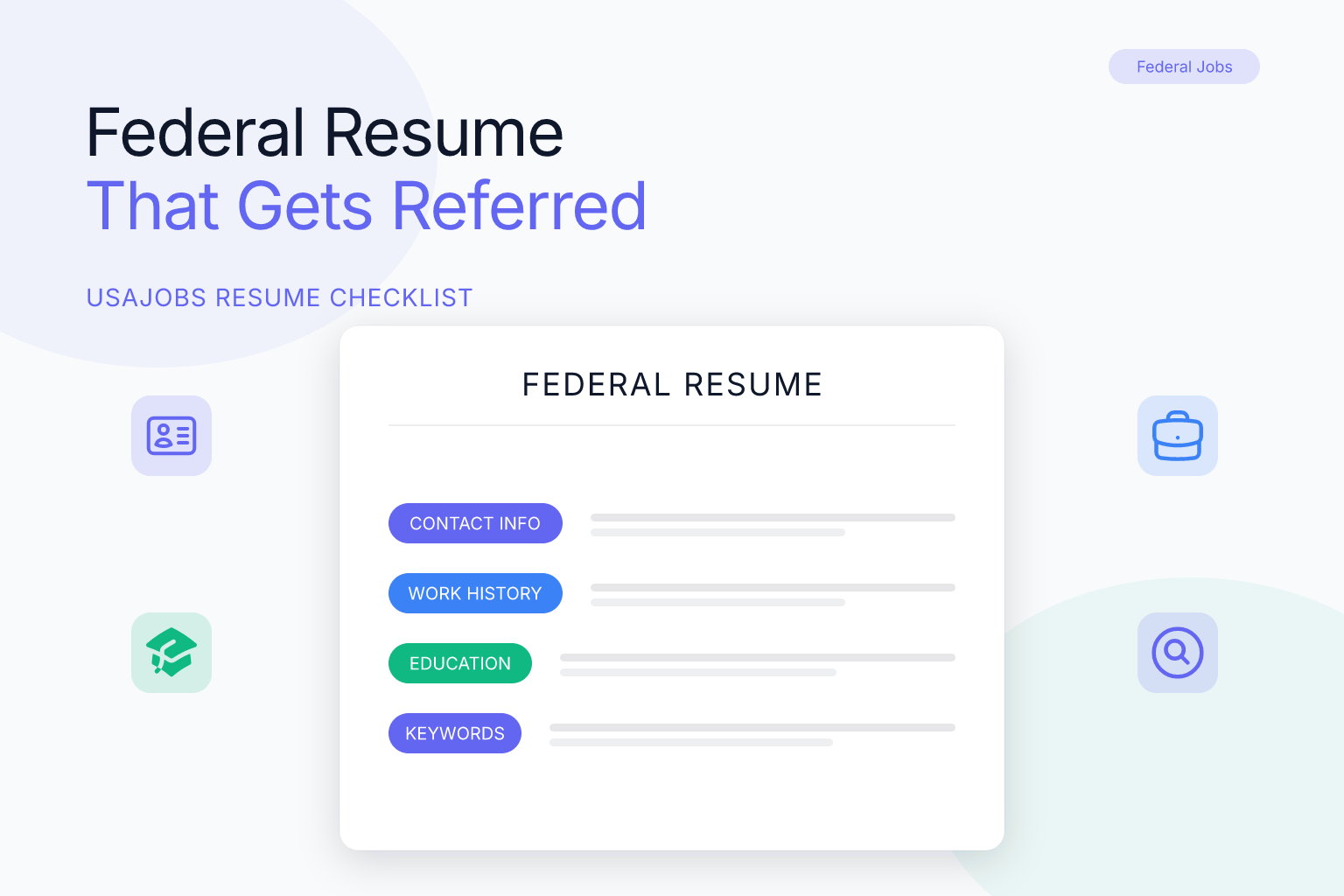
A federal resume must include:
- Hours worked per week (e.g., “40 hours/week”)
- Exact start and end dates (month/day/year)
- Salary for each position (can be a range or exact)
- Supervisor’s name and contact information (or a statement that you don’t know it)
- Whether the position was permanent or temporary
- Detailed descriptions of duties and accomplishments that map directly to the job announcement’s specialized experience
Without these elements, an HR specialist cannot verify that you meet the minimum qualifications, and your application will likely be rated ineligible. According to OPM’s own guidance, a federal resume is a “complete picture” of your work history — not a marketing summary. That means you should include every relevant job, even part-time or volunteer roles, and describe your responsibilities in enough detail that someone outside your field can understand the scope and impact of your work.
This “complete picture” approach also extends to the federal resume package — the resume plus all supporting documents (transcripts, SF-50, DD-214, etc.) that together prove your eligibility. We’ll cover how to assemble that package later in this guide.
Step-by-Step: How to Build Your Federal Resume in USAJOBS
The safest way to nail the resume format for USAJOBS is to use the built-in USAJOBS Resume Builder. It prompts you for every required field and structures the output exactly how the system expects. Here’s how to do it:
- Log into your USAJOBS account and go to Documents.
- Click Upload or build a resume, then select Build a Resume.
- Name your resume (e.g., “IT Specialist GS-12 Resume”).
- Fill out each section in order:
- Personal Information: Name, address, phone, email, citizenship.
- Work Experience: Add each job, including all the required details listed above. Use the “Add another position” button for each role.
- Education: List degrees, schools, credits, and relevant coursework.
- Job-Related Training: Certifications, licenses, workshops.
- Language Skills: If relevant to the job.
- Organizations/Affiliations: Professional memberships.
- References: Optional, but you can add them.
- Save the resume. You can create up to five resumes in your account and tailor each one to different job announcements.
Pro tip: Build a “master” federal resume first that includes every job you’ve ever held, with full details. Then, for each application, duplicate that master and trim or reword it to match the specific announcement. This saves hours of re-typing while keeping your base data intact.
If you already have a strong base resume, you can use a tool like the free ResumeMate AI resume builder to generate clean, ATS-friendly content, then copy the relevant sections into the USAJOBS builder. Just remember to add the federal-specific details (hours, salary, supervisor) that the builder requires. For help choosing a template that keeps your resume readable and ATS-safe, see our guide on how to choose the best resume builder template.
The Anatomy of a Federal Resume: Required Sections
Every federal resume must contain these sections to be considered complete. Missing even one can trigger an automatic disqualification.
1. Contact Information and Citizenship
Full name, mailing address, phone number, email, and country of citizenship. If you’re a non-citizen, you must state your eligibility to work in the U.S. This section is critical because federal jobs often have citizenship requirements mandated by law. Ensure your address is current, as some positions require residency in specific geographic areas.
2. Federal Status and Veterans’ Preference
Indicate if you’re a current or former federal employee, and if you’re claiming veterans’ preference. Upload supporting documents (DD-214, SF-50) separately. Claiming preference incorrectly can lead to disqualification, so verify your eligibility status before checking these boxes. Veterans should have their DD-214 (Member 4 copy) ready to upload immediately upon application.
3. Work Experience (The Core)
For each job, include:
- Job title
- Employer name and location
- Dates of employment (month/year to month/year, or present)
- Hours per week
- Salary (e.g., “$52,000 per year” or “GS-9 equivalent”)
- Supervisor’s name and phone number (write “May contact” or “Do not contact” if you prefer; if you don’t know, state “Unknown”)
- A bulleted list of duties and accomplishments that demonstrate the specialized experience required in the announcement
When writing your bullets, lead with strong action verbs and quantify results whenever possible. Instead of “Responsible for training staff,” write “Trained 12 new team members on case management software, reducing onboarding time by 20%.” For a list of powerful verbs grouped by impact, check out our 200+ action verbs for resumes.
4. Education
List all degrees, majors, schools, and graduation dates. If the job has a positive education requirement, include relevant coursework and credits. For example, if the announcement requires 24 semester hours in accounting, list the specific courses that fulfill that requirement. Include your GPA if it is above 3.0 and you are a recent graduate, as some entry-level federal paths prioritize academic performance.
5. Additional Sections
- Certifications and Licenses (Include expiration dates if applicable)
- Skills (technical and soft)
- Volunteer Work (can count toward experience if it’s relevant — treat it like a job entry with hours and duties)
- Publications, Presentations, Awards (List any recognition that validates your expertise)
How to Tailor Your Resume to a USAJOBS Job Announcement
Federal hiring is not a numbers game — it’s a matching exercise. Your resume must explicitly show that you meet the specialized experience listed in the announcement. The HR specialist will compare your resume against the job questionnaire, so every answer you claim on the questionnaire must be backed up in your resume.
Here’s a practical tailoring process:
- Print or save the full job announcement, including the “Duties” and “Qualifications” sections.
- Highlight every phrase that describes a required skill or experience. For example, “analyzing budget data using Excel” or “leading cross-functional teams.”
- Open the assessment questionnaire (usually linked at the bottom of the announcement) and note the exact wording of the self-assessment questions.
- For each highlighted phrase, add a bullet point in your work experience that demonstrates you’ve done that task, using similar language. If the questionnaire asks about “experience presenting findings to senior leadership,” your resume should include a bullet like “Presented quarterly budget analysis to division director and senior staff.”
- Use the same keywords that appear in the announcement. Federal HR systems often scan for exact matches. For a deeper dive into keyword strategy, see our guide on ATS resume keywords for 50+ jobs.
Tailoring is the single most important step. A generic federal resume will almost never get referred, no matter how impressive your background.
How to Find the Right Keywords for USAJOBS
Keywords are the bridge between your resume and the job announcement. To find them:
- Mine the “Duties” and “Specialized Experience” sections for repeated terms, tools, and processes. If the announcement mentions “Microsoft Power BI” three times, it’s a keyword you must include.
- Review the assessment questionnaire — the exact phrases used in the self-rating questions are often the same terms HR scans for.
- Check OPM’s Classification Standards for your target job series. These documents define the official competencies and tasks for each grade level, giving you a ready-made keyword list.
- Use a resume checker like the free ResumeMate score checker to upload your draft and see which keywords are missing compared to the job description.
Once you have your list, weave the keywords naturally into your experience bullets. Don’t just stuff them into a “Skills” section — the system and the HR specialist want to see them in context, proving you’ve actually performed the work.
Common USAJOBS Resume Mistakes That Get You Disqualified
Even experienced professionals make these errors. Avoid them:
- Omitting hours worked and salary. This is the #1 reason federal resumes are rejected. Without it, HR cannot determine if your experience was full-time or at the appropriate level.
- Using a private-sector resume. A one-page summary with no supervisor info or salary will be marked incomplete.
- Not addressing the specialized experience. If the announcement says “must have experience managing budgets over $1M,” your resume must explicitly state that you managed a budget of that size. Don’t assume they’ll infer it.
- Copying the job description verbatim. HR specialists can spot a copied duties list. Instead, describe your own accomplishments using the language of the announcement.
- Forgetting to upload required documents. Transcripts, SF-50s, DD-214s — missing documents can stop your application cold.
- Using graphics, tables, or columns. Stick to a plain, single-column format. While modern ATS can parse some multi-column layouts, the USAJOBS builder and many agency systems work best with simple text. For font and formatting tips that keep your resume readable, check out the best resume fonts for ATS and readability.
- Writing vague, non-quantified bullets. “Assisted with reports” tells HR nothing. “Compiled and analyzed monthly expenditure reports for a $4.2M program, identifying $120K in cost savings” proves your impact.
- Submitting the same resume for every job. Each announcement has unique specialized experience requirements. A one-size-fits-all resume will fail the matching process.
Should You Upload a PDF or Word Document?
USAJOBS accepts resumes in .doc, .docx, .pdf, .txt, and .rtf formats. The resume builder is the recommended method, but if you choose to upload a file, follow the announcement’s instructions carefully.
Some agencies specifically request a Word document because their legacy applicant tracking systems parse .docx files more reliably than PDFs. If the announcement says “submit your resume in Word format,” do it — no exceptions. In other cases, a clean, text-based PDF (not a scanned image) works perfectly. The ResumeMate resume builder exports ATS-friendly PDFs that modern systems parse without issues, but always defer to the agency’s stated preference.
Why do recruiters ask for a resume in Word format? In the federal context, it’s often about compatibility with older HR software that extracts text from .docx files more accurately. A PDF created from a word processor is usually fine, but if the system can’t read it, your application may be discarded. When in doubt, use the USAJOBS builder — it outputs a format that every agency can process.
Assembling Your Federal Application Package
A “federal resume package” is more than just the resume. It’s the complete set of documents that prove your eligibility and qualifications. Missing documents are a common reason for disqualification, so treat this as a checklist:
- Resume (built in USAJOBS or uploaded in the required format)
- Transcripts (official or unofficial, depending on the announcement; include if education is a requirement)
- SF-50 (for current or former federal employees, to verify status and tenure)
- DD-214 (for veterans claiming preference)
- Cover letter (optional but recommended if the announcement allows it — use it to highlight your top qualifications)
- Other documents like certifications, licenses, or writing samples as specified
Upload each document separately in your USAJOBS account and attach them to the application. Name files clearly (e.g., “Smith_Transcript_2025.pdf”) so HR can identify them easily. Double-check the “Required Documents” section of the announcement — if it’s listed, it’s mandatory. Incomplete packages are the easiest reason for HR to screen out an application without reviewing your qualifications.
How to Check Your Federal Resume for ATS Compatibility
Before you hit submit, run a quick compatibility check. While the USAJOBS builder handles formatting, you still need to ensure your content is complete and keyword-rich.
- Use the ResumeMate score checker. Upload your federal resume (or paste the text) into the free resume score checker. It will flag missing sections, weak phrasing, and keyword gaps.
- Review the job announcement questionnaire again. For every “expert” or “highly qualified” answer you selected, confirm your resume contains a bullet that proves it.
- Read your resume aloud. If a sentence sounds vague or generic, replace it with a specific, quantified accomplishment.
- Check for formatting glitches. If you uploaded a file, open it in a plain text editor to see how the ATS might read it. Remove any special characters or broken lines.
For a complete walkthrough on tailoring, see our guide on how to tailor a resume to a job description for ATS success.
Federal Resume Example: Before and After
Here’s a side-by-side comparison of a private-sector bullet and its federal resume equivalent for the same job.
Private-Sector Resume Bullet:
- Managed a team of five analysts to improve reporting efficiency.
Federal Resume Bullet (Same Job, USAJOBS Format):
- Supervised a team of five budget analysts (GS-11/12 equivalent) full-time, 40 hours/week, from March 2022 to present. Directed the redesign of monthly financial reporting processes, reducing report generation time by 30% and saving approximately 200 staff hours annually. Presented findings to the Chief Financial Officer and senior leadership. Supervisor: Jane Smith, (202) 555-0123, may contact.
The federal version includes hours, salary context, dates, supervisor info, and a quantified result — all directly tied to the specialized experience requirement of a typical financial management announcement.
Another example — IT Specialist (GS-2210):
Private-sector bullet:
- Installed and configured network servers.
Federal resume bullet:
- Installed, configured, and maintained 12 Windows Server 2019 physical and virtual servers supporting 300+ users, 40 hours/week, June 2020–August 2023. Applied security patches within 24 hours of release, maintaining 99.9% uptime. Documented standard operating procedures that reduced troubleshooting time by 25%. Supervisor: Mark Rivera, (555) 123-4567, may contact.
Notice how the federal version demonstrates the scope, impact, and compliance with security protocols — all likely specialized experience requirements for an IT role.
FAQ
Q: What is the best federal resume format?
A: The best format is the one created by the USAJOBS Resume Builder, as it ensures all required fields like hours and salary are included. If uploading a file, use a reverse-chronological format with clear headings and no graphics. Always prioritize readability and compliance with OPM guidelines over design aesthetics.
Q: How do I use the USA jobs resume builder?
A: Log into your USAJOBS account, navigate to Documents, and select “Build a Resume.” Follow the prompts to enter personal info, work history, and education, ensuring you include hours and salary for every role. Save the resume within the system to attach it directly to your applications.
Q: What keywords should I use for a USAJOBS resume?
A: The best keywords come directly from the “Duties” and “Specialized Experience” sections of the job announcement. Mirror the exact phrasing used in the assessment questionnaire to ensure your resume matches the HR specialist’s checklist. Avoid generic terms and focus on specific tools, processes, and competencies listed.
Q: Where can I find a federal resume example?
A: You can find examples in the USAJOBS Resource Center or by reviewing OPM’s classification standards for your target job series. Look for samples that include hours worked, salary, and supervisor contact info, as these are mandatory for federal applications. Avoid private-sector samples as they lack the required depth.
Q: Is there a specific federal resume template I should use?
A: The official template is built into the USAJOBS Resume Builder, which is the safest option for compliance. If you prefer working offline, ensure your document mimics this structure with clear section headers and single-column formatting. Never use creative or graphic-heavy templates designed for private industry.
Q: How long should a federal resume be?
A: Federal resumes are typically 3–5 pages, but there is no strict page limit as long as all relevant experience is included. Focus on completeness rather than brevity, ensuring every job demonstrates the specialized experience required. Do not cut relevant information to save space.
Q: Can I use a resume builder for USAJOBS?
A: Yes, you can use tools like the ResumeMate builder to draft content, but you must transfer the data into the USAJOBS builder to ensure federal compliance. Third-party builders help with wording and structure, but they may not include mandatory fields like supervisor contact info. Always verify your final document against the job announcement requirements.
Related articles:
Track Every Application While You Job Hunt
Stop losing track of where you’ve applied. The ResumeMate Job Tracker is a free Chrome extension that tracks every application, deadline, and follow-up in one place — right from your browser.