Cover Letter for Volunteer Position: Examples and How to Write One
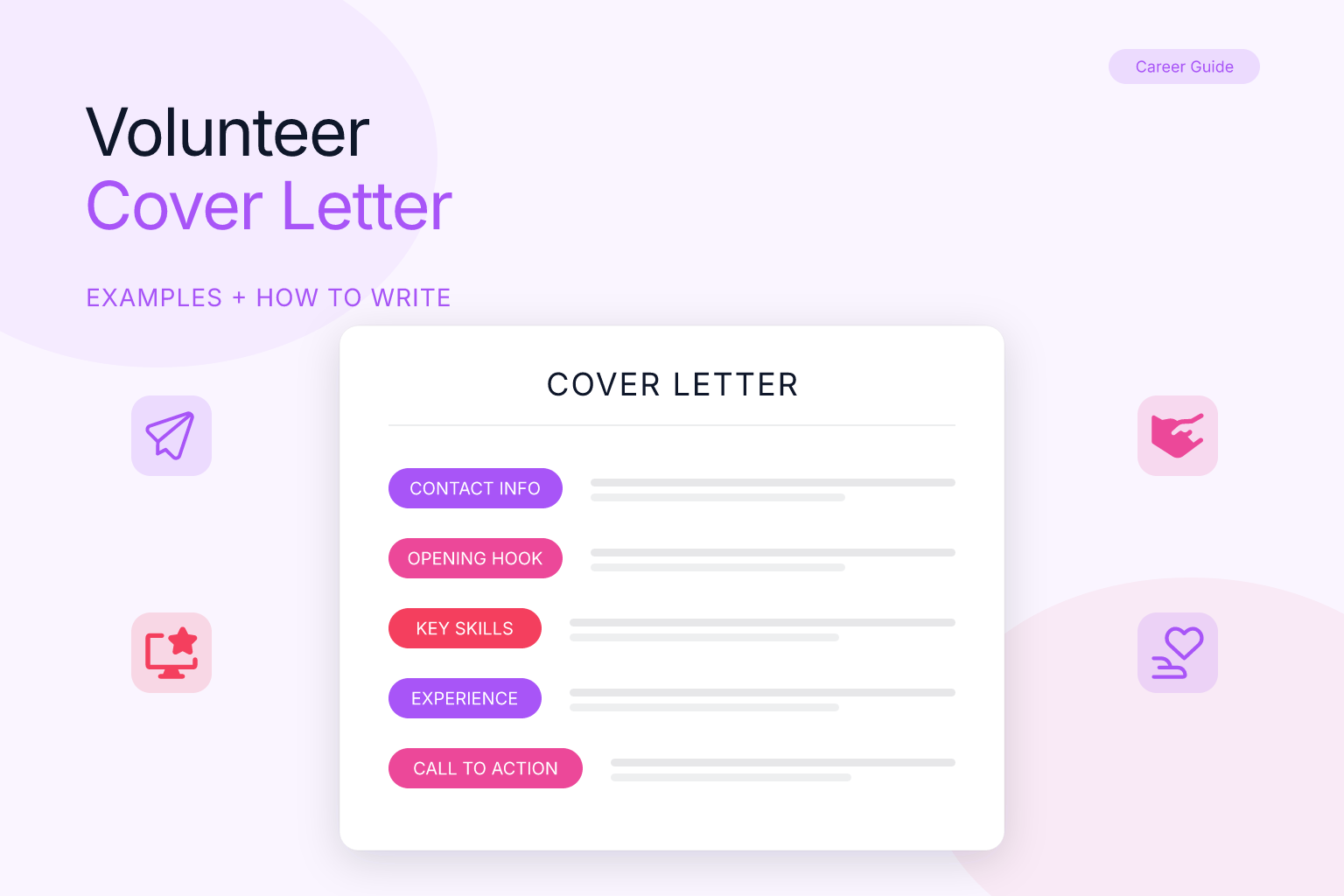
A cover letter for volunteer position applications is your chance to show why you care about the cause — not just what you can do. Unlike paid roles, volunteer coordinators often weigh passion, reliability, and fit over formal experience. This guide walks you through writing a compelling volunteer cover letter, with three full examples you can adapt, plus tips to avoid common mistakes.
Key Takeaways
- A volunteer cover letter should lead with your motivation for the specific organization, not a generic “I want to help.”
- You don’t need paid experience; transferable skills from school, hobbies, or life count just as much.
- Keep it to one page and mirror the language from the volunteer role description.
- Always state your availability and commitment level (e.g., “4 hours per week for 6 months”).
- Proofread carefully — volunteer coordinators often receive dozens of applications and discard sloppy ones.
| What to Do | Why It Matters | Time |
|---|---|---|
| Research the organization’s mission and recent projects | Shows genuine interest, not a mass application | 15 min |
| Match 2–3 of your skills to the role’s needs | Proves you can contribute from day one | 20 min |
| State your availability and time commitment | Helps coordinators plan schedules | 5 min |
| Keep the letter to one page | Respects busy volunteer managers’ time | 10 min |
| Proofread and read aloud | Catches errors that signal carelessness | 10 min |
How to Write a Cover Letter for a Volunteer Position (Step by Step)
Volunteer cover letters follow the same core structure as paid job cover letters, but the emphasis shifts from “hire me because I’m qualified” to “let me help because I believe in this work.” Here’s a four-step process that works for almost any volunteer role.
Step 1: Open with why this organization. Skip the generic “I am writing to apply for the volunteer position.” Instead, name the organization and a specific program, event, or mission element that drew you in. For example: “When I read about your after-school literacy program’s 40% improvement in reading scores last year, I knew I wanted to be part of that work.”
Step 2: Connect your skills to their needs. Even if you’ve never held a paid job, you have skills. Think about school projects, family responsibilities, hobbies, or previous volunteer work. If the role asks for “organized and detail-oriented,” mention how you managed a club budget or coordinated a neighborhood cleanup. Be specific: “As treasurer of my high school’s Key Club, I tracked a $2,000 annual budget and reconciled receipts every month.”
Step 3: Show reliability and commitment. Volunteer coordinators worry about no-shows more than anything else. State exactly when you’re available and for how long. “I can commit to Tuesday and Thursday afternoons from 2–5 p.m. for at least six months, starting immediately.” This one sentence often does more than a paragraph of enthusiasm.
Step 4: Close with a clear next step. End by thanking them and offering to meet or provide references. “I’d welcome the chance to discuss how I can support your team. I’m available for a phone call or in-person meeting at your convenience.”
If you’re unsure whether a cover letter is even expected for a volunteer role, check out our guide on do you need a cover letter — many volunteer applications still request one, and sending one anyway never hurts.
Volunteer Cover Letter Example: Student with No Paid Experience
Here’s a full example for a high school or college student applying to volunteer at a local animal shelter. Notice how it turns lack of paid work into an asset.
Subject: Volunteer Application – Weekend Animal Care Assistant
Dear Ms. Rivera,
I’m writing to apply for the weekend animal care volunteer position at Happy Paws Shelter. I’ve followed your organization on Instagram for two years and was moved by the story of Max, the senior dog you rescued in March. I want to be part of a team that gives animals like Max a second chance.
Although I don’t have paid work experience, I’ve spent the last three summers caring for neighbors’ pets while they traveled. I fed, walked, and administered medication to two dogs and a cat, and I never missed a scheduled visit. I also volunteer at my school’s community garden every Saturday, where I’ve learned to follow safety protocols and work as part of a team.
I can commit to Saturdays and Sundays from 9 a.m. to 1 p.m. for the entire school year, starting September 1. I’m comfortable cleaning kennels, walking dogs of all sizes, and following your shelter’s health and safety guidelines.
Thank you for considering my application. I’d love to visit the shelter and meet your team. I’m available for a phone call or in-person meeting any weekday after 3 p.m.
Sincerely, Jordan Lee (555) 123-4567 jordan.lee@email.com
Why this works: It names a specific animal and program, shows reliability through past pet-sitting, states exact availability, and closes with a clear next step. No paid experience needed.
Volunteer Cover Letter Example: Career Changer
If you’re switching from a corporate job to a volunteer role in a new field, your cover letter should bridge the gap. Here’s a shorter example for someone moving from marketing to volunteer tutoring.
Dear Volunteer Coordinator,
I’m applying for the adult literacy tutor position at Read Forward. After 10 years in digital marketing, I’m looking to use my communication and teaching skills in a way that directly helps my community. Your organization’s 92% learner retention rate convinced me this is the right place.
In my marketing role, I regularly explained complex concepts to clients with no technical background — a skill that translates directly to tutoring adults who are learning to read. I also trained three junior team members, which taught me patience and how to adapt my teaching style to different learners.
I can commit to two evenings per week (Monday and Wednesday, 6–8 p.m.) for at least one year. I’ve completed your online tutor orientation and am eager to start.
Thank you for your time. I’d welcome a conversation about how my background can support your learners.
Best regards, Sam Patel
Why this works: It acknowledges the career change without apologizing, maps corporate skills to volunteer needs, and shows commitment with a specific schedule.
Volunteer Cover Letter Example: Retiree or Experienced Professional
Retirees and experienced professionals often have decades of skills to offer. The key is to show you’re not just looking to fill time — you want to contribute meaningfully.
Dear Hiring Committee,
I’m writing to volunteer as a financial literacy coach with Money Matters. After a 30-year career as a certified public accountant, I retired last year and have been searching for a way to use my skills to help young adults avoid the financial mistakes I saw too often in my practice.
Your program’s focus on budgeting and credit education for first-generation college students aligns perfectly with my experience. I’ve taught financial workshops for my church and mentored two young professionals through a local business association. I’m comfortable with both one-on-one coaching and small group presentations.
I can volunteer Tuesday and Thursday mornings from 9 a.m. to noon, and I’m happy to commit for a full program cycle (typically 12 weeks). I’m also available for occasional evening workshops with advance notice.
I’d be honored to contribute to your mission. Please let me know if you’d like to discuss how I can help.
Sincerely, Margaret Chen, CPA
Why this works: It positions decades of experience as a gift, not a burden, and shows flexibility with availability.
Common Mistakes to Avoid in Volunteer Cover Letters
Volunteer coordinators often read dozens of applications in a single sitting. These mistakes will get yours skipped.
- Generic opening: “I want to give back to the community” tells them nothing. Name the organization and a specific reason you chose them.
- Focusing on what you’ll get out of it: “I need volunteer hours for school” or “I want to build my resume” is honest but off-putting. Frame it as what you can offer, not what you’ll gain.
- Ignoring availability: If you don’t state when you can volunteer, the coordinator has to email you to ask — and they often won’t bother.
- Writing a novel: One page is plenty. Busy volunteer managers skim. If you need help trimming, see our short cover letter examples for busy recruiters.
- Typos and sloppy formatting: A volunteer role may not pay, but it still deserves professionalism. Proofread twice, then read aloud.
How to Format Your Volunteer Cover Letter for ATS and Human Readers
Many volunteer applications now go through online portals that use applicant tracking systems (ATS) to filter candidates. Even if a human reads your letter eventually, the ATS may scan it first. Here’s how to format for both.
- Use a simple, single-column layout. Avoid tables, text boxes, and graphics. Most modern ATS parse clean, text-based PDFs fine, but if the portal asks for a specific format, follow that instruction.
- Stick to standard fonts like Arial, Calibri, or Times New Roman at 10–12 pt.
- Save as a PDF unless the portal explicitly requests a Word document. A clean PDF preserves your formatting and looks professional.
- Mirror keywords from the volunteer role description. If the posting says “reliable, compassionate, and detail-oriented,” use those exact words in your letter.
Once your cover letter is ready, pair it with a clean, ATS-friendly resume. You can build one in minutes with ResumeMate’s free AI resume builder, then run it through the resume score checker to catch any formatting or keyword issues before you apply.
What to Include When You Have No Relevant Experience
No paid experience? No problem. Volunteer roles are often the best place to start, and coordinators expect applicants with limited backgrounds. Here’s what to highlight instead.
- School projects: Group assignments, club leadership, or capstone projects show teamwork and responsibility.
- Hobbies and interests: Running a blog, organizing a fantasy football league, or caring for a family member all demonstrate real skills.
- Soft skills: Reliability, patience, communication, and willingness to learn matter more than technical skills in most volunteer roles.
- Previous informal volunteering: Helping a neighbor, coaching a youth team, or organizing a community event all count.
For a deeper dive on writing a cover letter with no experience, check out our guide on cover letter no experience examples and tips.
How to Follow Up After Sending a Volunteer Cover Letter
You sent your letter. Now what? A polite follow-up can set you apart, but timing matters.
- Wait 5–7 business days. Volunteer coordinators are often part-time or juggling multiple roles. Give them time.
- Send a brief email. Reference your original application and restate your interest. “I’m writing to follow up on my volunteer application for the food bank assistant role. I remain very interested and can start immediately if needed.”
- Don’t call unless the posting invites calls. Email is less intrusive and easier to track.
- If you don’t hear back after two weeks, move on. Some organizations are overwhelmed and never respond. Apply elsewhere and keep your options open.
FAQ
Q: Do I need a cover letter for a volunteer position?
A: Not always, but it’s strongly recommended. Many volunteer applications ask for one, and even when they don’t, a short cover letter shows you’re serious and helps you stand out from applicants who only submit a form. It takes 15 minutes and can make a real difference.
Q: How long should a volunteer cover letter be?
A: One page, or about 250–350 words. Volunteer coordinators are busy and often read applications on their phones. Three to four short paragraphs is ideal. If you’re struggling to keep it brief, see our short cover letter examples.
Q: What should I include if I have no experience?
A: Focus on transferable skills from school, hobbies, family responsibilities, or informal helping. Mention specific examples: “I organized a neighborhood food drive that collected 200 items” beats “I’m a hard worker.” Also state your availability and eagerness to learn. Our no experience cover letter guide has more examples.
Q: Can I use the same cover letter for multiple volunteer roles?
A: You can use a template, but you must customize the opening and skills section for each organization. A generic letter that says “I want to volunteer for your organization” without naming the group or its mission will be ignored. Spend 10 minutes tailoring each one.
Q: How do I address a volunteer cover letter if I don’t know the hiring manager’s name?
A: Use “Dear Volunteer Coordinator” or “Dear Hiring Committee.” Avoid “To Whom It May Concern” — it feels cold and outdated. If you can find a name on the organization’s website or LinkedIn, use it: “Dear Ms. Rivera” is always better.
Q: Should I mention that I’m volunteering to gain experience for a paid job later?
A: It’s fine to mention your long-term goal, but don’t lead with it. Frame it as a win-win: “I’m exploring a career in social work and want to learn from your team while contributing my organizational skills.” Focus on what you can give, not just what you’ll get.
Track Every Application While You Job Hunt
Stop losing track of where you’ve applied. The ResumeMate Job Tracker is a free Chrome extension that tracks every application, deadline, and follow-up in one place — right from your browser.