What Are Your Weaknesses? How to Answer in an Interview
When an interviewer asks, “What are your weaknesses?” it can feel like a trap. You’re there to sell yourself, not to list your flaws. But this question isn’t about catching you off guard — it’s one of the most reliable ways to gauge your self-awareness, honesty, and ability to grow. A well-prepared answer can set you apart from candidates who either freeze or give a canned, insincere response.
Navigating this question requires strategy. You need to balance honesty with professionalism, ensuring you don’t accidentally disqualify yourself. Below, we break down exactly how to formulate an answer that turns a potential negative into a demonstration of your growth mindset.
Key Takeaways
- The weakness question tests your self-awareness and coachability, not your actual flaws.
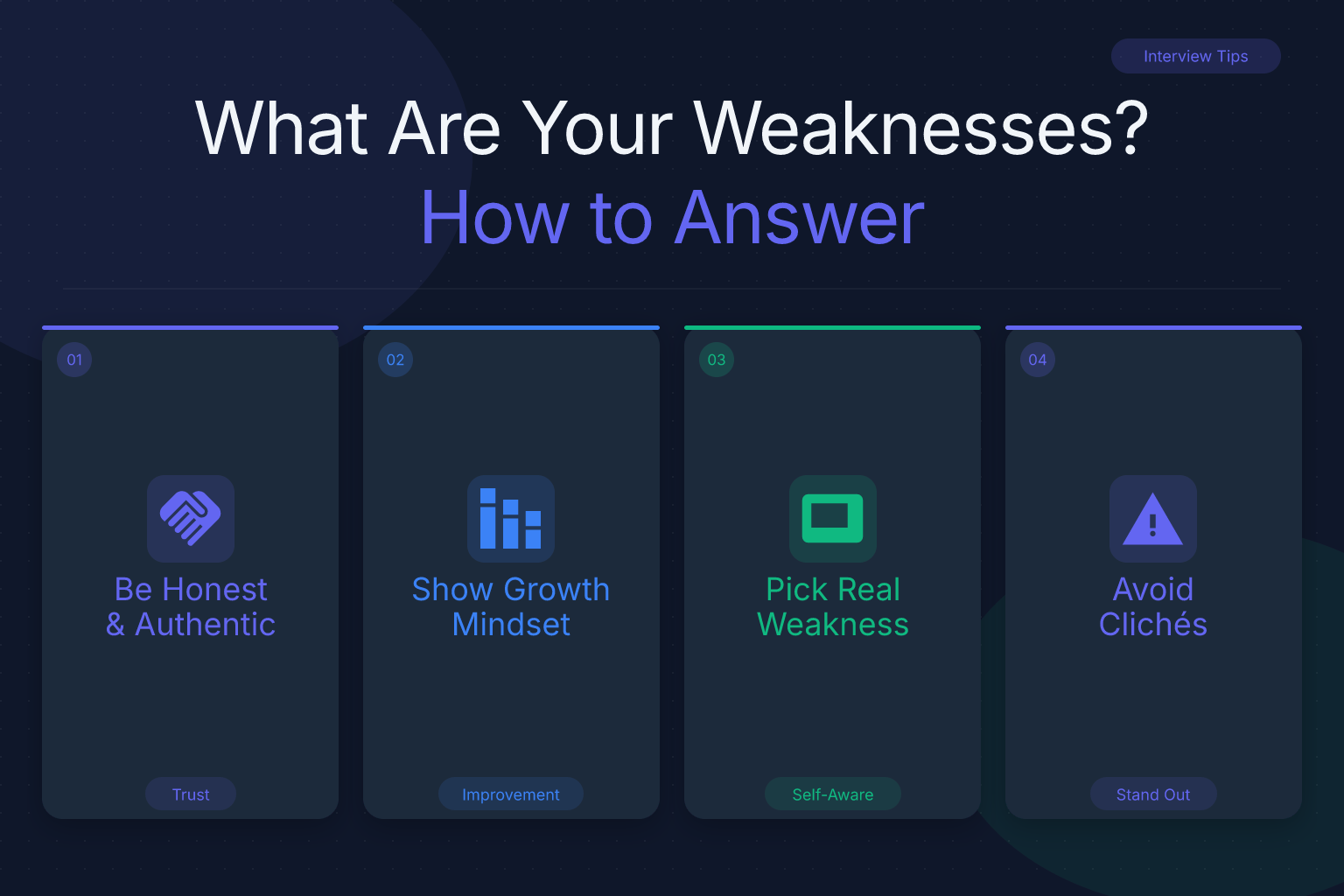
- Choose a genuine but non-critical weakness, then explain the specific steps you’ve taken to improve.
- Avoid clichés like “I’m a perfectionist” or “I work too hard” — they signal a lack of preparation.
- Structure your answer in three parts: name the weakness, describe your improvement strategy, and share a positive result.
- Practice your answer until it sounds natural, but never memorize it word-for-word.
| What to Do | Why It Matters | Time to Prepare |
|---|---|---|
| Choose a real, non-fatal weakness | Shows self-awareness without raising red flags | 10 minutes to brainstorm |
| Frame it with a specific example and improvement plan | Proves you’re proactive and coachable | 15 minutes to craft |
| Practice out loud | Builds confidence and smooth delivery | 10 minutes to rehearse |
| Avoid cliché answers like “I’m a perfectionist” | Interviewers hear this constantly and it sounds dishonest | N/A |
Why Interviewers Ask “What Are Your Weaknesses?”
This question isn’t a trick — it’s a test of three things:
- Self-awareness. Can you honestly assess your own skills and identify areas where you’re not yet strong? People who can’t name a single weakness often lack the introspection needed to grow in a role. For example, a candidate who says “I can’t think of any” misses the chance to show they reflect on their performance. In contrast, someone who admits “I’ve noticed I sometimes rush through proofreading” demonstrates they pay attention to their work habits.
- Honesty. Everyone has weaknesses. Claiming you have none makes you look either arrogant or oblivious. Interviewers have heard every evasive answer, and they’ll see through a fake strength immediately. Authenticity builds trust, which is crucial in any hiring decision.
- Growth mindset. The real answer isn’t the weakness itself — it’s what you’ve done about it. Interviewers want to see that you take initiative to improve. This is a core component of behavioral interviewing, where past behavior predicts future performance. Demonstrating how you manage your development aligns well with other forward-looking questions, such as when you discuss your career goals in an interview.
When you understand the intent behind the question, you can stop dreading it and start using it to demonstrate exactly the qualities employers want. A well-crafted answer shows you’re not only capable but also committed to continuous improvement — a trait that’s highly valued in any workplace.
Variations of the Weakness Question You Might Encounter
Interviewers rarely ask the question the same way twice. Here are the most common variations and what each one is really probing:
- “What is your biggest weakness?” — This is the classic version. The word “biggest” signals they want you to prioritize and show judgment. Don’t pick something trivial; pick something meaningful that you’ve genuinely worked on.
- “What are your areas of weakness?” — The plural “areas” invites you to discuss a broader pattern rather than a single skill gap. You can acknowledge a theme (like “I sometimes struggle with time estimation”) and then narrow to a specific example.
- “Describe your weaknesses.” — This open-ended phrasing gives you room to frame the answer on your own terms. Use it to your advantage by immediately pivoting to your improvement story.
- “What would your previous manager say is your biggest weakness?” — This tests whether your self-assessment matches how others perceive you. It requires a higher level of honesty and self-awareness. If you’re not sure what your manager would say, think back to performance reviews or feedback conversations.
- “Tell me about a time you failed or made a mistake.” — This is the weakness question in disguise. The interviewer wants to see how you handle setbacks, take accountability, and learn from errors. Your answer should follow the same Name-Action-Result structure.
Recognizing these variations helps you stay calm when the phrasing differs from what you practiced. The core strategy remains the same: be honest, show growth, and keep it relevant to the role.
The Wrong Way to Answer (Common Mistakes)
Before you craft your own response, know what to avoid. These missteps can sink an otherwise strong interview:
- The fake strength. “I work too hard” or “I care too much” are transparent attempts to dodge the question. Interviewers hear them constantly and they erode trust. For instance, saying “I’m a perfectionist” without a real story of how it caused a problem and how you’ve managed it sounds rehearsed and insincere. If you must use perfectionism, you need a concrete example like missing a deadline because you kept tweaking a report, and then implementing a “good enough” checklist.
- The fatal flaw. “I struggle with meeting deadlines” or “I have a hard time getting along with coworkers” are weaknesses that directly impact your ability to do the job. Never volunteer a weakness that’s core to the role. If you’re applying for a project manager position, saying you’re disorganized is a dealbreaker. Instead, choose something peripheral.
- The non-answer. “I can’t think of any” or “I used to have a weakness but I fixed it completely” signals a lack of preparation or self-reflection. Even if you’ve overcome something, frame it as a journey and mention what you’re currently working on. For example, “I used to struggle with public speaking, and while I’ve improved, I’m now focusing on making my presentations more interactive.”
- The ramble. A long, unfocused story that never gets to the point makes you look disorganized. Keep your answer tight. A good rule of thumb: your entire response should be under two minutes. Practice condensing your story to the essential elements.
- The overshare. Revealing a deeply personal struggle — like mental health challenges, family issues, or financial problems — can make the interviewer uncomfortable and derail the conversation. While honesty is important, keep your answer professional and focused on workplace skills. You can be genuine without being vulnerable about matters unrelated to the job.
Avoiding these pitfalls is half the battle. The other half is crafting a response that’s both honest and strategic.
How to Choose a Real Weakness That Won’t Sink You
The key is to pick a genuine weakness that is:
- Real — something you’ve actually struggled with, not a made-up flaw.
- Non-essential — not a core requirement of the job. If you’re applying for an accountant role, don’t say you’re bad with numbers.
- Fixable — you’ve already taken steps to improve, and you can show progress.
Weakness Categories That Work Well
| Category | Example Weakness | Why It’s Safe |
|---|---|---|
| Communication | Public speaking, presenting to large groups | Most roles don’t require daily presentations; it’s a skill you can build |
| Delegation | Difficulty letting go of tasks, trusting others | Shows you care about quality, but you’re learning to empower your team |
| Technical skill | Advanced Excel, a specific software | You can take a course and improve quickly |
| Patience | Getting frustrated when projects move slowly | You can frame it as eagerness for results, balanced with learning to appreciate process |
| Organization | Keeping a tidy workspace or managing email overload | You can implement systems to improve |
| Time estimation | Underestimating how long tasks will take | You can adopt planning tools and buffer time |
| Saying no | Taking on too many commitments | Shows dedication, but you’re learning to prioritize |
| Asking for help | Hesitating to seek input from colleagues | You can build a habit of regular check-ins |
Avoid weaknesses that hint at character issues (dishonesty, unreliability) or interpersonal problems (conflict with colleagues). Also, consider the company culture. A startup might value adaptability, so a weakness around needing structure could be reframed positively if you show you’ve learned to create your own systems.
Role-Specific Weakness Examples
Different roles call for different safe weaknesses. Here are examples tailored to common positions:
- Administrative assistant: “I sometimes get so focused on completing tasks efficiently that I forget to step back and ask if there’s a better way to organize the workflow. I’ve started blocking 15 minutes each Friday to review my processes and suggest improvements to my manager.” This shows you’re detail-oriented but also thinking about systems.
- Software engineer: “I used to jump into coding before fully mapping out the architecture. I’ve learned to spend more time on design documents and getting feedback from senior engineers before writing code, which has reduced rework significantly.”
- Sales representative: “I can be overly optimistic about closing timelines, which sometimes led to inaccurate forecasts. I’ve started using a more rigorous pipeline review process and checking in with prospects earlier to get a realistic read on their timeline.”
- Marketing manager: “I tend to want to try every new channel and tactic, which can spread resources thin. I’ve learned to prioritize based on data and run smaller experiments before scaling, which has improved our ROI.”
- Customer service representative: “I sometimes take customer frustration personally, which can affect my energy on the next call. I’ve developed a reset routine between calls — a quick breathing exercise and a mental note to treat each customer as a fresh start.”
Tailoring your weakness to your specific role shows the interviewer you’ve thought carefully about how you’ll perform in their environment, not just any job.
A Note on “Resume Weaknesses”
A common search query is “resume weakness,” but it’s important to clarify: you should not list weaknesses on your resume. Your resume is a marketing document designed to highlight your strengths, skills, and achievements. Including weaknesses there can immediately filter you out before you even get to the interview stage. Instead, use your resume to showcase your competencies, and save the discussion of areas for improvement for the interview itself. Before heading into an interview, ensure your resume is optimized by using a tool like the Resume Score Checker to verify your document is ATS-friendly and highlights your strengths effectively.
The 3-Step Formula for a Strong Answer
Use this structure to turn your weakness into a story of growth:
- Name the weakness clearly and briefly. Don’t dance around it. “I’ve struggled with public speaking in the past.” This shows you’re direct and self-aware.
- Describe the specific actions you’ve taken to improve. This is the most important part. Show, don’t just tell. “I joined a local Toastmasters club six months ago and have given five speeches. I also volunteered to present our team’s monthly updates to get more practice.” Concrete actions prove you’re proactive.
- Share a positive result or what you’ve learned. End on an upward trajectory. “Last month, I led a client presentation that went smoothly, and I received positive feedback from my manager. I’m still working on it, but I’m much more confident now.”
This formula works because it answers the question honestly while proving you’re proactive and coachable — exactly what hiring managers want. Let’s see it in action with a full example:
Weakness: Difficulty with delegating tasks.
- Name it: “I’ve always had a tendency to take on too much myself because I want things done a certain way.”
- Action: “I realized this was causing burnout and slowing down team projects. I started using a project management tool to assign tasks clearly and set check-in points instead of micromanaging. I also read a book on delegation and asked my manager for feedback.”
- Result: “Now I trust my team more, and we’ve actually improved our turnaround time by two days on average. I’m still working on letting go of smaller details, but I’ve seen that empowering others leads to better outcomes.”
You can adapt this formula to any weakness. The key is to be specific and genuine.
How to Tailor Your Weakness to the Job Description
One advanced strategy is to align your weakness with the role’s context. This shows you’ve done your homework and understand the challenges of the position. For example:
- If the job requires cross-functional collaboration, you might say: “I’ve sometimes been too focused on my own deliverables and not proactive enough in reaching out to other teams. I’ve started scheduling regular syncs with key stakeholders to improve alignment.”
- If the role is in a fast-paced startup, you could mention: “I used to prefer having clear processes, but I’ve learned to thrive in ambiguity by creating lightweight frameworks for myself. I now see uncertainty as a chance to innovate.”
- If the position involves client-facing presentations, you might choose a weakness like: “I tend to get nervous before big presentations, but I’ve developed a preparation routine that includes dry runs and feedback sessions, which has helped me deliver more confidently.”
- If the job emphasizes data analysis, you could say: “I sometimes get lost in the details of a dataset and lose sight of the bigger picture. I’ve started setting a timer for exploration and then forcing myself to summarize the top three insights before diving deeper.”
Tailoring your answer demonstrates that you’re not just reciting a generic response — you’re thinking about how you’ll grow in this specific role. This kind of future-oriented thinking is similar to how you might approach answering where do you see yourself in 5 years, connecting your current growth areas to your long-term trajectory within the company.
Sample Answers for Different Weaknesses
Here are full, ready-to-adapt responses for common weaknesses. Use them as inspiration, but always personalize with your own experience.
Public Speaking
“I’ve always been uncomfortable speaking in front of large groups. In my last role, I realized it was holding me back from sharing my ideas. I started by taking an online course in presentation skills, then volunteered to lead small team meetings. Over time, I built up to presenting at our quarterly all-hands. I still get nervous, but I’ve learned to prepare thoroughly and focus on the message rather than my anxiety.”
Delegation
“I tend to take on too much myself because I want things done a certain way. I noticed it was causing burnout and slowing down team projects. I began using a project management tool to assign tasks clearly and set check-in points instead of micromanaging. Now I trust my team more, and we’ve actually improved our turnaround time by two days on average.”
Impatience with Slow Processes
“I like to see results quickly, so I used to get frustrated when projects got bogged down in approvals. I’ve learned to channel that energy into mapping out bottlenecks early and suggesting process improvements. In my last role, I created a shared tracker that cut our review cycle by a week. I’m still working on being patient, but I’ve turned that impatience into a driver for efficiency.”
Technical Skill Gap
“When I started my last role, I wasn’t proficient in Salesforce. I knew it was essential for tracking client interactions, so I completed the Trailhead admin beginner course in my first month and asked a colleague to mentor me. Within three months, I was building custom reports for the team. Now I actively seek out information about my shortcomings and new tools to learn before I need them.”
Overthinking Decisions
“I sometimes overanalyze decisions, especially when there’s no clear right answer. I’ve learned to set time limits for research and to trust my instincts more. I also started using a decision matrix to weigh options objectively. This has helped me make faster calls without sacrificing quality, and my manager has noticed I’m more decisive in team meetings.”
Difficulty Saying No
“I have a tendency to say yes to every request, which sometimes means I spread myself too thin and can’t give my best to the most important projects. I’ve started using a priority matrix to evaluate new requests against my current commitments, and I’ve gotten more comfortable having honest conversations with my manager about capacity. This has actually improved the quality of my work because I’m focused on fewer, higher-impact tasks.”
Asking for Help
“I used to hesitate to ask for help because I didn’t want to burden my colleagues. I realized this was slowing down my learning and sometimes leading to mistakes I could have avoided. I’ve started scheduling regular check-ins with my manager and setting a personal rule to ask for input within 30 minutes of getting stuck on a problem. It’s made me more efficient and helped me build stronger relationships with my team.”
How to Practice Your Weakness Answer
A great answer falls flat if you stumble through it. Practice until it feels like a natural conversation, not a rehearsed script.
- Write bullet points, not a script. Jot down the three parts of your answer, but don’t memorize sentences. You want to sound authentic.
- Record yourself. Use your phone to record a practice answer. Listen for filler words, pacing, and tone. Adjust until you sound calm and confident.
- Practice with a friend or mentor. Ask them to throw in a follow-up question like “Can you give me another example?” so you’re ready for a deeper dive.
- Use AI to simulate the interview. Tools like ChatGPT can act as a mock interviewer, asking common questions and giving you feedback on your responses. For a full guide, see our post on ChatGPT interview prompts to prepare like a pro.
- Practice in the same format as the real interview. If your interview is on video, do a mock video call with a friend. Check your lighting, background, and eye contact. For tips on presenting yourself professionally on camera, see our guide to the best professional virtual backgrounds for job interviews.
What If You’re Asked About a Weakness You Don’t Have?
Sometimes the interviewer will ask about a specific weakness: “What’s your biggest weakness when it comes to teamwork?” If you genuinely don’t struggle in that area, don’t invent a problem. Instead, acknowledge that it’s a strength, then pivot to a related area where you’re still growing.
Example: “I actually find teamwork comes naturally to me — I enjoy collaborating and I’m good at reading the room. One area I’m working on within team settings is speaking up sooner when I see a potential issue. I tend to gather data first, but I’ve learned that flagging concerns early can save the team time.”
This approach shows honesty without undermining your strengths.
Turning the Question Into a Strength (Advanced Tips)
Once you’ve mastered the basics, use these strategies to make your answer even more compelling:
- Tie your weakness to the role’s context. If you’re interviewing for a startup, a weakness around “needing clear structure” can be reframed as “I’ve learned to thrive in ambiguity by creating my own lightweight systems.” This shows you understand the environment and have adapted.
- Mention a weakness that’s actually a double-edged sword. For example, “I can be overly critical of my own work, which sometimes slows me down. I’ve started setting time limits for revisions and asking a colleague for a quick sanity check instead of reworking things endlessly.” This reveals high standards while showing you’ve found a balance.
- Use the “weakness” to highlight a strength you’re building. If you’re moving into a leadership role, you might say, “I haven’t had much experience with direct reports, so I’m actively reading books on management and seeking mentorship. I’m excited to develop that skill.” This frames inexperience as a growth opportunity.
- Quantify your improvement when possible. Numbers make your story more credible. Instead of “I’ve gotten better at time management,” say “I’ve reduced my average project overrun from two weeks to three days by implementing buffer time and weekly progress reviews.”
Remember, the goal isn’t to trick the interviewer — it’s to demonstrate that you’re the kind of person who reflects, learns, and improves. That’s a quality every employer values.
FAQ
Q: How to answer what is your weakness?
A: The best way to answer is to name a real, non-critical weakness, explain the steps you’re taking to improve it, and share a positive result. Avoid clichés like “I work too hard” and focus on showing self-awareness and growth.
Q: How do you answer what are your weaknesses in an interview?
A: Use the three-step formula: (1) name the weakness clearly and briefly, (2) describe the specific actions you’ve taken to improve, and (3) share a positive result or what you’ve learned. Keep your answer under two minutes and make sure the weakness is not a core requirement of the job.
Q: What are the best answers for what are your weaknesses?
A: The best answers are specific and actionable. Examples include struggling with public speaking, delegating tasks, or learning a specific software. The key is to show you are actively managing the weakness, not just acknowledging it.
Q: What are example weaknesses for a job interview?
A: Safe examples include public speaking, delegation, time estimation, asking for help, saying no to extra commitments, impatience with slow processes, and technical skill gaps. Avoid weaknesses that are core to the role or that hint at character issues like dishonesty or unreliability.
Q: What are areas of weakness examples?
A: Common areas of weakness include communication (public speaking, writing), organization (time management, email overload), technical skills (specific software, data analysis), delegation (letting go of tasks), and patience (frustration with slow processes). Choose one that is real, non-essential to the role, and fixable.
Q: How to answer weakness interview questions?
A: Prepare at least two solid answers using the Name-Action-Result formula. Practice out loud until it sounds natural. When asked, stay calm, name the weakness directly, focus most of your answer on the actions you’ve taken, and end with a positive result. Never say you have no weaknesses.
Q: What is your biggest weakness?
A: Your biggest weakness should be something genuine but not critical to the job. For example: “I sometimes struggle with delegating tasks because I want things done a certain way. I’ve started using a project management tool to assign work clearly and set check-in points, which has improved my team’s turnaround time.”
Q: Should I list a personal weakness in my resume?
A: No, you should not list weaknesses on your resume. Your resume should focus on your skills and achievements. Weaknesses are appropriate for the interview stage when asked directly, where you can provide context on how you are improving.
Q: How to describe your weaknesses in an interview?
A: Describe your weaknesses using the “Name, Action, Result” formula. State the weakness clearly, describe the specific actions you’ve taken to improve, and share the positive outcome of those actions.
Q: Is “I actively seek out information about my shortcomings” a good answer?
A: This phrase is strong because it shows proactive growth, but it should be part of a larger answer. Use it to describe your action step (e.g., “I actively seek out information about my shortcomings by requesting feedback after every project”).
Q: How many weaknesses should I prepare?
A: Prepare at least two solid answers. Sometimes interviewers ask for a second weakness or a follow-up like “Tell me about another area you’re working on.” Having a backup prevents you from scrambling.
Q: How do I answer what are my weaknesses if I’m a recent graduate?
A: As a recent graduate, you can draw on academic or internship experiences. For example: “I sometimes struggle with time estimation on long-term projects. In my senior capstone, I underestimated how long the research phase would take. I’ve since started breaking projects into smaller milestones with deadlines and using a planner to track my progress.” This shows self-awareness even without extensive work history.
Related articles:
- What Is Your Communication Style? How to Answer
- How to Answer “What Is Your Notice Period?” (With Examples)
- Career Goals Interview: How to Answer (With Examples)
- Answer ‘Where Do You See Yourself in 5 Years?’ Examples
- Availability Start Date: 2026 Sample Answers & Tips
- How to Explain Being Fired for Performance in an Interview
- How to Answer ‘What Motivates You?’ in an Interview
Track Every Application While You Job Hunt
Stop losing track of where you’ve applied. The ResumeMate Job Tracker is a free Chrome extension that tracks every application, deadline, and follow-up in one place — right from your browser.