What Do You Know About Our Company? How to Answer
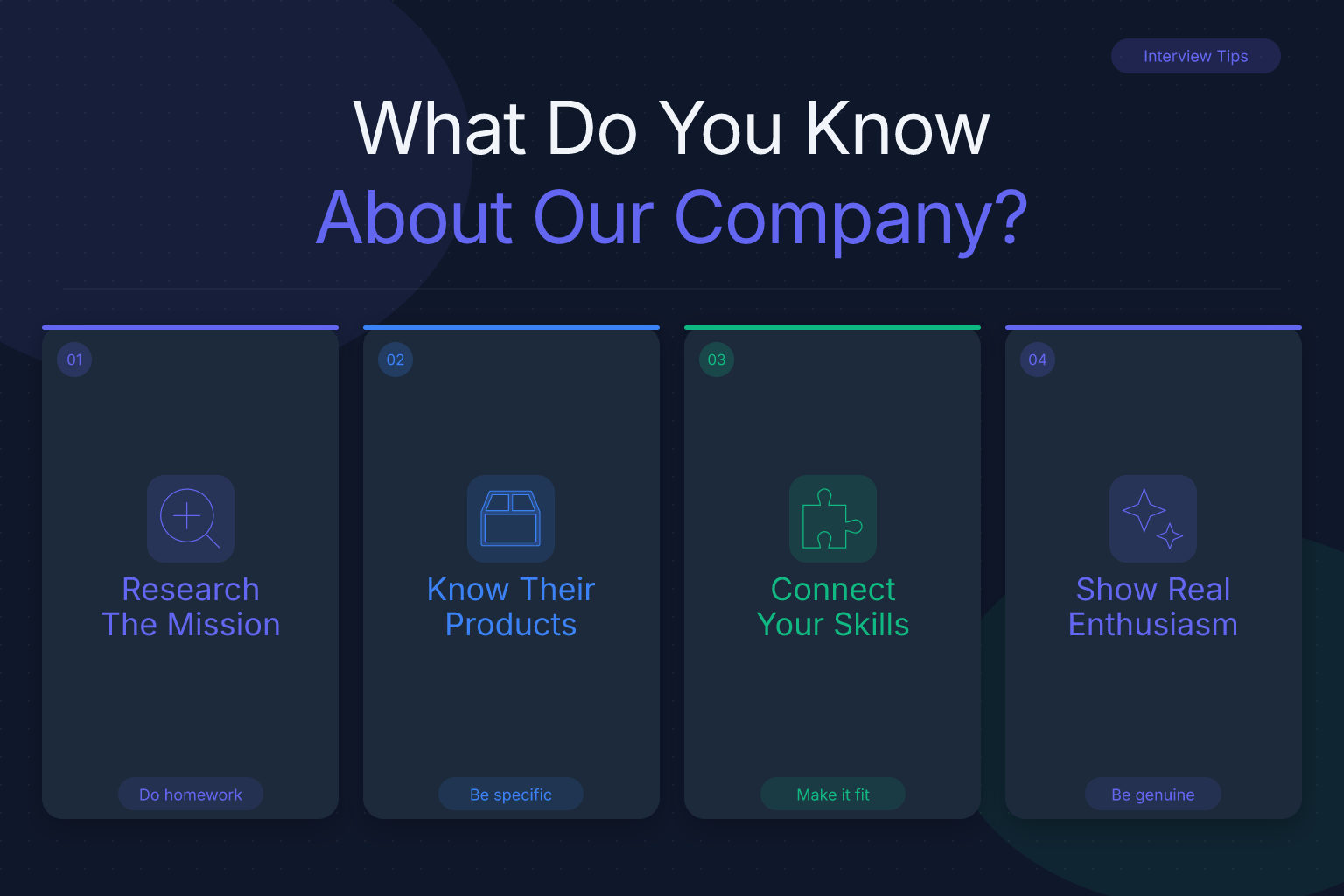
“What do you know about our company?” is one of the most predictable interview questions — yet many candidates still stumble through it. Interviewers ask this early in the conversation to gauge your genuine interest, your research skills, and whether you understand how the role fits into the bigger picture. A weak answer (“You’re a great company, I’d love to work here”) signals that you didn’t prepare. A strong answer shows you’ve done your homework and can connect your skills to the company’s actual goals.
This guide breaks down exactly how to answer this question with confidence. You’ll learn what interviewers are really looking for, a simple three-part formula, step-by-step research tips, example answers for different company types, and the mistakes that sink most candidates.
Key Takeaways
- Interviewers ask “what do you know about our company” to test your genuine interest, research effort, and whether you understand how the role supports the company’s current direction.
- A strong answer connects three things: one specific fact about the company, why that fact matters to you personally, and how your skills align with the company’s goals.
- Spend 30–60 minutes before the interview researching the company’s website, recent news, and LinkedIn page — you only need two or three meaningful points, not an encyclopedic summary.
- Avoid generic praise like “you’re a great company” or reciting the entire About Us page; focus on one or two details that show you did real homework.
- Practice your answer out loud so it sounds natural, stays under 60 seconds, and ends with a clear link to the role you’re applying for.
| What to Do | Why It Matters | Time |
|---|---|---|
| Research the company’s mission, products, and recent news | Shows genuine interest and preparation | 30–60 min before interview |
| Pick 2–3 specific facts that connect to the role | Makes your answer memorable and relevant | 10 min |
| Structure your answer: fact → why it matters → your fit | Keeps you focused and confident | 5 min to outline |
| Avoid generic statements or reciting the website | Prevents sounding rehearsed or uninterested | — |
| Practice out loud with a timer | Ensures a natural, concise delivery | 10 min |
Why Interviewers Ask “What Do You Know About Our Company?”
This question isn’t a trivia test. Interviewers already know you can read their website. What they’re really checking is whether you care enough to go beyond the surface — and whether you can think critically about how the company operates.
Here’s what your answer tells them:
- You’re genuinely interested. Candidates who apply to 50 jobs with the same resume rarely research each company. A specific, thoughtful answer signals this role matters to you.
- You understand the business context. If you can mention a recent product launch, a funding round, or a shift in strategy, you show you’re not just looking for any job — you’re looking for this job.
- You can connect your skills to their needs. The best answers don’t just list facts; they explain why those facts matter for the role you’re applying for.
For example, if you’re interviewing for a customer success role at a SaaS company that just announced a new enterprise tier, saying “I saw you launched an enterprise plan last quarter — I’ve spent three years supporting mid-market clients and would love to help onboard larger accounts” is far stronger than “I know you make software.”
What a Strong Answer Looks Like: The 3-Part Formula
You don’t need to memorize a script. You need a simple structure that keeps you focused and prevents rambling. Use this three-part formula:
- State one specific fact about the company. Pick something you learned from your research — a recent product launch, a company value, a market position, a customer segment, or a news item. Avoid generic facts like “you were founded in 2010” unless that year is directly relevant.
- Explain why that fact matters to you. Connect the fact to your own interests, values, or career goals. This is what makes your answer personal and memorable.
- Link it to the role you’re applying for. Show how your skills or experience align with that company fact. This turns a research summary into a pitch for why you’re a good fit.
Here’s the formula in action for a marketing role at a direct-to-consumer brand:
“I noticed you’ve been expanding heavily into TikTok and short-form video over the past year — your recent campaign with micro-influencers really stood out to me. I’ve spent the last two years running social media for a DTC skincare brand, and I’d be excited to bring that experience to your team as you scale that channel.”
That answer is specific, personal, and directly relevant to the job. It takes about 20 seconds to say.
Step-by-Step: How to Research the Company Before the Interview
You don’t need hours of prep. Thirty to sixty focused minutes is enough to gather two or three strong talking points. Here’s a simple research sequence:
- Start with the company’s own website. Read the About Us page, the mission or values page, and the product or services section. Look for language the company uses to describe itself — that’s the language you can mirror in your answer.
- Check their recent news or blog. Look for product launches, funding announcements, partnerships, awards, or leadership changes from the last 6–12 months. A recent development is always more impressive than a fact from five years ago.
- Look at their LinkedIn page and employee posts. See what the company is celebrating, what roles they’re hiring for, and what employees say about the culture. This gives you insight beyond the polished website.
- Search for industry context. If the company is in a competitive space, understand who their main competitors are and what differentiates them. You don’t need to mention competitors in your answer, but knowing the landscape helps you speak intelligently.
- Review the job description one more time. Note the key responsibilities and required skills. Your answer should connect your research to those specific requirements.
For a deeper dive into this process, check out our guide on how to research a company before an interview. It walks through each step with templates and checklists.
How to Structure Your Answer (With a Template)
Here’s a fill-in-the-blank template you can adapt for any company:
“I’ve been following [Company Name] for a while, and what stood out to me is [specific fact — product, mission, recent news, customer base]. That resonates with me because [personal reason — your values, experience, or career goals]. Given my background in [your relevant skill or experience], I’m excited about the opportunity to [specific contribution related to the role].”
Let’s break that down with a real example for a project manager role at a healthcare startup:
“I’ve been following your company since you raised your Series B last spring. What stood out to me is your focus on making telehealth accessible to rural communities — that’s a problem I care about deeply because I grew up in a small town with limited healthcare options. In my last role, I led a cross-functional team that launched a patient portal used by 40,000 people, and I’d love to bring that experience to your expansion into new states.”
Notice how the answer moves from fact → personal connection → role fit. It’s specific, honest, and under 45 seconds.
If you’re also preparing for the classic “why should we hire you” question, the same research will serve you well. Our guide on how to answer “why should we hire you” with examples shows how to turn company knowledge into a compelling pitch.
Example Answers for Different Scenarios
Different company types call for slightly different angles. Here are four examples you can adapt.
Startup or early-stage company
Focus on the mission, the problem they’re solving, and your willingness to wear multiple hats.
“I know you’re a seed-stage startup building AI tools for small accounting firms. What excites me is that you’re targeting a market that’s been underserved by big software companies. I’ve spent three years at a larger SaaS company, but I’m looking for a role where I can have more direct impact — and your focus on customer feedback loops really aligns with how I like to work.”
Large corporation
Focus on a specific business unit, recent initiative, or company value that connects to the role.
“I’ve followed your sustainability commitments over the past few years — particularly the goal to reach net-zero operations by 2030. That’s a big reason I applied for this supply chain role. In my current position, I reduced packaging waste by 18% across two distribution centers, and I’d love to contribute to that larger goal here.”
Nonprofit or mission-driven organization
Focus on the cause, the community served, and your personal connection to the mission.
“I’ve known about your work in youth literacy for a while — your summer reading program reached over 5,000 students last year. That matters to me because I volunteered as a reading tutor throughout college. With my background in program coordination, I’d be excited to help scale that program to more school districts.”
Company you’re less familiar with
If you didn’t have much time to research, be honest but still show effort. Pick one thing you did learn and connect it to the role.
“I’ll be honest — I wasn’t familiar with your company before I saw the job posting, but I spent time on your website this week. What stood out to me is your focus on customer education through free webinars and resources. That aligns with my experience creating onboarding content for B2B clients, and I think that’s a big reason this role appeals to me.”
Common Mistakes to Avoid
Even well-prepared candidates make these errors. Watch out for them:
- Reciting the entire About Us page. Interviewers don’t want a company history lesson. Pick one or two specific points and go deep, not broad.
- Generic praise. “You’re a great company” or “I love your products” without specifics sounds lazy. Always attach a concrete detail.
- Focusing only on perks or salary. Mentioning the free lunches or remote policy as your main reason for interest signals you care more about benefits than the work.
- Bringing up negative news without context. If the company had a rough quarter or a product failure, don’t lead with that unless you can frame it constructively (e.g., “I saw you pivoted your strategy after the Q2 results — I’m curious how that’s shaping the roadmap for this role”).
- Making up facts. If you’re not sure about a detail, don’t guess. It’s better to say “I read that you’re expanding into Europe, but I’d love to hear more about that” than to state something false.
- Talking for more than 60 seconds. A long answer loses impact. Aim for 30–45 seconds, then stop and let the interviewer follow up.
What If You Don’t Know Much About the Company?
It happens — maybe you applied to dozens of jobs, or the interview was scheduled quickly. You can still recover without sounding unprepared.
First, don’t panic. Second, be honest but frame it positively. Say something like:
“I’ll be transparent — I didn’t have as much time to research as I’d like, but from what I’ve seen on your website and LinkedIn, I understand you’re a [industry] company focused on [one thing you did notice]. I’m particularly interested in the [role] because [reason tied to your skills]. I’d love to hear more about what you’re working on right now.”
This shows self-awareness and a willingness to learn. It’s far better than bluffing with made-up facts.
If you’re early in your job search and still tailoring your resume to specific companies, make sure your resume itself reflects the research you’ve done. A free resume score check can help you spot gaps before you even get to the interview stage.
How to Practice and Deliver Your Answer Confidently
Knowing what to say is only half the battle. Delivery matters just as much.
- Write out your answer in bullet points, not full sentences. This keeps you from sounding scripted. You want key phrases, not a memorized paragraph.
- Practice out loud three to five times. Say it while looking in a mirror or recording yourself on your phone. Listen for filler words (“um,” “like”) and awkward pauses.
- Time yourself. Aim for 30–45 seconds. If you’re over 60 seconds, cut the least relevant detail.
- Prepare one follow-up point. Interviewers often ask a follow-up like “What else stood out to you?” Have a second fact ready so you don’t freeze.
- End with a question or a bridge. After your answer, you can naturally transition: “I’d love to hear more about how the team is approaching [topic you mentioned].” This turns a one-way answer into a conversation.
This question often comes right after “tell me about yourself,” so make sure your opening answer sets the right tone. Our guide on how to answer “tell me about yourself” in an interview covers that first impression in detail.
FAQ
Q: What if I genuinely don’t know anything about the company?
A: Be honest but show effort. Say you didn’t have as much time to research as you’d like, then share one thing you did notice from a quick look at their website or LinkedIn. Pivot to why the role interests you based on the job description. This is far better than making up facts.
Q: How long should my answer be?
A: Aim for 30–45 seconds, and never go over 60 seconds. A concise answer with one specific fact, a personal connection, and a link to the role is more memorable than a long list of company details.
Q: Should I mention the company’s competitors?
A: Only if it’s relevant and you can do it positively. For example, “I know you compete with X and Y, but your focus on customer support sets you apart” shows you understand the market. Avoid criticizing competitors or sounding like you’re comparing the company unfavorably.
Q: Can I use the same answer for every company I interview with?
A: No. A generic answer that could apply to any company will be obvious. Even if you use the same three-part structure, the specific fact and personal connection must change for each company. Spend at least 15–20 minutes researching each one before the interview.
Q: What if the company is a startup with very little public information?
A: Look at the founders’ LinkedIn profiles, the company’s job postings, any press releases, and their social media. Even a small detail — like the problem they’re solving or the industry they’re targeting — is enough. You can also say, “I know you’re early-stage, and I’m excited about the opportunity to help build from the ground up.”
Q: Is it okay to mention something negative I read about the company?
A: Only if you can frame it constructively and it’s directly relevant to the role. For example, “I saw you had some customer churn last year, and I’m curious how the team is addressing that — my background in customer success could help.” Avoid bringing up scandals, layoffs, or controversies unless the interviewer raises them first.
Q: How is this question different from “why do you want to work here?”
A: “What do you know about our company” tests your research and factual knowledge. “Why do you want to work here” tests your motivation and fit. You can use similar research for both, but the first question should lead with facts about the company, while the second should lead with your personal reasons and career goals.
Track Every Application While You Job Hunt
Stop losing track of where you’ve applied. The ResumeMate Job Tracker is a free Chrome extension that tracks every application, deadline, and follow-up in one place — right from your browser.