When an interviewer asks what is your conflict resolution style, they’re not looking for a textbook definition or a one-word label. They want to see how you handle disagreement, tension, and competing priorities when the stakes are real. A strong answer shows self-awareness, emotional control, and enough flexibility to work with people who don’t think like you. This guide breaks down what the question really means, the five styles you can reference, and how to build an answer that sounds authentic instead of rehearsed.
Key Takeaways
- The most credible answer names a specific style — usually collaborative or compromising — and backs it with a real example of a disagreement you resolved.
- Interviewers ask this to assess self-awareness, emotional regulation, and cultural fit, not to test whether you know the Thomas-Kilmann model.
- Use a three-step structure: state your style, explain when you use it, and share a brief STAR example with a clear outcome.
- Avoid saying you never experience conflict or that you always avoid it; both make you sound evasive or low in self-awareness.
- Adapt your answer to the role: customer-facing jobs favor de-escalation, leadership roles favor coaching, and technical roles favor data-driven problem solving.
Key Takeaways:
- The most credible answer names a specific style — usually collaborative or compromising — and backs it with a real example of a disagreement you resolved.
- Interviewers ask this to assess self-awareness, emotional regulation, and cultural fit, not to test whether you know the Thomas-Kilmann model.
- Use a three-step structure: state your style, explain when you use it, and share a brief STAR example with a clear outcome.
- Avoid saying you never experience conflict or that you always avoid it; both make you sound evasive or low in self-awareness.
- Adapt your answer to the role: customer-facing jobs favor de-escalation, leadership roles favor coaching, and technical roles favor data-driven problem solving.
| What to Do | Why It Matters | Time |
|---|---|---|
| Identify your default conflict style (e.g., collaborating, compromising) | Shows self-awareness and gives your answer a clear anchor | 10 min |
| Choose one real, low-stakes conflict example with a positive outcome | Concrete proof beats generic claims | 15 min |
| Structure the example with situation, action, result | Keeps the answer under 90 seconds and easy to follow | 10 min |
| Mention when you adjust your style based on the situation | Signals flexibility and emotional intelligence | 5 min |
| Practice aloud once or twice | Reduces rambling and filler words | 10 min |
What Interviewers Mean and the Five Common Conflict Resolution Styles
This question is a behavioral interview staple for a reason. Hiring managers rarely care whether you can recite the five conflict styles from a management textbook. They care about three things:
- Self-awareness: Do you know how you actually behave under pressure, or do you describe an idealized version of yourself?
- Emotional regulation: Can you stay calm and constructive when someone disagrees with you?
- Team fit: Will your approach to conflict mesh with the people you’ll work with every day?
For example, if a candidate says, “I avoid conflict,” an interviewer might follow up with, “Can you share a time you had to address a disagreement?” That follow-up reveals whether the candidate can handle friction when avoidance isn’t an option. The question also sits alongside other style-based prompts, such as what is your communication style and what is your problem-solving style. Interviewers often ask several of these in the same conversation to build a fuller picture of how you operate.
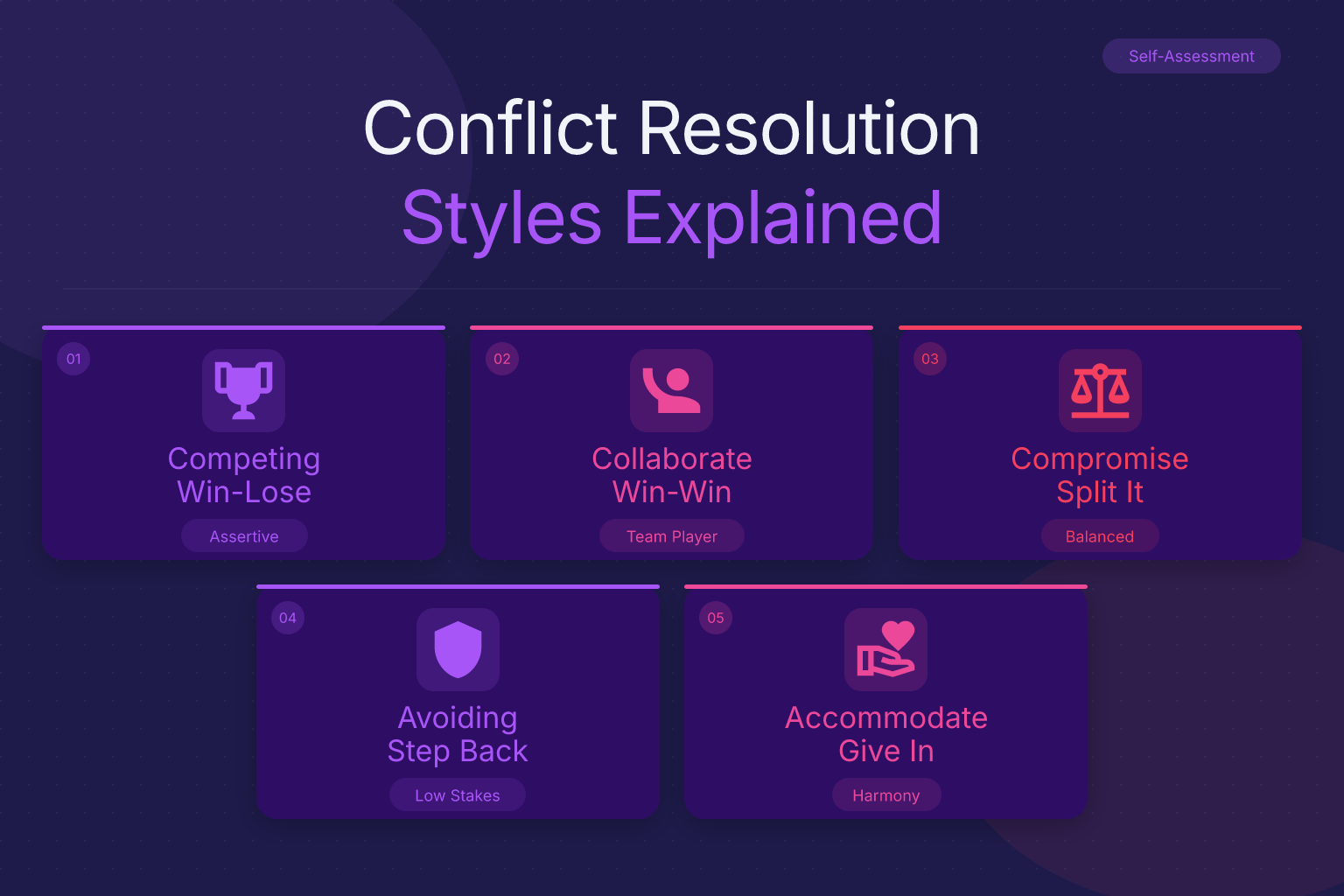
A useful framework for thinking about conflict is the Thomas-Kilmann Conflict Mode Instrument, which identifies five broad approaches. Here’s what each one signals, with a concrete example for each:
- Competing: You push for your position, even at the expense of the relationship. Example: “In a sales negotiation, I held firm on our pricing because we had a superior product, and the client eventually agreed.” This can sound assertive in sales or emergency roles, but it often reads as rigid or combative in collaborative teams.
- Collaborating: You work with the other person to find a solution that fully addresses both sides. Example: “A designer and I disagreed on a landing page layout. I asked her to walk me through her reasoning, shared page-speed data, and we agreed to A/B test both versions.” This is the strongest default answer because it shows you value the relationship and the outcome.
- Compromising: You find a middle ground where each side gives up something. Example: “Two teammates wanted different project timelines. I proposed a split deadline that gave each side partial ownership, and we shipped on time.” This is practical and realistic, especially when time is short or the stakes are moderate.
- Avoiding: You sidestep or delay the conflict. Example: “A coworker made a snarky comment in a meeting. I chose not to respond in the moment because it was trivial, but I later addressed a recurring pattern privately.” This can be appropriate for trivial issues, but as a primary style it makes you sound conflict-averse or disengaged.
- Accommodating: You yield to the other person to preserve harmony. Example: “A client insisted on a feature I thought was unnecessary. I accommodated their request to maintain the relationship, then later shared data showing low usage.” This can work in customer service, but overusing it suggests you struggle to advocate for your own needs.
For most roles, collaborating or compromising is the safest style to describe. Both show you can balance assertiveness with cooperation. If you’re applying for a leadership role, you might add that you shift toward coaching or mediating when the conflict involves two direct reports. If you’re in a technical role, you can frame your style as data-driven: you focus on the facts of the disagreement rather than personalities.
How to Choose the Right Conflict Resolution Style to Describe
Don’t just pick ‘collaborative’ because it sounds good. Interviewers can tell when an answer is generic. Instead, choose a style you can support with a real story.
Start by asking yourself three questions:
- What actually happened the last time I disagreed with a coworker or classmate? Write down two or three examples, even small ones.
- Which style did I use in those moments? Be honest. If you avoided the conflict, don’t pretend you collaborated.
- Which style fits the role I’m applying for? A customer support rep might emphasize de-escalation and compromise. A project manager might emphasize collaboration and mediation.
If you’re early in your career and don’t have workplace conflict examples, use a group project, a volunteer role, or a customer interaction. The key is specificity. ‘I collaborated with a teammate who wanted a different approach’ is weak. ‘I scheduled a 20-minute call, asked what outcome they needed, and proposed a split timeline that met both deadlines’ is strong.
You can also mention a secondary style to show range. For example: ‘My default is collaborative, but when a decision has to be made in hours rather than days, I’ll shift to compromising so the team can move forward.’ That one sentence signals flexibility without sounding indecisive.
A Simple 3-Step Formula for Answering the Question
You don’t need a script, but you do need a structure. Use this three-step formula to keep your answer under 90 seconds:
Step 1: Name your style and when you use it. ‘I’d describe my conflict resolution style as collaborative. I try to understand the other person’s underlying need before proposing a solution.’
Step 2: Give a specific example using a mini-STAR structure. ‘In my last role, a designer and I disagreed about a landing page layout. She wanted more visual emphasis; I wanted faster load time. I asked her to walk me through her reasoning, then shared the page-speed data. We agreed to test her version on half the traffic and mine on the other half. The data showed her layout converted better, so we shipped it.’
Step 3: Explain what you learned or how you adapt. ‘That experience reinforced that I should lead with questions before pushing my own solution. When the conflict is time-sensitive, I’ll shift to a compromise so we don’t stall.’
This structure works because it moves from claim to evidence to reflection. It also gives the interviewer a natural follow-up point if they want to dig deeper.
Sample Answers for Different Roles and Scenarios
Here are four sample answers you can adapt. Replace the details with your own experience.
For a project manager or team lead: ‘I’d call my style collaborative with a coaching element. When two people on my team disagree, I first meet with each person separately to understand their perspective, then bring them together to agree on a shared goal. Last quarter, two engineers disagreed on an API design. I asked each to write a one-page tradeoff summary, then facilitated a 30-minute discussion. They agreed on a hybrid approach that shipped on time, and both said they felt heard.’
For a customer service or client-facing role: ‘My style is to de-escalate first and compromise second. When a client was upset about a delayed deliverable, I acknowledged the frustration, explained the cause without making excuses, and offered a revised timeline plus a small credit. The client stayed with us and later renewed their contract. I’ve learned that in customer conflict, listening often matters more than winning the argument.’
For a technical or analytical role: ‘I’d describe my style as data-driven collaboration. I focus on the facts of the disagreement rather than who’s right. A data analyst and I once disagreed about which metric to use in a report. I pulled historical data showing which metric had predicted churn more accurately, and we agreed to use that one. When the data is ambiguous, I’m comfortable compromising so the team can move forward.’
For an early-career candidate: ‘In a group project, two teammates wanted different research methods. I suggested we split the work and compare results after one week. That let us test both approaches without arguing. We ended up combining the best parts of each. I’d call my style collaborative, but I also know when to compromise to keep momentum.’
Mistakes That Make You Sound Evasive or Difficult
Some answers hurt more than they help. Avoid these common traps, and notice how a concrete example can turn a weak answer into a strong one:
- Saying you never have conflicts. That’s either untrue or a sign you avoid hard conversations. Bad answer: “I never have conflicts because I get along with everyone.” Better: “I once disagreed with a coworker about a deadline. I scheduled a meeting, we each explained our constraints, and we found a compromise that worked for both of us.”
- Claiming you always avoid conflict. Avoidance can be appropriate for trivial issues, but as a default it signals low accountability. If you do mention avoiding, pair it with a specific situation where it was the right call and explain why. Example: “I avoid conflict over minor stylistic preferences, but I address disagreements that affect project outcomes directly.”
- Giving a vague, label-only answer. ‘I’m collaborative’ with no example is forgettable. Every claim needs proof.
- Blaming the other person. ‘They were being unreasonable, so I had to step in’ makes you sound defensive. Focus on what you did, not what they did wrong.
- Choosing a style that clashes with the role. Saying you compete hard and never back down may work for a high-pressure sales job, but it will likely raise red flags for a cross-functional product team.
- Rambling past two minutes. A long answer suggests you haven’t reflected on the question. Keep it tight.
How to Adapt Your Answer for Remote and Hybrid Workplaces
Conflict in remote teams often looks different. It happens in Slack threads, email chains, and video calls where tone is easy to misread. If you’re interviewing for a remote or hybrid role, acknowledge that context.
A strong remote-specific answer might sound like this:
‘In a remote setting, I’ve learned that written conflict can escalate quickly because tone is hard to read. My style is to move the conversation to a quick video call as soon as I sense friction. Last year, a teammate and I disagreed in a Slack thread about a project priority. I suggested a 15-minute call, and we realized we actually wanted the same outcome but had different assumptions about the timeline. We agreed on a shared doc to track decisions, which prevented the same misunderstanding later.’
This answer shows you understand the unique risks of asynchronous communication and have a concrete strategy for handling them. It also pairs well with the self-awareness interviewers look for when they ask about your decision-making style.
How to Practice and Refine Your Answer Before the Interview
A good answer sounds natural, not memorized. Practice it enough that the structure feels automatic, but leave room to adjust based on the interviewer’s follow-up.
Try this routine, and see how a rough answer can be refined:
- Write your answer in bullet points, not full sentences. Bullets keep you flexible.
- Record yourself answering out loud. Listen for filler words, rambling, or a monotone delivery.
- Time yourself. Aim for 60 to 90 seconds. If you’re over two minutes, cut details.
- Ask a friend to play interviewer. Have them ask a follow-up like ‘What would you do if the other person refused to compromise?’ so you can practice thinking on your feet.
- Align your example with your resume. If your resume highlights a team project or a customer win, use the same story in your answer. Consistency builds trust.
Example of refinement: A candidate initially said, “I’m collaborative.” After practicing, they refined it to: “I’m collaborative. Last month I mediated a disagreement between two teammates by asking each to write a one-page summary of their position, then we agreed on a hybrid solution that shipped on time.” The second version adds a concrete story and a clear outcome.
If you’re not sure which of your experiences best demonstrates conflict resolution, review your resume with fresh eyes. Look for moments where you collaborated across teams, handled a difficult customer, or mediated a disagreement. Those are the stories interviewers want to hear.
FAQ
Q: What are the 5 conflict resolution styles?
A: The five styles from the Thomas-Kilmann model are competing, collaborating, compromising, avoiding, and accommodating. In an interview, collaborating and compromising are usually the safest to describe because they show you balance your own needs with the relationship.
Q: What is the best conflict resolution style to say in an interview?
A: For most roles, say your style is collaborative, with a willingness to compromise when time is short or stakes are low. Back it with a specific example. Avoid claiming a style you can’t support with a real story.
Q: How do I answer ‘What is your conflict resolution style’ with no work experience?
A: Use a group project, volunteer role, class assignment, or customer interaction. Describe the disagreement, what you did to resolve it, and the outcome. The interviewer cares about your behavior, not the setting.
Q: Can I say I avoid conflict?
A: You can mention avoidance only as a situational choice, not your default. For example, you might say you avoid conflict over trivial issues but address important disagreements directly. Saying you always avoid conflict makes you sound disengaged or unable to handle hard conversations.
Q: How do I answer conflict resolution style for a leadership role?
A: Emphasize coaching and mediation. Describe a time you helped two people on your team resolve a disagreement, what you did to keep the conversation productive, and the outcome. Show you can balance empathy with accountability.
Q: How long should my answer be?
A: Aim for 60 to 90 seconds. That’s enough time to name your style, give one specific example, and explain what you learned. If the interviewer wants more detail, they’ll ask a follow-up.
Q: What if my real conflict style is competing or avoiding?
A: Be honest but frame it carefully. If you tend to compete, describe how you’ve learned to listen more and involve others. If you tend to avoid, describe how you now address important conflicts directly while still choosing your battles. Self-awareness plus growth is more credible than a perfect label.
Track Every Application While You Job Hunt
Stop losing track of where you’ve applied. The ResumeMate Job Tracker is a free Chrome extension that tracks every application, deadline, and follow-up in one place — right from your browser.