Interviewers often ask, “What is your problem-solving style?” to understand how you approach challenges, make decisions, and handle pressure. It’s not a trick question — it’s a chance to show that you have a repeatable, effective process for tackling the kinds of problems the job will throw at you. A strong answer combines self-awareness, a concrete example, and a clear link to the role you’re applying for.
Key Takeaways
- To answer ‘What is your problem-solving style?’, first identify whether you are primarily analytical, creative, collaborative, or decisive, and describe your approach in plain language rather than using buzzwords.
- Structure your answer using the STAR method (Situation, Task, Action, Result), focusing most of your response on the Action section to show your problem-solving process step by step.
- Support your stated style with a specific, recent example from your work, school, or volunteer experience, and quantify the outcome (e.g., time saved, revenue increased) to prove your style works.
- Tailor your answer to the job description by highlighting the problem-solving style that matches the role’s key challenges, such as emphasizing decisiveness for fast-paced roles or collaboration for cross-functional roles.
- Practice your answer out loud for 60-90 seconds, record yourself, and get feedback to ensure your style is clear and your delivery sounds natural, not memorized.
This guide breaks down why interviewers ask this question, the four most common problem-solving styles, how to structure your answer with the STAR method, and example responses you can adapt. By the end, you’ll have a framework to answer confidently in any interview.
Why Interviewers Ask About Your Problem-Solving Style (and the Four Common Styles)
Hiring managers ask this question for three main reasons. First, they want to see if you have self-awareness — can you articulate how you think and work? Second, they want to assess whether your approach fits the team’s culture and the demands of the role. A startup that needs rapid, independent decisions will value a different style than a large organization that prioritizes consensus and documentation. Third, they want evidence that your style actually produces results, not just a theoretical description.
This question is a close cousin of other behavioral interview questions like “Tell me about a time you failed” or “What are your weaknesses?” — it’s designed to reveal how you operate under real conditions. The difference is that it asks you to generalize your approach rather than recount a single incident. That means you need to do two things at once: name your style clearly and back it up with a specific example.
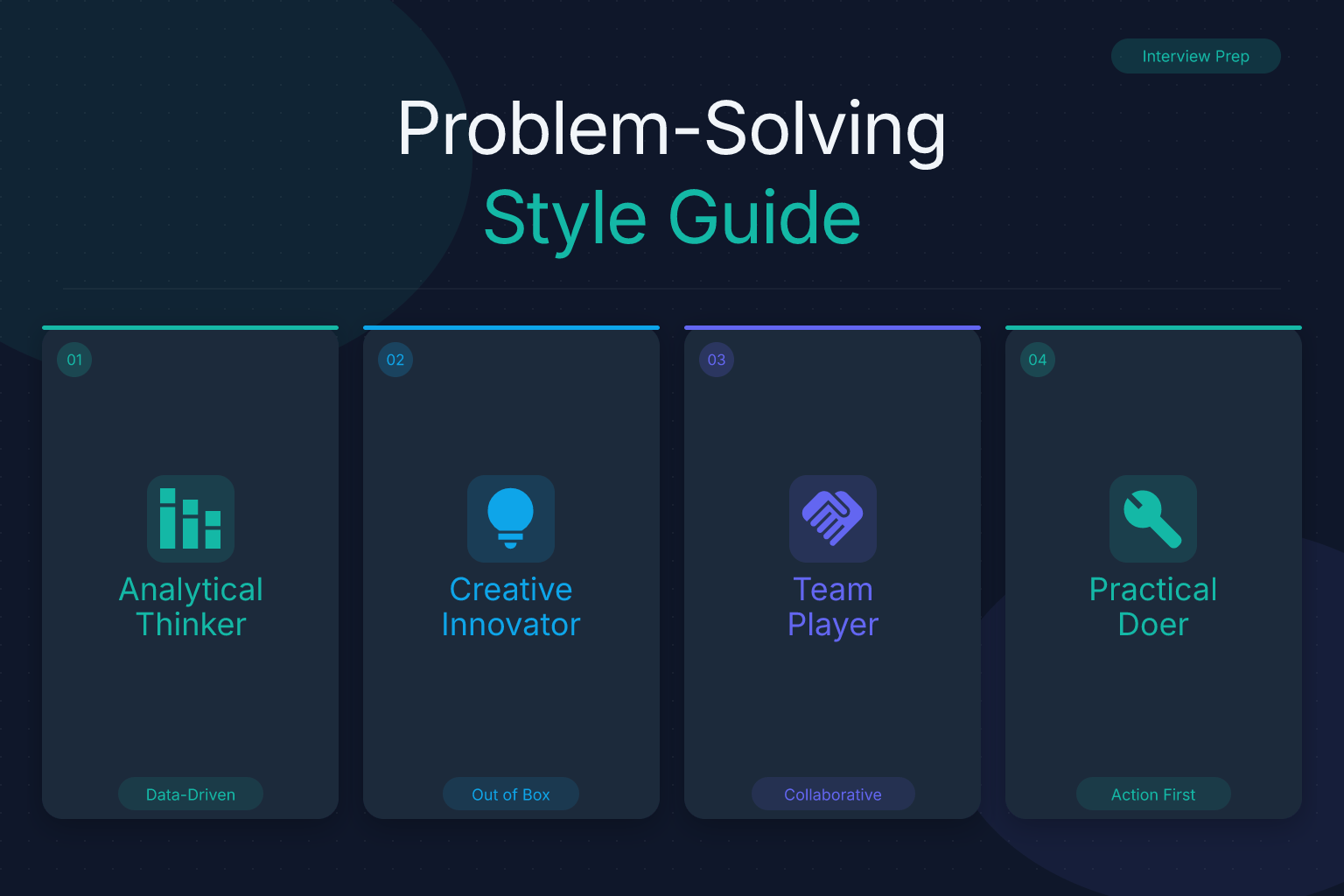
Most people fall into one of four broad problem-solving styles. You don’t need to fit perfectly into one box — many people blend two — but identifying your dominant tendency gives you a vocabulary to describe yourself. Here are the four styles, what they look like in practice, and a phrase you can use to introduce yours.
1. Analytical
Analytical problem-solvers break problems into smaller parts, gather data, and evaluate options systematically. They’re comfortable with numbers, logic, and structured frameworks. If you’re analytical, you might say: “I take a data-driven approach — I define the problem, gather relevant information, and test possible solutions against clear criteria.”
2. Creative
Creative problem-solvers generate many ideas, think outside conventional constraints, and are comfortable with ambiguity. They often reframe problems to find novel angles. If you’re creative, you might say: “I like to explore multiple perspectives before committing to a solution — I brainstorm broadly, then narrow down based on feasibility and impact.”
3. Collaborative
Collaborative problem-solvers involve others early and often. They value diverse input, build consensus, and ensure stakeholders are aligned. If you’re collaborative, you might say: “I bring the right people into the room — I gather input from those affected, facilitate discussion, and work toward a solution everyone can support.”
4. Decisive
Decisive problem-solvers act quickly, trust their instincts, and are comfortable making calls with incomplete information. They prioritize momentum over perfection. If you’re decisive, you might say: “I move fast — I assess the situation, make a decision based on the best available information, and adjust course if new data emerges.”
You don’t need to memorize these labels. The key is to describe your process in plain language. For example, instead of saying “I’m analytical,” say “I tend to break a problem into smaller pieces and test each one before moving forward.” That’s more concrete and easier for an interviewer to remember.
How to Structure Your Answer with the STAR Method
The STAR method — Situation, Task, Action, Result — is the gold standard for behavioral interview questions, and it works perfectly for “What is your problem-solving style?” Here’s how to apply it:
- Situation: Briefly describe the context. What was the challenge or problem you faced?
- Task: What was your responsibility in that situation? What were you trying to achieve?
- Action: Walk through the specific steps you took. This is where you demonstrate your style — describe your process, not just the outcome.
- Result: What happened as a result of your actions? Quantify the outcome if possible (time saved, revenue increased, errors reduced).
For example, if your style is analytical, your Action section might sound like: “I pulled the last six months of customer support tickets, categorized them by root cause, and ran a Pareto analysis to identify the top three issues. Then I designed a pilot fix for the biggest one and measured the impact over two weeks.” That shows your style in action without you ever saying the word “analytical.”
Step-by-Step: Crafting Your Answer
Follow these five steps to build a strong, tailored answer.
- Identify your style. Reflect on past projects or challenges. Do you tend to gather data first? Brainstorm with others? Make quick decisions? Write down two or three adjectives that describe your approach.
- Choose a specific example. Pick a real situation from your work, school, or volunteer experience where you solved a meaningful problem. The example should be recent (within the last 2–3 years) and relevant to the job you’re applying for.
- Map your example to STAR. Write out the Situation, Task, Action, and Result in bullet points. Focus the Action section on your process — the steps you took, the tools you used, the people you consulted.
- Connect your style to the job. Look at the job description. What problems will this role need to solve? If the role requires handling customer complaints, emphasize your collaborative or decisive style. If it requires data analysis, emphasize your analytical style. Make the link explicit: “In this role, I’d apply the same approach to [specific problem from the job description].”
- Practice out loud. Say your answer aloud three to five times. Time yourself — aim for 60 to 90 seconds. Record yourself or practice with a friend. The goal is to sound natural, not memorized.
Here’s a quick summary of the preparation steps and time estimates to help you plan your practice:
| What to Do | Why It Matters | Time |
|---|---|---|
| Identify your dominant problem-solving style (analytical, creative, collaborative, decisive) | Shows self-awareness and gives you a clear framework to describe | 15 min |
| Choose a specific example from your past work or projects | Proves your style works in practice, not just in theory | 20 min |
| Structure your answer with the STAR method | Keeps your response focused, logical, and easy for the interviewer to follow | 10 min |
| Practice out loud and get feedback from a friend or mentor | Builds confidence and smooths your delivery so you sound natural | 30 min |
Example Answers for Different Styles
Here are four example answers, one for each style. Adapt the details to your own experience.
Analytical style example
“I’d describe my problem-solving style as data-driven and systematic. For example, in my last role as a marketing coordinator, our email open rates dropped 20% over two months. I started by pulling the campaign data and segmenting it by audience, subject line, and send time. I found that open rates were lowest for emails sent on Friday afternoons. I proposed moving our sends to Tuesday mornings, and we tested it for three weeks. Open rates recovered to their previous level, and click-through rates actually improved by 8%.”
Creative style example
“I tend to approach problems by reframing them first. When I was working on a student project to increase campus recycling, the initial idea was to add more bins. But I asked, ‘Why aren’t students recycling in the first place?’ We interviewed 30 students and found that most didn’t know which items were recyclable. So instead of more bins, we created a simple visual guide and placed it above every bin. Recycling rates went up 35% in one semester, and the project cost almost nothing.”
Collaborative style example
“My style is collaborative — I bring the right people together early. In my previous job, we had a recurring issue where sales and engineering kept blaming each other for missed deadlines. I organized a weekly 30-minute sync between the two teams. We used a shared board to track blockers and assigned owners for each one. Within a month, the number of missed deadlines dropped by half, and both teams reported better working relationships.”
Decisive style example
“I’m a decisive problem-solver. I gather the essential information quickly, make a call, and adjust if needed. Last year, our website went down during a product launch. I had 15 minutes to decide whether to roll back the update or push a hotfix. I chose the hotfix because it preserved the new features, and I assigned two developers to monitor it. The site was back up in 40 minutes, and we lost no sales. Later, we did a full post-mortem to prevent a repeat.”
Common Mistakes to Avoid and How to Adapt Your Answer to the Job Description
Even well-prepared candidates make these mistakes. Watch out for them.
- Being too vague. Saying “I just work hard until the problem is solved” tells the interviewer nothing about your process. Be specific about the steps you take.
- Describing a style you don’t actually use. If you claim to be collaborative but your example shows you working alone, the interviewer will notice the mismatch. Choose a style that matches your real behavior.
- Focusing only on the result. The interviewer cares more about how you solved the problem than the outcome. Spend at least half your answer on the Action section.
- Using jargon or buzzwords. Phrases like “synergize cross-functional stakeholders” sound impressive but mean little. Use plain language.
- Rambling. Without a structure, answers can drift into unrelated details. The STAR method keeps you on track. If you struggle with this, review our guide on how to answer “What are your weaknesses?” — it covers similar pitfalls in behavioral questions.
The best answer is one that mirrors the problems the hiring manager actually needs solved. Before your interview, read the job description carefully and highlight the key challenges. Look for phrases like “must be able to handle ambiguity,” “work cross-functionally,” “analyze data,” or “make quick decisions.” Then adjust your answer to emphasize the style that matches.
For example, if the job description says “thrive in a fast-paced environment with shifting priorities,” lead with a decisive or creative style. If it says “collaborate with multiple departments,” lead with a collaborative style. If it says “use data to drive decisions,” lead with an analytical style.
This is the same principle behind answering other style-based questions, like “What is your communication style?”. The interviewer wants to see that you’ve thought about how you work and that your approach fits the team.
Practice and Preparation Tips
Preparation is what separates a rambling answer from a confident one. Here’s how to practice effectively.
- Write it out first. Draft your answer in bullet points, not full sentences. This helps you remember the structure without sounding scripted.
- Record yourself. Use your phone to record a practice run. Listen for filler words (“um,” “like”), pacing, and clarity. Aim for a conversational tone.
- Get feedback. Ask a friend or mentor to listen and tell you if your style comes through clearly. If they can’t name your style after hearing your answer, you need to be more explicit.
- Prepare a backup example. Sometimes the interviewer will ask a follow-up like “Can you give me another example?” Have a second STAR story ready.
- Tie it to the role. End your answer with a sentence that connects your style to the job: “That’s the approach I’d bring to [specific challenge in this role].”
If you’re also preparing for other behavioral questions, check out our guide on how to answer “Tell me about a time you failed” — it uses the same STAR framework and includes more example answers.
FAQ
Q: What is a good answer for “What is your problem-solving style?”
A: A good answer names a specific style (analytical, creative, collaborative, or decisive), describes your process in plain language, and backs it up with a concrete example using the STAR method. For instance: “I’m analytical — I break problems into parts, gather data, and test solutions. In my last role, I reduced customer complaints by 30% by analyzing support tickets and fixing the top three root causes.”
Q: How do I identify my problem-solving style?
A: Reflect on past challenges you’ve solved. Ask yourself: Do I gather data first or brainstorm ideas? Do I involve others or work independently? Do I decide quickly or deliberate? Look for patterns across three or four examples. You can also ask a former colleague or manager how they’d describe your approach.
Q: Can I say I have multiple problem-solving styles?
A: Yes, but be careful. It’s fine to say you adapt your style to the situation — for example, “I’m analytical when the problem is data-heavy, but collaborative when it involves multiple stakeholders.” However, don’t list four styles with no example. Pick one primary style and mention a secondary one only if you can support both with evidence.
Q: Should I use the STAR method for this question?
A: Yes. The STAR method (Situation, Task, Action, Result) keeps your answer focused and gives the interviewer a clear picture of your process. Spend most of your time on the Action section, because that’s where your style becomes visible.
Q: What if I don’t have a work example?
A: Use an example from school, a volunteer project, a personal project, or even a hobby. The key is that it’s a real problem you solved with a clear process. For example, planning a fundraising event or debugging a personal coding project both work.
Q: How long should my answer be?
A: Aim for 60 to 90 seconds. That’s enough time to name your style, give a STAR example, and connect it to the job. If the interviewer wants more detail, they’ll ask a follow-up question.
Related articles:
- How to Answer “What Is Your Adaptability?” (With Examples)
- What Is Your Conflict Resolution Style? Answer & Examples
Track Every Application While You Job Hunt
Stop losing track of where you’ve applied. The ResumeMate Job Tracker is a free Chrome extension that tracks every application, deadline, and follow-up in one place — right from your browser.