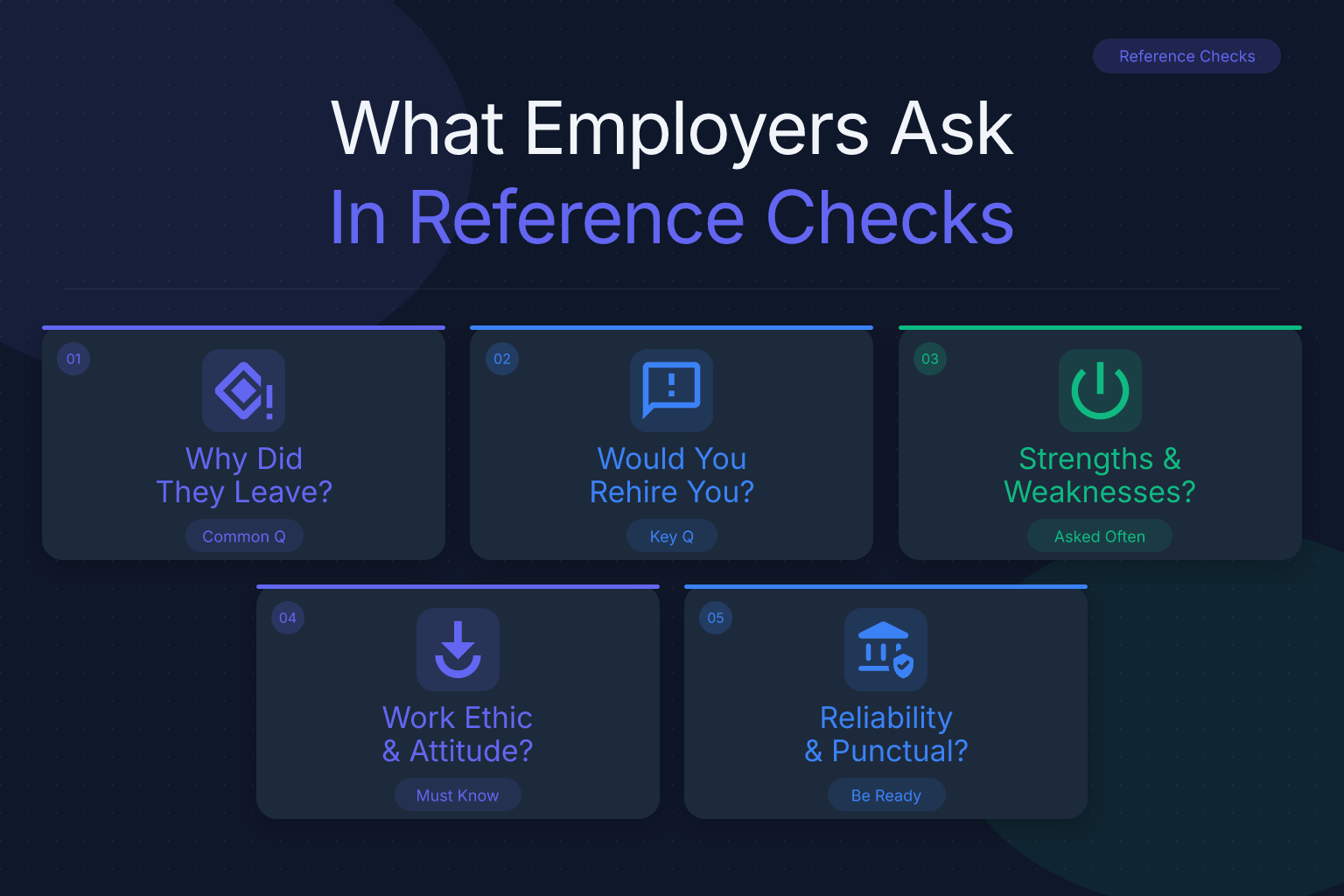
What Questions Do Employers Ask in Reference Checks? (Tips)
If you’re in the final stages of a job search, you might be wondering what questions do employers ask during reference checks — and how to make sure your references give answers that help you land the offer. Reference checks are a standard part of most hiring processes, usually happening after interviews but before a final decision or as a condition of a job offer. Knowing what employers ask lets you choose the right people, brief them properly, and avoid surprises that could derail your candidacy.
Key Takeaways
- Employers typically ask about your job title, employment dates, responsibilities, and reason for leaving to verify the accuracy of your resume.
- They ask about your work quality, strengths, weaknesses, and how you handled challenges, pressure, or conflict.
- Common questions cover reliability, attendance, teamwork, communication, and whether the reference would rehire you.
- You can prepare by choosing references who know your work well, asking permission, and briefing them on the role and your key accomplishments.
- Some employers ask about salary history (restricted in many states) and eligibility for rehire, but they cannot ask about protected characteristics like age, race, or disability.
- If you’re the one checking references, the same categories apply — and asking the right questions can save you from a bad hire.
| What to Do | Why It Matters | Time |
|---|---|---|
| Choose 3–5 professional references who supervised or worked closely with you | Ensures you have enough people who can speak credibly about your work | 1–2 hours |
| Brief each reference on the job, your resume, and specific projects to highlight | Helps them give specific, relevant examples instead of vague praise | 30 minutes per reference |
| Confirm contact information and availability before listing them | Avoids delays, missed calls, or a reference who is unreachable | 15 minutes |
| Send a thank-you note after the check is complete | Maintains good relationships for future job searches and networking | 10 minutes |
| Prepare a list of questions if you’re the one checking references | Ensures you gather consistent, useful information from every call | 20 minutes |
Reference checks serve two purposes: verifying the facts on your resume and getting a third-party perspective on your performance and character. Most employers use a structured set of questions, often delivered by phone, email, or an online form. While the exact wording varies, the underlying topics are consistent across industries. Here are the categories you can expect, with examples of how employers phrase them.
Verification Questions: Employment Dates, Title, and Responsibilities
The first thing an employer wants to confirm is that you actually worked where you said you worked, in the role you claimed, for the dates you listed. These questions are straightforward but critical — a mismatch here can immediately raise red flags. Common verification questions include:
- “Can you confirm [candidate’s name]’s job title and dates of employment?”
- “What were their primary responsibilities in that role?”
- “Did they work full-time or part-time?”
- “What was their reason for leaving?”
- “Were they in good standing when they left?”
- “Would you confirm their salary or pay band?” (Note: this is often restricted by law — see below)
Employers compare these answers against your resume and application. If your reference says you left in March but your resume says May, that discrepancy needs an explanation. This is why accuracy on your resume matters — and why tools like ResumeMate’s free resume builder can help you keep employment dates and titles consistent across every document you submit. Even a small typo in a date can trigger a deeper investigation, so double-check your resume before you list references.
Performance and Work Quality Questions
Once the basics are confirmed, employers dig into how well you actually did the job. They want specific examples, not just “they were great.” Expect questions like:
- “How would you rate [candidate]’s overall job performance on a scale of 1 to 10?”
- “What were their biggest strengths?”
- “What areas could they improve on?”
- “Can you give an example of a project they handled particularly well?”
- “How did they handle pressure or tight deadlines?”
- “What was the most significant contribution they made to your team?”
- “How did their performance compare to others in a similar role?”
- “Did they meet or exceed their goals? Can you share specific numbers?”
A good reference will be able to cite concrete achievements — a project you led, a problem you solved, a goal you exceeded. That’s why you should brief your references on the specific accomplishments you want them to mention. If you’re unsure which accomplishments to highlight, reviewing your resume with a free resume score check can help you identify your strongest selling points. The score checker gives you section-by-section feedback, so you can see exactly which achievements are most compelling to an employer.
Behavioral, Reliability, and Professionalism Questions
Employers care about how you’ll fit into their team, so they ask about your behavior, relationships with colleagues, and dependability. These questions often mirror behavioral interview questions but are asked of someone else. Examples include:
- “How did [candidate] work with teammates and other departments?”
- “Can you describe a time they had a conflict with a coworker? How did they handle it?”
- “How did they respond to feedback or criticism?”
- “Did they take initiative, or did they need close supervision?”
- “How would you describe their communication style?”
- “Was [candidate] reliable and punctual?”
- “Did they meet deadlines consistently?”
- “How was their attendance record?”
- “Did they follow company policies and procedures?”
- “Would you describe them as professional in their conduct?”
- “How did they handle stress or high-pressure situations?”
- “Did they ever have conflicts with management? How were they resolved?”
Your references should be prepared to give honest but positive examples. If you had a rocky relationship with a particular manager, don’t list that person — choose someone who saw your best work and can speak to your collaboration skills. These questions are hard to spin if the truth is negative, which is why you should only list references who genuinely saw you as reliable. If you had attendance issues at a past job, consider whether that reference is the right choice — or be upfront with them about how you’ve improved.
The “Would You Rehire?” Question and Other Final Checks
One of the most telling questions an employer can ask is some version of: “Would you rehire this person?” or “If given the opportunity, would you work with them again?” This single question cuts through polite praise and gets to the heart of whether the reference actually valued your work.
A strong “yes, absolutely” carries significant weight. A hesitant “well, it depends” or a flat “no” can kill your chances, even if everything else was positive. Employers listen carefully to the tone and speed of the answer. If a reference pauses or qualifies their response, that’s a red flag. This is why you should never list someone unless you’re confident they would rehire you without hesitation.
Some employers also ask about your salary history, your reason for leaving, and whether you’re eligible for rehire at the company. Here’s what to know about each:
- Salary history: Many states and cities have laws restricting employers from asking about salary history, either directly or through references. Even where it’s legal, many employers avoid it because it can perpetuate pay inequity. If a reference is asked, they can decline to answer or say they don’t know. If you’re negotiating an offer, you might also want to read our guide on how to ask for a signing bonus to make sure you’re not leaving money on the table.
- Reason for leaving: Employers want to know if you left voluntarily, were laid off, or were terminated. Your reference should give a consistent, professional answer that matches what you told the employer.
- Eligibility for rehire: This is a common question, especially for former employers. If you left on good terms, the answer is usually “yes.” If you were terminated for cause, the answer might be “no,” which can be a problem. Be honest with your references about what they should say, and if you’re worried about a negative answer, consider whether to list that employer at all.
Employers cannot legally ask about protected characteristics such as age, race, religion, disability, marital status, or family plans. If a reference reports being asked such questions, that’s a red flag about the employer’s practices.
What Questions Should You Ask When Checking References? (For Employers)
If you’re on the other side of the table — a hiring manager, recruiter, or small business owner — you need to know what to ask when calling references. The same categories apply, but your goal is to uncover red flags and verify the candidate’s claims. Here’s a structured list of questions to ask when checking references:
Verification
- Can you confirm the candidate’s job title, employment dates, and responsibilities?
- Were they full-time, part-time, or contract?
- What was their reason for leaving?
Performance
- How would you rate their overall performance on a scale of 1–10?
- What were their top strengths and areas for improvement?
- Can you share a specific example of a project they excelled on?
- How did they handle pressure, deadlines, or difficult situations?
Behavior and Fit
- How did they work with teammates and other departments?
- How did they respond to feedback or criticism?
- Were they reliable, punctual, and professional?
- Would you rehire them? Why or why not?
Closing
- Is there anything else I should know about this candidate?
- Would you recommend them for a role that requires [specific skill]?
Asking these questions consistently across all references helps you compare candidates fairly. And if you’re hiring for a technical role, you might also want to check out our guides on AWS jobs or Azure developer roles to understand what skills to probe for.
How to Prepare Your References for These Questions
Knowing what employers ask is only half the battle — you also need to make sure your references are ready to answer well. Here’s a step-by-step process:
- Choose the right people. Select 3–5 references who directly supervised you or worked closely with you and saw your best work. Former managers, team leads, and senior colleagues are ideal. Avoid personal friends or family unless the employer specifically asks for character references.
- Ask permission first. Never list someone without their consent. Send a polite email or call them, explain the job you’re applying for, and ask if they’re comfortable being a reference. This also gives them a chance to decline if they don’t feel they can give a strong recommendation.
- Brief them on the role. Share the job description, your resume, and a short summary of why you’re a good fit. Point out the specific skills and accomplishments you want them to emphasize.
- Remind them of specific projects. Jog their memory with concrete examples: “Remember the Q3 project where I led the team to cut costs by 15%? That would be a great thing to mention.”
- Warn them about potential tough questions. If there’s a gap in your employment, a past conflict, or a reason for leaving that might come up, tell your reference how you’d like them to handle it. Give them a consistent, honest narrative.
- Thank them afterward. Send a thank-you note or email after the check is complete, regardless of the outcome. This keeps the relationship strong for future opportunities.
For more on asking people to vouch for you, see our guide on how to ask for a letter of recommendation — many of the same principles apply to references.
What Happens If a Reference Gives a Bad Review?
A negative reference can derail your candidacy, but it’s not always the end of the road. If you suspect a reference might say something negative, you have options:
- Don’t list them. If you’re not confident someone will give a positive review, leave them off your list. It’s better to have fewer references than one who will hurt you.
- Address it proactively. If a past employer might give a lukewarm review, consider mentioning the situation to the hiring manager before the check. Explain what happened and what you learned from it.
- Provide alternative references. If a former manager is the problem, offer a different supervisor or a colleague from the same company who can speak positively about your work.
- Know your rights. In some cases, former employers are limited in what they can say. Many companies have policies to only confirm dates and titles, not give detailed performance reviews. If you’re worried, ask your former HR department what their policy is.
If a job offer is rescinded after a reference check, it’s frustrating but not always final. Read our guide on what to do if a job offer is rescinded for steps to recover and move forward.
Do Employers Always Check References?
Not every employer checks references, but most do — especially for full-time, professional roles. According to a survey by the Society for Human Resource Management (SHRM), the vast majority of employers conduct reference checks for at least some positions. Smaller companies or startups may skip them for speed, while larger organizations and government agencies almost always check. Some employers only check references for finalists, while others check all candidates who pass the interview stage.
You should assume your references will be contacted. Even if an employer doesn’t call, having a strong list ready shows professionalism and can speed up the process if they decide to check later.
Questions to Ask Your Interviewer About Their Reference Process
During your interview, you can ask about the company’s reference check process to prepare accordingly. Good questions include:
- “At what stage do you typically conduct reference checks?”
- “How many references do you usually contact?”
- “Do you prefer professional references, or are character references also acceptable?”
- “Is there anything specific you look for in a reference?”
- “Will you contact my current employer? I’d prefer to give notice first if that’s the case.”
Asking these questions shows you’re thorough and helps you tailor your reference list. For more smart questions to ask in an interview, see our list of 30 questions to ask an interviewer.
FAQ
Q: What questions do employers ask references about your character?
A: Employers often ask about your integrity, work ethic, attitude, and how you treat others. They may ask for examples of times you demonstrated honesty, took responsibility, or went above and beyond. Character questions are more common for roles involving trust, such as finance, healthcare, or childcare.
Q: Can employers ask references about your salary?
A: It depends on where you live. Many states and cities have laws prohibiting employers from asking about salary history, either directly or through references. Even where it’s legal, many employers avoid the question to prevent pay inequity. If a reference is asked, they can politely decline to answer.
Q: How many references do employers typically contact?
A: Most employers contact 2–3 references, though some may check more for senior or sensitive roles. It’s wise to have 3–5 references ready so you can provide alternates if someone is unreachable or declines.
Q: What if a reference gives a bad review?
A: A negative reference can hurt your chances, but you can mitigate the risk by only listing people who will speak positively about you. If you suspect a bad review, address it proactively with the hiring manager or provide alternative references from the same company.
Q: Do employers always check references?
A: No, but most do for professional roles. Larger companies and government agencies are more likely to check than small startups. Assume your references will be contacted and prepare accordingly.
Q: Can I use a coworker as a reference?
A: Yes, a coworker can be a good reference if they worked closely with you and can speak to your skills and work ethic. However, a former manager or supervisor is usually more credible because they can speak to your performance from a leadership perspective.
Q: What should I tell my references before they get called?
A: Tell them the job title, company, and key skills the employer is looking for. Share your resume and remind them of specific projects or accomplishments you’d like them to mention. Also warn them about any potential tough questions, such as a gap in employment or a past conflict, so they can answer consistently.
Q: What questions do recruiters ask references?
A: Recruiters typically ask the same categories of questions as hiring managers: verification of employment details, performance and work quality, behavioral traits, and whether they would rehire the candidate. They may also ask about the candidate’s reason for leaving and eligibility for rehire. The goal is to confirm the candidate’s claims and uncover any red flags before presenting them to the client.
Q: What questions should I ask when calling references for a job candidate?
A: If you’re the one checking references, ask about the candidate’s job title, dates, responsibilities, performance, strengths, weaknesses, teamwork, reliability, and whether you would rehire them. Use a consistent set of questions for every reference to make fair comparisons. Also ask if there’s anything else you should know.
Q: What can potential employers legally ask references?
A: Employers can ask about job performance, skills, work habits, and eligibility for rehire. They cannot ask about protected characteristics like age, race, religion, disability, marital status, or family plans. Salary history questions are restricted in many states. If a reference is asked an illegal question, they can decline to answer.
Q: What are good questions to ask a personal reference?
A: For personal or character references, ask about the person’s integrity, reliability, and how they handle responsibility. Questions might include: “How long have you known the candidate and in what capacity?” “Can you describe a time they demonstrated honesty or trustworthiness?” “Would you trust them with sensitive information or important tasks?” Personal references are less common for professional roles but may be requested for entry-level positions or roles involving vulnerable populations.
Track Every Application While You Job Hunt
Stop losing track of where you’ve applied. The ResumeMate Job Tracker is a free Chrome extension that tracks every application, deadline, and follow-up in one place — right from your browser.