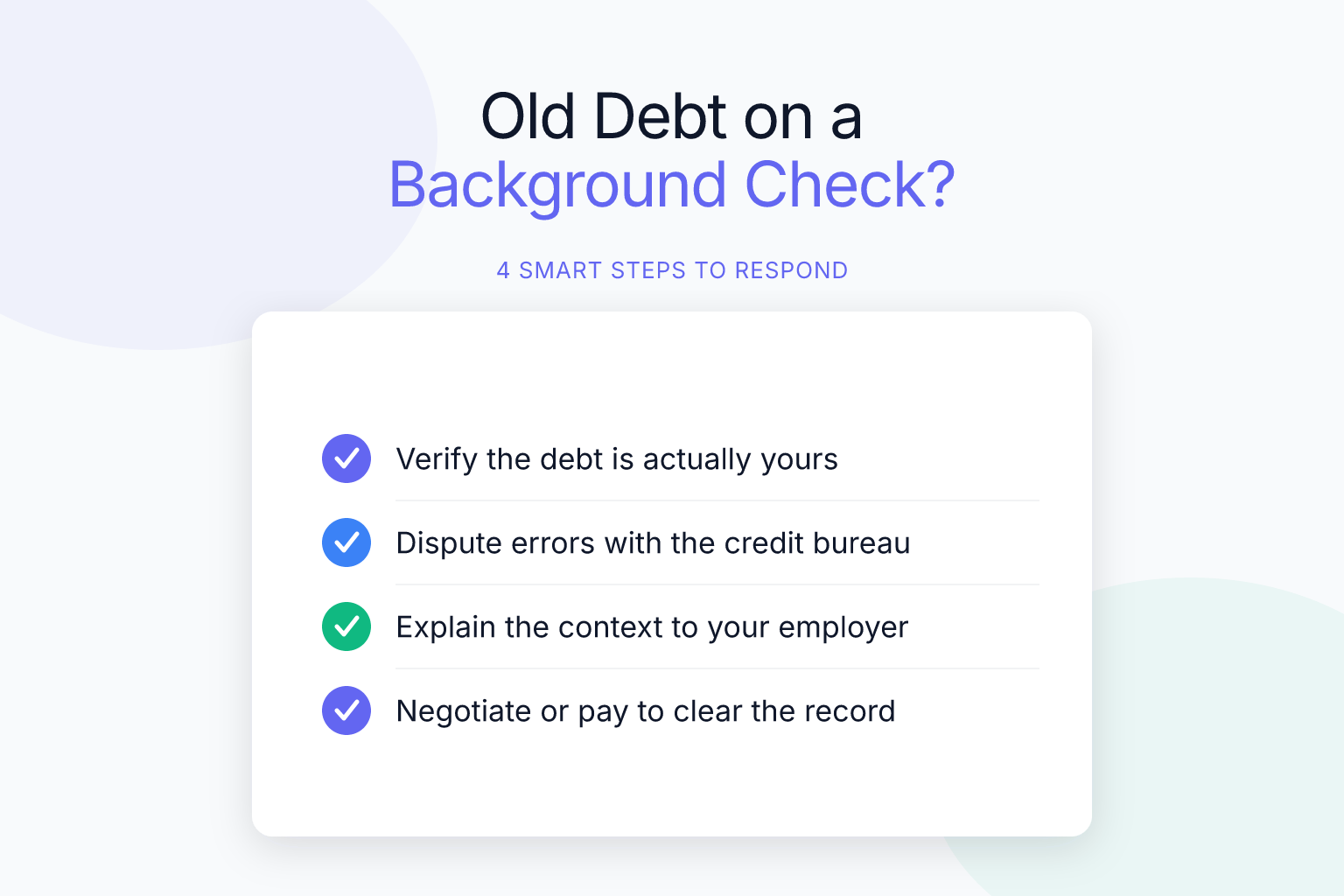
What to Do If a Background Check Reveals Old Debt
If you’re wondering what to do if a background check reveals old debt, you’re not alone — and the situation is rarely as dire as it feels in the moment. Many employers run credit checks as part of pre-employment screening, especially for roles that involve handling money, access to financial systems, or fiduciary responsibility. An old collection account, a charged-off credit card, or a medical bill from years ago can surface and trigger a difficult conversation. But here’s the key: old debt is not an automatic disqualifier at most companies. What matters is how you respond, what you can verify, and whether you take the right steps before the employer makes a final decision.
Key Takeaways
- Old debt on a background check is often not a dealbreaker; many employers only care about recent, severe financial issues or debt directly relevant to the job.
- You have the legal right under the Fair Credit Reporting Act (FCRA) to see the exact report the employer used and to dispute any errors before a final decision is made.
- Proactively pull your own credit report, verify the debt is actually yours and still reportable, and prepare a short, honest explanation that focuses on what you’ve done to address it.
- If the debt is legitimate, negotiating a payment plan or settlement and getting written confirmation can turn a red flag into a sign of responsibility.
- If an employer rescinds an offer because of the debt without following FCRA adverse action procedures, you may have legal recourse — and you can still recover professionally.
Summary Table
| What to Do | Why It Matters | Time |
|---|---|---|
| Request a copy of your credit report | You need to see exactly what the employer saw, including dates and amounts | 15 minutes |
| Verify the debt is yours and still within reporting limits | Old debts may be past the 7-year reporting window or belong to someone else | 1–2 hours |
| Prepare a concise, honest explanation | Employers respond better to proactive, factual context than to silence | 30 minutes |
| Dispute errors with the credit bureau | FCRA requires bureaus to investigate and remove inaccurate items | 30–45 days |
| Negotiate a payment plan or settlement | Shows the employer you’re addressing the issue, not ignoring it | 1–2 weeks |
What to Do If a Background Check Reveals Old Debt: Your First Three Moves
When an employer tells you that a background check turned up old debt, your first instinct might be to panic or get defensive. Don’t. Instead, take these three immediate steps:
- Ask for the specific report. Under the Fair Credit Reporting Act (FCRA), if an employer takes an adverse action based on a consumer report — including a credit check — they must give you a copy of the report and a summary of your rights. Ask for it in writing. You cannot fix what you cannot see.
- Pull your own credit reports. Go to AnnualCreditReport.com, the only federally authorized source for free weekly credit reports from Equifax, Experian, and TransUnion. Compare what the employer saw with what’s actually on your file. Sometimes the employer’s report is outdated or contains errors.
- Do not admit fault or promise payment on the spot. You need time to verify the debt. Say something like, “Thank you for letting me know. I’d like to review the report and respond within a few days.” This buys you time and shows professionalism.
For a broader look at what employers check and how to prepare before you ever apply, see our guide on how to prepare for an employment background check.
Understand Why Employers Check Credit and What They Actually Look For
Not every employer checks credit. According to a 2023 survey by the Society for Human Resource Management (SHRM), roughly half of employers conduct credit checks on some or all candidates, but the practice is most common in financial services, government, healthcare, and roles with access to cash, sensitive data, or company credit cards. Employers do not see your credit score. They see a modified credit report that includes:
- Open and closed accounts, payment history, and balances
- Collection accounts, charge-offs, and public records like bankruptcies or tax liens
- Inquiries from other lenders (though employment inquiries are usually not shown to other employers)
What employers care about is risk, not your personal financial history. They want to know: Are you likely to commit fraud, steal, or be susceptible to bribery because of financial pressure? A $200 medical bill from six years ago is far less concerning than a recent pattern of missed payments on multiple accounts or a bankruptcy filed last month. Context matters enormously.
Get a Copy of Your Credit Report and Verify the Debt
Before you say anything to the employer, verify three things about the debt:
- Is it actually yours? Identity theft and mixed credit files are common. A debt may belong to someone with a similar name or Social Security number.
- Is it still within the reporting window? Most negative information — including collections and charge-offs — can only stay on your credit report for seven years from the date of first delinquency. Bankruptcies can stay for up to 10 years. If the debt is older than that, it should not appear at all.
- Is the amount and date accurate? Collection agencies sometimes report incorrect balances, re-age accounts to extend the reporting period, or list a debt as unpaid when you already settled it.
Pull all three reports from AnnualCreditReport.com. If you find an error, you have the right to dispute it directly with the credit bureau and the furnisher (the company that reported the debt). The bureau must investigate within 30 days and remove or correct inaccurate information. For a step-by-step walkthrough of disputing background check errors — including credit report errors — read our guide on how to fix background check errors.
Dispute Errors on Your Credit Report Before the Employer Decides
If the debt is inaccurate, outdated, or not yours, act fast. Here’s the exact process:
- File a dispute online or by mail with each credit bureau that shows the error. Include copies (not originals) of any supporting documents, such as a paid-in-full letter, a police report for identity theft, or proof of the original delinquency date.
- Notify the employer in writing that you are disputing the item. Say, “I have reviewed the report and believe the debt listed is inaccurate. I have filed a dispute with the credit bureau under the FCRA and will provide updated documentation as soon as it is resolved.” This shows you are proactive and may buy you time.
- Follow up with the furnisher. The collection agency or original creditor must also investigate and correct their records. If they fail to respond, the item must be removed.
Under the FCRA, an employer cannot simply ignore your dispute. If they proceed with an adverse action based on an unverified or disputed item, they may be violating federal law. The Consumer Financial Protection Bureau (CFPB) has clear guidance on your rights — you can find it at consumerfinance.gov.
Prepare a Concise, Honest Explanation for the Employer
If the debt is legitimate and within the reporting window, you need to address it head-on. Silence reads as hiding something. A short, factual explanation can reframe the debt as a past challenge you’ve already handled. Here’s a template:
“I want to be transparent about the collection account that appeared on my background check. In 2022, I had an unexpected medical expense after a car accident, and the bill went to collections before I could arrange a payment plan. I’ve since set up a monthly payment agreement and have made six on-time payments. I’m happy to provide documentation of the payment plan and my current account status.”
Key principles:
- Keep it brief. Two or three sentences. No long sob stories.
- Focus on what you’ve done, not just what happened. Employers want to see responsibility and follow-through.
- Offer proof. A payment plan confirmation, a settlement letter, or a recent statement showing on-time payments goes a long way.
- Never lie or minimize. If the debt is recent and severe, acknowledge it honestly. Lying on a background check is often worse than the debt itself.
Negotiate or Settle the Debt Before It Costs You the Job
If the debt is legitimate and you haven’t addressed it yet, now is the time. You have two options:
- Set up a payment plan. Contact the collection agency or original creditor and ask for a monthly payment arrangement. Get the agreement in writing. Even one or two on-time payments before the employer’s final decision can demonstrate good faith.
- Negotiate a settlement. Collection agencies often accept 40–60% of the original balance to close the account. If you can pay a lump sum, ask for a “pay for delete” agreement — though not all agencies will do this, and the original creditor may still report the account as settled rather than paid in full. A settled account looks better than an open collection, but a paid-in-full account looks best.
Once you have an agreement, send a copy to the employer with a short note: “I’ve attached confirmation of a payment plan for the account in question. I’m committed to resolving this and appreciate your consideration.” This turns a negative into a positive signal of accountability.
What to Do If the Employer Rescinds the Offer
Sometimes, despite your best efforts, the employer decides to rescind the offer because of the debt. Before you accept that outcome, check whether they followed the law:
- Did they give you a copy of the report and a summary of your rights before the decision? Under the FCRA, they must provide a “pre-adverse action” notice, a copy of the report, and a reasonable time (usually 5–7 business days) to respond.
- Did they give you a final adverse action notice? After the decision, they must tell you the name and contact information of the credit reporting agency, state that the agency did not make the decision, and inform you of your right to dispute the report and get a free copy within 60 days.
- Was the debt actually relevant to the job? Some states restrict credit checks for employment unless the role involves financial responsibility. California, Colorado, Connecticut, Hawaii, Illinois, Maryland, Nevada, Oregon, Vermont, and Washington all have laws limiting when employers can use credit information.
If the employer skipped any of these steps, you may have a legal claim. Contact an employment attorney or your state labor department. Even if the offer is gone, you can still recover — and you’ll know your rights for the next opportunity. For a detailed walkthrough of what to do when an offer is pulled, read our guide on what to do if a job offer is rescinded.
How to Prevent Old Debt from Hurting Future Job Searches
The best time to deal with old debt is before an employer ever sees it. Here’s how to get ahead:
- Check your credit reports at least once a year. You’re entitled to free weekly reports from AnnualCreditReport.com. Review them for errors, outdated items, and accounts you don’t recognize.
- Dispute anything inaccurate immediately. Don’t wait for a background check to surface a problem.
- Pay off or settle small collection accounts. Even a $50 medical bill can show up. Many collection agencies will accept a fraction of the balance to close the account.
- Keep documentation of everything. Save payment confirmations, settlement letters, and dispute results. You may need them years later.
- Know your state’s laws. If you live in a state that restricts credit checks for employment, you may not need to worry about old debt at all for many jobs.
And when you’re actively job hunting, keep your applications organized so you can respond quickly if a background check issue arises. The ResumeMate Job Tracker is a free Chrome extension that tracks every application, deadline, and follow-up in one place — so you never lose track of where you stand.
FAQ
Q: Can an employer not hire me because of old debt?
A: Yes, in most states an employer can consider credit history as part of a background check, but only if it’s relevant to the job. Many states restrict credit checks to roles involving financial responsibility, and even where allowed, old debt is rarely the sole reason for rejection. Employers must follow FCRA adverse action procedures if they decide not to hire you based on the report.
Q: How far back can a background check go for debt?
A: Most negative credit information, including collections and charge-offs, can only appear on your credit report for seven years from the date of first delinquency. Bankruptcies can appear for up to 10 years. If a debt is older than that, it should not be on the report at all, and you can dispute it.
Q: What types of debt show up on employment background checks?
A: Employers see a modified credit report that includes open and closed accounts, payment history, collection accounts, charge-offs, and public records like bankruptcies or tax liens. They do not see your credit score, and they do not see medical debt in most cases (as of 2023, the major credit bureaus no longer report medical collections under $500, and paid medical collections are removed).
Q: Can I dispute a debt on my background check?
A: Yes. Under the Fair Credit Reporting Act, you have the right to dispute any inaccurate or outdated information with the credit bureau and the company that reported it. The bureau must investigate within 30 days and remove or correct the item if it cannot be verified.
Q: What should I say to an employer about old debt?
A: Be brief, honest, and focused on what you’ve done to address it. Acknowledge the debt, explain the circumstances in one or two sentences, and state the steps you’ve taken — such as a payment plan or settlement. Offer to provide documentation. Never lie or make excuses.
Q: Does paying off old debt remove it from my background check?
A: Paying off a collection account does not automatically remove it from your credit report. It will be updated to show “paid” or “settled,” which looks better than an open collection, but the account may still appear for the remainder of the seven-year reporting period. Some collection agencies will agree to a “pay for delete,” but this is not guaranteed.
Q: Can I get a job with bad credit?
A: Yes, in most cases. Many employers never check credit, and those that do often only care about recent, severe financial issues or debt directly relevant to the job. A single old collection account is unlikely to cost you a job if you address it proactively and honestly.
Track Every Application While You Job Hunt
Stop losing track of where you’ve applied. The ResumeMate Job Tracker is a free Chrome extension that tracks every application, deadline, and follow-up in one place — right from your browser.