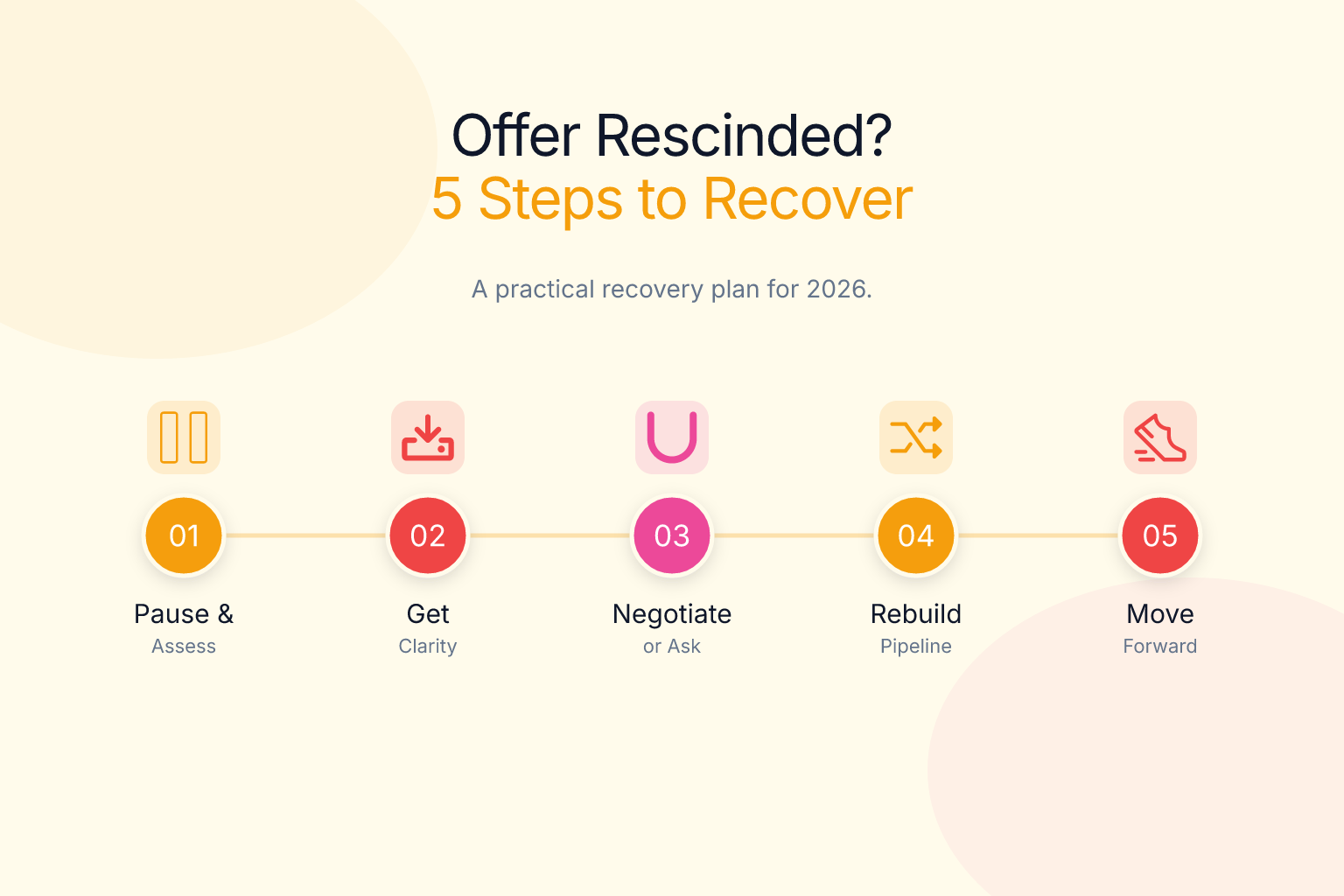
Job Offer Rescinded? Here’s What to Do: 5 Proven Steps to Recover Fast in 2026
Wondering what to do if a job offer is rescinded? You got the call, signed the letter, and maybe even gave notice at your current job—then the offer vanished. You’re likely feeling a mix of shock, anger, and panic. Take a breath. A rescinded offer is a setback, not a dead end. This guide walks you through exactly what to do next — from understanding why it happened to restarting your search with a stronger position.
Key Takeaways
- A rescinded job offer is rarely personal; common causes include budget freezes, failed background checks, or internal restructuring.
- You may have limited legal recourse unless the rescission was discriminatory, breached a signed contract, or you relied on the offer to your detriment (promissory estoppel).
- Immediately ask for a written explanation and, if appropriate, negotiate for a different role, delayed start, or contract work.
- Protect yourself in future offers by keeping your job search active until you’ve actually started, and by getting key terms in writing.
- Use the setback to reassess your target companies and strengthen your resume with free tools like ResumeMate’s AI builder and ATS score checker.
Summary Table: What to Do When a Job Offer Is Rescinded
| What to Do | Why It Matters | Time |
|---|---|---|
| Stay calm and get the reason in writing | Prevents emotional decisions and creates a record | 1–2 hours |
| Ask for reconsideration or alternatives | Some rescissions are negotiable; you may salvage a different role | 1–3 days |
| Review your legal options | Understand if you have a claim for reliance damages or discrimination | 1–2 weeks |
| Update your resume and restart your search | A fresh, ATS-optimized resume gets you back in the game faster | 2–3 days |
| Track every application going forward | Avoid losing momentum; a job tracker keeps you organized | Ongoing |
Why Do Job Offers Get Rescinded?
A rescinded job offer can feel like a personal rejection, but most of the time it’s not about you. Companies pull offers for reasons that have nothing to do with your qualifications. Understanding the common causes can help you depersonalize the situation and respond strategically.
Budget or restructuring changes. This is the most frequent reason. A hiring freeze, unexpected budget cut, or department reorg can eliminate the role you were hired for overnight. In 2023 and 2024, many tech companies rescinded offers en masse due to sudden economic shifts — sometimes just days before start dates.
Failed background check or reference. If something turns up that contradicts your application — a criminal record, a discrepancy in employment dates, a negative reference — the employer may withdraw the offer. Often, companies are required to give you a copy of the background report and a chance to dispute it under the Fair Credit Reporting Act (FCRA).
Contingency clauses not met. Many offers are contingent on things like a successful drug test, proof of right to work, or verification of a professional license. If you can’t satisfy these, the offer can be legally rescinded.
Negative social media or post-offer behavior. Employers sometimes check social media after extending an offer. Offensive posts, badmouthing the company, or evidence of illegal activity can lead to a rescission.
Internal miscommunication. Sometimes a hiring manager extends an offer without final approval from HR or senior leadership. When the higher-ups step in, they may reverse the decision.
Company performance or acquisition. If the company loses a major client, gets acquired, or faces a PR crisis, pending offers are often the first thing cut.
Knowing the reason matters because it shapes your next move. If it’s a budget issue, you might negotiate a delayed start or a different role. If it’s a background check error, you can dispute it.
Can an Employer Legally Rescind a Job Offer?
In most U.S. states, employment is “at-will,” meaning either party can end the relationship at any time — even before it starts. So yes, an employer can generally rescind a job offer. But there are important exceptions.
When a rescission may be illegal:
- Discrimination. If the offer was pulled because of your race, gender, age, religion, disability, or other protected characteristic, that’s illegal under federal and state anti-discrimination laws.
- Retaliation. If you complained about illegal practices or exercised a legal right (like requesting a reasonable accommodation) and the offer was then rescinded, you may have a retaliation claim.
- Breach of contract. If you signed a written employment contract that guaranteed employment for a specific period or outlined specific termination procedures, rescinding the offer could be a breach. Note: a standard offer letter is usually not a contract.
- Promissory estoppel. If you reasonably relied on the offer to your detriment — for example, you quit your old job, moved across the country, or turned down other offers — and the employer knew or should have known you would rely on it, you may be able to recover reliance damages. This is a high bar and varies by state.
What about the Fair Credit Reporting Act (FCRA)? If the rescission is based on a background check, the employer must give you a pre-adverse action notice, a copy of the report, and a summary of your rights. You then have a chance to dispute errors before the offer is formally withdrawn.
If you suspect discrimination or a contract breach, consult an employment attorney. Many offer free initial consultations. Document everything: the offer letter, any emails, and notes from phone calls.
Immediate Steps to Take When Your Offer Is Rescinded
Your first reaction might be to fire off an angry email or panic-apply to dozens of jobs. Instead, follow these steps to protect your interests and possibly salvage the situation.
1. Stay Professional and Ask for the Reason in Writing
Reply to the rescission notice calmly. Thank them for the update and ask for a written explanation. Something like:
“Thank you for letting me know. I’m disappointed, but I’d appreciate understanding the reason for the decision so I can learn from it. Could you provide a brief written explanation?”
This does two things: it creates a paper trail, and it may reveal whether the issue is fixable (like a background check error).
2. Don’t Quit Your Current Job Yet (If You Still Have It)
If you haven’t given notice, don’t. If you have, and your current employer hasn’t filled your role, you may be able to rescind your resignation. It’s awkward, but many managers would rather keep a known employee than restart a search. Approach it honestly: “The offer I accepted was unexpectedly rescinded. I’d like to discuss staying on if the position is still available.”
3. Request a Follow-Up Call
If the reason is vague or seems negotiable, ask for a brief phone call. You might learn that the role is on hold, not eliminated. In that case, you can ask to be considered when hiring resumes. If it’s a budget issue, you could propose a later start date or a part-time contract role.
4. Check Your Background Report
If the rescission is related to a background check, you’re entitled to a free copy of the report under the FCRA. Review it for errors. If you find inaccuracies, dispute them immediately with the background check company and inform the employer.
5. Preserve All Communications
Save every email, offer letter, and any notes from conversations. If you later explore legal options, this documentation will be critical.
6. Respond with a Professional Email (Even If You’re Upset)
How you respond to the rescission email can leave a lasting impression. A measured, professional reply keeps the door open for future opportunities and may even prompt the employer to reconsider. Here’s a template you can adapt:
Subject: Thank you for the update – [Your Name]
Dear [Hiring Manager Name],
Thank you for letting me know about the change in plans. While I’m disappointed, I appreciate your transparency.
If there’s any additional information I can provide — or if another opportunity arises that matches my skills — I’d welcome the chance to stay in touch. I remain genuinely interested in [Company Name] and would be glad to be considered for future roles.
Wishing you and the team all the best.
Best regards, [Your Name]
This approach shows grace under pressure and leaves a positive final impression. It also subtly signals that you’re still open to working there, which can lead to a different role or a reinstated offer down the line.
How to Negotiate After a Rescinded Offer
Not all rescissions are final. If the reason is budget-related or a misunderstanding, you may be able to negotiate an alternative.
Ask if there’s a different role. If the department you were hired into is frozen, another team might still be hiring. Express your continued interest in the company and ask if there are other openings that match your skills. Try: “I understand the original role is on hold. Are there any other teams currently hiring where my background could be a fit?”
Propose a delayed start date. If the company expects funding to come through in a few months, offer to start later. This shows flexibility and keeps the door open. You might say: “If the budget is expected to be restored in Q3, I’d be happy to adjust my start date accordingly. I’m still very excited about the opportunity.”
Suggest a contract or project-based arrangement. If they can’t commit to a full-time role, propose a short-term contract. This gets you in the door, builds relationships, and often converts to permanent later. Frame it as: “Would a contract or consulting arrangement be possible in the meantime? I’d love to contribute to the team’s immediate priorities while we wait for the full-time role to reopen.”
Negotiate a severance-like payment. If you’ve already quit your job and incurred costs (like moving expenses), you can ask the company to cover some of those losses. While they’re not legally obligated to do so, some employers will offer a goodwill payment to avoid bad PR or potential legal claims. Frame it as a request, not a demand. For example: “Given that I resigned from my previous role and incurred relocation expenses based on this offer, would the company consider a goodwill payment to help offset those costs?”
If you’re new to negotiating, our guide on how to ask for a signing bonus covers scripts and strategies that can be adapted for these conversations.
Financial and Legal Options to Consider
A rescinded offer can leave you in a financial bind, especially if you already resigned. Here’s what to explore.
File for unemployment. If you quit your previous job based on the firm offer and the offer was then rescinded, you may still qualify for unemployment benefits. Many states consider this a “constructive quit” for good cause. Apply immediately and explain the situation. You’ll need documentation of the offer and rescission. Be prepared to show that you had a definite start date, that you resigned in reliance on the offer, and that the offer was withdrawn through no fault of your own.
Check for reliance damages. As mentioned, promissory estoppel may allow you to recover costs you incurred because you relied on the offer. This could include moving expenses, lease break fees, or lost income from a job you left. To succeed, you generally need to prove: (1) the employer made a clear and definite promise of employment, (2) you reasonably relied on that promise, (3) the reliance was foreseeable to the employer, and (4) you suffered a financial loss as a result. For example, if you signed a lease in a new city after accepting a written offer with a start date, and the employer then rescinded, you might have a strong claim for those moving costs. Consult a lawyer to see if your case meets the threshold.
Review any signed agreements. If you signed a relocation agreement or a bonus clawback clause, read the fine print. Some companies will still reimburse expenses even if the offer is rescinded, especially if it’s their fault. Don’t assume you’re out of luck — ask.
Avoid burning bridges. Even if you’re angry, don’t vent on social media or badmouth the company. The professional world is small, and you may cross paths with these people again. A single angry post can undo years of networking.
How to Rebound and Restart Your Job Search
Once you’ve addressed the immediate fallout, it’s time to get back on the market. A rescinded offer doesn’t define your worth — but how you respond can accelerate your next opportunity.
Update Your Resume and LinkedIn
You likely paused your job search after accepting the offer. Now you need to reactivate it. Refresh your resume with any new skills or accomplishments, and make sure it’s optimized for applicant tracking systems (ATS). Use a free tool like ResumeMate’s AI resume builder to create a clean, single-column PDF that parses correctly in most ATS. Then run it through the resume score checker to see exactly what needs improvement.
Reconnect with Your Network
Reach out to contacts you may have put on hold. You don’t need to share the whole story — a simple “My situation changed, and I’m back on the market” is enough. Ask for informational interviews, referrals, or leads. Many jobs are filled through referrals before they’re ever posted.
Revisit Other Opportunities
If you turned down other interviews or offers, circle back. A polite email like “Circumstances have changed, and I wanted to see if the role is still open” can reopen doors. Employers understand that deals fall through. You can also browse fresh openings on the ResumeMate job board to find roles that match your updated criteria.
Treat This as a Learning Experience
Reflect on any red flags you might have missed. Did the company have a history of layoffs? Was the hiring process disorganized? Use these insights to vet future employers more carefully. Our post on how to find a job after being fired has strategies for bouncing back that apply here too.
How to Protect Yourself from Future Offer Rescissions
You can’t prevent every rescission, but you can reduce the risk and cushion the blow.
Keep your job search active until you start. Don’t stop networking or interviewing just because you accepted an offer. Continue attending events and keeping conversations warm until your first day on the job.
Get key terms in writing. An offer letter should include start date, salary, and any contingencies. If the employer promises something verbally (like a signing bonus or relocation package), ask for it in writing before you resign.
Research the company’s stability. Check recent news, funding rounds, layoff history, and employee reviews on sites like Glassdoor. A pattern of rescinded offers or sudden layoffs is a red flag.
Negotiate a safety net. If you’re relocating, ask for a relocation package that covers return costs if the offer falls through. Some companies will agree to a “reverse relocation” clause.
Don’t give notice prematurely. Wait until all contingencies (background check, drug test, references) are cleared. Even then, consider giving notice only after you have a signed contract, if possible.
Use a job tracker to stay organized. When you’re juggling multiple applications, it’s easy to lose track. The ResumeMate Job Tracker is a free Chrome extension that logs every application, deadline, and follow-up automatically — so you never miss an opportunity.
FAQ
Q: What to do if a job offer is rescinded?
A: First, stay calm and ask for a written explanation. Don’t quit your current job if you haven’t already. If you have, try to rescind your resignation. Then, assess whether the reason is negotiable — you may be able to salvage a different role or a delayed start. Finally, update your resume and restart your search.
Q: Can an employer rescind a job offer after you’ve signed the offer letter?
A: Yes, in most cases. Employment in the U.S. is generally at-will, meaning an employer can withdraw an offer at any time unless you have a signed employment contract that guarantees a specific term, or the rescission is based on discrimination or retaliation. A standard offer letter is not a binding contract.
Q: Can a rescinded job offer be reversed?
A: Sometimes. If the rescission was due to a budget hold, internal miscommunication, or a correctable issue (like a background check error), you may be able to get the offer reinstated by staying professional, providing missing information, or negotiating a delayed start. It’s not guaranteed, but it’s worth asking.
Q: How to respond to a rescinded job offer email?
A: Reply promptly and professionally. Thank the employer for the update, express disappointment without anger, and ask for a written explanation if one wasn’t provided. If you’re still interested, mention that you’d welcome future opportunities. (See the email template in the “Immediate Steps” section above.)
Q: Can you appeal a rescinded job offer?
A: There’s no formal appeal process, but you can ask the employer to reconsider — especially if the rescission was based on a misunderstanding or an error (like a background check mistake). Provide any evidence that corrects the issue and reiterate your enthusiasm for the role. If the decision was final, focus on leaving a positive impression for future openings.
Q: What does it mean when a job offer is rescinded?
A: It means the employer has withdrawn the offer of employment before you started working. The offer is no longer valid, and you won’t be joining the company in that role. It can happen for many reasons, from budget cuts to failed contingencies.
Q: Can you sue a company for rescinding a job offer?
A: You may have grounds to sue if you can prove discrimination, breach of contract, or promissory estoppel. Promissory estoppel requires showing that you reasonably relied on the offer to your detriment and the employer knew you would. Consult an attorney to evaluate your case.
Q: What happens if you rescind a job offer as an employer?
A: If an employer rescinds an offer, they risk legal claims like promissory estoppel if the candidate relied on the offer to their detriment. They may also face reputational damage and difficulty hiring in the future. Many employers try to offer a goodwill payment or alternative role to mitigate fallout.
Q: Why do job offers get rescinded?
A: Common reasons include budget cuts, hiring freezes, failed background checks, unmet contingencies, negative references, internal miscommunication, or company restructuring. It’s rarely about the candidate’s qualifications.
Q: What happens when a job offer is rescinded after you’ve quit your old job?
A: You may be eligible for unemployment benefits, and you could potentially recover reliance damages if you incurred costs like moving expenses. Immediately ask your former employer if you can stay, and consult an employment attorney if you believe the rescission was unlawful.
Q: What happens if you back out of a job offer as a candidate?
A: You’re generally free to decline an offer even after accepting, because at-will employment works both ways. However, you may burn bridges with that employer. It’s best to be professional and give as much notice as possible.
Q: Is it illegal to rescind a job offer?
A: It can be illegal if the rescission is based on discrimination (race, gender, age, etc.), retaliation for exercising a legal right, or breaches a signed employment contract. Otherwise, it’s usually legal under at-will employment.
Related articles:
- What Happens If You Fail a Pre-Employment Drug Test?
- Verify Job Offer Legitimacy Before Quitting or Sharing Info
- What to Do If a Background Check Reveals Old Debt
- Compare Health Insurance Plans: Job Offers Step-by-Step
- LinkedIn Featured Section: What to Add (2026 Guide)
- LinkedIn Creator Mode for Job Search: Step-by-Step Guide
- What to Do If You Ghosted an Interview by Mistake
- Add Verified Skills to LinkedIn Profile (Step-by-Step)
- Signs You’ll Get a Job Offer After Interview: 10 Key Signals
- How to Ask for a Raise After Six Months: Step-by-Step Guide
- Master the Take-Home Job Assignment: A Step-by-Step Guide
- What to Put in a Cover Letter When There Is No Job Posting
- Resume for Career Break Due to Illness: Step-by-Step Guide
Track Every Application While You Job Hunt
Stop losing track of where you’ve applied. The ResumeMate Job Tracker is a free Chrome extension that tracks every application, deadline, and follow-up in one place — right from your browser.